

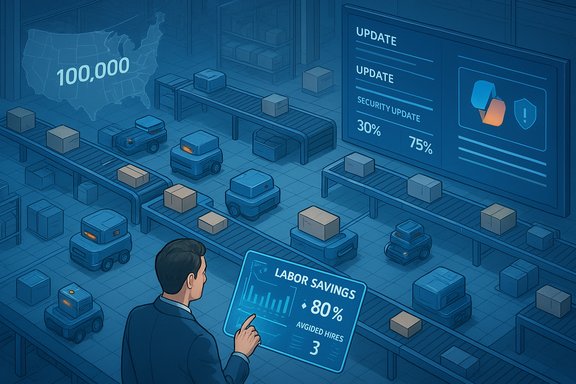
Amazon’s automation blueprint, the new H‑1B fee shock, and a fresh round of Windows update headaches have combined into one of the busiest weeks on the tech beat — a convergence that matters to IT leaders, systems administrators, and the millions of workers who keep digital commerce and enterprise systems running. The short version: Amazon’s robotics teams are planning dramatic automation that could avoid hiring hundreds of thousands of future workers; the U.S. government has imposed an unprecedented one‑time fee on new H‑1B visas that reshapes hiring economics for startups and big tech alike; and Microsoft’s ongoing cadence of Windows feature and security updates is producing new compatibility headaches for enterprise customers. Each story is important on its own — together they paint a picture of how technology, policy, and platform stability are reshaping the IT labor market and operational risk for the next decade.
The three developments that dominated headlines this week touch different parts of the technology stack but intersect in practical ways for IT organizations and workers. Amazon’s internal documents and public reporting show an aggressive robotics roadmap aimed at automating a large share of fulfillment tasks — a move framed internally as “flattening the hiring curve” even as the company expects volume growth. Shortly after, policy action in Washington introduced a one‑time, steep fee for new H‑1B petitions that immediately changed the calculus for firms that rely on sponsored foreign talent. The proclamation and subsequent clarifications set the fee at $100,000 for new petitions filed on or after the effective date and exempt renewals and current holders — but its economic and operational consequences are already being felt. Finally, Microsoft’s Windows servicing and feature rollouts — necessary for security and innovation — continue to produce unpredictable enterprise impacts, from accidental removal of Copilot to SMB and Citrix compatibility issues that force IT teams to weigh security versus stability. These problems are not new, but the frequency and scope continue to attract attention as Windows moves toward more AI features and a faster update cadence.
The short‑term choices made by CIOs, HR leaders, and company boards this quarter — about where to automation, how to sponsor talent, and how aggressively to install platform patches — will ripple for years. Organizations that treat these developments as isolated news items will be left reacting; those that update strategy, governance, and skills development will capture the next wave of productivity while mitigating social and operational risk.
Source: Computerworld Amazon’s automation surge, visa hikes, and Windows woes | Ep. 8
 Background / Overview
The three developments that dominated headlines this week touch different parts of the technology stack but intersect in practical ways for IT organizations and workers. Amazon’s internal documents and public reporting show an aggressive robotics roadmap aimed at automating a large share of fulfillment tasks — a move framed internally as “flattening the hiring curve” even as the company expects volume growth. Shortly after, policy action in Washington introduced a one‑time, steep fee for new H‑1B petitions that immediately changed the calculus for firms that rely on sponsored foreign talent. The proclamation and subsequent clarifications set the fee at $100,000 for new petitions filed on or after the effective date and exempt renewals and current holders — but its economic and operational consequences are already being felt. Finally, Microsoft’s Windows servicing and feature rollouts — necessary for security and innovation — continue to produce unpredictable enterprise impacts, from accidental removal of Copilot to SMB and Citrix compatibility issues that force IT teams to weigh security versus stability. These problems are not new, but the frequency and scope continue to attract attention as Windows moves toward more AI features and a faster update cadence. Amazon’s automation surge: what the numbers say
The core claim and where it came from
Reporting based on internal Amazon documents paints a clear internal strategy: the company’s robotics organization expects to automate up to 75% of key fulfillment operations, and that automation could allow Amazon to avoid hiring more than 160,000 U.S. workers by 2027 and more than 600,000 by 2033 (the latter figure is framed as hires avoided as demand grows, not necessarily immediate layoffs). Those near‑term avoided hires translate into an estimated ~$12.6 billion in savings across the 2025–2027 window, or roughly $0.30 saved per item shipped in the firm’s internal math.Independent corroboration and the wider evidence
Those figures have been echoed and analyzed across multiple outlets and analyst notes. Financial and tech press have reported similar projections, while robotics and supply‑chain reporting confirms Amazon already manages a massive deployed robot fleet and is iterating new designs that reduce headcount in retrofit and greenfield sites. Industry analysts note that facilities designed around robots, such as the Shreveport example, have demonstrably lower human staffing needs, and company statements confirm aggressive investment in automation technologies.What the numbers actually mean — parsing “avoid hiring” vs. “layoffs”
It is critical to parse Amazon’s wording. The reported figures primarily describe hires avoided as demand increases, not an immediate program of mass layoffs. That is an important semantic and legal distinction: the company suggests it will rely on automation and natural attrition rather than mass termination to realize its goals. Nonetheless, avoided hires are functionally equivalent to a long‑term reduction in human labor demand across logistics and fulfillment ecosystems — with ripple effects for communities and labor markets where Amazon is a major employer. The operational reality in a given facility can still be job‑disruptive, especially when legacy sites are retrofitted or new high‑automation sites replace older ones.Financial and productivity impact
Analyst re‑models indicate automation could materially improve unit economics. Morgan Stanley and others have suggested multi‑billion‑dollar annual savings once next‑generation robotic sites scale, while Amazon’s internal math points to tens of billions across a multiyear rollout horizon. These savings come from labor substitution, increased throughput, and tighter space utilization — standard industrial economics amplified by software and machine learning. However, projections depend on scale, uptime, maintenance costs, integration complexity, and supply‑chain constraints for robotic hardware.Risks and operational realities
- Integration complexity: Robotics requires not just machines but software orchestration, sensor fusion, and skilled technicians — roles that often pay more than traditional picking jobs but that may not be local or accessible to displaced workers.
- Edge cases and human oversight: Many fulfillment tasks still require human judgment, exception handling, and quality control; those tasks can be harder to automate economically.
- Public and political reaction: Large‑scale automation in communities reliant on fulfilment jobs can trigger local political pressure, regulatory scrutiny, and labor organizing.
- Narrative control: The company’s internal guidance to prefer the terms “advanced technology” or “cobot” over “automation” or “robot” underscores reputational sensitivity. This media strategy signals awareness that the public reaction matters and that language can shape perception even when operational change is real.
H‑1B visa fee hikes: a tectonic policy shift
What changed — the facts
The U.S. administration issued a proclamation that imposes a one‑time $100,000 fee on new H‑1B petitions filed after the effective date. The fee does not apply to renewals or to existing visa holders, per the clarifications issued by government sources and legal advisories. The fee’s effective date and definitions of what counts as a “new” petition have already spawned legal challenges and requests for administrative clarification from universities, industry groups, and state attorneys general.Immediate industry impacts
- Startups and SMBs: A $100K barrier per new hire makes sponsoring top foreign talent effectively unaffordable for most small firms, concentrating sponsorship power in large incumbents or forcing startups to hire locally or outsource.
- Big Tech: Large firms can absorb the fee but may still alter employment and travel policies. Some organizations moved quickly to advise abroad staff about travel or to accelerate pre‑existing petitions to avoid new costs.
- Universities and research labs: The academic sector depends on international talent for graduate programs, labs, and clinical roles; the fee is already the subject of lawsuits by university coalitions and trade groups citing harm to research capacity.
Legal and timing uncertainty
Legal challenges began almost immediately, claiming the proclamation exceeds executive authority and that the procedural rules for a fee of this scale were not followed. Courts will likely weigh in quickly because the change affects contracts, admissions, research staffing, and international talent pipelines. Until the disputes are resolved, firms face uncertainty on whether to accelerate hiring, invest in offshoring, or pause projects dependent on foreign specialists.How this ties to automation and the labor market
The H‑1B fee hike and Amazon’s automation plans are not independent: both reduce the marginal economic case for hiring large volumes of relatively low‑cost labor in the U.S. If H‑1B sponsorship is suddenly expensive, firms have stronger incentives to:- Invest in automation and tooling to reduce headcount per unit of output.
- Shift more work offshore where labor is cheaper or where visa barriers are lower.
- Restructure hiring into roles less likely to be automated (advanced analytics, robotics maintenance, software engineering), or pivot to contract and gig models.
Windows woes: why patching still bites IT teams
The symptom set
Microsoft’s ongoing update cadence — featuring security patches, cumulative updates, and preview feature releases — continues to be a necessary but fragile part of enterprise IT. Recent reports highlight:- An update that unintentionally removed Copilot on some Windows 11 systems and created deployment problems for Citrix environments.
- Patch‑related issues that affect SMB file sharing compatibility or cause application failures in virtualized and managed environments.
- New feature rollouts that introduce behavioral changes enterprises must test, particularly when AI features like Copilot and File Explorer AI actions are involved.
Why it matters now
Every major enterprise runs a mix of legacy applications, virtualization layers, and security controls. When a platform update changes APIs, DLL behavior, or system service interactions, the result can be:- Breaks for thin‑client and VDI users.
- Failed installs that trigger rollback behavior and service interruptions.
- Unexpected changes in default protections (e.g., BitLocker, TPM handling, or restore point retention) that complicate recovery plans.
Short‑term mitigations for administrators
- Maintain a small but real test pool that mirrors production workloads (VDI, Citrix, printers, and line‑of‑business apps).
- Subscribe to vendor‑specific advisories and Microsoft’s release notes; set automatic deferrals for non‑security feature updates where appropriate.
- Use staged deployment rings and monitor telemetry for rollbacks and regressions.
- Have a recovery plan for feature removals (e.g., re‑provision Copilot or restore pinned items) and thoroughly document manual remediation steps.
- Push device‑level training and communications to reduce help‑desk load for predictable UI/UX changes.
Converging effects: what this means for IT leaders and workers
Structural shifts in demand
- Automation + visa costs = higher skill premium: As routine operational roles become more automatable and the cost of importing talent rises, demand increases for higher‑skill roles (robotics technicians, machine‑learning ops, cloud architects, cybersecurity specialists). Those jobs will attract premium compensation and relocation packages.
- Regional impacts: Communities anchored by logistics hubs and fulfillment centers face concentrated employment risk. Public policy responses — from retraining grants to local economic development incentives — will become central to smoothing transitions.
- Startup ecosystem stress: Early‑stage firms that rely on sponsored hires face immediate financial pressure, pushing them to rely on contract talent, remote distribution, or offshore delivery models — all of which change how IT teams are organized.
Operational risk and resilience
Enterprises that depend on predictable platform behavior (Windows servicing) must double down on resilience: strong change management, improved observability, and automation that favours reversibility. Ironically, the same automation that reshapes warehouse floors will be needed in IT operations to handle accelerated change safely.Policy and investor implications
- Regulatory scrutiny: Large‑scale automation plans combined with controversial visa policy could prompt congressional hearings, state investigations, and litigation — especially where workforce displacement and public subsidies intersect.
- Investor focus: Analysts will increasingly model the labor‑savings from automation against reputational and regulatory costs. Firms that can demonstrate robust upskilling programs and community investments will likely face less political friction.
Strengths, weaknesses, and key risks — critical analysis
Notable strengths
- Productivity upside: Automation at scale offers real unit‑cost reductions and the potential to broaden margins and service levels, especially for firms with physical logistics footprints.
- Security posture from frequent updates: Microsoft’s iterative update model improves security hygiene across a broad ecosystem and enables rapid delivery of AI features and mitigation for zero‑day threats.
- Policy clarity (partial): Government clarifications that the H‑1B fee applies only to new petitions help some stakeholders plan interim strategies, even if uncertainty persists.
Major weaknesses and blind spots
- Human cost and retraining gap: The net effect on displaced workers depends on large scale reskilling success that has historically been spotty; automation frequently creates different roles that are not always accessible to the workers displaced.
- Concentration risk: A narrow focus on robotics ROI ignores vendor lock‑in, maintenance headwinds, and single‑point failures in automated systems.
- Policy externalities: The H‑1B fee change risks accelerating offshoring and reducing the U.S. pipeline for AI and cloud talent — a long‑term competitiveness risk that short‑sighted fiscal calculations might underestimate.
Specific risk scenarios IT leaders must watch
- Supply‑chain and hardware shortages slow robotic rollouts, making promised savings difficult to realize.
- Regulatory litigation invalidates or delays visa changes but leaves companies in limbo if they already altered hiring practices.
- Patch‑induced downtime when a critical update conflicts with a third‑party enterprise application, causing service outages or data access disruptions.
Practical recommendations for IT and operations teams
- Prioritize cross‑training: invest in mechanical, electrical, and robotic systems skills for operations staff; fund certificate programs that map to technician roles.
- Re‑spec hiring plans: re‑evaluate role definitions to favour hybrid skills (software + hardware + data) and reduce dependence on external visa pipelines where feasible.
- Harden update pipelines: create robust rolling‑test rings, maintain blocked update lists for known‑vulnerable business apps, and automate rollback when telemetry drops below predefined thresholds.
- Engage policy teams: work with legal and HR to model the impact of visa fee changes on hiring budgets and global delivery models.
- Plan for community impact: for organizations that rely on localized workforces, document transition plans and consider targeted community investments to reduce political and reputational risk.
Why this matters: long‑term view
The month’s headlines are not isolated events but signposts of larger trends: automation’s economic logic is accelerating, public policy is changing the economics of skilled immigration, and platform vendors continue to push features and fixes at an ever‑faster pace. For IT professionals, the combination demands new planning horizons — across workforce strategy, risk management, and platform lifecycle control.The short‑term choices made by CIOs, HR leaders, and company boards this quarter — about where to automation, how to sponsor talent, and how aggressively to install platform patches — will ripple for years. Organizations that treat these developments as isolated news items will be left reacting; those that update strategy, governance, and skills development will capture the next wave of productivity while mitigating social and operational risk.
Conclusion
This week’s convergence — Amazon’s internal automation roadmap, the sweeping H‑1B fee reform, and recurring Windows servicing headaches — is a practical reminder that technology, policy, and platform stability are inseparable. The net effect is a shifting labor and risk landscape: more demand for higher‑skill roles, more pressure on change management and observability, and more political attention to how tech companies manage community impacts. For technology leaders, the imperative is clear: invest in resilient operations, reskilling programs, and strategic workforce planning now, because the forces at work will only accelerate.Source: Computerworld Amazon’s automation surge, visa hikes, and Windows woes | Ep. 8

