

AMD’s message at CES landed with an unmistakable thesis: 2026 is the year the AI PC stops being an experimental niche and becomes the default expectation for new Windows machines — a shift driven by silicon (NPUs), OS-level integration (Copilot+), and an emerging developer ecosystem that will turn device-level AI from gimmick to workflow enabler.
AI PC is shorthand for a PC built to accelerate on-device machine learning workloads using dedicated silicon — typically a Neural Processing Unit (NPU) — alongside CPU and GPU compute. Microsoft’s Copilot+ program created a visible bar for this category (practical on-device inference), and silicon vendors answered with x86 and Arm chips that integrate NPUs large enough to run local models and accelerate multimodal features in Windows 11.
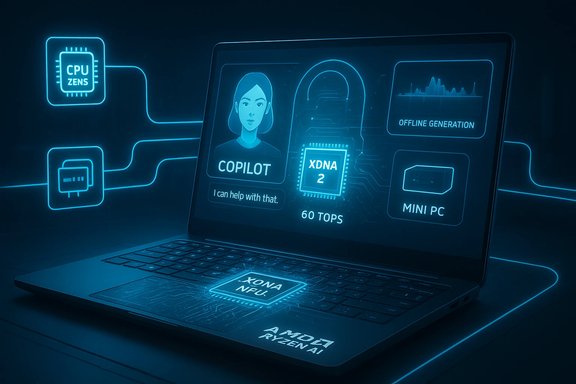
At CES 2026, AMD broadened that story in two ways: first, by arguing publicly that 2026 is the “AI PC crossover” year when sales of AI-enabled PCs will surpass non-AI PCs; second, by shipping a refreshed family of consumer and pro processors — the Ryzen AI 400 series and Ryzen AI Max+ — that aim to deliver higher NPU throughput and improved integrated graphics for on-device generative and inference tasks. AMD’s Corporate VP Jason Banta made the crossover prediction during a TechRadar Pro interview at CES, saying “2026 is the year we expect to see the AI PC crossover… we’re expecting more AI PCs to be sold than non-AI PCs.” Those claims are bolstered by AMD’s own CES announcements and keynote material: AMD and its executives framed a roadmap that pairs Zen 5 CPU cores and RDNA 3.5 graphics with a next‑generation XDNA 2 NPU rated up to ~60 TOPS on flagship mobile parts, and they positioned the family for Microsoft Copilot+ certification and a wave of OEM products. AMD’s press materials and the CES keynote transcript confirm the product family and the TOPS targets.
(Verification note: AMD’s Ryzen AI 400 family, the XDNA 2 NPU TOPS figures, and Jason Banta’s CES interview are documented in AMD’s CES materials and press releases as well as TechRadar and multiple trade outlets; Microsoft Copilot+ NPU guidance and ecosystem commentary appear in platform guidance and industry reporting. Vendor TOPS and comparative performance figures cited here are vendor-provided and should be validated with independent benchmarks for any critical procurement decision.
Source: MSN https://www.msn.com/en-us/news/tech...vertelemetry=1&renderwebcomponents=1&wcseo=1]
 Background: where the “AI PC” idea came from and why it matters
AI PC is shorthand for a PC built to accelerate on-device machine learning workloads using dedicated silicon — typically a Neural Processing Unit (NPU) — alongside CPU and GPU compute. Microsoft’s Copilot+ program created a visible bar for this category (practical on-device inference), and silicon vendors answered with x86 and Arm chips that integrate NPUs large enough to run local models and accelerate multimodal features in Windows 11.At CES 2026, AMD broadened that story in two ways: first, by arguing publicly that 2026 is the “AI PC crossover” year when sales of AI-enabled PCs will surpass non-AI PCs; second, by shipping a refreshed family of consumer and pro processors — the Ryzen AI 400 series and Ryzen AI Max+ — that aim to deliver higher NPU throughput and improved integrated graphics for on-device generative and inference tasks. AMD’s Corporate VP Jason Banta made the crossover prediction during a TechRadar Pro interview at CES, saying “2026 is the year we expect to see the AI PC crossover… we’re expecting more AI PCs to be sold than non-AI PCs.” Those claims are bolstered by AMD’s own CES announcements and keynote material: AMD and its executives framed a roadmap that pairs Zen 5 CPU cores and RDNA 3.5 graphics with a next‑generation XDNA 2 NPU rated up to ~60 TOPS on flagship mobile parts, and they positioned the family for Microsoft Copilot+ certification and a wave of OEM products. AMD’s press materials and the CES keynote transcript confirm the product family and the TOPS targets.
Overview: what AMD announced and what the industry heard
Key product highlights
- Ryzen AI 400 series (codenamed “Gorgon Point”) — mobile and desktop APUs built on Zen 5 CPU cores, integrated RDNA 3.5 graphics, and XDNA 2 NPUs.
- Top mobile SKU examples (public vendor claims): Ryzen AI 9 HX 475 — up to 12 cores / 24 threads, boost clocks around 5.2 GHz, LPDDR5X support up to 8,533 MT/s, integrated Radeon 890M / 16 CUs, and an NPU rated up to 60 TOPS.
- Ryzen AI Max+ and Halo variants aimed at on‑device model inference, creators, and developer workflows with higher memory ceilings and heavier iGPU/NPU configurations.
The ecosystem context
- Microsoft’s Copilot+ features demand device-level acceleration to deliver low-latency, privacy-friendly experiences (features such as Live Captions, real-time translation, camera effects and on‑device generative assists). Independent reporting and platform guidance indicate Copilot+ targets devices with NPUs in the 40+ TOPS range, making AMD’s 50–60 TOPS figures relevant.
- OEMs (HP, Acer, Asus, Lenovo, Dell) quickly announced Copilot+‑ready devices, including novel form factors like HP’s keyboard PC, and mini PCs were repeatedly called out as a fast-growing segment for AI-capable desktops. AMD reiterated the mini‑PC opportunity at CES and in interviews.
Why AMD believes 2026 will be the “AI PC crossover” — and the evidence
Jason Banta’s prediction rests on three observable trends:- Hardware parity — NPUs large enough to meaningfully accelerate local inference are now available across mainstream silicon stacks (AMD, Intel, Qualcomm). AMD maintains that the Ryzen AI 400 family raises the usable NPU bar for x86 laptops and desktops.
- OS and developer support — Windows 11’s Copilot+ primitives and Microsoft’s developer guidance (ONNX, DirectML, NPU device APIs) are making it easier to ship apps that use on‑device acceleration. That changes the calculus for ISVs to prioritize AI features.
- Product availability and OEM alignment — multiple vendors have committed to Copilot+ SKUs arriving in Q1 2026, and AMD says these parts will appear across price tiers (OEMs promised entry-level Copilot+ devices around the $499 starting point in some briefings). Independent press coverage corroborates early availability windows.
Technical verification: the numbers and what they actually mean
Technical claims need caremarketing shorthand to real‑world expectations.- NPU TOPS: AMD’s XDNA 2 NPU is rated by the vendor up to 60 TOPS on top mobile SKUs. That number is confirmed in AMD’s press release and multiple trade outlets’ coverage of CES. However, TOPS is a synthetic throughput metric for quantized integer operations (often INT8) and is not a direct predictor of latency or real‑world application throughput across diverse model types. For the TOPS claim, see AMD’s CES statement and trade reporting.
- Copilot+ thresholds: Microsoft’s Copilot+ program uses NPU throughput guidance in the 40+ TOPS range to gate the best on‑device experiences. That threshold explains why 50–60 TOPS is a meaningful headline for AMD’s marketing: it overtakes the Copilot+ baseline. This guidance appears consistently in developer and ecosystem coverage.
- CPU/GPU specs: AMD’s published SKU data (core counts, boost clocks, LPDDR5X memory support) and scanner coverage (e.g., Micro Center, Tom’s Hardware) align on key numbers such as 12 cores / 24 threads and up to 5.2 GHz boost for flagship mobile parts. Those figures were repeated across press coverage.
Strengths: what AMD’s roadmap and the AI PC wave deliver for Windows users
- Lower latency and privacy: On-device inference reduces round-trip latency and keeps private data on the user’s machine by default. That makes features like real-time translation, sensitive document summariz generation more acceptable to privacy-conscious users and enterprises.
- Energy efficiency for ubiquitous features: NPUs execute matrix math far more efficiently than general‑purpose CPUs. For continuous or background AI tasks (e.g., live captions, camera effects), a properly configured NPU can be more power-efficient—helping deliver “always-on” experiences without killing battery life.
- New workflows for creators and developers: AMD’s Ryzen AI Max+ family and on-device model compatibility (including Stable Diffusion variants optimized for XDNA 2 in earlier AMD initiatives) reduce the need for cloud compute in creative pipelines, potentially speeding iteration and lowering costs.
- Broader hardware availability: When x86 variants (AMD, Intel) and Arm variants (Qualcomm) can all support Copilot+ features, the market opens beyond niche Snapdragoat helps solve the long-standing compatibility and performance trade‑offs of Windows on Arm versus native x86 machines.
- Form factor and OEM creativity: Mini PCs, keyboard-PCs, and dual-screen laptops are getting new life as vendors leverage higher NPU and iGPU density in smaller enclosures. AMD and partners pointed to mini-PCs and unusual form factors as growth areas at CES and in interviews.
Risks and caveats: what could slow or complicate the AI PC transition
- TOPS are not apples-to-apples. Vendors report TOPS under different precisions and counting rules. A 60 TOPS INT8 pipeline can look very different from another vendor’s 60 TOPS measured at a different precision or with differing memory and DMA efficiencies. Treat TOPS as a directional metric, not a universal benchmark.
- Thermal and sustained tay be achieved in short bursts. Sustained on‑device model inference depends heavily on thermal headroom, memory bandwidth, and driver maturity. Thinner laptops and mini PCs face a harder engineering trade-off than thicker chassis. Early independent tests will reveal how close vendor claims come to real workloads.
- Software and driver maturity. The actual user experience depends on the availability of optimized runtimes (ONNX, DirectML, vendor drivers) and developer adoption. If ISVs don’t recompile or optimize their models for NPU backends, the hardware will sit idle for many features.
- Fragmentation and developer cost. Developers must target multiple hardware backends (NPUs, GPUs, CPUs; x86 vs Arm). Without clear, widely adopted toolchains and plug-and-play model support, fragmentation can slow the rollout of compelling apps.
- Security and compliance. On-device AI expands the attack surface (model theft, adversarial inputs, sensitive-data exfiltration). Enterprises will demand robust attestation, secure enclaves, and manageable update channels before broadly deploying Copilot+ endpoints in regulated environments.
- Economic trade-offs and market timing. While analysts saw steep AI PC adoption growth across 2024–2025, a full market crossover depends on pricing, chenterprise procurement windows. Analysts like Gartner and IDC flagged strong but varied adoption signals; vendors should prepare for uneven regional demand.
Practical implications for buyers, IT managers and enthusiasts
For consumers and prosumers
- If your use case relies on real-time features (translation, live captioning, local content generation, low-latency assistants), target a Copilot+‑certified or NPU-rated machine (40+ TOPS guidance). AMD’s Ryzen AI 400 notebooks and select mini PCs are explicit candidates for those buyers.
- Expect vendor claims about battery life and performance improvements to be conservatively validated by third‑party reviews. Wait for sustained workload testing if battery longevity under continuous inference matters to you.
For IT procurement and enterprises
- Identify the workload: Are you deploying AI features that must run locally for privacy/latency, or can cloud inference meet requirements?
- Pilot before scale: Run a short, focused pilot to evaluate power, performance, manageability, and security under representative loads.
- Ask vendors for attestation and manageability details: TPM/ME attestation, secure boot, driver update plans, and enterprise driver baseline policies matter for long-term security and compliance.
For developers
- Start by targeting portable model formats (ONNX) and test across CPU, GPU, and NPU runtimes to detect performance cliffs.
- Instrument your app to detect available acceleration and fall back gracefully.
- Prioritize features that save user time or remove friction: on-device summarization, context-aware assists, offline editing, and translator workflows are low-hanging fruit.
How to read vendor comparisons and marketing slides
Vendor slides at CES often show apples-to-oranges comparisons: different thermals, different power caps, and different driver stacks. Treat all vendor comparisons as hypotheses to be tested, not proof of universal superiority. For example, AMD’s slides compare Ryzen AI 400 vs. selected Intel parts in vendor-controlled scenarios — these are useful signals but require third‑party verification. Independent outlets and early reviews will be the necessary arbitrators.The bigger picture: what a mainstream AI PC market changes
- Software expectations shift from “features behind a cloud API” to “local-first” design thinking. That can improve privacy and responsiveness, but requires different update and security models.
- Creative workflows decentralize: more content generation and rapid iteration will happen locally, altering cloud cost models for studios and creators.
- Hardware becomes a services play: OEMs and silicon vendors will compete on performance-per-watt for AI workloads and on developer toolkits rather than raw GHz alone.
- Form factors diversify: mini PCs and keyboard PCs give IT new deployable endpoints for kiosks, labs, and hybrid workers — but management and ergonomics must be validated in pilots.
Conclusion: realistic optimism for the AI PC era
AMD’s argument that 2026 will mark an AI PC crossover is credible: silicon capable of delivering Microsoft’s Copilot+ baseline exists, Windows 11 includes richer primitives, and OEMs have product pipelines ready to ship. The Ryzen AI 400 family and AMD’s 50–60 TOPS XDNA 2 claims are validated across AMD’s press materials and broad trade coverage — but crucial real‑world questions remain about sustained throughput, thermal envelopes, software maturity, and vendor-comparison framing. Buyers should honor the optimism but move deliberately: prioritize pilot deployments, demand real sustained-performance data from vendors, and require clear manageability and security promises for enterprise fleets. For enthusiasts and developers, 2026 is the year to build for NPUs and multi‑backend deployments — the hardware is here, the OS support is improving, and the first wave of on‑device apps is already arriving. If the industry executes on drivers, runtimes, and cross‑vendor tooling, the “AI PC” could shift from marketing label to everyday expectation within this calendar year.(Verification note: AMD’s Ryzen AI 400 family, the XDNA 2 NPU TOPS figures, and Jason Banta’s CES interview are documented in AMD’s CES materials and press releases as well as TechRadar and multiple trade outlets; Microsoft Copilot+ NPU guidance and ecosystem commentary appear in platform guidance and industry reporting. Vendor TOPS and comparative performance figures cited here are vendor-provided and should be validated with independent benchmarks for any critical procurement decision.
Source: MSN https://www.msn.com/en-us/news/tech...vertelemetry=1&renderwebcomponents=1&wcseo=1]
