

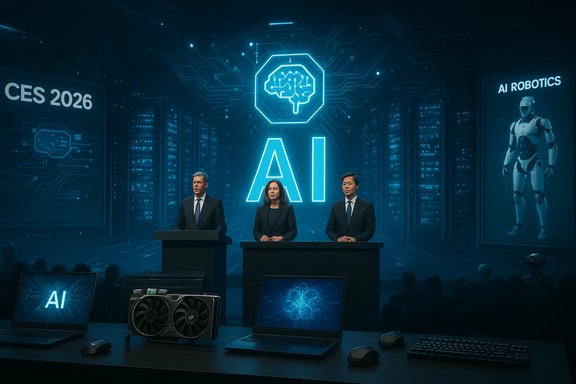
CES 2026 opened with a message that was impossible to miss: AI is the headline — and for PC gamers, the usual center-stage players looked increasingly like supporting acts. Major CES keynotes from AMD, Nvidia and Lenovo were dominated by artificial intelligence language and product positioning, while explicit gaming messaging was notably scarce or sequestered to side presentations. This shift reflects both corporate strategy and real money: data‑center AI workloads are now the most lucrative market for the chipmakers that built their reputations on desktop graphics and gaming CPUs, and CES was the public moment where that tectonic pivot became visible.
Background
CES has long been a proving ground for the PC ecosystem: new CPUs, GPUs, gaming laptops and peripherals have historically drawn the headlines that matter to enthusiasts. In 2026 the script changed. Top-tier keynotes were framed as AI and infrastructure events first, with gaming — while not abandoned — clearly moved down the agenda.Industry reporting and on‑the‑ground transcript analysis show this plainly. A recent tally of spoken keynotes counted explicit uses of the term “AI” in the flagship presentations: AMD’s keynote recorded roughly 210 mentions across a 117‑minute presentation, Nvidia’s main keynote clocked around 120 mentions in 91 minutes, and Lenovo’s Sphere event topped both at 219 mentions in 114 minutes. These raw counts, compiled and reported by multiple outlets, make a simple point — AI was not an accessory; it was the message.
Why the numbers matter: AI counts, context and methodology
What was measured
The “AI mentions” metric is straightforward on its face: count every spoken utterance of the token “AI” (and related product names that include the letters A‑I). Multiple outlets used automated transcription tools to process keynotes and identify every instance. PC Gamer’s analysis is the most visible example and has been widely republished; its findings match parallel counts reported elsewhere.Strengths and limits of the approach
- Strength: The metric is a blunt, verifiable proxy for messaging emphasis — when a speaker says a short, repeated token dozens or hundreds of times, the rhetorical priority is obvious.
- Limit: Counting words treats all mentions equally. An off‑hand reference in a product name (for example “Ryzen AI Max”) is counted the same as a strategic roadmap statement about yottascale infrastructure.
- Caveat: The transcription + counting method depends on accurate captions/subtitles. Background noise, speaker accents and overlapping audio can cause both false positives and misses. That’s why multiple independent counts and cross‑checks matter.
Overview: What chipmakers and OEMs actually said
AMD: AI as the platform
AMD used its CES keynote to frame a bold, infrastructure‑scale vision (Lisa Su’s “YottaScale” language typifies the rhetoric). The company’s spending and roadmap statements were squarely focused on data‑center AI: new Instinct accelerators, EPYC processors tuned for AI workloads, and integrated systems designed to scale inference and training. The AI mention rate in AMD’s keynote — about 1.8 mentions per minute — underlined how central the theme has become.Nvidia: enterprise and robotics first (with a side-stage for gaming)
Nvidia’s marquee presentation emphasized data‑center platforms, robotics and enterprise services. The main keynote’s language density around AI was still very high (roughly 1.3 mentions per minute), though Nvidia also staged separate gaming‑focused content outside the big investor/enterprise talk — an important nuance for desktop enthusiasts. Nvidia’s financials and product trajectory make the messaging choice logical; data‑center platforms now generate the lion’s share of the company’s revenue.Lenovo and other OEMs: AI as a product thread, not a sticker
Lenovo’s Sphere event pushed AI hard — more so than even the silicon firms, by one count — showing how OEMs are embedding local inference capabilities across laptops, services and business solutions. Conversely, some OEM briefings (notably Dell’s) were more pragmatic, emphasizing battery life, thermals and displays while quietly supporting Copilot+ hardware requirements. The variety of OEM approaches signals that the market is still figuring out how to sell AI to real consumers.The financial reality driving the message
Marketing follows money. CES rhetoric aligns with where margins are largest and growth is fastest.- Nvidia’s recent quarterly results show explosive growth in the data‑center business: in a recent reporting period total company revenue ran into the tens of billions, with data‑center revenue representing the overwhelming majority and gaming contributing only a single‑digit percentage slice in comparable quarters. For example, in a recent fiscal quarter Nvidia reported record revenues with data‑center figures that dwarf gaming income, and gaming revenue in that quarter was reported in the low‑to‑mid single‑digit billions. That financial mix explains why Nvidia’s investor-facing keynote was framed around AI infrastructure rather than consumer gaming.
- AMD’s near‑term pattern is different but convergent: the company reported quarterly results where data‑center revenue reached roughly $4.3 billion and client & gaming combined were around $4.0 billion in the same reporting period, meaning AMD’s business has recently reached a point where data‑center and client/gaming revenues are roughly comparable at the quarter level. That makes AMD’s dual messaging (AI + consumer) more defensible: it must support both markets even as it invests heavily in AI acceleration.
Where gaming was (and wasn’t) at CES
Low explicit mentions, not low product action
The surprising metric for many gamers was how rarely the word “gaming” appeared in the big keynotes: AMD and Lenovo only referenced gaming in their main events a handful of times, and Nvidia’s main AI keynote did not use the word at all — though Nvidia did run separate, pre‑recorded gaming content. This is an important communications shift: gaming is still a strategic product line, but it is not the top-line narrative used to sell future growth to investors.Product reality vs PR
That said, CES still contained tangible gaming announcements elsewhere: refreshed ROG and Legion laptops, new OLED gaming monitors, and handheld prototypes appeared across multiple booths. The key point is that the headline stage was no longer where gaming got the loudest air time; gaming news required more effort to locate amid the AI deluge. Coverage that focuses only on the largest keynotes will understate the quantity of gaming hardware being introduced — but it accurately reflects what the major companies prioritized on the biggest stages.What this means for PC gamers and hardware buyers
Short term
- Expect fewer spectacle‑style keynote gaming demos from the largest chipmakers on the biggest investor stages. Gaming product rollouts will continue, but they’ll often be presented in more focused events or product‑specific streams.
- Supply and production planning may favor AI accelerator capacity for data centers where margins are higher. That doesn’t mean gaming GPUs will disappear, but allocations and priority can shift when data‑center orders are revenue‑dominant.
- Gaming features will increasingly be pitched as benefits of AI‑capable silicon: framerate optimizations, AI upscaling, smarter in‑game NPCs, procedural content generation and features like DLSS/FSE style hybrid rendering will be the marquee “gaming” narratives rather than raw rasterization benchmarks.
Medium to long term
- There will be trickle‑down benefits. Hardware optimized for AI inference often brings improvements to shader workloads, texture decompression, denoising and upscaling pipelines, which can enhance gaming visuals and performance.
- Platform ordering may invert: high‑end dies — optimized and validated for data‑center inference workloads — may be repurposed or scaled back for consumer gaming parts rather than the historical model of designing gaming GPUs first.
- The competitive dynamic could shift how quickly new gaming features arrive. If gaming variants are lower‑priority by revenue, gamers might see longer gaps between generations or fewer SKUs in the mainstream channel during strong AI demand cycles.
Opportunities and risks
Opportunities
- AI‑assisted gaming features will accelerate: faster ray‑reconstruction, generative textures, advanced upscaling and AI audio/voice features are on the horizon.
- Improved driver ecosystems: as GPU vendors unify software stacks for enterprise AI and game engines, drivers may mature in ways that benefit both sectors (better scheduling, inference offload, hybrid GPU/NPU workloads).
- New form factors: NPUs inside laptops and even peripherals open up new gameplay experiences (local avatars, real‑time translation, smart spectating).
Risks
- Allocation and supply shifts: OEMs and foundries could prioritize data‑center SKU production when margins are highest, potentially constricting gaming GPU availability and raising prices.
- Marketing disconnect: Consumers may grow skeptical if “AI” becomes a ubiquitous buzzword without clear, day‑to‑day value; this could slow adoption in mainstream segments.
- Privacy and telemetry: More on‑device intelligence can mean more sensitive data processed locally or sent to cloud services; buyers should demand clarity on data residency and opt‑out controls.
- Fragmentation and measurement inconsistency: Vendors report NPUs in TOPS and displays in dimming zones; inconsistent measurement makes direct product comparisons harder and increases the need for independent testing.
Practical guidance for gamers and enthusiasts
- If you’re buying a gaming PC in 2026, ask the OEM:
- Which AI features are on‑device vs cloud?
- What is the sustained thermal behavior when running simultaneous GPU and NPU workloads?
- Are GPU allocations limited by enterprise demand, and what is the expected shipping window for the SKU you want?
- For upgrades:
- Prioritize real‑world performance metrics (frame pacing, sustained clocks) over marketing slides about TOPS.
- Watch for independent benchmarks that test new AI‑enabled gaming features (e.g., frame reconstruction, AI upscaling comparisons).
- For modders and devs:
- Explore hybrid approaches that can offload non‑rendering workloads (AI voice, in‑game assistants) to NPUs to leave the GPU focused on rendering.
- For communities and buyers:
- Demand transparency from OEMs on telemetry, privacy and firmware update policies for NPUs.
The communications angle: why CES sounded like a data‑center conference
Investor expectations and corporate roadmaps set the tone. When a segment produces the majority of margins and growth, company presentations — especially at high‑visibility venues — will naturally speak in the language investors care about. That is precisely what happened at CES: AI-centric commerce drives narratives and product positioning. For Nvidia, whose data‑center revenues dwarfed gaming in recent quarters, the corporate stage was a presentation about AI platforms rather than consumer graphics cards. AMD’s messaging balanced both worlds because its quarterly mix still shows meaningful client/gaming income alongside rapidly expanding data‑center sales. The result is an industry that is pivoting toward AI-first engineering, with consumer gaming benefiting indirectly rather than being the lead story.What to watch next
- Independent benchmarks of new NPUs for sustained local LLM inference and gaming‑relevant workloads.
- Production allocation signals from foundries and board partners (are gaming SKUs shipping on schedule or being deferred?.
- OEM messaging in subsequent product launches — are vendors dialing back AI claims when consumer feedback is tepid, or doubling down with clearer use cases?
- Regulatory and privacy updates affecting on‑device models and telemetry. As NPUs migrate into laptops and peripherals, data governance will become a procurement checklist item for both consumers and IT buyers.
Final analysis and conclusion
CES 2026 was a clear inflection point in public messaging: AI is now the platform language that both chipmakers and OEMs use to describe their roadmaps. That choice reflects hard financial dynamics — data‑center AI workloads generate the largest margins and fastest growth — and it explains why the language and visual focus at the biggest keynotes skewed heavily toward infrastructure, robotics and enterprise use cases.For PC gamers, the implications are mixed but not dire. The short‑term tradeoffs could include tighter gaming GPU allocations and more marketing noise about AI features. Over the medium term, however, many AI investments will unlock genuinely useful gaming improvements: better upscaling, smarter in‑game systems, and hybrid CPU/GPU/NPU workflows that enhance both performance and immersion.
Readers should treat the “AI mentions” metric as an informative but blunt indicator — useful for diagnosing emphasis and priorities but not a substitute for hands‑on benchmarking. And because the companies involved publish earnings and product claims at regular cadence, the financial and product trends that dictated the tone at CES will continue to evolve across 2026; independent lab verification and careful vendor Q&A remain essential for separating PR from engineering reality.
AI dominated the stage at CES, but the hardware that powers tomorrow’s games will still be built — it will simply share the spotlight with racks, robots and enterprise buyers more often than it used to.
Source: EJS Computers CES 2026: AI Takes Over While PC Gaming Gets Quietly Sidelined
