

AMD is preparing a CPPC “Highest Frequency” capability for future processors, surfaced in Linux kernel patches dated May 4, 2026, to let operating systems read a core’s actual maximum boost frequency rather than infer it from abstract performance values. If it lands as expected in ACPI 6.7 and future AMD firmware, Windows 11 and Linux should have cleaner data for CPU scheduling, boost-ratio calculation, and capacity modeling. That does not mean a magic frame-rate switch is arriving tomorrow. It means AMD is trying to remove one of the small but stubborn translation errors between silicon, firmware, and the operating system.
The important word here is translation. Modern Ryzen and EPYC chips do not simply run “fast” or “slow”; they continuously negotiate frequency, power, thermals, preferred cores, sleep states, and workload placement with the OS. AMD’s proposed Highest Frequency field is a modest-looking addition to that negotiation, but it points to a larger truth: as CPUs become more heterogeneous in behavior even when not heterogeneous in branding, the scheduler needs fewer hints and more facts.
The new feature surfaced in a five-patch Linux kernel series from AMD engineer Mario Limonciello under the plain title “Add CPPC HighestFreq support.” The patches describe a problem that will sound familiar to anyone who has watched Ryzen behavior closely: on some systems, the relationship between CPPC performance values and real-world frequency is not linear across cores. In other words, the OS can be given a relative “performance” number and still make an imperfect assumption about what that means in gigahertz.
CPPC, or Collaborative Processor Performance Control, is the mechanism that lets firmware and the operating system cooperate on CPU performance decisions. Instead of the old world of fixed P-states, where the OS selected from a relatively small menu of frequency-voltage combinations, CPPC lets the platform expose more nuanced performance capabilities and preferences. It is one of the reasons modern AMD systems can ramp aggressively, idle efficiently, and tell the scheduler which cores are better candidates for foreground work.
But “better” is not always the same thing as “highest frequency.” A core may carry a higher CPPC performance ranking because of platform policy, silicon characterization, thermal headroom, cache topology, firmware decisions, or the way the vendor wants the OS to rank cores. That is useful information, but it is not identical to an actual maximum boost clock. AMD’s proposed Highest Frequency register is meant to close that gap by giving the OS a direct frequency value when firmware can provide it.
The result is not a new turbo mode. The CPU is not suddenly gaining more headroom because Windows can see a new register. The likely benefit is that the OS can make better decisions with less interpolation, particularly when calculating boost ratios and estimating CPU capacity.
That distinction matters because CPU performance mythology loves a silver bullet. Windows scheduler fixes have been blamed for, credited with, and mythologized around nearly every major Ryzen generation. Sometimes the software really did matter. Just as often, the effect was subtler: a firmware update, chipset driver, BIOS toggle, game patch, or power-plan change moved the needle enough to become lore.
Those are not always direct frequencies. They are performance abstractions. The OS, driver, and kernel code then use those abstractions to estimate what a CPU can do, which core should receive latency-sensitive work, and how capacity should be modeled relative to other cores.
This has worked well enough to become the foundation of modern AMD scheduling. Windows uses CPPC and preferred-core information to decide where to place threads. Linux uses amd-pstate and related kernel infrastructure to manage performance and energy behavior. Laptop vendors depend on the same underlying cooperation to balance burst performance against battery life and fan noise.
The rub is that abstractions age badly when the hardware underneath becomes more complicated. Ryzen cores within a CCD may not boost identically. Multi-CCD desktop chips introduce topology tradeoffs. X3D parts complicate the story further by separating the fastest-frequency cores from the largest-cache cores. Mobile chips face aggressive thermal and platform limits. Server parts run into capacity modeling at a scale where small errors can multiply.
Highest Frequency is AMD acknowledging that the old abstraction is not always precise enough. If the OS needs to know the top boost behavior, then the cleanest answer is to report it directly rather than ask the OS to reconstruct it from relative CPPC values.
Yet plumbing is often where platform performance is won or lost. A scheduler is only as good as the topology and capacity data it receives. If the OS believes one core’s boost potential maps cleanly from a performance value when it does not, it may still make a reasonable decision most of the time — but not the best one every time.
On lightly threaded workloads, that can affect which core gets the job. On bursty workloads, it can affect how quickly the platform predicts and reaches an efficient boost state. On multi-core workloads, it can influence capacity scaling and the way the system balances work across cores that are nominally similar but not identical.
The interesting phrase in AMD’s patch description is that Highest Frequency eliminates the need for interpolation when available. Interpolation is a polite word for educated guessing. It is not inherently bad; operating systems do it constantly. But when firmware can report the answer directly, the guess becomes unnecessary technical debt.
That is why the feature’s significance is bigger than its surface area. It does not add a user-facing performance mode. It makes an existing model less lossy.
The Ryzen 9 X3D era made this visible to ordinary users. On some AMD desktop chips, the “best” core for a game is not necessarily the core with the highest clock; it may be the core attached to the cache-rich CCD. For a compiling workload, a rendering job, or a high-frequency lightly threaded task, the answer may be different. Windows has had to rely on a combination of firmware hints, drivers, Xbox Game Bar detection, chipset software, and power-management policy to do the right thing.
Highest Frequency does not solve all of that. It does not tell Windows whether a workload wants cache or clocks. It does not replace vendor logic around X3D scheduling. It does not remove the need for chipset drivers or firmware quality. But it gives the OS a cleaner piece of the puzzle: what peak frequency this core or performance domain is actually expected to reach.
That matters because Windows scheduling is increasingly a contest between general-purpose policy and hardware-specific truth. The more accurate the hardware truth, the less Windows has to lean on broad heuristics. A future Windows 11 release could use Highest Frequency to improve capacity estimates, refine preferred-core behavior, or avoid treating two cores as more equivalent than they really are.
The TweakTown framing points toward possible Windows 11 26H2 or 27H2 relevance, but that should be treated cautiously. The Linux patches are real and dated. The ACPI 6.7 proposal is described as trending toward inclusion. But Windows support depends on Microsoft, AMD firmware, OEM BIOS implementation, platform validation, and shipping silicon. This is a pipeline, not a patch Tuesday promise.
Still, “could debut with Zen 6” is not the same as “Zen 6 requires it” or “Zen 5 cannot benefit.” ACPI features are implemented through firmware tables and platform support. Some capabilities arrive only with new silicon. Others can appear on select existing platforms if the hardware and firmware already expose the necessary data. The patch language points to future availability when the register is present, not a blanket retrofit.
The larger strategic point is that AMD is laying groundwork. CPU vendors increasingly have to coordinate hardware launches with operating-system readiness well in advance. A processor can have excellent silicon and still leave performance on the table if Windows or Linux does not understand how to schedule it. Conversely, a clever scheduler cannot invent facts the firmware never reports.
That is why Linux kernel work often tells us where client Windows is headed, even when Microsoft is not part of the patch thread. ACPI is the shared contract. If AMD is proposing a new CPPC field through the ACPI specification process, the goal is not Linux-only optimization. It is cross-platform vocabulary.
For enthusiasts, the temptation will be to read this as a Zen 6 performance leak. It is better read as a Zen 6 readiness signal. AMD expects future processors to benefit from more explicit frequency reporting, and it wants the OS ecosystem to be ready when those processors ship.
The proposed Linux support is pragmatic. If the CPPC HighestFreq value exists, the kernel can use it. If it does not, existing behavior remains. That kind of optional path is exactly how platform transitions should work, because ACPI tables vary by OEM, firmware version, and product class.
The amd-pstate driver is especially relevant here. AMD has spent years improving Linux CPU frequency behavior, moving from older acpi-cpufreq assumptions toward CPPC-aware control that better matches modern Ryzen and EPYC behavior. Highest Frequency fits neatly into that project: another piece of firmware-provided information that lets the kernel avoid a less accurate model.
There is also an enterprise angle. Linux servers and workstations care about capacity accounting, scheduling fairness, and performance-per-watt across many cores. A minor misestimate on a desktop might become a benchmark oddity. At server scale, those estimates affect consolidation, latency, and thermal behavior under sustained load.
That does not mean every EPYC box will suddenly run faster. It means the OS can describe the hardware more faithfully. In scheduler land, faithful description is the beginning of almost every real optimization.
Modern CPUs have made that impossible. A core’s observed performance depends on frequency, voltage, power budget, thermal state, instruction mix, cache locality, memory latency, firmware policy, and how many neighbors are active. The maximum boost frequency is valuable data, but it is still one variable among many.
That is why the new field should be understood as a correction, not a simplification. AMD is not saying frequency is the only truth. It is saying that when frequency is part of the calculation, the OS should not derive it through a shaky conversion from abstract CPPC values.
This is the kind of change that may produce uneven real-world gains. A benchmark that depends on short, lightly threaded bursts might benefit if Windows or Linux places work more consistently on the most appropriate core. A heavily threaded workload already saturating the package may see little difference. A laptop constrained by skin temperature and firmware policy may gain more in consistency than peak score.
That unevenness does not make the feature unimportant. It makes it typical of mature platform work. The easy performance wins are gone; the remaining gains come from removing friction between layers.
PC enthusiasts know this movie. Early BIOS releases can ship with incorrect tables, conservative boost behavior, odd power defaults, broken sleep states, or settings that change meaning across AGESA revisions. Laptop firmware is even more constrained, because OEM thermal policy often overrides what the silicon could theoretically do.
Highest Frequency reduces one kind of ambiguity, but it does not eliminate platform variation. A value reported through ACPI still reflects what firmware chooses to expose. If the firmware says a core’s highest frequency is a certain number, the OS must trust that the number is meaningful for scheduling and capacity calculations.
That trust relationship is why standards matter. If Highest Frequency becomes part of ACPI 6.7, AMD and platform vendors will have a formal definition to implement against. Linux and Windows will have a common contract. Debugging will become easier because the expected behavior is no longer buried in vendor-specific interpretation.
Still, the first generation of any new firmware-reported capability should be watched carefully. The real test will not be whether a kernel patch can read the field. It will be whether retail systems report sane values across desktop boards, laptops, workstations, and server platforms.
That is why features like Highest Frequency matter to Windows even if Microsoft never markets them. The average user will not see a checkbox labeled “use CPPC HighestFreq.” They may see a system that wakes faster, boosts more predictably, or chooses a better core for a foreground task. More likely, they will simply not notice the class of misbehavior that the feature helps avoid.
The danger is that these improvements are hard to communicate. Enthusiast culture wants a before-and-after graph. Enterprise IT wants predictable support matrices. Microsoft wants fewer regressions. AMD wants its silicon shown in the best light. Each audience evaluates the same change differently.
For Microsoft, the best outcome is invisibility. If Windows 11 uses better CPPC data and no one complains about scheduling, that is success. Scheduler wins often look like the absence of drama.
The same applies to AMD. The company does not need users to know what Highest Frequency is. It needs future Ryzen and EPYC systems to behave in a way that matches their silicon potential without requiring forum guides, registry edits, or BIOS folklore.
Consistency is underrated in CPU performance. A machine that chooses the right core nine times out of ten can still feel worse than one that chooses it ninety-nine times out of a hundred when the misses happen during latency-sensitive work. Scheduling mistakes often show up not as low average performance but as weird dips, slow launches, uneven frame pacing, or benchmark variance.
Highest Frequency can help by making one part of the scheduler’s model less ambiguous. If Windows knows the real maximum frequency of a core, it can better compare capacity across cores and performance domains. If Linux knows it, amd-pstate can calculate boost ratios more accurately. The decision tree gets a cleaner input.
That is not glamorous, but it is exactly the kind of improvement modern PCs need. We are past the era where every generation delivered obvious, universal performance leaps from frequency alone. Today’s gains come from topology awareness, power management, cache behavior, memory tuning, and scheduler cooperation.
For users, the best practical advice is boring: keep BIOS and chipset drivers current, pay attention to platform firmware notes, and resist turning off CPPC-related features unless you are diagnosing a specific problem. The old forum habit of disabling anything “automatic” can backfire badly on CPUs whose best behavior depends on collaboration with the OS.
Intel’s Thread Director made this obvious in hybrid CPUs, where the OS needs to understand not only which cores are faster but which cores are different in kind. AMD’s approach is less visibly hybrid on mainstream desktop Ryzen, but it still depends on nuanced performance hints. Apple, outside the Windows ecosystem, has taken the integrated route by controlling silicon, firmware, and OS together.
The PC industry cannot use Apple’s vertically integrated shortcut. It has to make AMD CPUs, Intel CPUs, Microsoft Windows, Linux kernels, motherboard firmware, laptop thermal policies, and enterprise management tools cooperate through specifications. ACPI is old, sometimes unloved, and frequently blamed for firmware weirdness, but it remains one of the central treaties of the PC platform.
Highest Frequency is a treaty amendment. It says the old CPPC vocabulary needs a more explicit way to express actual boost capability. That is not a dramatic reinvention of scheduling, but standards rarely are. They accumulate until the platform behaves differently.
The real lesson is that CPU performance is becoming less about secret sauce inside a single component and more about the quality of the handoff between components. Silicon still matters most. But bad handoffs waste good silicon.
That confusion is almost inevitable because the feature sits at the intersection of several layers. A CPU may support it. Firmware may expose it. The OS may read it. The scheduler may use it. Applications may or may not benefit. Each step can become the weak link.
For Windows users, the version question will loom large. If Microsoft adds or refines support in a future Windows 11 release, the improvement may be tied to a feature update rather than a simple driver install. If AMD’s chipset package includes related policy changes, users may need both OS and driver updates. If OEM firmware is required, laptop users may wait longest.
Linux users will have a clearer paper trail but not necessarily a simpler experience. Kernel version, distribution defaults, amd-pstate mode, firmware tables, and governor behavior all matter. The open development model makes the change visible, but visibility is not the same as universal deployment.
The likely future is gradual adoption. First the kernel support lands. Then the ACPI specification catches up. Then early hardware exposes the field. Then operating systems learn to exploit it more confidently. Then users forget it exists because it becomes part of the baseline.
AMD’s new CPPC work is a reminder that the next phase of PC performance will be fought in the seams: between boost logic and schedulers, between firmware tables and kernels, between cache-aware placement and frequency-aware placement. If Highest Frequency ships broadly with future Ryzen and EPYC platforms, most users will never know its name — and that will be the point. The best scheduling fix is the one that quietly turns a guess into a fact.
Source: TweakTown AMD's new CPPC 'Highest Frequency' feature could improve CPU scheduling and boost behavior in Windows 11
The important word here is translation. Modern Ryzen and EPYC chips do not simply run “fast” or “slow”; they continuously negotiate frequency, power, thermals, preferred cores, sleep states, and workload placement with the OS. AMD’s proposed Highest Frequency field is a modest-looking addition to that negotiation, but it points to a larger truth: as CPUs become more heterogeneous in behavior even when not heterogeneous in branding, the scheduler needs fewer hints and more facts.
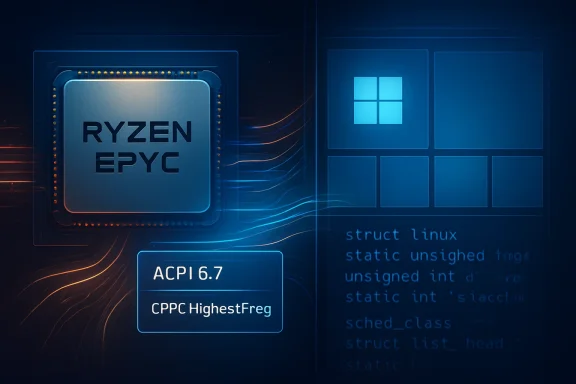 AMD Is Teaching the Scheduler to Stop Guessing
The new feature surfaced in a five-patch Linux kernel series from AMD engineer Mario Limonciello under the plain title “Add CPPC HighestFreq support.” The patches describe a problem that will sound familiar to anyone who has watched Ryzen behavior closely: on some systems, the relationship between CPPC performance values and real-world frequency is not linear across cores. In other words, the OS can be given a relative “performance” number and still make an imperfect assumption about what that means in gigahertz.CPPC, or Collaborative Processor Performance Control, is the mechanism that lets firmware and the operating system cooperate on CPU performance decisions. Instead of the old world of fixed P-states, where the OS selected from a relatively small menu of frequency-voltage combinations, CPPC lets the platform expose more nuanced performance capabilities and preferences. It is one of the reasons modern AMD systems can ramp aggressively, idle efficiently, and tell the scheduler which cores are better candidates for foreground work.
But “better” is not always the same thing as “highest frequency.” A core may carry a higher CPPC performance ranking because of platform policy, silicon characterization, thermal headroom, cache topology, firmware decisions, or the way the vendor wants the OS to rank cores. That is useful information, but it is not identical to an actual maximum boost clock. AMD’s proposed Highest Frequency register is meant to close that gap by giving the OS a direct frequency value when firmware can provide it.
The result is not a new turbo mode. The CPU is not suddenly gaining more headroom because Windows can see a new register. The likely benefit is that the OS can make better decisions with less interpolation, particularly when calculating boost ratios and estimating CPU capacity.
That distinction matters because CPU performance mythology loves a silver bullet. Windows scheduler fixes have been blamed for, credited with, and mythologized around nearly every major Ryzen generation. Sometimes the software really did matter. Just as often, the effect was subtler: a firmware update, chipset driver, BIOS toggle, game patch, or power-plan change moved the needle enough to become lore.
CPPC Was Already the Deal Between Windows and Ryzen
To understand why Highest Frequency matters, it helps to remember what CPPC already does. It gives the OS a set of performance descriptors through ACPI so the scheduler and frequency driver can understand the CPU’s capabilities. Those descriptors include concepts such as the highest performance, nominal performance, lowest nonlinear performance, and other platform-defined values.Those are not always direct frequencies. They are performance abstractions. The OS, driver, and kernel code then use those abstractions to estimate what a CPU can do, which core should receive latency-sensitive work, and how capacity should be modeled relative to other cores.
This has worked well enough to become the foundation of modern AMD scheduling. Windows uses CPPC and preferred-core information to decide where to place threads. Linux uses amd-pstate and related kernel infrastructure to manage performance and energy behavior. Laptop vendors depend on the same underlying cooperation to balance burst performance against battery life and fan noise.
The rub is that abstractions age badly when the hardware underneath becomes more complicated. Ryzen cores within a CCD may not boost identically. Multi-CCD desktop chips introduce topology tradeoffs. X3D parts complicate the story further by separating the fastest-frequency cores from the largest-cache cores. Mobile chips face aggressive thermal and platform limits. Server parts run into capacity modeling at a scale where small errors can multiply.
Highest Frequency is AMD acknowledging that the old abstraction is not always precise enough. If the OS needs to know the top boost behavior, then the cleanest answer is to report it directly rather than ask the OS to reconstruct it from relative CPPC values.
The Patch Is Small Because the Problem Is Deep
The Linux patch series does not read like a revolution. It updates CPPC definitions, adds support for reading HighestFreq, refactors boost-ratio handling, and teaches both acpi-cpufreq and amd-pstate paths to use the new value when available. That is engineering plumbing, not keynote material.Yet plumbing is often where platform performance is won or lost. A scheduler is only as good as the topology and capacity data it receives. If the OS believes one core’s boost potential maps cleanly from a performance value when it does not, it may still make a reasonable decision most of the time — but not the best one every time.
On lightly threaded workloads, that can affect which core gets the job. On bursty workloads, it can affect how quickly the platform predicts and reaches an efficient boost state. On multi-core workloads, it can influence capacity scaling and the way the system balances work across cores that are nominally similar but not identical.
The interesting phrase in AMD’s patch description is that Highest Frequency eliminates the need for interpolation when available. Interpolation is a polite word for educated guessing. It is not inherently bad; operating systems do it constantly. But when firmware can report the answer directly, the guess becomes unnecessary technical debt.
That is why the feature’s significance is bigger than its surface area. It does not add a user-facing performance mode. It makes an existing model less lossy.
Windows 11 Needs Better Hardware Truth, Not Another Toggle
For Windows 11, the appeal is obvious. Microsoft’s scheduler has spent the last several years trying to understand processors that no longer behave like simple blocks of interchangeable cores. Intel’s hybrid architecture forced Windows to care deeply about performance cores, efficiency cores, Thread Director hints, and foreground responsiveness. AMD, meanwhile, has stayed more conventional in core design but has created its own scheduling puzzles with chiplets, boost variance, power limits, and 3D V-Cache products.The Ryzen 9 X3D era made this visible to ordinary users. On some AMD desktop chips, the “best” core for a game is not necessarily the core with the highest clock; it may be the core attached to the cache-rich CCD. For a compiling workload, a rendering job, or a high-frequency lightly threaded task, the answer may be different. Windows has had to rely on a combination of firmware hints, drivers, Xbox Game Bar detection, chipset software, and power-management policy to do the right thing.
Highest Frequency does not solve all of that. It does not tell Windows whether a workload wants cache or clocks. It does not replace vendor logic around X3D scheduling. It does not remove the need for chipset drivers or firmware quality. But it gives the OS a cleaner piece of the puzzle: what peak frequency this core or performance domain is actually expected to reach.
That matters because Windows scheduling is increasingly a contest between general-purpose policy and hardware-specific truth. The more accurate the hardware truth, the less Windows has to lean on broad heuristics. A future Windows 11 release could use Highest Frequency to improve capacity estimates, refine preferred-core behavior, or avoid treating two cores as more equivalent than they really are.
The TweakTown framing points toward possible Windows 11 26H2 or 27H2 relevance, but that should be treated cautiously. The Linux patches are real and dated. The ACPI 6.7 proposal is described as trending toward inclusion. But Windows support depends on Microsoft, AMD firmware, OEM BIOS implementation, platform validation, and shipping silicon. This is a pipeline, not a patch Tuesday promise.
Zen 6 Is the Obvious Candidate, but Not the Only Story
Reports have naturally attached this feature to Zen 6, because the timing lines up and because future CPUs are where new ACPI capabilities usually become meaningful. If ACPI 6.7 formalizes Highest Frequency and AMD is already preparing Linux support, it is reasonable to assume the company wants the operating-system side ready before the hardware arrives.Still, “could debut with Zen 6” is not the same as “Zen 6 requires it” or “Zen 5 cannot benefit.” ACPI features are implemented through firmware tables and platform support. Some capabilities arrive only with new silicon. Others can appear on select existing platforms if the hardware and firmware already expose the necessary data. The patch language points to future availability when the register is present, not a blanket retrofit.
The larger strategic point is that AMD is laying groundwork. CPU vendors increasingly have to coordinate hardware launches with operating-system readiness well in advance. A processor can have excellent silicon and still leave performance on the table if Windows or Linux does not understand how to schedule it. Conversely, a clever scheduler cannot invent facts the firmware never reports.
That is why Linux kernel work often tells us where client Windows is headed, even when Microsoft is not part of the patch thread. ACPI is the shared contract. If AMD is proposing a new CPPC field through the ACPI specification process, the goal is not Linux-only optimization. It is cross-platform vocabulary.
For enthusiasts, the temptation will be to read this as a Zen 6 performance leak. It is better read as a Zen 6 readiness signal. AMD expects future processors to benefit from more explicit frequency reporting, and it wants the OS ecosystem to be ready when those processors ship.
Linux Gets the Receipts First
Linux is where this story became visible because Linux development happens in public. Kernel mailing lists expose the sausage-making: patch revisions, subsystem maintainers, regressions, driver refactors, and terse technical explanations that later become invisible inside consumer platforms. Windows development is comparatively opaque, so the Linux patch often becomes the first public breadcrumb for a cross-OS hardware feature.The proposed Linux support is pragmatic. If the CPPC HighestFreq value exists, the kernel can use it. If it does not, existing behavior remains. That kind of optional path is exactly how platform transitions should work, because ACPI tables vary by OEM, firmware version, and product class.
The amd-pstate driver is especially relevant here. AMD has spent years improving Linux CPU frequency behavior, moving from older acpi-cpufreq assumptions toward CPPC-aware control that better matches modern Ryzen and EPYC behavior. Highest Frequency fits neatly into that project: another piece of firmware-provided information that lets the kernel avoid a less accurate model.
There is also an enterprise angle. Linux servers and workstations care about capacity accounting, scheduling fairness, and performance-per-watt across many cores. A minor misestimate on a desktop might become a benchmark oddity. At server scale, those estimates affect consolidation, latency, and thermal behavior under sustained load.
That does not mean every EPYC box will suddenly run faster. It means the OS can describe the hardware more faithfully. In scheduler land, faithful description is the beginning of almost every real optimization.
The Old MHz Myth Keeps Getting Less Useful
Highest Frequency may sound like a return to clock-speed worship, but it actually proves the opposite. If gigahertz were the whole story, the OS would not need CPPC, preferred cores, energy-performance preferences, cache-aware scheduling, or boost-ratio modeling. It would simply throw work at the core with the highest number.Modern CPUs have made that impossible. A core’s observed performance depends on frequency, voltage, power budget, thermal state, instruction mix, cache locality, memory latency, firmware policy, and how many neighbors are active. The maximum boost frequency is valuable data, but it is still one variable among many.
That is why the new field should be understood as a correction, not a simplification. AMD is not saying frequency is the only truth. It is saying that when frequency is part of the calculation, the OS should not derive it through a shaky conversion from abstract CPPC values.
This is the kind of change that may produce uneven real-world gains. A benchmark that depends on short, lightly threaded bursts might benefit if Windows or Linux places work more consistently on the most appropriate core. A heavily threaded workload already saturating the package may see little difference. A laptop constrained by skin temperature and firmware policy may gain more in consistency than peak score.
That unevenness does not make the feature unimportant. It makes it typical of mature platform work. The easy performance wins are gone; the remaining gains come from removing friction between layers.
Firmware Remains the Weak Link
The uncomfortable part is that ACPI features are only as good as the firmware that exposes them. Windows and Linux can support Highest Frequency perfectly and still receive bad, missing, or inconsistent data from a motherboard BIOS. AMD can design the mechanism, but OEMs and board vendors have to implement it correctly.PC enthusiasts know this movie. Early BIOS releases can ship with incorrect tables, conservative boost behavior, odd power defaults, broken sleep states, or settings that change meaning across AGESA revisions. Laptop firmware is even more constrained, because OEM thermal policy often overrides what the silicon could theoretically do.
Highest Frequency reduces one kind of ambiguity, but it does not eliminate platform variation. A value reported through ACPI still reflects what firmware chooses to expose. If the firmware says a core’s highest frequency is a certain number, the OS must trust that the number is meaningful for scheduling and capacity calculations.
That trust relationship is why standards matter. If Highest Frequency becomes part of ACPI 6.7, AMD and platform vendors will have a formal definition to implement against. Linux and Windows will have a common contract. Debugging will become easier because the expected behavior is no longer buried in vendor-specific interpretation.
Still, the first generation of any new firmware-reported capability should be watched carefully. The real test will not be whether a kernel patch can read the field. It will be whether retail systems report sane values across desktop boards, laptops, workstations, and server platforms.
Microsoft’s Scheduler Story Is Becoming a Platform Story
Windows 11 has taken criticism for its hardware requirements, update behavior, and shifting interface priorities, but under the hood Microsoft has been doing serious work to adapt Windows to modern processors. The scheduler is no longer just a fairness machine deciding which runnable thread goes next. It is a policy engine balancing responsiveness, battery life, cache locality, core type, boost opportunity, and platform hints.That is why features like Highest Frequency matter to Windows even if Microsoft never markets them. The average user will not see a checkbox labeled “use CPPC HighestFreq.” They may see a system that wakes faster, boosts more predictably, or chooses a better core for a foreground task. More likely, they will simply not notice the class of misbehavior that the feature helps avoid.
The danger is that these improvements are hard to communicate. Enthusiast culture wants a before-and-after graph. Enterprise IT wants predictable support matrices. Microsoft wants fewer regressions. AMD wants its silicon shown in the best light. Each audience evaluates the same change differently.
For Microsoft, the best outcome is invisibility. If Windows 11 uses better CPPC data and no one complains about scheduling, that is success. Scheduler wins often look like the absence of drama.
The same applies to AMD. The company does not need users to know what Highest Frequency is. It needs future Ryzen and EPYC systems to behave in a way that matches their silicon potential without requiring forum guides, registry edits, or BIOS folklore.
The Enthusiast Payoff Will Be Consistency Before Speed
The headline promise of “better boost behavior” invites inflated expectations. Some systems may benchmark better. Some games may pick up a little smoothness if thread placement improves. Some laptops may feel snappier in bursty tasks. But the more realistic payoff is consistency.Consistency is underrated in CPU performance. A machine that chooses the right core nine times out of ten can still feel worse than one that chooses it ninety-nine times out of a hundred when the misses happen during latency-sensitive work. Scheduling mistakes often show up not as low average performance but as weird dips, slow launches, uneven frame pacing, or benchmark variance.
Highest Frequency can help by making one part of the scheduler’s model less ambiguous. If Windows knows the real maximum frequency of a core, it can better compare capacity across cores and performance domains. If Linux knows it, amd-pstate can calculate boost ratios more accurately. The decision tree gets a cleaner input.
That is not glamorous, but it is exactly the kind of improvement modern PCs need. We are past the era where every generation delivered obvious, universal performance leaps from frequency alone. Today’s gains come from topology awareness, power management, cache behavior, memory tuning, and scheduler cooperation.
For users, the best practical advice is boring: keep BIOS and chipset drivers current, pay attention to platform firmware notes, and resist turning off CPPC-related features unless you are diagnosing a specific problem. The old forum habit of disabling anything “automatic” can backfire badly on CPUs whose best behavior depends on collaboration with the OS.
The Industry Is Quietly Standardizing Around Smarter Hints
AMD’s Highest Frequency proposal also reflects a broader industry settlement. Hardware vendors have accepted that operating systems need richer information. Operating systems have accepted that generic scheduling is not enough. Standards bodies have become the place where those needs get translated into durable interfaces.Intel’s Thread Director made this obvious in hybrid CPUs, where the OS needs to understand not only which cores are faster but which cores are different in kind. AMD’s approach is less visibly hybrid on mainstream desktop Ryzen, but it still depends on nuanced performance hints. Apple, outside the Windows ecosystem, has taken the integrated route by controlling silicon, firmware, and OS together.
The PC industry cannot use Apple’s vertically integrated shortcut. It has to make AMD CPUs, Intel CPUs, Microsoft Windows, Linux kernels, motherboard firmware, laptop thermal policies, and enterprise management tools cooperate through specifications. ACPI is old, sometimes unloved, and frequently blamed for firmware weirdness, but it remains one of the central treaties of the PC platform.
Highest Frequency is a treaty amendment. It says the old CPPC vocabulary needs a more explicit way to express actual boost capability. That is not a dramatic reinvention of scheduling, but standards rarely are. They accumulate until the platform behaves differently.
The real lesson is that CPU performance is becoming less about secret sauce inside a single component and more about the quality of the handoff between components. Silicon still matters most. But bad handoffs waste good silicon.
Where the Next Ryzen Tuning Fight Will Move
If Zen 6 systems arrive with Highest Frequency support, the first wave of analysis will probably be messy. Reviewers will test different BIOS versions, Windows builds, Linux kernels, chipset drivers, and power plans. Forum users will compare HWiNFO readings, Ryzen Master stars, CPPC preferred-core rankings, and benchmark deltas. Some will find real issues. Some will find ghosts.That confusion is almost inevitable because the feature sits at the intersection of several layers. A CPU may support it. Firmware may expose it. The OS may read it. The scheduler may use it. Applications may or may not benefit. Each step can become the weak link.
For Windows users, the version question will loom large. If Microsoft adds or refines support in a future Windows 11 release, the improvement may be tied to a feature update rather than a simple driver install. If AMD’s chipset package includes related policy changes, users may need both OS and driver updates. If OEM firmware is required, laptop users may wait longest.
Linux users will have a clearer paper trail but not necessarily a simpler experience. Kernel version, distribution defaults, amd-pstate mode, firmware tables, and governor behavior all matter. The open development model makes the change visible, but visibility is not the same as universal deployment.
The likely future is gradual adoption. First the kernel support lands. Then the ACPI specification catches up. Then early hardware exposes the field. Then operating systems learn to exploit it more confidently. Then users forget it exists because it becomes part of the baseline.
The Small Register That Explains the Next Windows Performance Fight
The concrete story is narrow, but the implications are broad enough to keep in view. AMD is not just adding another acronym to the already crowded pile of CPPC, ACPI, EPP, P-state, and preferred-core terminology. It is trying to make the operating system’s model of the processor less fictional.- AMD’s proposed CPPC Highest Frequency field lets firmware report actual maximum boost frequency to the operating system when the platform supports it.
- The Linux patch series says the feature is intended to avoid inaccurate interpolation when CPPC performance values do not map linearly to frequency.
- The work is tied to a proposed ACPI 6.7 addition, which means the long-term goal is cross-platform support rather than a Linux-only tweak.
- Windows 11 could benefit through better scheduling, boost-ratio calculation, and CPU capacity modeling, but Microsoft support and timing remain unconfirmed.
- Zen 6 is the most plausible debut target, though actual availability will depend on silicon, firmware, BIOS implementation, and OS support.
- Users should expect improved consistency before they expect dramatic benchmark gains.
AMD’s new CPPC work is a reminder that the next phase of PC performance will be fought in the seams: between boost logic and schedulers, between firmware tables and kernels, between cache-aware placement and frequency-aware placement. If Highest Frequency ships broadly with future Ryzen and EPYC platforms, most users will never know its name — and that will be the point. The best scheduling fix is the one that quietly turns a guess into a fact.
Source: TweakTown AMD's new CPPC 'Highest Frequency' feature could improve CPU scheduling and boost behavior in Windows 11
