

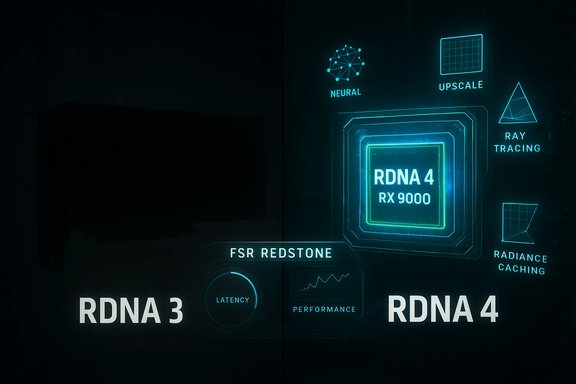
AMD’s machine‑learning driven FSR “Redstone” landed as part of the Adrenalin 25.12.1 driver in December 2025, but the full suite of features is explicitly built for RDNA 4 (Radeon RX 9000) silicon — leaving owners of RDNA 3 GPUs watching from the sidelines and asking whether that door might ever be opened. The short answer today is: technically possible in limited ways, unlikely in full form unless AMD approves a targeted pathway — and the reasons are rooted in hardware design, developer effort, and product‑quality risk management rather than pure marketing.
Background: what AMD shipped and what it means for gamers
AMD’s December 10, 2025 Adrenalin 25.12.1 driver formally introduced FSR “Redstone”, a consolidated ML‑centric suite that bundles improved upscaling, ML frame generation, ray‑assisted denoising and radiance‑caching primitives. The launch explicitly targeted RDNA 4 hardware (Radeon RX 9000), citing the new architecture’s dedicated ML inferencing capabilities and low‑precision compute modes as fundamental to the experience AMD aims to deliver. Redstone is more than a single upscaler — it’s an umbrella for several ML modules:- FSR Upscaling (ML‑trained reconstructor for high perceived resolution),
- FSR Frame Generation (neural frame interpolation to multiply perceived framerate),
- FSR Ray Regeneration / denoiser (ML inference to reconstruct ray‑traced lighting from sparse samples),
- FSR Radiance Caching (learned caching of indirect lighting to lower per‑frame ray costs).
Why RDNA 3 was left out (the technical case)
At the core of AMD’s decision is performance parity and user experience. The Redstone ML pipelines were designed to leverage RDNA 4’s new ML accelerators and precision modes; without them, the models either run too slowly, consume too much power, or introduce quality artifacts that would degrade rather than improve gameplay.Key technical reasons:
- Dedicated ML hardware: RDNA 4 includes matrix units and low‑precision inferencing paths optimized for neural workloads. RDNA 3 lacks the same density of ML primitives, meaning inference either falls back to shader cores or runs at significantly reduced throughput.
- Precision and numeric modes: Modern ML models often use low‑precision formats (INT8 / FP8) for speed and memory efficiency. RDNA 4’s support for these modes is a performance multiplier; RDNA 3’s hardware does not offer the same combination of precision and throughput at the same efficiency.
- Memory and bandwidth requirements: Radiance caching and ray regeneration benefit from higher memory bandwidth and larger caches; older architectures can become memory‑bound when trying to run the same ML pipelines.
- Latency and power envelopes: Frame generation needs to produce frames under strict latency budgets. On older silicon the increased compute time can translate to input lag or thermal spikes that harm the play experience. AMD’s position has been that enabling Redstone wholesale on RDNA 3 would not “give the right experience” for most users.
What AMD has said publicly — and what it suggests
AMD executives have been blunt about the motivation: it’s not about artificially forcing upgrades, it’s about ensuring the quality of experience. In an interview at CES 2026, AMD’s Andrej Zdravkovic reiterated that Redstone’s full feature set is linked to RDNA 4 because enabling it on older cards would often produce poor or inconsistent results for most users. He also acknowledged that technically curious users and modders will try to force the features, and that AMD doesn’t oppose experimentation — but the company’s official shipping decision was to “cut the line” to preserve a consistent, supported experience for the majority. Importantly, Zdravkovic did not categorically rule out any future possibility: when asked about an official “beta” for older GPUs, he said that it’s “currently not in the plan, but thanks for the hint. We may want to think about something like that.” That phrasing leaves room for AMD to consider developer or enthusiast‑facing releases if demand, tooling, or optimization paths justify it.Could AMD ship a limited or beta Redstone for RDNA 3?
Yes — but with major caveats. There are three realistic paths to broader availability, each with tradeoffs:- Official beta / opt‑in driver support
- AMD could choose to release a beta or experimental driver branch that enables subsets of Redstone features on RDNA 3 with conservative per‑title profiles and enforced safety checks.
- Benefit: gives enthusiasts a supported path to experiment without driver hacking.
- Risk: increases driver support surface, possible negative perception if artifacts or regressions affect many configurations. AMD has explicitly said a beta is not in current plans but might be considered.
- Analytical fallbacks and scaled ML models
- AMD can continue providing analytical or simplified fallbacks (as it already does for some features) and selectively allow lighter, less demanding ML variants that execute acceptably on RDNA 3.
- Benefit: broader compatibility without full ML burden.
- Risk: quality gap between full Redstone and fallback may be wide, and developers still need to tune per‑title.
- Open or partially open‑sourced components + community tooling
- AMD has signaled broader openness around FSR’s codebase in various public venues; partial open‑sourcing (excluding proprietary neural weights or certain IP) could empower third‑party ports and optimized community builds for older hardware. That route already produced community experiments in the past that forced FSR builds onto unsupported GPUs — often with mixed results.
- Benefit: community can iterate quickly and sometimes unlock broader compatibility.
- Risk: unsupported hacks put production machines at risk and result in fractured experiences that reflect poorly on the ecosystem as a whole.
The modder reality: community ports and risks
Historically, community developers have attempted to force newer upscalers onto older hardware. That pattern repeated with Redstone: early accidental or experimental releases showed parts of the stack can run on older GPUs, but with widely varying performance and frequent artifacts. Enthusiast forums and early Reddit threads documented both successes and failures; the net effect is patchwork compatibility rather than a consistent, QA‑vetted experience. The practical risks of running unofficial ports include:- Stability issues or driver conflicts that require clean reinstalls,
- Increased input latency or graphical artifacting that can ruin gameplay,
- Potential anti‑cheat or multiplayer compatibility problems if a driver‑level tweak is treated as tampering by an anti‑cheat stack,
- Lack of warranty and no formal support channel if things go wrong.
Developer implications and the per‑title reality
Even if AMD were to create a sanctioned path for RDNA 3, a significant amount of developer work remains necessary for high‑quality results. Redstone‑class ML solutions require game engines to expose rich G‑buffer channels (motion vectors, depth, normals, material properties) and often benefit from per‑title model tuning.Game studios face these realities:
- Integrating Redstone components into an engine is non‑trivial and requires QA and tuning.
- Per‑title profiles improve artifact behavior; a one‑size‑fits‑all driver toggle rarely matches engine‑level integration in quality or latency.
- Anti‑cheat, DRM, and cross‑platform concerns complicate rollout schedules.
Business and market consequences: fragmentation vs. progress
AMD’s decision to tie the full Redstone experience to RDNA 4 is strategically defensible, but it has market consequences.Strengths of the approach:
- Keeps the user experience consistent on the platforms Redstone targets.
- Encourages hardware evolution: shipping features that require new silicon signals vendors and studios to plan for ML primitives in future GPUs.
- Simplifies AMD’s support and driver QA matrices at launch.
- Fragmentation across a large installed base of RDNA 3 owners creates friction and may accelerate upgrade cycles, which can annoy price‑sensitive customers.
- Creates short‑term perception risk if early coverage frames Redstone as “exclusive,” even when AMD’s engineering reasons are justified.
- Slows the pace at which the majority of gamers see the practical benefits of ML‑led rendering until either prices fall on RDNA 4 or AMD finds a safe pathway to broader compatibility.
What RDNA 3 owners should do now
For players with RDNA 3 cards who want the best possible experience today:- Continue using FSR 3.1 and previous FSR releases that run well on older hardware. These remain robust options for many games.
- Watch for per‑title updates: some games may expose engine‑level integrations that use lighter forms of Redstone functionality or tuned fallbacks.
- Avoid unsupported driver hacks on production or competitive rigs — if experimentation matters, use a spare machine or VM to test.
- Consider measured upgrades if Redstone‑class features are a must for your playstyle: RDNA 4 hardware was designed for these workloads and will be a safer bet for reliable ML frame generation, ray assistance, and radiance caching.
A cautious road forward: how AMD could expand access without breaking quality
If AMD chooses to broaden Redstone’s reach, here are realistic engineering and product strategies that would preserve quality while widening availability:- Official experimental drivers that carry prominent warnings, limited support, and a telemetry opt‑in so AMD can measure real‑world quality before wider rollout. This echoes the “beta” suggestion AMD has vaguely left open.
- Scaled‑down ML models specifically trained to run on shader cores or lower‑throughput inferencing paths with explicit per‑title tuning — a lower‑fidelity but safer compromise.
- Partial open‑sourcing of SDK hooks and reference implementations (while protecting model weights/IP), enabling the community and middleware vendors to produce optimized ports under AMD’s oversight. Past accidental source exposures and discussions around FSR’s codebase show this can spur broader experimentation. This route must be managed carefully to avoid IP loss or misinterpretation.
- Developer tooling and profiles distributed via the Adrenalin control panel that automatically apply safe presets for older cards and specific games, reducing the need for manual configuration and limiting the window for poor outcomes.
Conclusion: a pragmatic expectation for RDNA 3 owners
Technically, pieces of FSR Redstone can be coaxed to run on older AMD hardware, and community experimentation will continue to push boundaries. Strategically, AMD’s decision to gate the full Redstone experience to RDNA 4 reflects a conservative, experience‑first posture: enable only where the platform can meet the quality bar. The company has not closed the door — it has simply argued that opening it broadly today would produce inconsistent and often unsatisfactory results.For RDNA 3 owners the practical reality is to expect gradual increases in compatibility through developer work, scaled fallbacks, community tools, or an eventual curated beta — not an immediate, full‑feature backport. Those who prioritize stability and supported gameplay should rely on existing FSR releases, while tinkerers may experiment at their own risk and with an understanding of the tradeoffs involved.
Quick takeaways (for scanners)
- AMD shipped FSR Redstone in Adrenalin 25.12.1 on December 10, 2025, and it’s engineered for RDNA 4 (RX 9000) hardware.
- RDNA 3 GPUs are largely excluded because they lack the ML inferencing throughput and low‑precision hardware Redstone expects; enabling it broadly risks poor user experiences.
- AMD hasn’t ruled out experimental or beta routes for older GPUs, but there’s no firm plan today; community ports exist but are unsupported and inconsistent.
- Developers must expose rich engine inputs and tune per‑title models for top results; wide availability depends as much on developer adoption as on drivers.
Source: Windows Central Could gamers with an older AMD GPU one day get access to FSR Redstone?
