

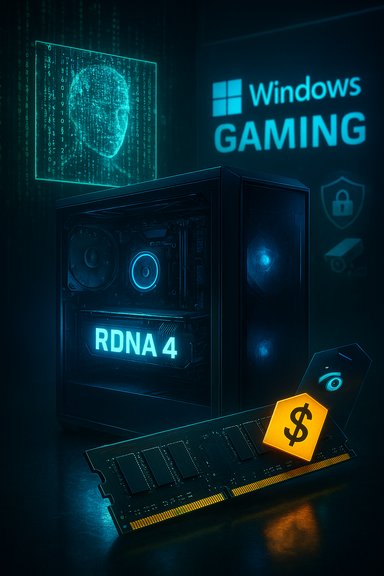
The week’s PC-hardware and security headlines arrived as a perfectly chaotic bundle: AMD finally shipping its ML‑powered FSR Redstone stack alongside the RDNA 4 Radeon RX 9000 family, a painful and sustained surge in DDR5 pricing that is reshaping desktop and laptop economics, Microsoft publicly promising a major Windows 11 push to make the OS “the best place to play” in 2026, and an odd-but-important privacy fiasco around Kohler’s new Dekoda “toilet camera.” Those stories — plus coverage of Noctua‑branded 3D filaments, ongoing Steam / Bazzite ecosystem shifts, and the accelerating decline of traditional one‑time passwords — were the loudest notes in PC Perspective’s Podcast #848 briefing and the wider tech press this week. The headlines are connected: silicon, software, and security are all changing rapidly, and buyers, builders, and admins need clear, practical guidance to respond.
PC hardware and gaming ecosystems are in the middle of two simultaneous transitions. First, GPUs and graphics stacks are increasingly integrating ML acceleration into core rendering features — not just ray-tracing denoisers, but frame generation, radiance caching, and neural upscaling. AMD’s Redstone initiative is the most visible example of that trend at scale, and the company has tied its full ML feature set to the new RDNA 4/Radeon RX 9000 line. That shift matters because it changes hardware baselines and support windows for gamers and developers.
Second, memory supply and pricing dynamics have reversed the long-running consumer trend toward cheaper RAM. DDR5 kit prices have spiked markedly in late 2025 as DRAM makers refocus capacity toward high-margin datacenter and AI workloads, creating practical shortages for mainstream PC builders and OEMs. The timing collides with new platform launches and the broad adoption of larger memory configs in gaming and professional workloads.
Overlaying both is a continuing security and privacy story: companies are pushing novel “smart home / health” sensors and using legacy marketing terms (like “end‑to‑end encryption”) in ways that confuse ordinary users — and occasionally put highly personal data at risk. Meanwhile, authentication is evolving: passkeys and FIDO‑based passwordless systems are moving from fringe to mainstream, making SMS and app‑based one‑time passwords progressively less defensible as a primary security control.
The remainder of this piece verifies the big claims, explains the technical details where needed, and provides concrete takeaways for Windows power users, system builders, and IT decision-makers. Key claims have been cross‑checked against vendor material and independent coverage where possible, and I call out areas that remain vendor‑asserted or presently ambiguous.
The PC and gaming ecosystems are changing in parallel — faster GPUs with ML brains, tighter DRAM markets, OS makers re-optimizing for play, and new identity technologies displacing legacy ideas. That combination keeps the hobby exciting but also raises the cost of making mistakes. The weeks ahead will be telling: watch the Redstone game‑list rollout, monitor DDR5 spot prices closely, and demand precise, auditable claims from vendors making bold privacy and security promises.
Source: PC Perspective Podcast #848 - Weekly DDR5 Discussion, AMD Redstone, Steam on Windows 7, Noctua 3D Filament, Cyberpunk Police +more! - PC Perspective
 Background / Overview
PC hardware and gaming ecosystems are in the middle of two simultaneous transitions. First, GPUs and graphics stacks are increasingly integrating ML acceleration into core rendering features — not just ray-tracing denoisers, but frame generation, radiance caching, and neural upscaling. AMD’s Redstone initiative is the most visible example of that trend at scale, and the company has tied its full ML feature set to the new RDNA 4/Radeon RX 9000 line. That shift matters because it changes hardware baselines and support windows for gamers and developers.Second, memory supply and pricing dynamics have reversed the long-running consumer trend toward cheaper RAM. DDR5 kit prices have spiked markedly in late 2025 as DRAM makers refocus capacity toward high-margin datacenter and AI workloads, creating practical shortages for mainstream PC builders and OEMs. The timing collides with new platform launches and the broad adoption of larger memory configs in gaming and professional workloads.
Overlaying both is a continuing security and privacy story: companies are pushing novel “smart home / health” sensors and using legacy marketing terms (like “end‑to‑end encryption”) in ways that confuse ordinary users — and occasionally put highly personal data at risk. Meanwhile, authentication is evolving: passkeys and FIDO‑based passwordless systems are moving from fringe to mainstream, making SMS and app‑based one‑time passwords progressively less defensible as a primary security control.
The remainder of this piece verifies the big claims, explains the technical details where needed, and provides concrete takeaways for Windows power users, system builders, and IT decision-makers. Key claims have been cross‑checked against vendor material and independent coverage where possible, and I call out areas that remain vendor‑asserted or presently ambiguous.
AMD Redstone and RDNA 4: what changed and why it matters
What AMD announced and what shipped
AMD has shipped its FSR Redstone suite — a bundled set of ML‑accelerated features including an ML upscaler, ML frame generation (frame‑gen), ray regeneration (ML denoising for ray‑tracing), and the developer‑facing Radiance Caching tools — as part of the Adrenalin Edition driver 25.12.1 and a Redstone SDK for game developers. The company explicitly tied the full ML-accelerated Redstone feature set to RDNA 4 silicon (Radeon RX 9000 series), meaning legacy RDNA 2/3/3.5 cards get analytical fallbacks or limited functionality. This is AMD’s architectural bet: RDNA 4 includes FP8 / specialized matrix math acceleration intended specifically to accelerate the neural models Redstone uses. The claim and the driver release are documented in AMD’s own materials and confirmed in independent early reviews. File-level coverage and the PC Perspective podcast discussion also highlight that Redstone was rolled into the public Adrenalin driver and that early adopters should expect growing game lists and some initial teething issues in drivers and game integrations.Technical anatomy — why AMD focused RDNA 4
Redstone’s ML pipeline relies on matrix‑multiply acceleration and low‑precision FP8 math to run inference quickly and with acceptable power and latency on consumer GPUs. RDNA 4 added dedicated matrix units and FP8 support that materially increase inference throughput relative to older RDNA hardware. The practical consequence: ML frame generation and advanced denoising can run on a single consumer GPU with low latency only when the hardware provides those on‑die accelerators. AMD’s documentation and independent hardware deep dives make this clear; vendor performance claims exist, but independent testing is the real arbiter.Early results, strengths and caveats
- Strengths:
- Frame‑generation and ML upscaling can deliver noticeable frame rate gains while preserving motion clarity compared with older analytical frame‑generation approaches.
- Ray Regeneration shows promise for denoising path‑traced scenes in supported titles, improving visual fidelity with lower trace budgets.
- The modular SDK approach (developers can adopt individual Redstone components) lowers integration friction in some engines.
- Caveats and risks:
- Vendor performance slides are marketing data; independent tests show good gains where supported, but game-to-game variability is high and claimed “multi‑fold” frame increases often rely on specific, favorable scenarios. Treat early numbers as indicative, not definitive.
- At launch, full Redstone ML features are restricted to RDNA 4 cards; owners of RX 6000/7000-series hardware should expect fallbacks and limited functionality for the ML bits unless/until AMD adds broader support (which would require software fallbacks or new driver tricks).
- Early driver/SDK releases frequently have compatibility bugs; AMD’s release notes for 25.12.1 list several known issues and vendor guidance on problem games. Expect iterative fixes across 2026 as game devs and drivers converge.
Practical guidance for buyers and builders
- If you are buying a new GPU primarily to leverage ML frame‑gen and Redstone features, favor RDNA 4 / Radeon RX 9000 hardware today — the ML features are hardware‑gated at launch.
- For mixed workloads or long upgrade cycles, weigh whether current titles you play actually support Redstone frame‑gen; early support lists are small and will expand gradually.
- For system integrators and QA teams: plan for driver churn and maintain a regression test matrix that includes key titles and capture workflows for frame‑gen + native rendering modes.
DDR5 pricing shock: supply, causes, and the fallout for builders
What’s happening to DDR5 prices
After years of steady decline, DDR5 and general DRAM prices spiked sharply in the back half of 2025. Multiple OEMs and shops reported sudden list and spot increases, and an unusually tight channel supply was driven by memory makers reallocating capacity to higher‑margin datacenter / AI segments. That shift has created a consumer‑visible “RAMageddon”: vendors such as Framework publicly raised their upgrade prices (Framework announced a 50% price increase for some DDR5 options) and retailers have shifted to more volatile spot pricing models. Independent market trackers published dramatic percentage increases in contract and spot pricing for DDR5 modules through late 2025. File-level discussion and the PC Perspective podcast echo this: DDR5 availability and pricing were major episode topics, with hosts warning builders that memory economics have become a dominant variable in total build cost.Causes and market forces
- AI/datacenter demand: Large AI customers and accelerator programs dramatically increased demand for DRAM and LPDDR5X, and HBM demand siphons packaging/wafer capacity, pushing vendors to prioritize high-margin server/AI contracts.
- Supplier allocation: DRAM makers can and do prioritize long-term contracts with hyperscalers over spot consumer allocations; the shortfall in consumer channel supply is a direct consequence.
- Geopolitical and logistics friction: Shipping and foundry allocation issues added near-term pressure to already tight supply lines.
Practical impact and risks
- For gamers and builders: DDR5 kits that were affordable in mid‑2025 may now cost 1.5–3× retail prices, especially for large 64–256 GB kits. That shifts the sweet spot for many builds toward smaller capacity or toward used/cleared DDR5 inventories — or toward buying prebuilt systems when OEMs can secure supply at better contract prices.
- For OEMs and MSPs: higher memory bills will compress margins on thin‑client and ultra‑portable designs, and may cause vendors to alter product SKUs or memory bundling.
- For enterprise procurement: plan longer lead times and multi‑vendor sourcing strategies; consider swapping to DDR4 in constrained refresh cycles if acceptable for workloads.
Actionable recommendations
- If you need capacity now: buy sooner rather than later — the market has shown step increases with little warning.
- If you’re building for price/performance: consider 1) waiting for normalized supply (if tolerable), 2) evaluating OEM prebuilt deals, or 3) choosing platform SKUs that let you add memory later if prices ease.
- For IT teams: lock multi‑quarter contracts or negotiate allocation commitments with suppliers; avoid last‑minute single‑source purchases.
Microsoft’s Windows 11 gaming roadmap for 2026 — promises, mechanics, and ecosystem reaction
What Microsoft stated
Microsoft published a detailed “Windows PC gaming in 2025” / roadmap commentary and committed to making Windows 11 “the best place to game”, with a concentrated push in 2026 to optimize background workloads, power/scheduling, graphics stack behavior, and driver interfaces. Key items slated for broader rollout include expansion of the Xbox Full Screen Experience (FSE) to more Windows systems, broader Advanced Shader Delivery (ASD) support to reduce shader stutters and first‑run delays, and OS‑level Auto Super Resolution (Auto SR) previews on select hardware. Microsoft framed this as a “cross‑stack” push — OS, drivers, and developer tooling — and signaled further announcements at major developer events in early 2026.How the ecosystem reacted
- Valve / Steam / Linux stacks: the immediate reaction from some parts of the Linux/gaming community and alternate OS projects (like Bazzite) is pragmatic: Microsoft’s efforts will improve Windows gaming ergonomics and performance for many users, but alternative clients and Linux‑based OS forks claim differentiation in footprint, update control, and community‑driven optimizations. Several outlets covering the Steam ecosystem note that Steam and specialized distros aren’t “worried” in the existential sense — rather, they emphasize that the market is multi‑platform and Valve’s ecosystem remains central to PC gaming. Bazzite and SteamOS forks continue to gain traction in specific handheld and privacy‑conscious use cases.
- Developers: the promise of OS‑level features like Auto SR and ASD can reduce per‑title integration costs, but developer uptake will depend on clear APIs, measurable benefit, and cross‑platform parity (i.e., parity across Windows, Linux, consoles). Microsoft’s blog post and follow‑ups say they’ll push tools and documentation, but real-world developer adoption varies.
Practical perspective for Windows users
- Expect incremental OS-level improvements in 2026 that could reduce stutter and lower power/perf tradeoffs on certain devices, especially handheld WinPCs and Copilot+ or dealer‑certified systems.
- Don’t presume feature parity across GPUs or hardware generations; driver and vendor support remain the gating factor.
- If you use Linux or SteamOS forks today: those projects are viable alternatives for certain hardware and use cases and will co-exist with Microsoft’s improvements rather than be immediately displaced.
Steam, Bazzite, and Windows 7: compatibility, forks, and client evolution
Steam client changes and community OS forks
Valve’s client transitions (32‑bit to 64‑bit, SteamOS evolutions) and the emergence of community OS forks like Bazzite have changed the landscape for handheld and living‑room PC gaming. Bazzite is an active, Fedora‑based distribution that has positioned itself as a more flexible, gaming‑focused Linux alternative, and media coverage indicates it is growing in usage particularly among handheld users and power users who want a Steam‑Deck‑like experience on different hardware. Bazzite’s creators and communities emphasize faster updates, broader driver support, and easier package installs — traits some users prefer to “vanilla” SteamOS.Steam on Windows 7 and legacy Windows installs
Steam’s user base on legacy OSes has dwindled but not disappeared. The Steam Hardware Survey shows small, persistent Windows 7 and Windows 10 user segments for niche or legacy applications. Valve’s broader client changes (64‑bit transition, end‑of‑32‑bit support) and Microsoft’s push to Windows 11 will accelerate migration pressure, but specialized setups (legacy mods, older software) will keep a tiny tail of legacy Windows builds in place. The practical reality for most gamers is that Windows 11 is becoming the primary target for new gaming features.The Kohler Dekoda privacy episode: why a “toilet camera” matters for security buyers
What happened
Kohler’s Dekoda — a $599 smart camera that clips to a toilet and analyzes bowl imagery for gut health signals — positioned itself as privacy‑centric in marketing; the product page originally used the phrase “end‑to‑end encryption” to describe its protections. Security researcher Simon Fondrie‑Teitler publicly challenged that characterization, pointing out Kohler’s implementation was standard TLS (encryption in transit) and that Kohler’s servers decrypt and process images for analysis and model training. When reporters probed the claim, Kohler updated its marketing copy to remove “end‑to‑end encryption” and clarified the data is encrypted at rest and in transit but is accessible to Kohler for processing. Independent reporting and security commentary rightly called out the misuse of the E2EE term and flagged the privacy risk of server‑side decryption for highly sensitive personal health imagery.The broader point
This episode is a reminder: vendors often use technical phrases imprecisely in marketing. For sensitive health data — especially images captured inside a private space like a bathroom — the practical difference between TLS and true end‑to‑end encryption is critical. If a device vendor can access raw data on its servers, that data is subject to breach, legal requests, and possible reuse in training datasets, whether de‑identified or not. Security‑conscious buyers and enterprise procurement teams need to verify encryption models and data‑processing practices in contract clauses, not rely on marketing shorthand. Multiple outlets have reported and repeated the Kohler correction; the vendor’s own page was altered after scrutiny.Buying guidance
- Treat “end‑to‑end encryption” as a legal/contractual claim: ask vendors whether they hold decryption keys, whether processing happens client‑side, and what data‑retention and deletion policies exist.
- For highly personal health telemetry, prefer solutions that either process locally or use cryptographic designs that prevent vendor-side access unless explicitly consented and auditable.
Noctua 3D filament, niche hardware news, and peripheral culture
Small, culturally resonant moves matter in the enthusiast space. Noctua’s signature brown/beige color scheme is now available as an officially color‑matched 3D printing filament through a collaboration with Prusa — a niche product that signals how strong brand identity and modding culture have become in PC hobbyist circles. This is the kind of release that matters to modders and small‑scale system builders who want a coherent aesthetic across fans, printed brackets, and custom shrouds. Coverage from Prusa and outlets confirms availability and pricing for 1 kg spools, as well as special Noctua‑edition resources for the community.Authentication is shifting: why OTPs are becoming “passé”
The trend: passkeys and device‑bound authentication
The authentication world is moving rapidly from SMS/OTP and app‑based tokens toward passkeys and FIDO‑based passwordless methods. Large vendors, payment networks, and identity providers are investing in passkeys as a phishing‑resistant, device‑bound replacement for OTPs. Real deployments — from Mastercard’s Payment Passkey pilots to broad vendor support — show the architecture is both viable and being actively deployed in payment and consumer flows. Security agencies and vendors likewise signal support for phishing‑resistant multi‑factor options. In short: the vulnerability profile of OTP via SMS (SIM swap, interception) and even soft‑OTP apps is increasingly viewed as inadequate for core authentication flows.Practical outcomes and guidance
- For consumer services and enterprises: plan a migration roadmap to passkeys (FIDO2/WebAuthn) with fallbacks and user‑education workstreams. Expect reduced helpdesk costs and lower credential‑theft incidents where passkeys roll out effectively.
- For compliance‑conscious apps (finance, healthcare): prioritize passkeys and hardware‑backed authenticators for high‑risk operations; treat OTPs as mitigations, not primary controls.
Strengths, risks, and a short checklist for readers
Strengths across the week’s news
- Real, palpable progress in GPU ML capabilities (AMD Redstone) brings new performance/quality tradeoffs for gamers and creators.
- Microsoft’s 2026 gaming push could materially reduce friction for a range of gaming scenarios — handhelds, consoles, and PCs.
- The authentication industry is converging on more secure, phishing‑resistant options (passkeys), which is a net win for security.
Risks and unresolved areas
- AMD’s RDNA 4 lock‑in for ML features creates a hardware segmentation problem (upgrade pressure, fragmentation).
- DDR5 supply and price volatility is an immediate, economic risk for consumers, SMBs, and OEMs; procurement workflows must adapt.
- Vendors using imprecise security language (e.g., “end‑to‑end encryption”) risk regulatory and reputational blowback; buyers must demand specifics.
Quick action checklist
- If GPU features matter to you, verify whether the games you play support Redstone and whether your GPU is RDNA 4‑capable before upgrading.
- If you need DDR5 now, buy earlier rather than later — prices and available inventories have been volatile. For procurement, seek allocation commitments.
- For authentication strategy, prioritize passkey pilots for workforce and customer‑facing services; treat OTPs as a transitional option.
- For IoT and “health” devices, demand explicit cryptographic models in writing: who holds keys, is processing client‑side, and what explicit data‑use consent and deletion guarantees exist.
Conclusion
This week’s mix of AMD’s Redstone rollout, the DDR5 price shock, Microsoft’s public gaming roadmap and the odd Kohler privacy episode together form a coherent picture: silicon-led feature innovation is accelerating, but supply chains, vendor policy, and security realities are the balancing forces that determine who benefits and how quickly. For PC builders, IT managers, and serious gamers the practical implication is simple: be deliberate. Verify hardware feature claims against independent tests, secure memory allocations or shift procurement strategies if you need capacity soon, pilot passkeys to reduce authentication risk, and treat vendor encryption claims as contract-level obligations rather than marketing promises.The PC and gaming ecosystems are changing in parallel — faster GPUs with ML brains, tighter DRAM markets, OS makers re-optimizing for play, and new identity technologies displacing legacy ideas. That combination keeps the hobby exciting but also raises the cost of making mistakes. The weeks ahead will be telling: watch the Redstone game‑list rollout, monitor DDR5 spot prices closely, and demand precise, auditable claims from vendors making bold privacy and security promises.
Source: PC Perspective Podcast #848 - Weekly DDR5 Discussion, AMD Redstone, Steam on Windows 7, Noctua 3D Filament, Cyberpunk Police +more! - PC Perspective
