

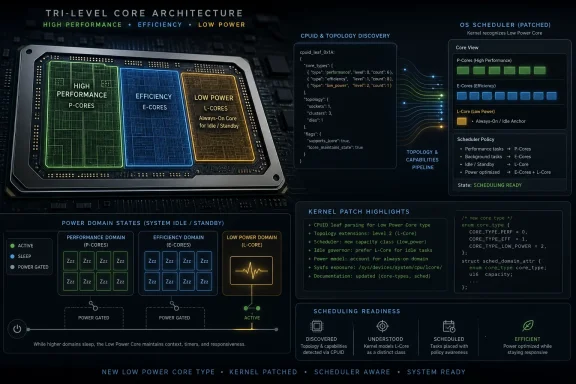
AMD has posted a Linux kernel patch series that adds a distinct “Low Power” CPU core type for future AMD heterogeneous processors, expanding x86 topology handling beyond today’s performance and efficiency classifications as of late June 2026. That is a small kernel-side change with large architectural implications. AMD is preparing operating systems to see a third kind of CPU core, not merely a denser Zen core wearing a new marketing badge. For Windows users, Linux users, laptop buyers, and administrators watching the next Ryzen generation, the message is clear: the era of AMD’s relatively simple core topology is ending.
The most interesting hardware news often arrives without a keynote, a benchmark bar chart, or a CEO promising “leadership performance.” It shows up as a sober patch to a mailing list, written for maintainers who care less about branding than about whether the scheduler can identify the hardware in front of it. AMD’s new Linux work does exactly that: it teaches the kernel to recognize a low-power CPU core type exposed through CPUID on AMD heterogeneous processors.
That matters because operating systems cannot schedule intelligently on hardware they cannot describe. If a processor reports that one core is built for high performance, another for efficiency, and a third for minimal power during idle or background work, the scheduler needs vocabulary before it can have policy. AMD is not merely asking Linux to rename something it already understood. It is adding a new class to the topology model.
Until now, AMD’s hybrid story has been comparatively restrained. Zen C cores, such as Zen 4c and Zen 5c, have generally been understood as denser implementations of the same broad Zen architecture, not Intel-style small cores with radically different capabilities. That distinction helped AMD avoid some of the software anxiety that accompanied Intel’s Alder Lake transition. The new low-power classification complicates that clean narrative.
It does not prove a retail Zen 6 laptop part will ship exactly as rumor accounts describe. The patch does not name Ryzen, Medusa Point, or a launch window. But hardware vendors do not usually add kernel-visible CPU classes for imaginary silicon. When AMD tells Linux there is a low-power core type worth distinguishing from efficiency cores, it is reasonable to treat that as architectural groundwork rather than idle bookkeeping.
A low-power core type points at a different problem. Density is about how many cores fit in a given die area. Low-power residency is about how long the rest of the chip can stay asleep. In laptops, handhelds, and always-connected devices, the important question is often not “how fast can this thread finish?” but “can this email sync, notification, audio stack, sensor poll, or OS housekeeping task run without waking the expensive part of the silicon?”
That is where the Intel comparison becomes unavoidable but incomplete. Intel has spent several generations trying to make hybrid CPUs work as a consumer-facing platform feature, first with performance and efficiency cores and later with low-power E-cores in designs such as Meteor Lake. The goal is not just benchmark scaling; it is power-domain management. Keep trivial work on a small island, avoid lighting up the big cores, and stretch battery life in the messy middle ground between active use and idle.
AMD has historically won credibility by not copying Intel’s more complicated choices unless the engineering case was strong. The company’s Zen revival was built on relatively coherent core blocks, strong SMT, chiplet economics, and an execution model that software could understand. If AMD is now preparing a third core type, it suggests the company sees a power-management opportunity large enough to justify the added scheduling complexity.
The important phrase is third core type. Performance and efficiency are already broad buckets. A low-power type suggests AMD wants a core class whose purpose is not simply “slower but more efficient under load,” but “cheap enough to keep awake when almost everything else should be dark.” That is a subtle difference, and it is exactly the kind of subtlety that determines whether a modern laptop feels magically efficient or just inconsistently sleepy.
That is not a trivial point. Windows already had to evolve for Intel’s hybrid approach, including the interaction between the scheduler, power plans, firmware hints, and Intel’s Thread Director. Microsoft’s operating system can handle heterogeneous processors, but “can handle” and “always makes the choice an enthusiast would prefer” are not the same thing. Anyone who has watched a game, compiler, browser, or background antivirus scan bounce across core types knows that hybrid scheduling is a practical art, not a solved abstraction.
AMD may have an easier path if its low-power cores remain ISA-compatible Zen-family cores rather than something closer to Intel’s historically distinct P-core and E-core split. Compatibility reduces the number of hard cliffs. But it does not eliminate the central question: which threads should run where, for how long, and under which power plan?
The answer will vary by device. A thin-and-light laptop wants background services and standby maintenance to avoid the big cores. A gaming handheld wants the operating system to stay out of the way while the APU gives the GPU as much power budget as possible. A workstation laptop plugged into the wall may prefer responsiveness over power minimalism. The scheduler has to infer intent from foreground state, quality-of-service hints, utilization history, firmware data, and sometimes user-selected power modes.
That is why the Linux patch is the beginning of the story, not the end. Recognition is table stakes. Policy is where users feel the difference.
A Windows laptop is rarely doing nothing. It is syncing cloud storage, indexing files, managing Bluetooth devices, checking notifications, maintaining security state, servicing widgets, updating telemetry, talking to firmware, and keeping a dozen vendor utilities alive. Even if each task is individually small, the aggregate effect can be death by a thousand wakeups. The device is nominally idle, but not electrically quiet.
A low-power core cluster gives silicon designers a place to park that noise. If AMD can run background maintenance on a small always-available core while allowing higher-performance core complexes to remain in deeper sleep states, the battery-life gain could be more meaningful than a modest uplift in peak efficiency. The difference between waking a big CPU complex fifty times a minute and keeping a tiny housekeeping core active is exactly the kind of invisible engineering that separates a great mobile platform from a merely fast one.
This is also where AMD’s APU ambitions matter. The company’s mobile chips increasingly live in devices where CPU, GPU, NPU, media engines, display logic, memory controllers, and firmware power states all fight for the same thermal and energy budget. If the CPU side can consume less power during light work, the system may have more headroom for graphics bursts, AI inference, or simply a cooler chassis.
The operating system has to be a partner in that bargain. A low-power core that Windows or Linux ignores is just die area with a nice name. A low-power core that attracts the wrong latency-sensitive work becomes a source of stutter. A low-power core used well can make the entire SoC feel calmer.
That simplicity was never guaranteed to last. Once mobile power efficiency becomes the main battlefield, homogeneous CPU design looks less like purity and more like a luxury. Apple’s Arm-based Macs normalized a world where high-performance and efficiency cores coexist under a scheduler that aggressively manages energy. Qualcomm’s renewed Windows-on-Arm push has also made battery life and standby behavior central to the PC story. Intel’s hybrid journey may have been awkward, but it dragged the industry toward a destination AMD can no longer ignore.
The difference is that AMD appears to be approaching the problem from its own architectural tradition. Zen C did not behave like an alien core grafted onto the side of the chip. It was a compact member of the Zen family. If Zen 6-era low-power cores follow that philosophy, AMD may get some of the power-domain benefits of hybrid design without all of the compatibility baggage.
But the market will not grade AMD on elegance. It will grade shipping laptops on whether fans spin less often, standby drain improves, video calls last longer, games stop hitching, and Windows feels responsive when the device wakes from sleep. A patch that adds a topology label is a promise that the rest of the stack must keep.
That is uncomfortable for enthusiasts because it makes outcomes less deterministic. Two laptops with the same nominal CPU can behave differently because of firmware tuning, OEM thermal limits, Windows power profiles, driver versions, and background software load. Add a third AMD core type and the number of visible failure modes grows. A benchmark could accidentally avoid low-power cores. A background-heavy workload could benefit disproportionately. A latency-sensitive app could suffer if classification goes wrong.
For administrators, this moves CPU selection closer to platform validation. Enterprise IT does not just need the fastest processor at a given price. It needs predictable behavior across fleet imaging, endpoint security software, remote management agents, VPN clients, browser workloads, and sleep policies. A low-power core type may improve battery life across a managed laptop fleet, but only if the OS and OEM firmware treat common enterprise background tasks intelligently.
For developers, especially those building performance-sensitive Windows applications, it reinforces the importance of thread priority, quality-of-service APIs, and sane background behavior. Apps that spin uselessly in the background are not just rude anymore; they can distort the power-management strategy of the whole machine. The more heterogeneous CPUs become, the more software has to stop assuming that all runnable threads are equal citizens on equal cores.
This is the deeper significance of AMD’s patch. It does not merely reveal a possible Zen 6 feature. It confirms that modern CPU performance is less about the core in isolation and more about where the operating system chooses to spend wakefulness.
The distinction matters because AMD could expose this core type across several families, reserve it for mobile APUs, experiment with it in handheld-oriented silicon, or use it in designs that never reach retail desktop sockets. A CPUID field and Linux support tell us that AMD hardware can identify low-power cores. They do not tell us how many such cores will ship, which products will include them, how they will be arranged on the die, or whether OEMs will tune them consistently.
The rumored configuration of two low-power cores is interesting precisely because it sounds like a housekeeping island rather than a throughput strategy. Two cores are not enough to transform multithreaded performance, but they may be enough to run OS background work, media-adjacent tasks, telemetry, security agents, and idle maintenance while larger complexes stay parked. In that sense, the small number makes the rumor more believable, not less.
Still, AMD has every reason to keep its public message disciplined until launch. Hybrid design is easy to oversell and hard to explain. If the company says “low-power cores,” desktop buyers may fear Intel-style scheduling drama. If it says nothing, the Linux patches tell the story for it. For now, AMD’s silence leaves the technical community parsing code comments and CPUID values, which is both familiar and imperfect.
The safe conclusion is narrower but still important: AMD is preparing software for processors with a distinct low-power core class. Whether the first high-volume expression is Zen 6 mobile, a future handheld APU, or another heterogeneous design, the architectural direction is no longer hypothetical.
Intel already taught the market that not all cores contribute equally to all workloads. AMD’s twist is that its core types may be more closely related architecturally while still serving different power and performance roles. That could make the distinctions less dramatic in instruction compatibility, but no less important in real behavior. A low-power core with small caches and conservative clocks should not be treated as equivalent to a full Zen 6 performance core just because both speak x86.
This will matter in laptops advertised with big core totals. If two of those cores are designed mainly for background or idle tasks, their value is real but different. They may make the machine better without making it much faster. That is a hard nuance to sell in a market trained to equate more cores with more performance.
It will also matter for WindowsForum’s favorite class of user: the person who notices when a system feels wrong. Hybrid scheduling issues often appear as anecdotes before they become benchmark categories. A game stutters after an update. A DAW thread lands somewhere odd. A VM behaves differently on battery. A security suite eats standby time. These are the kinds of problems that arise when hardware topology grows more sophisticated than the user-facing controls.
The answer is not to reject heterogeneous CPUs. The answer is to demand transparency. Users should be able to see what core types exist, administrators should be able to manage power behavior sensibly, and reviewers should test both plugged-in performance and battery-state behavior. If AMD wants credit for low-power cores, it should also accept scrutiny for how those cores are exposed and used.
That chain is only as strong as its weakest link. A well-designed SoC can be undermined by aggressive vendor utilities, poor sleep tuning, outdated firmware, or power policies that prioritize benchmark responsiveness over battery life. Conversely, a modest low-power island can shine if the platform keeps background noise contained and avoids unnecessary wakeups.
This is one reason Microsoft’s own role will be crucial. Windows has become more heterogeneous-aware, but it also carries decades of compatibility expectations and an enormous ecosystem of background services. The OS must balance user intent against application behavior that is often less than disciplined. AMD can provide the hardware hints; Windows has to turn those hints into good everyday decisions.
OEMs will then add their own layer of chaos. The same AMD silicon in a premium ultrabook, a gaming handheld, a corporate laptop, and a convertible tablet may ship with very different thermal targets and power policies. Low-power cores could become a headline feature in one device and an invisible footnote in another.
For buyers, the practical advice is to wait for system-level testing. Do not assume that a Zen 6-era laptop with low-power cores will automatically have class-leading battery life. Do not assume it will have scheduling problems either. The meaningful question will be how the whole platform behaves over a day of mixed use.
That is not a weakness. It may be the necessary next step. The PC is no longer a box that alternates between idle and full load. It is a layered, always-connected machine expected to wake instantly, sip power, run local AI features, keep radios alive, drive high-refresh displays, and still deliver burst performance on demand. No single core design is ideal across that range.
The danger is that AMD inherits the complexity without delivering a visible payoff. If low-power cores merely inflate core counts or create scheduling edge cases, enthusiasts will treat them as a gimmick. If they materially improve standby drain, light-use endurance, thermals, and handheld battery behavior, the complaints will fade quickly. Users forgive architectural complexity when the laptop lasts longer and feels better.
AMD’s best argument will not be that it has followed Intel. It will be that it has adapted heterogeneous design to the Zen ecosystem in a way that keeps software compatibility boring while making power management smarter. That is a harder story to tell than “more cores,” but it is a better one.
For Windows enthusiasts and IT pros, the practical implications are already visible:
AMD’s low-power core patch is not a product announcement, but it is a directional marker: the company that once benefited from keeping x86 core design simple is preparing for a PC world where simplicity no longer wins by itself. If AMD and Microsoft can make the scheduler, firmware, and silicon cooperate, Zen 6-era laptops could feel less like faster versions of today’s machines and more like PCs that finally understand the cost of waking up.
 AMD’s Quiet Patch Says More Than a Product Teaser Would
The most interesting hardware news often arrives without a keynote, a benchmark bar chart, or a CEO promising “leadership performance.” It shows up as a sober patch to a mailing list, written for maintainers who care less about branding than about whether the scheduler can identify the hardware in front of it. AMD’s new Linux work does exactly that: it teaches the kernel to recognize a low-power CPU core type exposed through CPUID on AMD heterogeneous processors.That matters because operating systems cannot schedule intelligently on hardware they cannot describe. If a processor reports that one core is built for high performance, another for efficiency, and a third for minimal power during idle or background work, the scheduler needs vocabulary before it can have policy. AMD is not merely asking Linux to rename something it already understood. It is adding a new class to the topology model.
Until now, AMD’s hybrid story has been comparatively restrained. Zen C cores, such as Zen 4c and Zen 5c, have generally been understood as denser implementations of the same broad Zen architecture, not Intel-style small cores with radically different capabilities. That distinction helped AMD avoid some of the software anxiety that accompanied Intel’s Alder Lake transition. The new low-power classification complicates that clean narrative.
It does not prove a retail Zen 6 laptop part will ship exactly as rumor accounts describe. The patch does not name Ryzen, Medusa Point, or a launch window. But hardware vendors do not usually add kernel-visible CPU classes for imaginary silicon. When AMD tells Linux there is a low-power core type worth distinguishing from efficiency cores, it is reasonable to treat that as architectural groundwork rather than idle bookkeeping.
Zen C Was Density; This Looks Like Residency
AMD’s existing compact-core strategy has been easy to explain in enthusiast shorthand: Zen C gives AMD more cores in less area, with lower clocks and different cache tradeoffs, while preserving architectural compatibility. That is why EPYC could use dense cores to chase throughput and why mobile APUs could mix full-fat and compact cores without creating the same “which instruction set does this thread need?” anxiety that once haunted asymmetric designs.A low-power core type points at a different problem. Density is about how many cores fit in a given die area. Low-power residency is about how long the rest of the chip can stay asleep. In laptops, handhelds, and always-connected devices, the important question is often not “how fast can this thread finish?” but “can this email sync, notification, audio stack, sensor poll, or OS housekeeping task run without waking the expensive part of the silicon?”
That is where the Intel comparison becomes unavoidable but incomplete. Intel has spent several generations trying to make hybrid CPUs work as a consumer-facing platform feature, first with performance and efficiency cores and later with low-power E-cores in designs such as Meteor Lake. The goal is not just benchmark scaling; it is power-domain management. Keep trivial work on a small island, avoid lighting up the big cores, and stretch battery life in the messy middle ground between active use and idle.
AMD has historically won credibility by not copying Intel’s more complicated choices unless the engineering case was strong. The company’s Zen revival was built on relatively coherent core blocks, strong SMT, chiplet economics, and an execution model that software could understand. If AMD is now preparing a third core type, it suggests the company sees a power-management opportunity large enough to justify the added scheduling complexity.
The important phrase is third core type. Performance and efficiency are already broad buckets. A low-power type suggests AMD wants a core class whose purpose is not simply “slower but more efficient under load,” but “cheap enough to keep awake when almost everything else should be dark.” That is a subtle difference, and it is exactly the kind of subtlety that determines whether a modern laptop feels magically efficient or just inconsistently sleepy.
Linux Gets the First Vocabulary Lesson, but Windows Will Be the Main Exam
Linux kernel patches are often the first public breadcrumb because Linux support has to be negotiated in the open. That makes Linux a useful early-warning system for CPU features, even when the eventual volume market is Windows. AMD has to ensure Linux can see the core type correctly, report it through topology interfaces, and apply the right performance-scaling logic. But if these cores land in mainstream Ryzen mobile chips, Windows scheduling will decide how most users experience them.That is not a trivial point. Windows already had to evolve for Intel’s hybrid approach, including the interaction between the scheduler, power plans, firmware hints, and Intel’s Thread Director. Microsoft’s operating system can handle heterogeneous processors, but “can handle” and “always makes the choice an enthusiast would prefer” are not the same thing. Anyone who has watched a game, compiler, browser, or background antivirus scan bounce across core types knows that hybrid scheduling is a practical art, not a solved abstraction.
AMD may have an easier path if its low-power cores remain ISA-compatible Zen-family cores rather than something closer to Intel’s historically distinct P-core and E-core split. Compatibility reduces the number of hard cliffs. But it does not eliminate the central question: which threads should run where, for how long, and under which power plan?
The answer will vary by device. A thin-and-light laptop wants background services and standby maintenance to avoid the big cores. A gaming handheld wants the operating system to stay out of the way while the APU gives the GPU as much power budget as possible. A workstation laptop plugged into the wall may prefer responsiveness over power minimalism. The scheduler has to infer intent from foreground state, quality-of-service hints, utilization history, firmware data, and sometimes user-selected power modes.
That is why the Linux patch is the beginning of the story, not the end. Recognition is table stakes. Policy is where users feel the difference.
The Real Target Is the Laptop That Never Quite Sleeps
The desktop enthusiast instinct is to ask whether low-power cores will help Cinebench, gaming frame rates, or compile times. In most cases, probably not directly. A tiny background-oriented core is not there to win a benchmark that wakes every high-performance unit on the chip. Its value appears in the dull, frustrating, battery-draining realities of modern PCs.A Windows laptop is rarely doing nothing. It is syncing cloud storage, indexing files, managing Bluetooth devices, checking notifications, maintaining security state, servicing widgets, updating telemetry, talking to firmware, and keeping a dozen vendor utilities alive. Even if each task is individually small, the aggregate effect can be death by a thousand wakeups. The device is nominally idle, but not electrically quiet.
A low-power core cluster gives silicon designers a place to park that noise. If AMD can run background maintenance on a small always-available core while allowing higher-performance core complexes to remain in deeper sleep states, the battery-life gain could be more meaningful than a modest uplift in peak efficiency. The difference between waking a big CPU complex fifty times a minute and keeping a tiny housekeeping core active is exactly the kind of invisible engineering that separates a great mobile platform from a merely fast one.
This is also where AMD’s APU ambitions matter. The company’s mobile chips increasingly live in devices where CPU, GPU, NPU, media engines, display logic, memory controllers, and firmware power states all fight for the same thermal and energy budget. If the CPU side can consume less power during light work, the system may have more headroom for graphics bursts, AI inference, or simply a cooler chassis.
The operating system has to be a partner in that bargain. A low-power core that Windows or Linux ignores is just die area with a nice name. A low-power core that attracts the wrong latency-sensitive work becomes a source of stutter. A low-power core used well can make the entire SoC feel calmer.
Intel’s Hybrid Detour Becomes the Industry Road
AMD spent years benefiting from Intel’s pain. Alder Lake introduced a bold hybrid desktop and mobile strategy, but the transition created confusion around scheduling, game compatibility, DRM, benchmarking, and what “core count” meant when cores were no longer equal. AMD, by contrast, could sell Ryzen with a cleaner mental model: cores were cores, threads were threads, and performance scaled in a way enthusiasts broadly understood.That simplicity was never guaranteed to last. Once mobile power efficiency becomes the main battlefield, homogeneous CPU design looks less like purity and more like a luxury. Apple’s Arm-based Macs normalized a world where high-performance and efficiency cores coexist under a scheduler that aggressively manages energy. Qualcomm’s renewed Windows-on-Arm push has also made battery life and standby behavior central to the PC story. Intel’s hybrid journey may have been awkward, but it dragged the industry toward a destination AMD can no longer ignore.
The difference is that AMD appears to be approaching the problem from its own architectural tradition. Zen C did not behave like an alien core grafted onto the side of the chip. It was a compact member of the Zen family. If Zen 6-era low-power cores follow that philosophy, AMD may get some of the power-domain benefits of hybrid design without all of the compatibility baggage.
But the market will not grade AMD on elegance. It will grade shipping laptops on whether fans spin less often, standby drain improves, video calls last longer, games stop hitching, and Windows feels responsive when the device wakes from sleep. A patch that adds a topology label is a promise that the rest of the stack must keep.
The Scheduler Is Now Part of the Product
There was a time when CPU reviews could mostly treat the operating system as a test platform. Install the latest updates, set a power plan, run the suite, report the numbers. Hybrid processors made that view obsolete. The scheduler, firmware, drivers, and silicon are now a single performance surface.That is uncomfortable for enthusiasts because it makes outcomes less deterministic. Two laptops with the same nominal CPU can behave differently because of firmware tuning, OEM thermal limits, Windows power profiles, driver versions, and background software load. Add a third AMD core type and the number of visible failure modes grows. A benchmark could accidentally avoid low-power cores. A background-heavy workload could benefit disproportionately. A latency-sensitive app could suffer if classification goes wrong.
For administrators, this moves CPU selection closer to platform validation. Enterprise IT does not just need the fastest processor at a given price. It needs predictable behavior across fleet imaging, endpoint security software, remote management agents, VPN clients, browser workloads, and sleep policies. A low-power core type may improve battery life across a managed laptop fleet, but only if the OS and OEM firmware treat common enterprise background tasks intelligently.
For developers, especially those building performance-sensitive Windows applications, it reinforces the importance of thread priority, quality-of-service APIs, and sane background behavior. Apps that spin uselessly in the background are not just rude anymore; they can distort the power-management strategy of the whole machine. The more heterogeneous CPUs become, the more software has to stop assuming that all runnable threads are equal citizens on equal cores.
This is the deeper significance of AMD’s patch. It does not merely reveal a possible Zen 6 feature. It confirms that modern CPU performance is less about the core in isolation and more about where the operating system chooses to spend wakefulness.
Rumors Fill the Vacuum AMD Has Left Open
The reporting around this patch has naturally drifted toward Zen 6, Medusa Point, and claims that at least some future AMD APUs may include two low-power cores. That speculation is plausible, but it should be treated as unconfirmed until AMD announces product configurations. Kernel patches can reveal capability; they do not always reveal shipping segmentation.The distinction matters because AMD could expose this core type across several families, reserve it for mobile APUs, experiment with it in handheld-oriented silicon, or use it in designs that never reach retail desktop sockets. A CPUID field and Linux support tell us that AMD hardware can identify low-power cores. They do not tell us how many such cores will ship, which products will include them, how they will be arranged on the die, or whether OEMs will tune them consistently.
The rumored configuration of two low-power cores is interesting precisely because it sounds like a housekeeping island rather than a throughput strategy. Two cores are not enough to transform multithreaded performance, but they may be enough to run OS background work, media-adjacent tasks, telemetry, security agents, and idle maintenance while larger complexes stay parked. In that sense, the small number makes the rumor more believable, not less.
Still, AMD has every reason to keep its public message disciplined until launch. Hybrid design is easy to oversell and hard to explain. If the company says “low-power cores,” desktop buyers may fear Intel-style scheduling drama. If it says nothing, the Linux patches tell the story for it. For now, AMD’s silence leaves the technical community parsing code comments and CPUID values, which is both familiar and imperfect.
The safe conclusion is narrower but still important: AMD is preparing software for processors with a distinct low-power core class. Whether the first high-volume expression is Zen 6 mobile, a future handheld APU, or another heterogeneous design, the architectural direction is no longer hypothetical.
Core Counts Are About to Get More Political
Once a processor contains performance cores, compact efficiency cores, and low-power cores, the simple core-count number becomes even less useful. A “12-core” chip could mean many different things depending on how those cores are divided, clocked, cached, powered, and scheduled. Marketing departments will be tempted to flatten those distinctions. Reviewers and buyers should resist.Intel already taught the market that not all cores contribute equally to all workloads. AMD’s twist is that its core types may be more closely related architecturally while still serving different power and performance roles. That could make the distinctions less dramatic in instruction compatibility, but no less important in real behavior. A low-power core with small caches and conservative clocks should not be treated as equivalent to a full Zen 6 performance core just because both speak x86.
This will matter in laptops advertised with big core totals. If two of those cores are designed mainly for background or idle tasks, their value is real but different. They may make the machine better without making it much faster. That is a hard nuance to sell in a market trained to equate more cores with more performance.
It will also matter for WindowsForum’s favorite class of user: the person who notices when a system feels wrong. Hybrid scheduling issues often appear as anecdotes before they become benchmark categories. A game stutters after an update. A DAW thread lands somewhere odd. A VM behaves differently on battery. A security suite eats standby time. These are the kinds of problems that arise when hardware topology grows more sophisticated than the user-facing controls.
The answer is not to reject heterogeneous CPUs. The answer is to demand transparency. Users should be able to see what core types exist, administrators should be able to manage power behavior sensibly, and reviewers should test both plugged-in performance and battery-state behavior. If AMD wants credit for low-power cores, it should also accept scrutiny for how those cores are exposed and used.
Windows Users Should Watch Firmware as Closely as Silicon
The kernel patch is Linux-specific, but Windows users should not dismiss it as someone else’s plumbing. Linux is simply where the public evidence surfaced. If AMD’s future mobile chips include low-power cores, Windows support will depend on a chain of firmware tables, CPUID reporting, chipset drivers, scheduler policy, power plans, and OEM defaults.That chain is only as strong as its weakest link. A well-designed SoC can be undermined by aggressive vendor utilities, poor sleep tuning, outdated firmware, or power policies that prioritize benchmark responsiveness over battery life. Conversely, a modest low-power island can shine if the platform keeps background noise contained and avoids unnecessary wakeups.
This is one reason Microsoft’s own role will be crucial. Windows has become more heterogeneous-aware, but it also carries decades of compatibility expectations and an enormous ecosystem of background services. The OS must balance user intent against application behavior that is often less than disciplined. AMD can provide the hardware hints; Windows has to turn those hints into good everyday decisions.
OEMs will then add their own layer of chaos. The same AMD silicon in a premium ultrabook, a gaming handheld, a corporate laptop, and a convertible tablet may ship with very different thermal targets and power policies. Low-power cores could become a headline feature in one device and an invisible footnote in another.
For buyers, the practical advice is to wait for system-level testing. Do not assume that a Zen 6-era laptop with low-power cores will automatically have class-leading battery life. Do not assume it will have scheduling problems either. The meaningful question will be how the whole platform behaves over a day of mixed use.
AMD’s Efficiency Story Is Becoming Less Ideological and More Practical
AMD’s public identity over the last decade has been built around execution: better cores, better chiplets, better server density, better desktop value, better performance per watt. The company did not need to preach an exotic philosophy because the products spoke clearly. Hybrid CPU design challenges that simplicity. It forces AMD to explain not just how fast a core is, but why a particular core exists.That is not a weakness. It may be the necessary next step. The PC is no longer a box that alternates between idle and full load. It is a layered, always-connected machine expected to wake instantly, sip power, run local AI features, keep radios alive, drive high-refresh displays, and still deliver burst performance on demand. No single core design is ideal across that range.
The danger is that AMD inherits the complexity without delivering a visible payoff. If low-power cores merely inflate core counts or create scheduling edge cases, enthusiasts will treat them as a gimmick. If they materially improve standby drain, light-use endurance, thermals, and handheld battery behavior, the complaints will fade quickly. Users forgive architectural complexity when the laptop lasts longer and feels better.
AMD’s best argument will not be that it has followed Intel. It will be that it has adapted heterogeneous design to the Zen ecosystem in a way that keeps software compatibility boring while making power management smarter. That is a harder story to tell than “more cores,” but it is a better one.
The Patch Is Small, but the Buying Advice Changes
The concrete lesson from this week’s Linux patch is not that everyone should wait for Zen 6, nor that AMD has suddenly become Intel. It is that CPU topology is becoming a first-order buying consideration, especially in mobile systems. The next wave of Ryzen laptops may need to be judged less like desktop CPUs and more like complete power-managed platforms.For Windows enthusiasts and IT pros, the practical implications are already visible:
- AMD has added Linux support for a distinct low-power CPU core type, separate from existing performance and efficiency classifications.
- The patch points to future AMD heterogeneous processors, but it does not by itself confirm final Zen 6 product names, launch SKUs, or core counts.
- Low-power cores are likely to matter most for laptops, handhelds, and idle or background workloads rather than peak desktop-style benchmarks.
- Windows scheduling, firmware quality, chipset drivers, and OEM power tuning will determine whether users actually benefit from the hardware.
- Reviewers should test battery-state responsiveness, standby drain, background-task behavior, and plugged-in performance instead of relying only on peak benchmark runs.
- Administrators should treat future heterogeneous Ryzen systems as platforms that require validation, not just CPUs with a familiar brand name.
AMD’s low-power core patch is not a product announcement, but it is a directional marker: the company that once benefited from keeping x86 core design simple is preparing for a PC world where simplicity no longer wins by itself. If AMD and Microsoft can make the scheduler, firmware, and silicon cooperate, Zen 6-era laptops could feel less like faster versions of today’s machines and more like PCs that finally understand the cost of waking up.
References
- Primary source: Tom's Hardware
Published: Tue, 30 Jun 2026 16:50:50 GMT
Loading…
www.tomshardware.com - Independent coverage: videocardz.com
Published: 2026-06-30T10:30:11.094715
Loading…
videocardz.com - Related coverage: phoronix.com
Loading…
www.phoronix.com - Related coverage: topcpu.net
Loading…
www.topcpu.net - Related coverage: pcgamer.com
Loading…
www.pcgamer.com - Related coverage: vgtimes.com
Linux Kernel Patches Reveal Ultra-Low-Power Core Type for AMD Zen 6 Processors
AMD's upcoming Zen 6 processors will introduce a significant architectural shift with the addition of a new "Low Power" core type, designed...vgtimes.com
- Related coverage: eteknix.com
Loading…
www.eteknix.com - Related coverage: webpronews.com
Loading…
www.webpronews.com - Related coverage: hardware-news.de
Loading…
www.hardware-news.de - Related coverage: technologyinsider.nl
Loading…
www.technologyinsider.nl - Related coverage: techradar.com
Linux 7.0 finally arrives with AMD Zen 6 and Intel Nova Lake support, packed with massive new performance features | TechRadar
Linux 7.0 is bringing faster file systems, better graphics, and wider hardware supportwww.techradar.com