
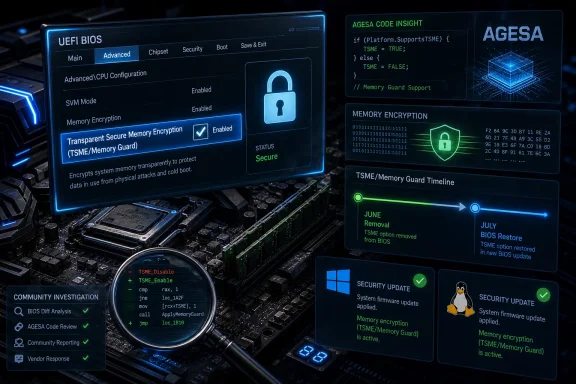
AMD told Tom’s Hardware on June 19, 2026, that it will restore Transparent Secure Memory Encryption on certain non-PRO Ryzen 9000 desktop processors through a July BIOS update after removing the option in recent AGESA-based firmware. The reversal is narrow, but the lesson is broad: firmware has become the place where PC features can disappear without the box, the spec sheet, or even the motherboard vendor making much noise. For Windows enthusiasts and Linux power users alike, this is less a story about one obscure memory-encryption switch than about trust in the platform beneath the operating system. AMD has now done the right thing, but only after the community proved the thing had been done at all.
Transparent Secure Memory Encryption, or TSME, is not the sort of feature that sells gaming desktops on a Best Buy shelf. It does not raise frame rates, unlock extra cache, or make a Ryzen 7 9700X behave like an X3D part. It is a security feature that encrypts system memory using a processor-generated key, intended to reduce the risk from cold-boot and other physical memory attacks.
That niche status is precisely why AMD’s quiet removal landed so badly. The people who notice a feature like TSME are the same people who understand what it means when a CPU, firmware stack, and motherboard BIOS together decide that yesterday’s supported capability is today’s “not supported.” They are also the people who file bug reports, compare firmware revisions, and ask uncomfortable questions in public.
According to the reporting that surfaced the issue, the change appeared with newer AMD Generic Encapsulated Software Architecture firmware, including AGESA 1.2.7.0, which motherboard makers incorporate into BIOS updates. On affected consumer Ryzen systems, TSME that had previously worked no longer appeared available. PRO-class Ryzen chips, meanwhile, continued to support the feature.
That distinction made the whole episode look less like a random firmware regression and more like product segmentation by subtraction. AMD’s public line now is that Memory Guard, its branding for TSME in the Ryzen PRO world, remains a foundational security feature for supported PRO processors and that certain non-PRO Ryzen 9000 desktop chips will regain the BIOS option in July. That is a welcome answer. It is not a full explanation.
But security is not measured only by the average user’s attack surface. It is also measured by whether platform vendors can be relied upon to preserve documented or discoverable capabilities across updates. A desktop CPU is not a cloud service where the provider is expected to change server-side behavior overnight. PC buyers still assume, reasonably, that a processor and motherboard combination will not quietly lose security functionality because a firmware bundle moved forward.
That assumption is increasingly fragile. Modern x86 systems are not just CPUs and operating systems; they are layered stacks of microcode, platform firmware, security processors, boot policies, UEFI settings, vendor utilities, and operating-system probes. A user may believe they are updating a motherboard for better memory compatibility or a new AGESA revision, only to inherit a changed security posture in a submenu they may never open.
AMD’s problem was not merely that TSME went away on some machines. It was that the disappearance was hard to detect, poorly communicated, and initially difficult to attribute. If a Linux hobbyist had not been paying close attention, the change might have remained a footnote known only to a handful of firmware engineers and unlucky auditors.
For Windows users, the opacity is worse. Linux tooling can expose enough low-level platform detail for motivated users to notice that encrypted memory support has changed. Windows systems generally do not surface that same state in a consumer-friendly way. The result is an uncomfortable asymmetry: a security feature can be disabled below the OS while the user interface above it remains serenely unaware.
The trouble is that retroactive feature removal feels different from upfront segmentation. If AMD had said from day one that TSME was supported only on Ryzen PRO and EPYC, non-PRO buyers could judge accordingly. If a consumer Ryzen chip never exposed the switch, there would be little drama. Instead, the feature appears to have worked on some mainstream Ryzen systems for years, with past AMD-adjacent discussion suggesting consumer support was at least expected in some cases.
That history matters. Enthusiasts do not parse product stacks like procurement departments. They buy hardware, test what it can do, share findings, and build expectations around observed behavior. When a capability survives across generations and then vanishes through firmware, the burden shifts to the vendor to explain whether it was accidental exposure, unsupported behavior, a validation risk, or a deliberate product-policy change.
AMD’s first posture, as reported, seemed to leave too much unsaid. The company framed TSME as part of AMD PRO Technologies, which may be technically and commercially true, but it did not answer the community’s core complaint: why remove a working option from consumer systems without a clear advisory? Silence created room for the least charitable interpretation.
The reversal suggests AMD recognized that the least charitable interpretation was becoming the dominant one. Restoring the BIOS option for certain Ryzen 9000 desktop processors does not turn non-PRO chips into PRO chips. It simply acknowledges that removing an already-visible security capability from buyers who knew they had it was not worth the damage.
That gives AGESA enormous influence over what a system is. A motherboard BIOS update can improve DDR5 training, add support for new processors, patch security issues, adjust boost behavior, or change how firmware exposes hardware capabilities. The update page may contain three bullet points and a warning not to power off the machine, but the actual consequences can be far deeper.
The enthusiast community has learned this the hard way. BIOS releases have become both routine maintenance and a source of anxiety, especially on platforms where memory compatibility, processor support, and security fixes evolve over time. Users are told to update for stability, but also warned not to update unless necessary. Both pieces of advice can be true, which is precisely the problem.
TSME’s disappearance fits this pattern because it was not a Windows Update, not a driver rollback, and not an application-level change. It was a platform-level alteration delivered through the motherboard ecosystem. AMD creates the underlying firmware package, board makers integrate it, users install it, and then everyone argues about who owns the consequences.
That chain of responsibility is messy, but it cannot be allowed to become a fog machine. If AMD changes security-feature exposure in AGESA, AMD owns the policy decision. If a board vendor hides or mislabels a BIOS option, the vendor owns the implementation. If both parties know a feature is changing, both owe users a changelog that says so plainly.
Yet security engineering has never been only about the most common attack. Laptops get stolen. Desktops are seized, resold, serviced, abandoned, or accessed by insiders. Developers store secrets. Journalists protect sources. Small-business machines handle customer data without enterprise procurement discipline. Home labs increasingly look like production infrastructure with worse paperwork.
TSME is not magic. It does not replace full-disk encryption, secure boot discipline, firmware passwords, TPM-backed key protection, or sane account controls. It also does not protect against an attacker who compromises the system while it is running and the memory is already in use. But it adds a layer in a specific class of attack where unencrypted DRAM contents can outlive the assumptions users make about shutdown and power loss.
The key word is layer. Security-minded users tend to assemble defenses from imperfect parts because no single mechanism is sufficient. Removing one of those parts without notice is not catastrophic in most cases, but it is corrosive. It tells careful users that the platform may be less deterministic than they thought.
There is also a symbolic dimension. Memory encryption has been one of AMD’s differentiators in servers and enterprise machines, especially as confidential-computing narratives have grown around EPYC and cloud workloads. If AMD wants to be seen as the company that takes hardware security seriously, it cannot treat low-volume desktop security users as an inconvenient edge case.
For users, however, the distinction is almost invisible. The BIOS comes from ASUS, MSI, Gigabyte, ASRock, or another board vendor. The CPU comes from AMD. The security option appears in a firmware menu. When something breaks or disappears, the average enthusiast has to reverse-engineer the supply chain before they can even decide whom to blame.
This is not sustainable. PC firmware has become too consequential for changelogs that read like fortune cookies. “Improve system stability” may be acceptable for a minor memory-training tweak, but it is not acceptable when a release changes security-feature availability. “Update AGESA” is not a meaningful disclosure if the AGESA update includes policy changes that alter the machine’s threat model.
Board vendors should not need to discover these changes from customers, and customers should not need to discover them by comparing security-audit output before and after a BIOS flash. The ecosystem needs a clearer security-impact classification for firmware updates, especially now that consumer systems routinely include TPMs, secure boot, virtualization security features, memory encryption hooks, and firmware-controlled mitigations.
AMD’s July restoration is therefore only half of the repair. The other half is process. If the company wants users to trust AGESA updates, it should document security-relevant feature changes with the same seriousness it applies to processor errata, vulnerability mitigations, and compatibility notes.
Windows users, by contrast, often receive a more polished abstraction. That can be good for sanity and supportability, but it also means subtle platform changes can pass unnoticed. If Device Security says the basics are in place and the machine boots normally, most users will assume the hardware security story is unchanged.
This is where Windows enthusiasts should pay attention. A BIOS update can change the assumptions under Windows without Windows being the actor that changed them. Virtualization-based security, BitLocker behavior, TPM state, secure boot settings, memory-remapping options, IOMMU configuration, and CPU security features all sit in the uneasy borderland between firmware and OS.
The TSME reversal is not a Windows story in the narrow sense. It is a WindowsForum story because Windows users live on the same firmware ground. The most common Ryzen desktop owner affected by this class of change is likely booting Windows, updating BIOS from a vendor utility or UEFI flash tool, and never seeing a clear before-and-after security report.
Microsoft has pushed Windows hardware security forward over the past several years, especially with Windows 11’s TPM and secure-boot requirements. But the operating system can only build on the platform it is handed. If firmware silently changes what the platform exposes, Windows inherits the result.
A user noticed an anomaly. Others compared systems. A motherboard vendor helped test firmware behavior. Reporters connected the dots and pressed AMD for an answer. Public discussion transformed an obscure technical regression into a reputational problem. Then AMD changed course.
That sequence is messy, but it is healthier than the alternative. The alternative is a locked-down PC ecosystem where firmware behavior is unknowable, vendor statements are final, and ordinary users have no practical way to challenge platform changes. Enthusiast scrutiny is one of the reasons the PC remains more accountable than many closed computing devices.
It is also a reminder that “community feedback” is often a polite phrase for “users supplied the QA, documentation pressure, and reputational incentive that the vendor process failed to provide.” AMD deserves credit for reversing course quickly once the issue reached the wider press. It deserves less credit for letting the issue require that escalation.
There is a delicate balance here. Vendors cannot expose every internal validation detail, and not every firmware option should be treated as a contractual promise forever. But security features occupy a different category from overclocking conveniences or cosmetic BIOS menus. If a vendor removes one, the default should be disclosure, not discovery.
The word “certain” is doing work. If AMD’s restoration is limited to Ryzen 9000 desktop CPUs, some users will reasonably ask why earlier chips that previously appeared to support TSME are excluded. If the answer is validation, AMD should say so. If the answer is product segmentation, AMD should say that too. Ambiguity is what created this problem.
The rollout will also depend on motherboard vendors. AMD can supply the AGESA-level change, but BIOS delivery is fragmented across model lines, regional support sites, beta releases, and vendor priorities. High-end X870 and X870E boards may see updates sooner than older or lower-volume boards. Users who care about the feature will have to watch release notes carefully and verify after flashing.
There is also the perennial BIOS-update dilemma. Users who lost TSME may want the July update immediately. Users whose systems still expose TSME on older firmware may hesitate to touch anything until the fix is confirmed. And users who do not care about TSME may still need later AGESA updates for memory compatibility, processor support, or security fixes unrelated to this controversy.
That is why AMD should pair the restoration with explicit documentation. A line in a motherboard changelog saying the BIOS “reinstates Memory Guard/TSME option for supported non-PRO Ryzen 9000 desktop processors” would do more for trust than a vague stability note. Better still would be an AMD-maintained table of affected CPU families and firmware versions.
That gap matters more every year. Firmware is no longer a sleepy pre-boot ritual. It is where silicon vendors enforce mitigations, expose virtualization capabilities, initialize trusted computing features, configure memory behavior, and define what the OS can prove about the machine. A change below the OS can be as meaningful as a change inside it.
The industry already has models it could borrow from. Browser vendors publish security notes. Operating systems identify known issues and compatibility holds. Enterprise firmware ecosystems track advisories, mitigations, and platform impacts. Consumer motherboard BIOS pages do not need to become legal novels, but they do need to stop hiding material security changes behind generic language.
AMD in particular has a reason to care. The company has spent years building credibility with enthusiasts after the long pre-Zen wilderness, and it has successfully turned Ryzen into the default recommendation for many desktop builders. That goodwill is valuable because enthusiasts influence purchases far beyond their own machines. They are the friends, admins, builders, forum moderators, and office troubleshooters who translate platform reputation into buying advice.
Silent removals spend that goodwill quickly. Restoring TSME earns some of it back, but the better move is to make similar surprises less likely. That means documenting which features are supported, which are merely exposed without support guarantees, and which are being changed by firmware policy.
That leverage is especially important in an era when hardware vendors increasingly behave like platform operators. CPUs receive firmware updates. Motherboards are software products. Security features are marketed as ecosystems. Product segmentation can be enforced by code long after purchase. The old idea that a PC is a static object you buy and own is giving way to something more fluid and less comfortable.
AMD is hardly alone in this. Intel, Microsoft, OEMs, GPU vendors, and storage vendors all participate in the same trend. The modern PC is a negotiated state between hardware capability, firmware policy, driver support, operating-system requirements, cloud services, and vendor lifecycle decisions. Ownership still exists, but it is mediated by update channels.
That is why small switches matter. TSME is a niche feature, but the precedent is not niche. If a security capability can vanish silently because it is inconvenient to support outside a premium SKU, users are entitled to ask what else might move from “working” to “not supported” in the next firmware wave.
The answer should not be paranoia. It should be governance. Vendors need clearer policies, better release notes, and a stronger presumption that removing a security feature from existing systems is an exceptional act requiring explicit notice.
The strongest version of AMD’s response would include a public support note that explains which processors are covered, which AGESA versions removed the option, which upcoming versions restore it, and whether other consumer Ryzen generations are in or out. It should distinguish Memory Guard as a supported PRO feature from TSME availability on selected non-PRO desktop parts without implying that users imagined the previous behavior.
Motherboard vendors should then echo that language in BIOS release notes. Users should not have to flash, boot, dig through UEFI menus, and run low-level checks just to learn whether a security option has returned. The update should say what it does.
This is also an opportunity for better tooling. Windows and Linux users alike would benefit from clearer reporting of platform memory-encryption state. Enthusiasts can use specialized tools today, but the average technically capable user should not need to become a firmware archaeologist to answer a simple question: is my system memory encryption feature enabled, disabled, or unsupported?
 AMD Learns That Silent Firmware Cuts Are Still Product Cuts
Transparent Secure Memory Encryption, or TSME, is not the sort of feature that sells gaming desktops on a Best Buy shelf. It does not raise frame rates, unlock extra cache, or make a Ryzen 7 9700X behave like an X3D part. It is a security feature that encrypts system memory using a processor-generated key, intended to reduce the risk from cold-boot and other physical memory attacks.That niche status is precisely why AMD’s quiet removal landed so badly. The people who notice a feature like TSME are the same people who understand what it means when a CPU, firmware stack, and motherboard BIOS together decide that yesterday’s supported capability is today’s “not supported.” They are also the people who file bug reports, compare firmware revisions, and ask uncomfortable questions in public.
According to the reporting that surfaced the issue, the change appeared with newer AMD Generic Encapsulated Software Architecture firmware, including AGESA 1.2.7.0, which motherboard makers incorporate into BIOS updates. On affected consumer Ryzen systems, TSME that had previously worked no longer appeared available. PRO-class Ryzen chips, meanwhile, continued to support the feature.
That distinction made the whole episode look less like a random firmware regression and more like product segmentation by subtraction. AMD’s public line now is that Memory Guard, its branding for TSME in the Ryzen PRO world, remains a foundational security feature for supported PRO processors and that certain non-PRO Ryzen 9000 desktop chips will regain the BIOS option in July. That is a welcome answer. It is not a full explanation.
The Obscure Switch Became a Trust Test
The practical risk here was always limited. A cold-boot attack requires physical access or a highly unusual threat model, and most consumer desktops face more immediate danger from phishing, weak passwords, malicious browser extensions, unpatched software, and careless privilege escalation. Nobody should pretend that TSME is the difference between a safe gaming PC and a doomed one.But security is not measured only by the average user’s attack surface. It is also measured by whether platform vendors can be relied upon to preserve documented or discoverable capabilities across updates. A desktop CPU is not a cloud service where the provider is expected to change server-side behavior overnight. PC buyers still assume, reasonably, that a processor and motherboard combination will not quietly lose security functionality because a firmware bundle moved forward.
That assumption is increasingly fragile. Modern x86 systems are not just CPUs and operating systems; they are layered stacks of microcode, platform firmware, security processors, boot policies, UEFI settings, vendor utilities, and operating-system probes. A user may believe they are updating a motherboard for better memory compatibility or a new AGESA revision, only to inherit a changed security posture in a submenu they may never open.
AMD’s problem was not merely that TSME went away on some machines. It was that the disappearance was hard to detect, poorly communicated, and initially difficult to attribute. If a Linux hobbyist had not been paying close attention, the change might have remained a footnote known only to a handful of firmware engineers and unlucky auditors.
For Windows users, the opacity is worse. Linux tooling can expose enough low-level platform detail for motivated users to notice that encrypted memory support has changed. Windows systems generally do not surface that same state in a consumer-friendly way. The result is an uncomfortable asymmetry: a security feature can be disabled below the OS while the user interface above it remains serenely unaware.
Ryzen PRO Segmentation Was the Wrong Hill to Defend
AMD’s business instinct is understandable. Ryzen PRO exists to bundle manageability, validation, enterprise support, and security features for business buyers who pay for a more predictable platform. Intel has long done similar segmentation with vPro. The PC market is full of capabilities that exist in silicon but are exposed, fused off, validated, or supported differently depending on SKU.The trouble is that retroactive feature removal feels different from upfront segmentation. If AMD had said from day one that TSME was supported only on Ryzen PRO and EPYC, non-PRO buyers could judge accordingly. If a consumer Ryzen chip never exposed the switch, there would be little drama. Instead, the feature appears to have worked on some mainstream Ryzen systems for years, with past AMD-adjacent discussion suggesting consumer support was at least expected in some cases.
That history matters. Enthusiasts do not parse product stacks like procurement departments. They buy hardware, test what it can do, share findings, and build expectations around observed behavior. When a capability survives across generations and then vanishes through firmware, the burden shifts to the vendor to explain whether it was accidental exposure, unsupported behavior, a validation risk, or a deliberate product-policy change.
AMD’s first posture, as reported, seemed to leave too much unsaid. The company framed TSME as part of AMD PRO Technologies, which may be technically and commercially true, but it did not answer the community’s core complaint: why remove a working option from consumer systems without a clear advisory? Silence created room for the least charitable interpretation.
The reversal suggests AMD recognized that the least charitable interpretation was becoming the dominant one. Restoring the BIOS option for certain Ryzen 9000 desktop processors does not turn non-PRO chips into PRO chips. It simply acknowledges that removing an already-visible security capability from buyers who knew they had it was not worth the damage.
AGESA Has Become the Hidden Operating System of the AMD Desktop
To understand why this incident matters, it helps to understand the role of AGESA. AMD’s firmware package is not just a dull compatibility layer. It is the foundation that motherboard vendors use to initialize Ryzen processors, memory controllers, power behavior, PCIe links, and a widening range of platform features before Windows or Linux ever takes control.That gives AGESA enormous influence over what a system is. A motherboard BIOS update can improve DDR5 training, add support for new processors, patch security issues, adjust boost behavior, or change how firmware exposes hardware capabilities. The update page may contain three bullet points and a warning not to power off the machine, but the actual consequences can be far deeper.
The enthusiast community has learned this the hard way. BIOS releases have become both routine maintenance and a source of anxiety, especially on platforms where memory compatibility, processor support, and security fixes evolve over time. Users are told to update for stability, but also warned not to update unless necessary. Both pieces of advice can be true, which is precisely the problem.
TSME’s disappearance fits this pattern because it was not a Windows Update, not a driver rollback, and not an application-level change. It was a platform-level alteration delivered through the motherboard ecosystem. AMD creates the underlying firmware package, board makers integrate it, users install it, and then everyone argues about who owns the consequences.
That chain of responsibility is messy, but it cannot be allowed to become a fog machine. If AMD changes security-feature exposure in AGESA, AMD owns the policy decision. If a board vendor hides or mislabels a BIOS option, the vendor owns the implementation. If both parties know a feature is changing, both owe users a changelog that says so plainly.
Physical Attacks Still Matter, Even When They Are Rare
The most dismissive read of this controversy is that almost no consumer Ryzen owner needs TSME. There is some truth there. If an attacker can open your desktop, freeze or remove memory modules, and attempt forensic recovery, you are already in a scenario far beyond ordinary malware hygiene.Yet security engineering has never been only about the most common attack. Laptops get stolen. Desktops are seized, resold, serviced, abandoned, or accessed by insiders. Developers store secrets. Journalists protect sources. Small-business machines handle customer data without enterprise procurement discipline. Home labs increasingly look like production infrastructure with worse paperwork.
TSME is not magic. It does not replace full-disk encryption, secure boot discipline, firmware passwords, TPM-backed key protection, or sane account controls. It also does not protect against an attacker who compromises the system while it is running and the memory is already in use. But it adds a layer in a specific class of attack where unencrypted DRAM contents can outlive the assumptions users make about shutdown and power loss.
The key word is layer. Security-minded users tend to assemble defenses from imperfect parts because no single mechanism is sufficient. Removing one of those parts without notice is not catastrophic in most cases, but it is corrosive. It tells careful users that the platform may be less deterministic than they thought.
There is also a symbolic dimension. Memory encryption has been one of AMD’s differentiators in servers and enterprise machines, especially as confidential-computing narratives have grown around EPYC and cloud workloads. If AMD wants to be seen as the company that takes hardware security seriously, it cannot treat low-volume desktop security users as an inconvenient edge case.
Motherboard Vendors Were Put in an Impossible Middle
One of the stranger details in the reporting is that motherboard vendors did not appear to be fully ahead of the change. That rings true because board makers often sit between AMD’s platform decisions and user anger. They package firmware, expose BIOS menus, write support notes, and field complaints, but they do not control every policy embedded in AGESA.For users, however, the distinction is almost invisible. The BIOS comes from ASUS, MSI, Gigabyte, ASRock, or another board vendor. The CPU comes from AMD. The security option appears in a firmware menu. When something breaks or disappears, the average enthusiast has to reverse-engineer the supply chain before they can even decide whom to blame.
This is not sustainable. PC firmware has become too consequential for changelogs that read like fortune cookies. “Improve system stability” may be acceptable for a minor memory-training tweak, but it is not acceptable when a release changes security-feature availability. “Update AGESA” is not a meaningful disclosure if the AGESA update includes policy changes that alter the machine’s threat model.
Board vendors should not need to discover these changes from customers, and customers should not need to discover them by comparing security-audit output before and after a BIOS flash. The ecosystem needs a clearer security-impact classification for firmware updates, especially now that consumer systems routinely include TPMs, secure boot, virtualization security features, memory encryption hooks, and firmware-controlled mitigations.
AMD’s July restoration is therefore only half of the repair. The other half is process. If the company wants users to trust AGESA updates, it should document security-relevant feature changes with the same seriousness it applies to processor errata, vulnerability mitigations, and compatibility notes.
Linux Spotted the Smoke Before Windows Saw the Fire
It is fitting that this story appears to have been cracked open by a Linux user. Linux users are often more exposed to the raw truth of hardware support, for better and worse. They read kernel messages, inspect CPU flags, run hardware security tools, and notice when a platform capability disappears from the view of the operating system.Windows users, by contrast, often receive a more polished abstraction. That can be good for sanity and supportability, but it also means subtle platform changes can pass unnoticed. If Device Security says the basics are in place and the machine boots normally, most users will assume the hardware security story is unchanged.
This is where Windows enthusiasts should pay attention. A BIOS update can change the assumptions under Windows without Windows being the actor that changed them. Virtualization-based security, BitLocker behavior, TPM state, secure boot settings, memory-remapping options, IOMMU configuration, and CPU security features all sit in the uneasy borderland between firmware and OS.
The TSME reversal is not a Windows story in the narrow sense. It is a WindowsForum story because Windows users live on the same firmware ground. The most common Ryzen desktop owner affected by this class of change is likely booting Windows, updating BIOS from a vendor utility or UEFI flash tool, and never seeing a clear before-and-after security report.
Microsoft has pushed Windows hardware security forward over the past several years, especially with Windows 11’s TPM and secure-boot requirements. But the operating system can only build on the platform it is handed. If firmware silently changes what the platform exposes, Windows inherits the result.
The Community Audit Worked Exactly as Designed
There is a cynical way to read AMD’s reversal: the company got caught, took heat, and backed down. That is not wrong, but it is incomplete. This is also an example of the enthusiast ecosystem doing what it is supposed to do.A user noticed an anomaly. Others compared systems. A motherboard vendor helped test firmware behavior. Reporters connected the dots and pressed AMD for an answer. Public discussion transformed an obscure technical regression into a reputational problem. Then AMD changed course.
That sequence is messy, but it is healthier than the alternative. The alternative is a locked-down PC ecosystem where firmware behavior is unknowable, vendor statements are final, and ordinary users have no practical way to challenge platform changes. Enthusiast scrutiny is one of the reasons the PC remains more accountable than many closed computing devices.
It is also a reminder that “community feedback” is often a polite phrase for “users supplied the QA, documentation pressure, and reputational incentive that the vendor process failed to provide.” AMD deserves credit for reversing course quickly once the issue reached the wider press. It deserves less credit for letting the issue require that escalation.
There is a delicate balance here. Vendors cannot expose every internal validation detail, and not every firmware option should be treated as a contractual promise forever. But security features occupy a different category from overclocking conveniences or cosmetic BIOS menus. If a vendor removes one, the default should be disclosure, not discovery.
The July BIOS Update Will Not End the Argument
AMD’s promised July BIOS release should restore the Memory Guard or TSME option for certain non-PRO Ryzen 9000 desktop processors. That phrasing matters. It does not necessarily mean every consumer Ryzen generation that ever exposed TSME will regain it. It does not necessarily mean every motherboard will receive the update on the same schedule. It does not necessarily settle how AMD will treat Zen 3, Zen 4, mobile Ryzen, or future non-PRO parts.The word “certain” is doing work. If AMD’s restoration is limited to Ryzen 9000 desktop CPUs, some users will reasonably ask why earlier chips that previously appeared to support TSME are excluded. If the answer is validation, AMD should say so. If the answer is product segmentation, AMD should say that too. Ambiguity is what created this problem.
The rollout will also depend on motherboard vendors. AMD can supply the AGESA-level change, but BIOS delivery is fragmented across model lines, regional support sites, beta releases, and vendor priorities. High-end X870 and X870E boards may see updates sooner than older or lower-volume boards. Users who care about the feature will have to watch release notes carefully and verify after flashing.
There is also the perennial BIOS-update dilemma. Users who lost TSME may want the July update immediately. Users whose systems still expose TSME on older firmware may hesitate to touch anything until the fix is confirmed. And users who do not care about TSME may still need later AGESA updates for memory compatibility, processor support, or security fixes unrelated to this controversy.
That is why AMD should pair the restoration with explicit documentation. A line in a motherboard changelog saying the BIOS “reinstates Memory Guard/TSME option for supported non-PRO Ryzen 9000 desktop processors” would do more for trust than a vague stability note. Better still would be an AMD-maintained table of affected CPU families and firmware versions.
Security Features Need a Changelog, Not a Scavenger Hunt
The PC industry is still bad at communicating firmware security changes to normal technical users. Security advisories exist for named vulnerabilities. BIOS changelogs exist for board-level releases. Processor product pages exist for marketing and specifications. But there is no consistent, user-facing contract that says: here are the platform security features you had before this update, here are the ones you have after it, and here is why anything changed.That gap matters more every year. Firmware is no longer a sleepy pre-boot ritual. It is where silicon vendors enforce mitigations, expose virtualization capabilities, initialize trusted computing features, configure memory behavior, and define what the OS can prove about the machine. A change below the OS can be as meaningful as a change inside it.
The industry already has models it could borrow from. Browser vendors publish security notes. Operating systems identify known issues and compatibility holds. Enterprise firmware ecosystems track advisories, mitigations, and platform impacts. Consumer motherboard BIOS pages do not need to become legal novels, but they do need to stop hiding material security changes behind generic language.
AMD in particular has a reason to care. The company has spent years building credibility with enthusiasts after the long pre-Zen wilderness, and it has successfully turned Ryzen into the default recommendation for many desktop builders. That goodwill is valuable because enthusiasts influence purchases far beyond their own machines. They are the friends, admins, builders, forum moderators, and office troubleshooters who translate platform reputation into buying advice.
Silent removals spend that goodwill quickly. Restoring TSME earns some of it back, but the better move is to make similar surprises less likely. That means documenting which features are supported, which are merely exposed without support guarantees, and which are being changed by firmware policy.
AMD’s Reversal Shows Where the Real Power Still Lives
The most encouraging part of this episode is that it proves the PC community still has leverage. Not formal leverage, exactly. No single user forced AMD’s hand, and no regulator stepped in. But public technical scrutiny still matters when a vendor’s decision undermines the expectations of a knowledgeable customer base.That leverage is especially important in an era when hardware vendors increasingly behave like platform operators. CPUs receive firmware updates. Motherboards are software products. Security features are marketed as ecosystems. Product segmentation can be enforced by code long after purchase. The old idea that a PC is a static object you buy and own is giving way to something more fluid and less comfortable.
AMD is hardly alone in this. Intel, Microsoft, OEMs, GPU vendors, and storage vendors all participate in the same trend. The modern PC is a negotiated state between hardware capability, firmware policy, driver support, operating-system requirements, cloud services, and vendor lifecycle decisions. Ownership still exists, but it is mediated by update channels.
That is why small switches matter. TSME is a niche feature, but the precedent is not niche. If a security capability can vanish silently because it is inconvenient to support outside a premium SKU, users are entitled to ask what else might move from “working” to “not supported” in the next firmware wave.
The answer should not be paranoia. It should be governance. Vendors need clearer policies, better release notes, and a stronger presumption that removing a security feature from existing systems is an exceptional act requiring explicit notice.
The BIOS Fix Is Only as Good as the Disclosure That Follows
AMD can still turn this into a net positive if the July update is handled cleanly. The company has already made the most important decision by committing to restore the option on affected Ryzen 9000 systems. Now it needs to make the restoration boring, verifiable, and well documented.The strongest version of AMD’s response would include a public support note that explains which processors are covered, which AGESA versions removed the option, which upcoming versions restore it, and whether other consumer Ryzen generations are in or out. It should distinguish Memory Guard as a supported PRO feature from TSME availability on selected non-PRO desktop parts without implying that users imagined the previous behavior.
Motherboard vendors should then echo that language in BIOS release notes. Users should not have to flash, boot, dig through UEFI menus, and run low-level checks just to learn whether a security option has returned. The update should say what it does.
This is also an opportunity for better tooling. Windows and Linux users alike would benefit from clearer reporting of platform memory-encryption state. Enthusiasts can use specialized tools today, but the average technically capable user should not need to become a firmware archaeologist to answer a simple question: is my system memory encryption feature enabled, disabled, or unsupported?
The Lesson AMD Should Not Have Needed to Learn
The concrete take is simple: AMD made a reversible mistake, the community caught it, and a July BIOS update is now supposed to put the feature back for at least part of the affected Ryzen 9000 desktop audience. The broader take is more uncomfortable because it touches every vendor shipping firmware-mediated features into consumer PCs.- AMD says it will restore the TSME, or Memory Guard, BIOS option for certain non-PRO Ryzen 9000 desktop processors in a July 2026 BIOS release.
- The removal appears to have arrived through recent AGESA-based firmware, with reports pointing to AGESA 1.2.7.0 and later behavior on affected systems.
- Ryzen PRO processors remain the line where AMD formally positions Memory Guard as a supported enterprise security feature.
- The controversy was driven less by mass consumer risk than by the silent removal of a security capability that some users had already been relying on.
- Windows users should care because firmware-level security changes can alter a PC’s posture beneath the operating system without obvious user-facing warnings.
- AMD and motherboard vendors can repair trust only if the restoration is accompanied by explicit changelogs and clear processor support boundaries.
References
- Primary source: Wccftech
Published: Sat, 20 Jun 2026 12:35:00 GMT
Loading…
wccftech.com - Related coverage: tomshardware.com
Loading…
www.tomshardware.com - Related coverage: tomshw.it
Loading…
www.tomshw.it - Related coverage: pcper.com
Loading…
pcper.com - Related coverage: gazlog.jp
Loading…
gazlog.jp - Related coverage: elchapuzasinformatico.com
AMD bloquea el cifrado de memoria TSME en los Ryzen de PC
AMD bloquea TSME para los Ryzen de PC y portátiles sin previo aviso deshabilitando la opción en AGESA, aunque aparece activa. elchapuzasinformatico.com
- Related coverage: frandroid.com
Loading…
www.frandroid.com