

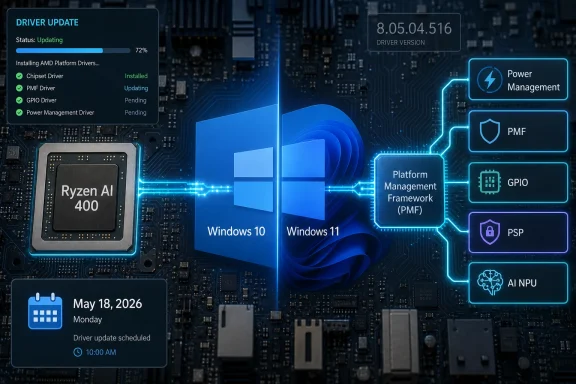
AMD released Ryzen chipset driver 8.05.04.516 on May 18, 2026, for 64-bit Windows 10 and Windows 11 systems, adding support for Ryzen AI 400 platform components while rolling in bug fixes across power, GPIO, PSP, provisioning, PMF, and HSMP drivers. The headline is not a glamorous one, but the timing matters: AMD is preparing Windows PCs for another wave of AI-branded silicon, and the plumbing has to arrive before the machines do. For most desktop users, this is a maintenance update. For OEMs, IT departments, and early adopters tracking Ryzen AI 400 systems, it is a small but telling marker of where the Windows PC stack is headed.
Chipset drivers rarely get the attention that graphics drivers do. A GPU update can unlock a new game profile, fix a crash in a blockbuster title, or change benchmark charts overnight. A chipset package, by contrast, lives in the less glamorous territory of power plans, GPIO controllers, platform security processors, provisioning files, and firmware-facing support components.
That is precisely why this release is worth watching. AMD’s new package is not selling frames per second; it is preparing Windows for platform behavior. The update includes bug fixes for established components and adds a new AMD PMF Ryzen AI 400 Series driver, the clearest sign that Ryzen AI 400 support is moving from announcement slides into the Windows driver ecosystem.
The version number, 8.05.04.516, also tells a story of incremental readiness rather than reinvention. AMD is not asking users to rethink their systems. It is asking them to keep the lower layers current so that newer CPUs, NPUs, and firmware-managed power features can behave correctly under Windows 10 and Windows 11.
That split matters. Windows enthusiasts often treat driver updates as optional unless something is visibly broken. Platform vendors treat them as a condition of support. The distance between those two attitudes is where many modern PC problems live.
The most explicit addition is the AMD PMF Ryzen AI 400 Series Driver, version 26.10.9.0. PMF, or Platform Management Framework, is one of those terms that sounds generic until something goes wrong. It is the layer that helps coordinate power, thermal, and performance behavior between firmware, hardware capabilities, and the operating system.
That makes PMF especially important in AI PC designs. NPUs are not just another block on the die; they are power-sensitive accelerators whose value depends on being available without dragging the whole machine into an inefficient state. If Windows, firmware, and AMD’s platform drivers are not aligned, the user may never see a clean failure. They may simply see worse battery life, erratic performance, missing device capabilities, or inconsistent behavior between power modes.
The new Ryzen AI 400 PMF driver suggests AMD is setting the table for systems that rely on tighter coordination between CPU, GPU, NPU, memory, and power policy. That is not exciting in the way a new GPU control panel is exciting. It is more important than that.
But the strategic center of gravity is plainly Windows 11. Microsoft’s AI PC branding, Copilot+ PC requirements, and NPU-driven features are overwhelmingly tied to the newer operating system. Windows 10 compatibility is maintenance; Windows 11 support is the growth story.
That distinction matters for administrators. A chipset package may install on both operating systems, but the value proposition is not identical. On Windows 10, the update may mean bug fixes, compatibility cleanup, and preparation for hardware that may still expose some device-level functionality. On Windows 11, it is part of a larger vendor stack that includes NPU awareness, modern power policy, firmware coordination, and future-facing feature enablement.
This is where driver release notes can undersell the stakes. “Bug fixes included” is a tiny phrase doing a lot of work. It does not tell you whether the fix affects sleep reliability, device enumeration, power-state transitions, performance scaling, installer behavior, or platform telemetry. In the chipset world, ambiguity is normal — and frustrating.
Those are not consumer-facing brand names, but they affect consumer-facing behavior. Power management support helps determine how the processor enters and exits performance states. GPIO drivers can affect low-level communication with platform devices. PSP support touches AMD’s security co-processor layer. Provisioning files can influence how Windows understands platform-specific power and performance policies.
AMD’s PMF entries are especially crowded in this release. The package lists AMD PMF-8000 Series Driver versions for Windows 10 and Windows 11, AMD PMF Ryzen AM MAX 300 Series Driver 1, AMD PMF Ryzen AI 300 Series Driver, AMD PMF Ryzen AI 300 Series Driver 2, and the new AMD PMF Ryzen AI 400 Series Driver. That is not elegant, but it reflects the reality of AMD’s expanding mobile and desktop APU portfolio.
This is what platform fragmentation looks like when it is being managed responsibly. Different chip families need different support files, and Windows needs to know which behavior belongs to which system. The ugly alternative would be a single vague driver path that fails quietly across edge cases.
The first issue concerns downgrading. After installing AMD Chipset Installer version 7.xx.xx.xx, users cannot install version 6.xx.xx.xx or earlier unless they remove the newer installer and delete the Qt_Dependencies folder under AMD’s Chipset_Software directory. That is not the kind of problem most mainstream users will encounter, but it matters for enthusiasts, repair shops, and IT teams that keep known-good driver packages on hand.
The workaround is straightforward, but the existence of the issue is a reminder that driver installers are software platforms in their own right. Once vendors change installer frameworks, dependencies, or package assumptions, rollback paths can become messier than the version number suggests. This is particularly relevant for administrators who test a new package, find a regression, and expect to return to an older image or driver set without drama.
The second known issue is cosmetic but still telling: on a non-English operating system, some driver names may appear in English. For most users, that is harmless. For organizations with multilingual support desks or strict localization requirements, it is the kind of rough edge that can generate unnecessary tickets.
The third issue is more hardware-specific: a yellow bang may appear on the AMS Mailbox driver for AMD Ryzen Threadripper 9000 Series processors on WRX90 under Windows 10. A yellow bang in Device Manager is never confidence-inspiring, even when the practical impact is limited. On workstation-class systems, where users expect premium hardware to behave cleanly, visible device errors carry reputational weight.
A yellow bang on a WRX90 Threadripper 9000 system under Windows 10 may not break the machine. It may not affect the workloads that justify such a system in the first place. But it signals that the old operating system is no longer the cleanest landing zone for the newest hardware.
That will frustrate some users, and not without reason. Windows 10 has been a remarkably durable platform, and many workstation buyers prefer to change as little as possible once a production environment is certified. Yet every new generation of silicon adds firmware features, security components, and power-management expectations that are harder to backport cleanly into an aging OS model.
AMD is not alone here. Intel, Microsoft, OEMs, and peripheral vendors are all pushing the industry in the same direction. The difference is that chipset release notes make the pressure visible in a way marketing copy does not.
But none of it works without the boring stuff. NPU features depend on drivers. Drivers depend on firmware. Firmware depends on OEM validation. Windows features depend on OS builds, application support, and hardware capability discovery. The result is a stack in which a missing or stale platform driver can make an expensive new feature feel invisible.
That is why a chipset driver adding Ryzen AI 400 PMF support is more than housekeeping. It is part of the precondition for AMD’s AI PC pitch. If the industry wants users to care about NPUs, it first has to make them boringly reliable.
There is also a practical support angle. When AI-related features fail, users often blame the application or Windows. Sometimes that will be correct. But in the AI PC era, platform drivers are going to sit closer to the center of the troubleshooting map. Device Manager, power policy, firmware updates, OEM utility packages, and chipset revisions will all matter more than the marketing term “AI PC” suggests.
That is especially true for users who have just built or upgraded an AM5 system, owners of Ryzen AI 300 or 400-class machines, and anyone seeing odd power-management behavior. Chipset packages can resolve annoyances that are difficult to diagnose directly: sleep issues, inconsistent boosting, missing platform devices, or minor instability around low-power states.
For heavily tuned systems, patience is still warranted. Users running manual overclocks, undervolts, custom power plans, or workstation workloads should avoid combining multiple variables at once. Install the chipset driver separately from BIOS updates, GPU driver swaps, and Windows feature updates so that any regression has a clear suspect.
There is also a difference between AMD’s generic chipset package and OEM-provided support stacks. Laptops and compact OEM systems often include vendor-specific tuning, thermal profiles, and firmware hooks. On those systems, the latest AMD package may not always be the best first stop unless the OEM also points users in that direction.
The Ryzen AI 400 addition raises that importance. If organizations are preparing AI PC pilots, platform drivers need to be part of the baseline image discussion from day one. It is not enough to ask whether a machine has a qualifying NPU. Administrators need to know which chipset package, BIOS version, OEM utility layer, Windows build, and management policy combination actually exposes the features they intend to test.
For mixed fleets, Windows 10 and Windows 11 differences must be tracked explicitly. A driver package that supports both operating systems does not erase OS-level capability gaps. Nor does it guarantee identical device behavior across old and new platforms.
The downgrade issue also matters in enterprise testing. If a new AMD chipset installer changes the rollback path, test rings should account for that before broad deployment. A clean uninstall and dependency-folder removal workaround is manageable for a lab machine. It is less attractive across hundreds or thousands of endpoints.
AMD is not uniquely guilty here. Hardware vendors often provide sparse chipset release notes because low-level fixes can be complicated, platform-specific, or tied to partner validation. But that explanation does not make the result satisfying. A user deciding whether to update a production workstation deserves more than a two-word changelog.
Better release notes would separate fixes by impact category. Power management, installer behavior, device-enumeration cleanup, security-processor changes, and platform support additions should not all disappear into one bucket. Even a high-level description would improve trust.
This matters more as platforms become more complex. In the AI PC era, driver packages are not merely compatibility bundles. They are part of the feature delivery system. Vendors that want users to value platform updates need to explain them with more respect for the people who install and support them.
For desktop enthusiasts, AMD’s direct download is usually the cleanest route. For laptops, mini-PCs, and business desktops, the answer is less universal. OEMs may package AMD components alongside firmware assumptions, thermal profiles, and device-specific services. Installing AMD’s generic driver may work perfectly, but it can also leave OEM-specific tuning untouched.
This is the hidden cost of platform diversity. AMD’s wide compatibility is a strength, but it pushes responsibility outward to motherboard vendors, OEMs, and users. The same chipset package can be a simple maintenance update on one machine and part of a larger validation puzzle on another.
Windows Update adds another layer of ambiguity. It may deliver individual components, older tested versions, or OEM-approved packages rather than the latest AMD bundle. That is not necessarily bad. It is simply a different channel with a different priority: broad reliability over immediacy.
Intel has historically benefited from tight platform branding and deep OEM integration. AMD has gained enormous ground in CPU performance and efficiency over the last several Ryzen generations, but the AI PC transition shifts some of the contest back toward platform completeness. The question is not only whose CPU cores are faster. It is whose device stack behaves predictably under Windows.
The Ryzen AI 400 PMF driver is therefore small evidence in a larger case. AMD is building out the support matrix for processors that are supposed to carry its client AI story through 2026 systems. That includes consumer PCs, commercial notebooks, desktops, and compact machines where power behavior and local acceleration matter.
The risk is that the AI PC story becomes too fragmented for users to follow. Ryzen AI 300, Ryzen AI 400, Ryzen AI Max, PRO variants, desktop APUs, mobile parts, Windows 10 support, Windows 11 feature gating, OEM packages, and Microsoft branding all overlap. Drivers can help make that complexity invisible — but only if they work.
A chipset driver update like 8.05.04.516 sits at the center of that contradiction. It is a single download, but inside it are multiple platform drivers with different roles, version numbers, and hardware targets. Users see one installer. Windows sees a chain of components that may affect power, security, sensor behavior, firmware communication, and device identity.
That is why blindly ignoring chipset drivers is no longer a great policy. It is also why blindly installing them the minute they appear is not always wise. The right habit is disciplined maintenance: track the release, understand the known issues, update through the appropriate channel, and avoid stacking too many system-level changes at once.
For WindowsForum readers, that is familiar territory. The people who build, repair, and administer Windows PCs have long known that the least glamorous driver can be the one that determines whether a system feels solid.
 AMD’s Quietest Driver Release Is Really About the Next PC Cycle
Chipset drivers rarely get the attention that graphics drivers do. A GPU update can unlock a new game profile, fix a crash in a blockbuster title, or change benchmark charts overnight. A chipset package, by contrast, lives in the less glamorous territory of power plans, GPIO controllers, platform security processors, provisioning files, and firmware-facing support components.That is precisely why this release is worth watching. AMD’s new package is not selling frames per second; it is preparing Windows for platform behavior. The update includes bug fixes for established components and adds a new AMD PMF Ryzen AI 400 Series driver, the clearest sign that Ryzen AI 400 support is moving from announcement slides into the Windows driver ecosystem.
The version number, 8.05.04.516, also tells a story of incremental readiness rather than reinvention. AMD is not asking users to rethink their systems. It is asking them to keep the lower layers current so that newer CPUs, NPUs, and firmware-managed power features can behave correctly under Windows 10 and Windows 11.
That split matters. Windows enthusiasts often treat driver updates as optional unless something is visibly broken. Platform vendors treat them as a condition of support. The distance between those two attitudes is where many modern PC problems live.
Ryzen AI 400 Support Moves From Marketing to Motherboards
AMD’s Ryzen AI 400 family has been positioned as part of the company’s broader push into AI PCs, with Zen 5 CPU cores, updated Radeon integrated graphics, and second-generation XDNA NPU technology appearing across new consumer and commercial systems. The chipset driver does not create that hardware support out of thin air, but it gives Windows the specific components it needs to recognize and manage parts of the platform properly.The most explicit addition is the AMD PMF Ryzen AI 400 Series Driver, version 26.10.9.0. PMF, or Platform Management Framework, is one of those terms that sounds generic until something goes wrong. It is the layer that helps coordinate power, thermal, and performance behavior between firmware, hardware capabilities, and the operating system.
That makes PMF especially important in AI PC designs. NPUs are not just another block on the die; they are power-sensitive accelerators whose value depends on being available without dragging the whole machine into an inefficient state. If Windows, firmware, and AMD’s platform drivers are not aligned, the user may never see a clean failure. They may simply see worse battery life, erratic performance, missing device capabilities, or inconsistent behavior between power modes.
The new Ryzen AI 400 PMF driver suggests AMD is setting the table for systems that rely on tighter coordination between CPU, GPU, NPU, memory, and power policy. That is not exciting in the way a new GPU control panel is exciting. It is more important than that.
Windows 10 Support Is Useful, But Windows 11 Is Where the Strategy Lives
AMD is offering the package for both 64-bit Windows 10 and Windows 11, and that is good news for users with older installations or environments that still have a long Windows 10 tail. The supported platform list remains broad, covering many Ryzen desktop, mobile, Threadripper, and older AMD processor families depending on the chipset page and OS path.But the strategic center of gravity is plainly Windows 11. Microsoft’s AI PC branding, Copilot+ PC requirements, and NPU-driven features are overwhelmingly tied to the newer operating system. Windows 10 compatibility is maintenance; Windows 11 support is the growth story.
That distinction matters for administrators. A chipset package may install on both operating systems, but the value proposition is not identical. On Windows 10, the update may mean bug fixes, compatibility cleanup, and preparation for hardware that may still expose some device-level functionality. On Windows 11, it is part of a larger vendor stack that includes NPU awareness, modern power policy, firmware coordination, and future-facing feature enablement.
This is where driver release notes can undersell the stakes. “Bug fixes included” is a tiny phrase doing a lot of work. It does not tell you whether the fix affects sleep reliability, device enumeration, power-state transitions, performance scaling, installer behavior, or platform telemetry. In the chipset world, ambiguity is normal — and frustrating.
The New Driver List Shows the Real Shape of a Modern AMD Platform
The updated package includes multiple components, and the names are a reminder that a modern PC is not managed by one driver so much as a federation of small, specialized pieces. AMD Ryzen Power Plan and AMD Processor Power Management Support moves to 8.0.1.13. AMD GPIO2 Driver reaches 2.2.0.137. AMD PSP Driver is listed at 5.44.0.0. The AMD PPM Provisioning File Driver moves to 8.0.0.62.Those are not consumer-facing brand names, but they affect consumer-facing behavior. Power management support helps determine how the processor enters and exits performance states. GPIO drivers can affect low-level communication with platform devices. PSP support touches AMD’s security co-processor layer. Provisioning files can influence how Windows understands platform-specific power and performance policies.
AMD’s PMF entries are especially crowded in this release. The package lists AMD PMF-8000 Series Driver versions for Windows 10 and Windows 11, AMD PMF Ryzen AM MAX 300 Series Driver 1, AMD PMF Ryzen AI 300 Series Driver, AMD PMF Ryzen AI 300 Series Driver 2, and the new AMD PMF Ryzen AI 400 Series Driver. That is not elegant, but it reflects the reality of AMD’s expanding mobile and desktop APU portfolio.
This is what platform fragmentation looks like when it is being managed responsibly. Different chip families need different support files, and Windows needs to know which behavior belongs to which system. The ugly alternative would be a single vague driver path that fails quietly across edge cases.
The Known Issues Are More Revealing Than the Changelog
AMD’s changelog is brief. The known issues section is more useful.The first issue concerns downgrading. After installing AMD Chipset Installer version 7.xx.xx.xx, users cannot install version 6.xx.xx.xx or earlier unless they remove the newer installer and delete the Qt_Dependencies folder under AMD’s Chipset_Software directory. That is not the kind of problem most mainstream users will encounter, but it matters for enthusiasts, repair shops, and IT teams that keep known-good driver packages on hand.
The workaround is straightforward, but the existence of the issue is a reminder that driver installers are software platforms in their own right. Once vendors change installer frameworks, dependencies, or package assumptions, rollback paths can become messier than the version number suggests. This is particularly relevant for administrators who test a new package, find a regression, and expect to return to an older image or driver set without drama.
The second known issue is cosmetic but still telling: on a non-English operating system, some driver names may appear in English. For most users, that is harmless. For organizations with multilingual support desks or strict localization requirements, it is the kind of rough edge that can generate unnecessary tickets.
The third issue is more hardware-specific: a yellow bang may appear on the AMS Mailbox driver for AMD Ryzen Threadripper 9000 Series processors on WRX90 under Windows 10. A yellow bang in Device Manager is never confidence-inspiring, even when the practical impact is limited. On workstation-class systems, where users expect premium hardware to behave cleanly, visible device errors carry reputational weight.
The Threadripper Warning Is a Windows 10 Reality Check
The Threadripper-related known issue deserves more than a passing glance because it captures a broader industry tension. Windows 10 remains widely deployed, especially in professional environments where stability and application compatibility can matter more than new OS features. But the newest workstation platforms are increasingly being designed, validated, and marketed around Windows 11-era assumptions.A yellow bang on a WRX90 Threadripper 9000 system under Windows 10 may not break the machine. It may not affect the workloads that justify such a system in the first place. But it signals that the old operating system is no longer the cleanest landing zone for the newest hardware.
That will frustrate some users, and not without reason. Windows 10 has been a remarkably durable platform, and many workstation buyers prefer to change as little as possible once a production environment is certified. Yet every new generation of silicon adds firmware features, security components, and power-management expectations that are harder to backport cleanly into an aging OS model.
AMD is not alone here. Intel, Microsoft, OEMs, and peripheral vendors are all pushing the industry in the same direction. The difference is that chipset release notes make the pressure visible in a way marketing copy does not.
AI PC Hardware Depends on Boring Driver Discipline
The PC industry’s AI push has been loud, sometimes clumsy, and often ahead of the software that would make it feel necessary. Users have been promised local AI acceleration, better conferencing effects, faster content creation tools, smarter productivity workflows, and lower-latency inference. Much of that remains uneven.But none of it works without the boring stuff. NPU features depend on drivers. Drivers depend on firmware. Firmware depends on OEM validation. Windows features depend on OS builds, application support, and hardware capability discovery. The result is a stack in which a missing or stale platform driver can make an expensive new feature feel invisible.
That is why a chipset driver adding Ryzen AI 400 PMF support is more than housekeeping. It is part of the precondition for AMD’s AI PC pitch. If the industry wants users to care about NPUs, it first has to make them boringly reliable.
There is also a practical support angle. When AI-related features fail, users often blame the application or Windows. Sometimes that will be correct. But in the AI PC era, platform drivers are going to sit closer to the center of the troubleshooting map. Device Manager, power policy, firmware updates, OEM utility packages, and chipset revisions will all matter more than the marketing term “AI PC” suggests.
Enthusiasts Should Update, But Not Like It Is a GPU Launch Day
For a typical Ryzen desktop user on a stable system, this update should be treated as a routine chipset refresh rather than an emergency. There is no public indication that version 8.05.04.516 is a security crisis release, nor does the changelog claim a sweeping performance improvement. The sensible approach is to download from AMD or the motherboard vendor, create a restore point or backup if the machine is important, and install when convenient.That is especially true for users who have just built or upgraded an AM5 system, owners of Ryzen AI 300 or 400-class machines, and anyone seeing odd power-management behavior. Chipset packages can resolve annoyances that are difficult to diagnose directly: sleep issues, inconsistent boosting, missing platform devices, or minor instability around low-power states.
For heavily tuned systems, patience is still warranted. Users running manual overclocks, undervolts, custom power plans, or workstation workloads should avoid combining multiple variables at once. Install the chipset driver separately from BIOS updates, GPU driver swaps, and Windows feature updates so that any regression has a clear suspect.
There is also a difference between AMD’s generic chipset package and OEM-provided support stacks. Laptops and compact OEM systems often include vendor-specific tuning, thermal profiles, and firmware hooks. On those systems, the latest AMD package may not always be the best first stop unless the OEM also points users in that direction.
IT Departments Need to Treat Chipset Drivers as Fleet Policy
In business environments, chipset updates occupy an awkward category. They are not as visible as monthly Windows cumulative updates, not as obviously urgent as browser patches, and not as user-facing as application upgrades. Yet they can affect reliability at the exact layers that determine whether modern standby works, whether docking behaves, whether power states recover cleanly, and whether security co-processors enumerate correctly.The Ryzen AI 400 addition raises that importance. If organizations are preparing AI PC pilots, platform drivers need to be part of the baseline image discussion from day one. It is not enough to ask whether a machine has a qualifying NPU. Administrators need to know which chipset package, BIOS version, OEM utility layer, Windows build, and management policy combination actually exposes the features they intend to test.
For mixed fleets, Windows 10 and Windows 11 differences must be tracked explicitly. A driver package that supports both operating systems does not erase OS-level capability gaps. Nor does it guarantee identical device behavior across old and new platforms.
The downgrade issue also matters in enterprise testing. If a new AMD chipset installer changes the rollback path, test rings should account for that before broad deployment. A clean uninstall and dependency-folder removal workaround is manageable for a lab machine. It is less attractive across hundreds or thousands of endpoints.
AMD’s Release Notes Still Leave Too Much to the Imagination
The weakest part of this release is not the driver package; it is the communication around it. “Bug fixes included” is technically useful and editorially useless. Users and administrators do not need every internal defect number, but they do need enough detail to understand whether an update addresses a problem they have.AMD is not uniquely guilty here. Hardware vendors often provide sparse chipset release notes because low-level fixes can be complicated, platform-specific, or tied to partner validation. But that explanation does not make the result satisfying. A user deciding whether to update a production workstation deserves more than a two-word changelog.
Better release notes would separate fixes by impact category. Power management, installer behavior, device-enumeration cleanup, security-processor changes, and platform support additions should not all disappear into one bucket. Even a high-level description would improve trust.
This matters more as platforms become more complex. In the AI PC era, driver packages are not merely compatibility bundles. They are part of the feature delivery system. Vendors that want users to value platform updates need to explain them with more respect for the people who install and support them.
The Motherboard Vendor Layer Remains the Messy Middle
AMD provides the chipset package, but many users interact with drivers through motherboard support pages, OEM update utilities, or Windows Update. That creates a familiar problem: the newest AMD release may appear before a board vendor has posted it, while OEM systems may lag behind AMD’s public package for validation reasons.For desktop enthusiasts, AMD’s direct download is usually the cleanest route. For laptops, mini-PCs, and business desktops, the answer is less universal. OEMs may package AMD components alongside firmware assumptions, thermal profiles, and device-specific services. Installing AMD’s generic driver may work perfectly, but it can also leave OEM-specific tuning untouched.
This is the hidden cost of platform diversity. AMD’s wide compatibility is a strength, but it pushes responsibility outward to motherboard vendors, OEMs, and users. The same chipset package can be a simple maintenance update on one machine and part of a larger validation puzzle on another.
Windows Update adds another layer of ambiguity. It may deliver individual components, older tested versions, or OEM-approved packages rather than the latest AMD bundle. That is not necessarily bad. It is simply a different channel with a different priority: broad reliability over immediacy.
Ryzen AI 400 Makes the Driver Stack a Selling Point
AMD’s AI PC ambitions are not just about silicon. They are about whether the company can provide a platform that OEMs and Microsoft can depend on through multiple product cycles. Chipset support is part of that credibility.Intel has historically benefited from tight platform branding and deep OEM integration. AMD has gained enormous ground in CPU performance and efficiency over the last several Ryzen generations, but the AI PC transition shifts some of the contest back toward platform completeness. The question is not only whose CPU cores are faster. It is whose device stack behaves predictably under Windows.
The Ryzen AI 400 PMF driver is therefore small evidence in a larger case. AMD is building out the support matrix for processors that are supposed to carry its client AI story through 2026 systems. That includes consumer PCs, commercial notebooks, desktops, and compact machines where power behavior and local acceleration matter.
The risk is that the AI PC story becomes too fragmented for users to follow. Ryzen AI 300, Ryzen AI 400, Ryzen AI Max, PRO variants, desktop APUs, mobile parts, Windows 10 support, Windows 11 feature gating, OEM packages, and Microsoft branding all overlap. Drivers can help make that complexity invisible — but only if they work.
Windows Users Are Being Asked to Trust the Plumbing Again
The modern Windows PC has become both easier and harder to maintain. Easier, because Windows Update, vendor utilities, and unified installers have reduced the need to hunt down individual INF files. Harder, because the components being managed are more numerous, more interdependent, and less visible.A chipset driver update like 8.05.04.516 sits at the center of that contradiction. It is a single download, but inside it are multiple platform drivers with different roles, version numbers, and hardware targets. Users see one installer. Windows sees a chain of components that may affect power, security, sensor behavior, firmware communication, and device identity.
That is why blindly ignoring chipset drivers is no longer a great policy. It is also why blindly installing them the minute they appear is not always wise. The right habit is disciplined maintenance: track the release, understand the known issues, update through the appropriate channel, and avoid stacking too many system-level changes at once.
For WindowsForum readers, that is familiar territory. The people who build, repair, and administer Windows PCs have long known that the least glamorous driver can be the one that determines whether a system feels solid.
The Practical Read on AMD’s May Chipset Drop
This release is not a dramatic turning point, but it is a useful checkpoint for where AMD’s Windows platform is going. The new package tightens existing support while adding the driver component needed for Ryzen AI 400 systems, and the known issues show where old OS support and installer history still complicate the picture.- AMD Ryzen chipset driver 8.05.04.516 is a Windows 10 and Windows 11 64-bit release dated May 18, 2026.
- The most important new component is AMD PMF Ryzen AI 400 Series Driver 26.10.9.0, which adds support for AMD’s newest AI PC platform family.
- Existing components such as Ryzen power management, GPIO2, PSP, PPM provisioning, HSMP, and several PMF drivers receive bug-fix updates.
- Users who need to roll back from newer AMD chipset installer generations to version 6.xx.xx.xx or earlier may need to uninstall the current package and remove AMD’s Qt_Dependencies folder first.
- Windows 10 remains supported, but the known Threadripper 9000 WRX90 yellow-bang issue is another reminder that new platform behavior is increasingly cleaner on Windows 11.
- Enthusiasts can treat this as a sensible maintenance update, while IT teams should validate it as part of a broader BIOS, Windows build, and OEM-driver baseline.
References
- Primary source: Neowin
Published: Tue, 19 May 2026 17:16:00 GMT
AMD releases new Windows 11/10 chipset drivers with improvements and new processor support - Neowin
AMD has released a new chipset driver for supported motherboards. Version 8.05.01.516 is now available for download on Windows 11 and 10 PCs with bug fixes and new processor support. www.neowin.net
- Related coverage: amd.com
B850 Drivers and Downloads | Latest Version
Get drivers and downloads for the latest version of B850www.amd.com - Related coverage: station-drivers.com
Amd Chipsets Ryzen (3XX/4XX/5XX/6XX/8XX/TRX40) drivers Version 8.05.04.516
Windows 10/11www.station-drivers.com
- Related coverage: wccftech.com
AMD Ryzen AI 400 "Gorgon" CPUs Confirmed In Latest Chipset Software Driver
AMD's upcoming Ryzen AI 400 CPUs, which will be part of the Gorgon Point family, have been confirmed in the latest chipset drivers.wccftech.com
