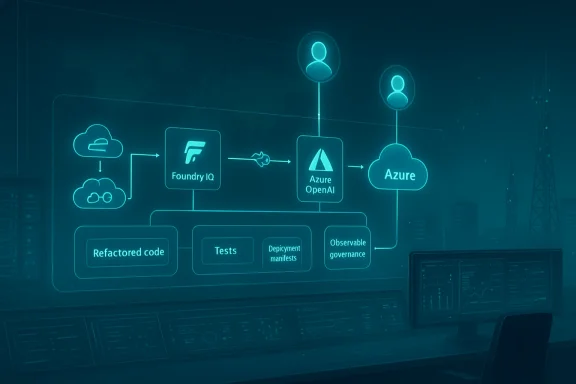
Amdocs’ new partnership with Microsoft, unveiled at Mobile World Congress 2026, formally packages the vendor’s agentic operating system (aOS) and its Agentic Services with Microsoft’s Foundry, Azure OpenAI models, GitHub Copilot and Fabric IQ to deliver an agent-led, AI-accelerated path for large-scale application modernization and cloud migration—promising faster refactoring, repeatable workflows, and measurable business outcomes from “business case to execution.”
Modern enterprise application modernization has entered a phase where automation and generative AI are central to delivery, rather than optional accelerators. Legacy portfolios—monolithic ERP, billing platforms, OSS/BSS stacks, and bespoke middleware—are costly to maintain and slow to change. Vendors and systems integrators are responding by building agentic frameworks: coordinated collections of software agents that automate discovery, code analysis, refactoring, test generation, deployment orchestration, and post‑migration observability. Amdocs’ aOS and Microsoft’s Foundry are self-described examples of that shift.
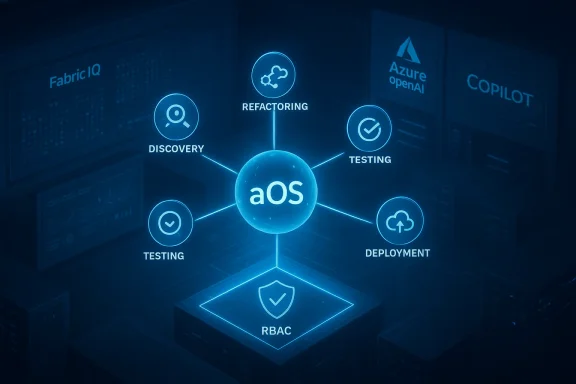
Amdocs positions aOS (the agentic operating system) and Agentic Services as an enterprise-grade orchestration layer that brings telco domain knowledge, prebuilt agent libraries, and end‑to‑end workflows to modernization projects. Microsthe model and runtime fabric—Foundry, Fabric IQ, and Azure OpenAI—plus developer automation through GitHub Copilot. Together the vendors say this combination creates a “Service‑as‑Software” delivery model in which AI agents execute or accelerate work under human supervision.
Why this matters now: operators and large enterprises are under relentless pressure to reduce technical debt, shorten time-to-market, and extract value from AI. The Amdocs‑Microsoft announcement is explicitly timed to address that need with prebuilt, customizable multi‑agent workflows and cloud migration accelerators designed for Azure. Microsoft’s own MWC narrative highlights partners—Nokia, Colt, MTN and others—building production-grade telco AI on top of Fabric and Foundry, which indicates this is intended not a one‑off integration.
However, the technology is not a silver bullet. The real determinant of value will be disciplined execution: selecting the right pilot, validating agent outputs against domain expertise, enforcing governance and security controls, and modeling long‑term costs. Enterprises that treat this as a co‑engineering program with clear human checkpoints, auditability, and financial transparency stand to benefit. Organizations that accept fully automated refactors without rigorous validation risk operational and compliance surprises.
Amdocs’ fiscal scale and Microsoft’s production-grade Foundry lower the commercial and technical risk compared with smaller vendors, but they also raise the stakes: the decisions made during onboarding will shape an enterprise’s modernization paths for years. That makes the procurement, legal, and architecture review phases more important than ever—because agentic modernization is less about a single migration and more about changing how software is operated and evolved on a day‑to‑day basis.
Source: The Globe and Mail MWC 2026: Amdocs Collaborates with Microsoft to Bring AI-Accelerated Application Modernization to Enterprises
 Background
Modern enterprise application modernization has entered a phase where automation and generative AI are central to delivery, rather than optional accelerators. Legacy portfolios—monolithic ERP, billing platforms, OSS/BSS stacks, and bespoke middleware—are costly to maintain and slow to change. Vendors and systems integrators are responding by building agentic frameworks: coordinated collections of software agents that automate discovery, code analysis, refactoring, test generation, deployment orchestration, and post‑migration observability. Amdocs’ aOS and Microsoft’s Foundry are self-described examples of that shift.Amdocs positions aOS (the agentic operating system) and Agentic Services as an enterprise-grade orchestration layer that brings telco domain knowledge, prebuilt agent libraries, and end‑to‑end workflows to modernization projects. Microsthe model and runtime fabric—Foundry, Fabric IQ, and Azure OpenAI—plus developer automation through GitHub Copilot. Together the vendors say this combination creates a “Service‑as‑Software” delivery model in which AI agents execute or accelerate work under human supervision.
Why this matters now: operators and large enterprises are under relentless pressure to reduce technical debt, shorten time-to-market, and extract value from AI. The Amdocs‑Microsoft announcement is explicitly timed to address that need with prebuilt, customizable multi‑agent workflows and cloud migration accelerators designed for Azure. Microsoft’s own MWC narrative highlights partners—Nokia, Colt, MTN and others—building production-grade telco AI on top of Fabric and Foundry, which indicates this is intended not a one‑off integration.
What the collaboration actually delivers
The components, explained
- Amdocs Agentic Services / aOS — Amdocs’ orchestration layer that coordinates specialized agents across discovery, refactoring, quality engineering, and migration. It offers a library of prebuilt workflows tailored to telco and large enterprise workloads, designed to reduce manual steps and increase consistency.
- Microsoft Foundry (Foundry Models & Agent Services) — The enterprise-grade agent runtime and model-management layer that hosts models (including Azure OpenAI variants) and provides the plumbing for multi‑agent orchestration, RBAC, VNet isolation, and monitoring. Microsoft positions Foundry as the runtime that enables connected agents with persistent thread storage and integrated observability.
- Azure OpenAI in Foundry Models — Grounded model instances that agents can call for code analysis, refactoring suggestions, natural language translation of business requirements, and test-case generation. Amdocs lists Azure OpenAI among the model backends used in Foundry‑hosted agents.
- Microsoft Migration Agents & GitHub Copilot — Automation artifacts and developer-centric copilots to accelerate repetitive code transformations, generate migration human engineers in validating agent recommendations. These tools help turn agent outputs into deployable code and CI/CD artifacts.
- Fabric IQ — The unified data layer that indexes business and operational data so agents operate on accurate, contextualized information rather than fragile heuristics. Fabric IQ’s role is to provide provenance and retrieval-driven grounding for agent decisions.
How a modernization engagement would look in practice
- Discovery agent performs automated inventory and dependency mapping of legacy estates.
- Analysis agents evaluate code smell, risky patterns, and candidate services for refactoring or replacement.
- Refactoring agents (with Copilot-assisted code transformations) generate PR-ready code and automated tests.
- Migration agents orchestrate packaging, environment provisioning, and infrastructure-as-code deployments into Azure.
- Quality & Observability agents run automated tests, validate telemetry, and set up post-migration SLO dashboards.
Why the pairing is credible — and why vendors are racing to this model
There are three reasons the Amdocs‑Microsoft combination is likely to attract attention from large enterprises.- Domain expertise plus platform scale. Amdocs brings decades of OSS/BSS delivery experience and telco-specific domain models that are valuable when automating complex telecom processes. Microsoft brings a production-ready agent runtime, model hosting, and an enterprise governance stack at hyperscaler scale. The pairing bridges domain knowledge and cloud‑native infrastructure.
- Prebuilt workflows reduce project uncertainty. Modernization programs often fail or balloon because discovery and refactor stages are unpredictable. Prebuilt agentic workflows—if they truly work across heterogeneous landscapes—convert high‑variance labor into repeatable outputs, which reduces risk and shortens timelines. Amdocs markets exactly that repeatability as the core value of Agentic Services.
- Ecosystem lock-in that enterprises accept for operational simplicity. Large carriers and enterprises already consume managed services and vendor‑provided OSS/BSS; accepting a blended “software + managed execution” delivery model is a logical extension—provided governance, auditability, and data residency needs are met. Microsoft’s MWC narrative explicitly pushes the ecosystem angle, with partners integrating Fabric and Foundry for carrier-grade use cases.
Critical analysis: strengths, real-world value, and immediate caveats
Strengths — where this strategy could genuinely move the needle
- Operational speed with auditability. AI agents that generate code, tests, and deployment artifacts can compress months of manual labor into weeks—if they are accurate and produce auditable outputs. The inclusion of observability and provenance via Foundry and Fabric IQ addresses the “trust” problem that many enterprises cite when evaluating AI outputs.
- Reduced labor friction through Copilot integration. Developers can accept, adjust, or reject refactor suggestions generated by agents; combining automated PRs with human review reduces both error rates and cognitive load. This human-in-the-loop model is a practical compromise between full automation and manual migration.
- Telco‑focused semantics. For communications providers, the value of domain‑aware agents—those that understand OSS/BSS constructs and telco data models—cannot be overstated. Amdocs’ telco proficiency is a structural advantage for migrations where domain nuance is critical.
- Repeatability and scale through libraries of workflows. Once an agentic workflow is tuned for a particular architecture pattern (e.g., billing, order management), it can be reused across similar customers, yielding predictable time and cost improvements. Amdocs positions its library as a core differentiator.
Caveats and material risks — what vendors are not solving automatically
- Data governance, residency, and compliance. Enterprises operating in regulated industries (telecom, finance, healthcare) must ensure that agent decisions, model access, and logs meet jurisdictional rules. While Foundry supports RBAC and private networking, customers must validate that data pipelines and model telemetry meet local compliance requirements. Microsoft’s messaging at MWC underscores governance but concrete compliance mappings are customer responsibilities.
- Model hallucinations and correctness of refactors. Generative models are powerful but not perfect. Automated refactors suggested by LLMs must be validated by domain experts; otherwise, subtle semantic bugs can be introduced into mission‑critical systems. The human-in-the-loop model reduces this risk but does not eliminate it. Independent verification remains essential.
- Vendor and ecosystem lock‑in. The combined offering is tightly integrated with Azure, Foundry, and Amdocs’ agent library. Organizations that want portability to other clouds or on‑prem vectors must scrutinize escape clauses, data exportability, and the portability of agent logic. This matters particularly for telcos with sovereign cloud needs. Microsoft’s ecosystem play is a strength, but it increases switching friction.
- Hidden operational overheads. Agentic deployments introduce new operational constructs—agent lifecycle mane, model versioning, and observability pipelines—that teams must learn to manage. Migrating to an agentic model is not simply a one‑time migration; it’s an operational shift that requires reorganized runbooks and SRE practices.
- Cost unpredictability. Model calls, large-scale refactors, and extended agent runs incur cloud compute and data costs. While the promise is faster delivery, organizations must model the incremental cost of continuous agent-driven operations during and after migration, including model-hosting fees, Copilot licensing, and specialized managed services. The vendors will tout efficiency gains; procurement teams must demand transparent TCO modeling.
- Security exposure. Agents that operate across codebases, production environments, and telemetry streams increase the attack surface. Proper isolation, least-privilege credentials, and careful secrets management are required to prevent an agent’s compromised identity from becoming a lateral-movement vector. Amdocs and Microsoft both highlight enterprise controls, but real-world security depends on configuration discipline.
How to evaluate the Amdocs + Microsoft offering if you’re an enterprise buyer
If your organization is considering this combined agentic modernization approach, here’s a practical checklist to use during procurement and the pilot phase.Minimum technicalaves)
- Confirm the exact model hosting and data residency configuration for Azure OpenAI/Foundry models and who retains access to training or fine‑tuning telemetry.
- Require audit logs and immutable provenance for agent outputs: who triggered an agent, what prompts and model versions were used, and what changes were produced.
- Validate RBAC and secret management for agent identities; insist on principle-of-least-privilege roles for each agent.
Operational and organizational checks
- Start with **a narrow pilor one business domain) and measure both delivery time and post‑migration defect rates.
- Model the total cost of ownership including model‑inference costs, Copilot licenses, Foundry runtime fees, and managed‑service hours.
- Define a roll‑back and remediation plan for automated refactors; ensure manual gates exist before deployment to production.
Governance and compliance steps
- Map regulatory constraints (data locality, retention, audit) to the proposed agent architecture.
- Require contractual language for data handling, telemetry reuse, and IP for generated code/artifacts.
- Insist on periodic independent security assessments and model‑output QA.
Competitive context: this is an industry pattern, not a one-off play
Amdocs’ move is part of a broader vendor trend where systems integrators pair domain expertise with hyperscaler AI fabrics. Kyndryl, DXC and other major integrators have announced similar Microsoft‑centric modernization services that combine generative AI tools with migration accelerators and managed operations—evidence that the market is coalescing around the same opportunity set (legacy modernization + generative AI). The choice for enterprises will often come down to sector-specific knowledge, risk appetite, and the quality of agent libraries.Practical recommendations for CIOs and CTOs
- Prioritize pilots on systems with high operational cost and well‑understood interfaces (e.g., billing modules, order management) where measurable ROI can be captured within 3–6 months.
- Insist on observable metrics for each pilot: unit test coverage increase, post‑migration incident rate, mean time to deploy, and actual consumption costs foruntime.
- Negotiate escrow or portability terms for agent libraries and transformation artifacts so you aren’t trapped if you later choose to run agents on another platform or on-premises.
- Invest in internal SRE and platform engineering—agentic automation creates new operational primitives that must be staffed and governed.
An honest look at outcomes: what success looks like — and what failure looks like
Success indicators
- A measurable reduction in time-to‑migrate for targeted application classes (e.g., a 40–60% reduction in classical lift‑and‑shift timelines for billing/commerce systems).
- Smaller post‑migration defect volumes due to automated test generation and stronger architecture hardening.
- Repeatable workflows that can be templatized across multiple business units or regional subsidiaries.
Failure modes
- Projects that save time up front but introduce subtle semantic bugs that cause cascading operational issues in production.
- Ballooning cloud and inference costs that erode the promised efficiency gains.
- Compliance or data residency violations triggered by insufficient data governance in agent pipelines.
Final assessment: a pragmatic, production-focused step — with responsibilities
Amdocs and Microsoft are offering a pragmatic productization of the agentic-modernization playbook. The partnership is convincing on paper: Amdocs contributes verticalized domain knowledge and runbooks; Microsoft supplies production runtime, governance features, and model hosting at hyperscale. For telcos and large enterprises with complex OSS/BSS estates, the appeal is strong—when the program is scoped, governed, and piloted correctly.However, the technology is not a silver bullet. The real determinant of value will be disciplined execution: selecting the right pilot, validating agent outputs against domain expertise, enforcing governance and security controls, and modeling long‑term costs. Enterprises that treat this as a co‑engineering program with clear human checkpoints, auditability, and financial transparency stand to benefit. Organizations that accept fully automated refactors without rigorous validation risk operational and compliance surprises.
Amdocs’ fiscal scale and Microsoft’s production-grade Foundry lower the commercial and technical risk compared with smaller vendors, but they also raise the stakes: the decisions made during onboarding will shape an enterprise’s modernization paths for years. That makes the procurement, legal, and architecture review phases more important than ever—because agentic modernization is less about a single migration and more about changing how software is operated and evolved on a day‑to‑day basis.
Closing takeaways
- The Amdocs + Microsoft MWC 2026 collaboration formalizes an emerging market approach: pair domain-rich systems integrators with hyperscaler agent runtimes and model fabrics to industrialize application modernization.
- For enterprises, the opportunity is real—but success requires rigorous pilots, governance, and financial transparency. Demand measurable KPIs up front and insist on auditability for every automated change.
- Expect the market to fragment into specialized stacks (telco, finance, healthcare) where domain libraries and compliance posture will determine winners. The Amdocs‑Microsoft play is an early exemplar of that direction, offering a high‑credibility option for telcos and similar operators—but it is not a turnkey replacement for careful engineering and governance.
Source: The Globe and Mail MWC 2026: Amdocs Collaborates with Microsoft to Bring AI-Accelerated Application Modernization to Enterprises