

Amdocs said on May 13, 2026, that it will migrate one of Lumen Technologies’ enterprise billing platforms to Microsoft Azure, extending an existing relationship that has already moved some Lumen systems to Google Cloud as part of the U.S. carrier’s cloud-first strategy. The announcement is easy to file under routine cloud modernization, but billing is not a routine workload in telecom. It is the ledger, the product catalog’s shadow, the revenue engine, and often the place where decades of acquisitions and exceptions go to live forever. Moving it to Azure is less a story about infrastructure than a signal that telecom’s back office is finally being forced to behave like software.
Telecom operators have spent years making their networks more programmable while leaving many commercial systems stuck in an older operational era. Software-defined networking, network-as-a-service portals, private connectivity to hyperscalers, and AI-ready data fabrics all promise speed. Then a customer asks for a complicated enterprise contract, usage-based pricing, or a cross-cloud service bundle, and the billing stack quietly reminds everyone who is really in charge.
That is why this Amdocs-Lumen project matters. Enterprise billing is not just invoice generation. It handles rating, account hierarchies, tax logic, contract commitments, service changes, credits, disputes, and the long tail of bespoke pricing arrangements that define large business customers.
For a company like Lumen, whose enterprise strategy increasingly depends on connecting customers across clouds, data centers, security services, and networking products, billing has to keep pace with the product motion. If the commercial system cannot model, meter, and adjust new services quickly, the front-end innovation becomes theater.
The uncomfortable truth for telecom is that many of its most strategic systems were built for a world where services changed slowly. Cloud-first strategy is partly about infrastructure resilience, but it is also about escaping the drag of platforms that make every product change feel like archaeology.
That matters because telecom operators rarely have the luxury of clean-room architecture. They inherit systems through mergers, support services across geographies, and serve enterprise customers that have their own cloud preferences. A single-cloud narrative may be tidy for marketing, but actual carrier IT is a map of dependencies, regulatory constraints, latency requirements, vendor histories, and commercial commitments.
Azure is a logical landing zone for this kind of enterprise workload because Microsoft has spent years courting regulated and infrastructure-heavy industries. But Lumen’s posture looks less like “move everything to Microsoft” and more like “place systems where they fit the operating model.” That is the more realistic version of cloud-first: not cloud as religion, but cloud as an execution layer.
For WindowsForum readers, the Microsoft angle is still worth watching closely. Azure is no longer just where companies run web apps and analytics jobs. It is increasingly where old-line enterprise transaction systems are being rehosted, refactored, wrapped in automation, and connected to AI tooling.
Billing migration is full of the kind of work AI vendors love to describe: dependency analysis, code and configuration review, test generation, data mapping, anomaly detection, process documentation, and cutover planning. These are not magical tasks, but they are labor-intensive, repetitive, and prone to human fatigue. If AI can reduce some of that toil while keeping humans in control of decisions, it could make a real dent.
The danger is that “agentic” becomes a way to hide complexity rather than manage it. A telecom billing platform cannot be migrated on vibes. Revenue-impacting logic needs verification, audit trails, rollback paths, parallel runs, reconciliation, security review, and governance that is boring by design.
Amdocs has a credible reason to pitch itself here because it lives in the OSS/BSS world rather than approaching telecom as a generic cloud integrator. The company’s advantage is not simply that it can move workloads. It is that it understands the business logic operators are terrified of breaking.
The newer pitch is resilience, agility, and scalability. That is the language Lumen and Amdocs are using here, and it is more honest. The point of moving a billing platform to Azure is not necessarily that every compute cycle becomes cheaper on day one. It is that the platform can become easier to scale, protect, monitor, patch, integrate, and evolve.
For a mission-critical billing environment, resilience has a concrete meaning. It means reducing exposure to aging infrastructure, improving disaster recovery options, standardizing operational tooling, and making capacity less dependent on procurement timelines. It also means accepting a new class of risks: cloud configuration mistakes, identity sprawl, network dependency, cost governance failures, and vendor-specific operational patterns.
That is the tradeoff enterprise IT now lives with. Cloud does not remove complexity. It relocates it, exposes it through APIs, and gives organizations better tools to manage it if they are disciplined enough to use them.
If an operator wants to sell dynamic connectivity, usage-sensitive services, or AI-adjacent infrastructure bundles, its commercial systems need to become more flexible. Static catalogs and heavily customized billing workflows are a poor fit for a market that expects faster provisioning and consumption-based pricing. The product may be modern at the edge, but the bill still has to be explainable at the end of the month.
This is where Amdocs’ strategy becomes interesting. The company is not just trying to defend its traditional OSS/BSS territory. It is trying to reposition that territory as the control plane for AI-era telecom operations. In that framing, billing, care, orchestration, and assurance are not legacy baggage; they are the workflow substrate on which intelligent agents act.
That is a bold claim, and it deserves skepticism. But it is also plausible that the companies with the deepest knowledge of messy telecom processes may have an advantage over generic AI platforms. An agent that does not understand account hierarchies, service orders, credit rules, or regulatory boundaries is not an enterprise agent. It is a demo.
Identity becomes the first battleground. A migrated enterprise platform needs privileged access management, service principals or managed identities, secrets handling, conditional access, logging, and clear separation between human administration and automated processes. If AI-enabled migration tooling is involved, administrators need to know what it can read, what it can change, and how its actions are approved.
Observability becomes the second. Billing systems demand more than uptime dashboards. They need business-level telemetry: rating accuracy, batch completion, invoice generation status, exception queues, reconciliation results, and data latency. A cloud platform can make this telemetry richer, but only if teams design for it rather than lifting old monitoring assumptions into a new environment.
Cost management is the third. Enterprise billing systems can involve batch workloads, databases, storage-heavy archives, integration queues, and non-production environments that quietly multiply. Azure offers many ways to optimize, but it also offers many ways to burn money with impressive speed.
Security is the thread through all of it. A billing platform contains sensitive customer, contract, and financial data. Moving it to cloud does not inherently make it less secure, but it does demand a different security muscle: policy-as-code, continuous posture management, key management, network segmentation, data classification, and incident response that assumes cloud-native failure modes.
If the Azure migration results in the same release cadence, the same manual approval chains, the same opaque dependencies, and the same fear around change windows, then the project will be a modernization in hosting more than operating model. That may still be valuable, especially if it improves resilience. But it would not fully justify the strategic language around agility.
The bigger payoff comes if the migrated platform becomes easier to test, integrate, scale, and evolve. That means automated regression testing for billing logic, safer deployment pipelines, stronger environment parity, faster data reconciliation, and clearer ownership between Amdocs, Lumen, and Microsoft-facing operations teams.
This is where AI-assisted migration could either prove itself or fade into the press-release fog. The value is not just in accelerating the move. It is in leaving behind better documentation, better test coverage, cleaner dependency maps, and operational knowledge that survives beyond the migration team.
Telecom has a long history of transformation programs that replace one form of complexity with another. The winners will be the operators that treat cloud migration as a chance to simplify how they run the business, not merely where they run the servers.
Billing platforms, ERP systems, mainframe-adjacent applications, identity infrastructure, and industry-specific transaction engines do not become irrelevant because cloud-native architects dislike them. They become modernization targets because they are too important to remain frozen. Azure’s opportunity is to be the place where those systems can be stabilized first and transformed over time.
For Microsoft, telecom is a particularly valuable arena. Operators are both customers and channels. They buy cloud services, partner on edge and private networking, connect enterprise customers to Azure, and increasingly participate in AI infrastructure conversations. A Lumen billing migration is not a flashy consumer AI story, but it fits Microsoft’s enterprise flywheel.
There is also a Windows ecosystem implication. Many enterprise operations teams still live across Windows Server, Active Directory or Entra ID, SQL Server estates, PowerShell automation, Azure DevOps, GitHub, and Microsoft security tooling. When a core telecom workload moves to Azure, it often pulls those operational patterns deeper into the cloud.
That does not guarantee Microsoft wins every layer. Lumen’s multicloud direction makes clear that Google Cloud and AWS remain part of the picture. But Azure’s role in hosting a mission-critical billing platform gives Microsoft a seat close to the revenue engine, and that is a more durable position than hosting a peripheral workload.
The industry’s old separation between network transformation and IT transformation is breaking down. Enterprise customers do not experience a carrier as a network diagram. They experience quoting, provisioning, service changes, support tickets, usage visibility, and billing accuracy. A faultless network paired with confusing invoices still damages trust.
That makes enterprise billing strategically awkward. It is not a product customers admire when it works. It is a product they notice when it fails. Yet it is also where the operator’s commercial imagination is either enabled or blocked.
Lumen’s move suggests a recognition that cloud-first strategy cannot stop at customer-facing portals or analytics platforms. The revenue machinery has to come along. Otherwise, the company risks building modern services on top of administrative foundations that slow them down.
There is also the question of outage tolerance. Billing platforms may not always need the same real-time availability profile as customer-facing network services, but they have strict business deadlines and downstream dependencies. Month-end processing, invoice runs, usage ingestion, and revenue recognition can create pressure points that ordinary cloud scaling does not automatically solve.
Data gravity will matter. Enterprise billing data connects to CRM systems, order management, tax services, payment systems, reporting platforms, customer portals, and compliance archives. Moving the core platform to Azure may simplify some integrations while complicating others, especially in a multicloud estate.
The governance model is the invisible architecture. Amdocs may manage the migration, Microsoft provides the cloud platform, and Lumen owns the business outcome. That three-party model can work well, but only when responsibilities are explicit. In cloud operations, “shared responsibility” is useful as a principle and dangerous as a shrug.
This is not unique to telecom. Banks, insurers, healthcare systems, manufacturers, and government agencies are all trying to modernize revenue-critical platforms without breaking the businesses that depend on them. The pattern is familiar: cloud first, AI-assisted, vendor-led, risk-managed, and surrounded by language that makes hard engineering sound smoother than it is.
The difference in telecom is that the commercial systems are now colliding with network reinvention. Operators want to sell programmable services into an AI-hungry enterprise market. That ambition requires more than bandwidth. It requires back-office systems that can support faster packaging, metering, settlement, and support.
The Amdocs-Lumen project is therefore a useful marker. It shows that modernization has moved from the edges of carrier IT into the financial core. Once billing is in scope, very little is sacred.
Source: Telecompaper Amdocs migrates Lumen enterprise billing to Azure
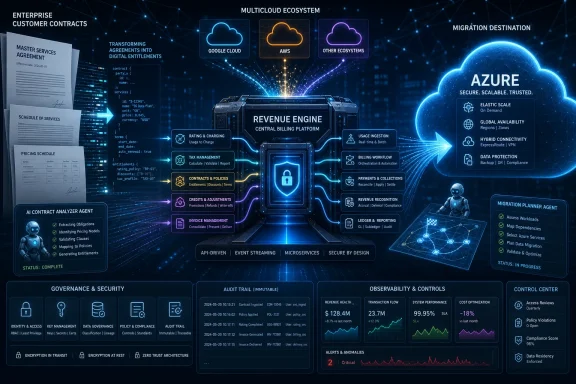 Billing Is the System Nobody Wants to Touch Until It Becomes the Bottleneck
Telecom operators have spent years making their networks more programmable while leaving many commercial systems stuck in an older operational era. Software-defined networking, network-as-a-service portals, private connectivity to hyperscalers, and AI-ready data fabrics all promise speed. Then a customer asks for a complicated enterprise contract, usage-based pricing, or a cross-cloud service bundle, and the billing stack quietly reminds everyone who is really in charge.That is why this Amdocs-Lumen project matters. Enterprise billing is not just invoice generation. It handles rating, account hierarchies, tax logic, contract commitments, service changes, credits, disputes, and the long tail of bespoke pricing arrangements that define large business customers.
For a company like Lumen, whose enterprise strategy increasingly depends on connecting customers across clouds, data centers, security services, and networking products, billing has to keep pace with the product motion. If the commercial system cannot model, meter, and adjust new services quickly, the front-end innovation becomes theater.
The uncomfortable truth for telecom is that many of its most strategic systems were built for a world where services changed slowly. Cloud-first strategy is partly about infrastructure resilience, but it is also about escaping the drag of platforms that make every product change feel like archaeology.
Azure Gets the Workload, but Multicloud Gets the Strategy
The immediate destination is Microsoft Azure, but the broader story is multicloud. Amdocs and Lumen are framing this as a continuation of an existing collaboration, including work that has already placed some Lumen systems on Google Cloud. Reporting around the announcement also points to Lumen’s use of Azure, Google Cloud, and Amazon Web Services as part of a wider transformation rather than a single-vendor bet.That matters because telecom operators rarely have the luxury of clean-room architecture. They inherit systems through mergers, support services across geographies, and serve enterprise customers that have their own cloud preferences. A single-cloud narrative may be tidy for marketing, but actual carrier IT is a map of dependencies, regulatory constraints, latency requirements, vendor histories, and commercial commitments.
Azure is a logical landing zone for this kind of enterprise workload because Microsoft has spent years courting regulated and infrastructure-heavy industries. But Lumen’s posture looks less like “move everything to Microsoft” and more like “place systems where they fit the operating model.” That is the more realistic version of cloud-first: not cloud as religion, but cloud as an execution layer.
For WindowsForum readers, the Microsoft angle is still worth watching closely. Azure is no longer just where companies run web apps and analytics jobs. It is increasingly where old-line enterprise transaction systems are being rehosted, refactored, wrapped in automation, and connected to AI tooling.
Amdocs Is Selling Migration as an AI Problem Now
Amdocs says it will apply agentic, AI-enabled migration capabilities through its Amdocs Operating System framework. That language lands squarely in 2026’s enterprise software dialect, where every automation suite now wants to be an agentic platform. The useful question is not whether the phrase is fashionable. It is whether AI changes the economics and risk profile of a migration that would otherwise be slow, brittle, and expensive.Billing migration is full of the kind of work AI vendors love to describe: dependency analysis, code and configuration review, test generation, data mapping, anomaly detection, process documentation, and cutover planning. These are not magical tasks, but they are labor-intensive, repetitive, and prone to human fatigue. If AI can reduce some of that toil while keeping humans in control of decisions, it could make a real dent.
The danger is that “agentic” becomes a way to hide complexity rather than manage it. A telecom billing platform cannot be migrated on vibes. Revenue-impacting logic needs verification, audit trails, rollback paths, parallel runs, reconciliation, security review, and governance that is boring by design.
Amdocs has a credible reason to pitch itself here because it lives in the OSS/BSS world rather than approaching telecom as a generic cloud integrator. The company’s advantage is not simply that it can move workloads. It is that it understands the business logic operators are terrified of breaking.
The Cloud Migration Pitch Has Matured From Savings to Survivability
A decade ago, many enterprise cloud stories were sold with a savings narrative. Shut down data centers, stop buying hardware, and let someone else handle the undifferentiated heavy lifting. That argument never disappeared, but it has become less persuasive for complex legacy workloads where cloud bills can surprise the unprepared.The newer pitch is resilience, agility, and scalability. That is the language Lumen and Amdocs are using here, and it is more honest. The point of moving a billing platform to Azure is not necessarily that every compute cycle becomes cheaper on day one. It is that the platform can become easier to scale, protect, monitor, patch, integrate, and evolve.
For a mission-critical billing environment, resilience has a concrete meaning. It means reducing exposure to aging infrastructure, improving disaster recovery options, standardizing operational tooling, and making capacity less dependent on procurement timelines. It also means accepting a new class of risks: cloud configuration mistakes, identity sprawl, network dependency, cost governance failures, and vendor-specific operational patterns.
That is the tradeoff enterprise IT now lives with. Cloud does not remove complexity. It relocates it, exposes it through APIs, and gives organizations better tools to manage it if they are disciplined enough to use them.
Telecom’s Back Office Is Being Dragged Into the AI Era
The AI framing around this project is not incidental. Telecom operators are under pressure to support AI-driven enterprise demand while also using AI internally to reduce operating costs. Lumen has been positioning itself around AI-era connectivity, multicloud networking, and services that help enterprises move data where compute is available. But the back office has to support that story.If an operator wants to sell dynamic connectivity, usage-sensitive services, or AI-adjacent infrastructure bundles, its commercial systems need to become more flexible. Static catalogs and heavily customized billing workflows are a poor fit for a market that expects faster provisioning and consumption-based pricing. The product may be modern at the edge, but the bill still has to be explainable at the end of the month.
This is where Amdocs’ strategy becomes interesting. The company is not just trying to defend its traditional OSS/BSS territory. It is trying to reposition that territory as the control plane for AI-era telecom operations. In that framing, billing, care, orchestration, and assurance are not legacy baggage; they are the workflow substrate on which intelligent agents act.
That is a bold claim, and it deserves skepticism. But it is also plausible that the companies with the deepest knowledge of messy telecom processes may have an advantage over generic AI platforms. An agent that does not understand account hierarchies, service orders, credit rules, or regulatory boundaries is not an enterprise agent. It is a demo.
Windows and Azure Admins Should Read This as a Governance Story
For sysadmins and IT pros, the headline may look distant: a telecom operator, a billing vendor, and a hyperscale cloud migration. The practical lesson is much closer to home. The hard part of cloud modernization is rarely the phrase “move to Azure.” The hard part is deciding who owns the controls after the move.Identity becomes the first battleground. A migrated enterprise platform needs privileged access management, service principals or managed identities, secrets handling, conditional access, logging, and clear separation between human administration and automated processes. If AI-enabled migration tooling is involved, administrators need to know what it can read, what it can change, and how its actions are approved.
Observability becomes the second. Billing systems demand more than uptime dashboards. They need business-level telemetry: rating accuracy, batch completion, invoice generation status, exception queues, reconciliation results, and data latency. A cloud platform can make this telemetry richer, but only if teams design for it rather than lifting old monitoring assumptions into a new environment.
Cost management is the third. Enterprise billing systems can involve batch workloads, databases, storage-heavy archives, integration queues, and non-production environments that quietly multiply. Azure offers many ways to optimize, but it also offers many ways to burn money with impressive speed.
Security is the thread through all of it. A billing platform contains sensitive customer, contract, and financial data. Moving it to cloud does not inherently make it less secure, but it does demand a different security muscle: policy-as-code, continuous posture management, key management, network segmentation, data classification, and incident response that assumes cloud-native failure modes.
The Real Test Comes After the Cutover
Cloud migration announcements tend to treat the move itself as the achievement. For workloads like this, the cutover is only the midpoint. The real test is whether Lumen can use the new environment to change how quickly it improves the platform afterward.If the Azure migration results in the same release cadence, the same manual approval chains, the same opaque dependencies, and the same fear around change windows, then the project will be a modernization in hosting more than operating model. That may still be valuable, especially if it improves resilience. But it would not fully justify the strategic language around agility.
The bigger payoff comes if the migrated platform becomes easier to test, integrate, scale, and evolve. That means automated regression testing for billing logic, safer deployment pipelines, stronger environment parity, faster data reconciliation, and clearer ownership between Amdocs, Lumen, and Microsoft-facing operations teams.
This is where AI-assisted migration could either prove itself or fade into the press-release fog. The value is not just in accelerating the move. It is in leaving behind better documentation, better test coverage, cleaner dependency maps, and operational knowledge that survives beyond the migration team.
Telecom has a long history of transformation programs that replace one form of complexity with another. The winners will be the operators that treat cloud migration as a chance to simplify how they run the business, not merely where they run the servers.
Microsoft’s Quiet Win Is Becoming the Place Legacy Systems Go to Become Strategic Again
Microsoft has spent years making Azure feel familiar to enterprises that cannot simply abandon existing systems. That is a different posture from the early cloud-native mythology, which often implied that older workloads were embarrassing things to be rewritten or left behind. In the real world, the old systems are often where the money is.Billing platforms, ERP systems, mainframe-adjacent applications, identity infrastructure, and industry-specific transaction engines do not become irrelevant because cloud-native architects dislike them. They become modernization targets because they are too important to remain frozen. Azure’s opportunity is to be the place where those systems can be stabilized first and transformed over time.
For Microsoft, telecom is a particularly valuable arena. Operators are both customers and channels. They buy cloud services, partner on edge and private networking, connect enterprise customers to Azure, and increasingly participate in AI infrastructure conversations. A Lumen billing migration is not a flashy consumer AI story, but it fits Microsoft’s enterprise flywheel.
There is also a Windows ecosystem implication. Many enterprise operations teams still live across Windows Server, Active Directory or Entra ID, SQL Server estates, PowerShell automation, Azure DevOps, GitHub, and Microsoft security tooling. When a core telecom workload moves to Azure, it often pulls those operational patterns deeper into the cloud.
That does not guarantee Microsoft wins every layer. Lumen’s multicloud direction makes clear that Google Cloud and AWS remain part of the picture. But Azure’s role in hosting a mission-critical billing platform gives Microsoft a seat close to the revenue engine, and that is a more durable position than hosting a peripheral workload.
The Carrier Cloud Era Is Less Glamorous Than the Network Cloud Hype
Telecom cloud stories often focus on network functions, edge computing, 5G cores, and low-latency services. Those are important, but the less glamorous back-office migrations may have equal or greater impact on how operators actually compete. A programmable network is constrained if the systems around ordering, billing, support, and assurance remain slow.The industry’s old separation between network transformation and IT transformation is breaking down. Enterprise customers do not experience a carrier as a network diagram. They experience quoting, provisioning, service changes, support tickets, usage visibility, and billing accuracy. A faultless network paired with confusing invoices still damages trust.
That makes enterprise billing strategically awkward. It is not a product customers admire when it works. It is a product they notice when it fails. Yet it is also where the operator’s commercial imagination is either enabled or blocked.
Lumen’s move suggests a recognition that cloud-first strategy cannot stop at customer-facing portals or analytics platforms. The revenue machinery has to come along. Otherwise, the company risks building modern services on top of administrative foundations that slow them down.
The Fine Print Is Where Administrators Should Be Paying Attention
Amdocs and Lumen are emphasizing resilience, agility, scalability, and operational efficiency. Those are reasonable goals, but administrators should translate them into implementation questions. Which parts of the platform are being rehosted, refactored, or replaced? What data moves, and what data stays? Which integrations are synchronous, and which are redesigned around events or queues?There is also the question of outage tolerance. Billing platforms may not always need the same real-time availability profile as customer-facing network services, but they have strict business deadlines and downstream dependencies. Month-end processing, invoice runs, usage ingestion, and revenue recognition can create pressure points that ordinary cloud scaling does not automatically solve.
Data gravity will matter. Enterprise billing data connects to CRM systems, order management, tax services, payment systems, reporting platforms, customer portals, and compliance archives. Moving the core platform to Azure may simplify some integrations while complicating others, especially in a multicloud estate.
The governance model is the invisible architecture. Amdocs may manage the migration, Microsoft provides the cloud platform, and Lumen owns the business outcome. That three-party model can work well, but only when responsibilities are explicit. In cloud operations, “shared responsibility” is useful as a principle and dangerous as a shrug.
A Small Announcement Points to a Larger Enterprise Reckoning
The most concrete reading of the news is straightforward: Amdocs is migrating a Lumen enterprise billing platform to Microsoft Azure. But the larger reading is that the last generation of telecom systems is being pulled into a new operating environment before it collapses under the weight of new product expectations.This is not unique to telecom. Banks, insurers, healthcare systems, manufacturers, and government agencies are all trying to modernize revenue-critical platforms without breaking the businesses that depend on them. The pattern is familiar: cloud first, AI-assisted, vendor-led, risk-managed, and surrounded by language that makes hard engineering sound smoother than it is.
The difference in telecom is that the commercial systems are now colliding with network reinvention. Operators want to sell programmable services into an AI-hungry enterprise market. That ambition requires more than bandwidth. It requires back-office systems that can support faster packaging, metering, settlement, and support.
The Amdocs-Lumen project is therefore a useful marker. It shows that modernization has moved from the edges of carrier IT into the financial core. Once billing is in scope, very little is sacred.
The Useful Signal Beneath the Cloud-First Slogan
The immediate facts are narrow, but the implications are practical for anyone running complex enterprise systems.- Amdocs is moving one of Lumen’s enterprise billing platforms to Microsoft Azure as part of Lumen’s cloud-first strategy.
- The project extends an existing Amdocs-Lumen relationship that has also involved moving some Lumen systems to Google Cloud.
- The migration is tied to resilience, scalability, operational agility, and efficiency rather than a simple promise of lower infrastructure cost.
- Amdocs is positioning its agentic, AI-enabled migration capabilities as a way to reduce the risk and effort of moving telecom business systems.
- The strategic test will be whether Lumen gains a more adaptable billing operating model after migration, not merely a new hosting location.
- For Azure administrators, the story underscores the importance of identity, observability, cost control, data governance, and clear shared-responsibility boundaries.
Source: Telecompaper Amdocs migrates Lumen enterprise billing to Azure
