

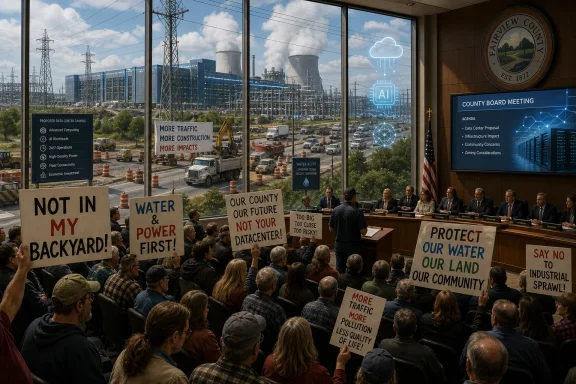
Microsoft’s AI-era data center expansion is colliding with local resistance across the United States in May 2026, as a new Gallup survey finds roughly seven in ten Americans oppose building AI data centers near where they live. The fight is no longer a niche zoning dispute or a handful of environmental lawsuits. It is becoming the political bottleneck for the next phase of cloud computing, and the industry’s favorite answer — more scale, faster — is precisely what makes communities suspicious.
For WindowsForum readers, this is not some distant real estate story. The same infrastructure race that trains foundation models, runs Copilot, powers Azure, and underwrites the next decade of Windows-integrated AI has to land somewhere. Increasingly, “somewhere” means a county board meeting packed with residents who do not want to become the physical backend of the AI economy.
For most of the cloud era, data centers were treated as abstract infrastructure. Consumers saw apps, subscriptions, and storage tiers; developers saw APIs and regions; enterprise admins saw availability zones and service-level agreements. The physical machine rooms that made all of it possible were mostly hidden behind a comforting vocabulary of clouds, fabrics, and platforms.
AI has broken that illusion. Training and serving large models demands enormous concentrations of power, cooling, land, fiber, substations, and backup systems. The result is that cloud infrastructure has become legible to the public not as a miracle of abstraction, but as a very large building complex with a very large utility appetite.
Gallup’s new polling captures the political consequence of that shift. Americans are not merely skeptical about AI data centers; many are strongly opposed to having them built nearby. That opposition is notable because data centers do not carry the obvious visual stigma of smokestacks or refineries. They are often marketed as clean, quiet, high-tech campuses.
But the public appears to be judging them less by architectural renderings and more by inputs and tradeoffs. If a facility needs massive power, water, land, transmission upgrades, tax incentives, and years of construction, residents are asking why the benefits accrue globally while the burdens localize at the end of their road.
This is the central tension the industry has not solved. AI is sold as a national priority, an economic revolution, and a productivity engine. Data centers are approved or rejected by local governments, local courts, and local voters who do not necessarily see themselves as participants in a national industrial strategy.
That intensity matters. In local politics, motivated opposition often beats diffuse support. A hyperscale data center may be defensible in a macroeconomic presentation, but county supervisors and planning commissions respond to rooms full of angry residents, legal challenges, and referendum threats.
The reasons for opposition are also revealing. Among those against nearby AI data centers, resource use dominates the concern set. Water and energy are not abstract climate anxieties in fast-growing communities; they are household bills, aquifers, transmission lines, brownouts, substations, and the daily sense that ordinary residents are being asked to subsidize extraordinary corporate demand.
Quality of life concerns follow behind. Noise, traffic, construction disruption, visual impact, and the industrialization of rural or semi-rural land are not always captured in a developer’s economic impact statement. Nor is the psychological shift that happens when residents realize a community once valued for open land or historic character is being reclassified as ideal infrastructure terrain.
Supporters, by contrast, point to jobs, tax revenue, and development. That argument is not frivolous. Many localities want a broader tax base and high-value commercial development, especially when data centers promise revenue without the school enrollment growth associated with residential construction. But the political problem is that the jobs case is often strongest during construction and weakest once the campus is running.
A warehouse full of GPUs may be economically powerful, but it is not a factory floor in the old industrial sense. Communities hear billions of dollars in investment and ask how many permanent jobs will actually exist, who will get them, and whether the tax structure has been negotiated away before the first server rack arrives.
That scale transformed the debate. Supporters saw taxable infrastructure and a place in the global cloud economy. Opponents saw industrial sprawl near a nationally significant battlefield, the loss of rural character, environmental risk, and a county government moving too quickly on a decision with generational consequences.
The county board voted 4-3 in December 2023 to rezone the land, which might once have been enough to move the project from controversy to implementation. Instead, lawsuits followed. The Virginia Court of Appeals later sided with opponents, finding that the approval process had been accelerated in a way that deprived the public of a fair opportunity to weigh in.
That ruling is important beyond Prince William County. It suggests that the friction around data centers is not only about whether a project is good or bad, but whether residents believe the process itself is legitimate. In land-use fights, perceived procedural unfairness can be as combustible as the project details.
Compass Datacenters and the county chose not to appeal, while QTS has reportedly asked Virginia’s Supreme Court to review the case. However that litigation ends, the message to developers is already clear: a rezoning vote is not the finish line if the public believes the decision was rushed, opaque, or preordained.
That is a strange burden to place on county governments. A planning commission may be asked to evaluate stormwater runoff, but the underlying project might be tied to cloud capacity for AI assistants, defense workloads, enterprise automation, or model training at national scale. The mismatch between local authority and global consequence is widening.
Developers often arrive with the language of modernization. They talk about high-tech investment, resilient infrastructure, tax revenue, and America’s need to compete in AI. Residents reply with the language of place: roads, wells, schools, farms, noise, night skies, property values, and whether the county still resembles what they chose to live in.
Neither side is fully wrong. The United States does need more computing infrastructure if AI demand continues along its current trajectory. But communities are also right to notice when “the cloud” arrives as a land-intensive, power-hungry neighbor whose benefits are distributed far beyond the locality hosting it.
This is why the politics are bipartisan. Conservative rural residents, progressive environmental groups, historic preservationists, fiscal skeptics, and suburban homeowners may disagree on almost everything else, but they can converge around opposition to a project they view as imposed, oversized, or insufficiently accountable.
A 9-gigawatt figure is not a normal local planning detail. It is power-system-scale language. It invites comparisons to statewide electricity consumption, large generating fleets, and the kind of infrastructure typically associated with heavy industry or national grids rather than a “data center campus.”
Supporters argue that the project would generate its own power, use private land, create investment, and place Utah at the center of the AI economy. Opponents see a massive industrial footprint, questions about water rights, air quality, noise, and a development process that appears to be adapting public rules around private infrastructure needs.
The Utah fight also illustrates how the data center debate is expanding beyond individual buildings. The modern AI campus is not just a server farm. It can include dedicated power generation, transmission infrastructure, pipeline connections, water systems, road upgrades, and negotiated tax treatment. At that point, residents are not evaluating a building; they are evaluating a new industrial district.
That shift changes the legitimacy test. The larger the project, the harder it is to persuade residents that ordinary permitting procedures are adequate. When a development’s power requirements are compared with statewide electricity use, local opposition no longer sounds parochial. It sounds like a rational demand for a bigger public conversation.
Microsoft, Google, Amazon, Meta, Oracle, and other major infrastructure players are spending heavily because AI capacity has become a strategic asset. The company with the GPUs, power contracts, and data center capacity can train models, host inference workloads, serve enterprise customers, and lock in developers. Capacity is no longer back-office plumbing; it is competitive advantage.
But that logic runs into a democratic reality. The people who live near proposed sites do not necessarily care which model family is being trained, which cloud region is oversubscribed, or which enterprise AI feature depends on the next tranche of capacity. They care whether the project raises their utility bills, changes their landscape, strains their water system, or makes their local government seem captured by outside capital.
This is where Big Tech’s reputation becomes a liability. The industry spent years telling the public that digital services were frictionless, efficient, and environmentally optimized. Now it is asking communities to accept visible, resource-intensive facilities in exchange for promises that often feel indirect.
The old bargain — cheap cloud services in exchange for invisible infrastructure — is ending. The new bargain has to be negotiated in public, and the public is not especially inclined to trust glossy claims from companies that have also normalized layoffs, surveillance advertising, subscription creep, and opaque AI training practices.
A very efficient facility can still use a very large amount of power. A water-conscious design can still raise local questions in a drought-prone region or a county worried about long-term growth. A renewable power purchase agreement may satisfy corporate accounting, but residents still ask what happens to the local grid, the interconnection queue, and the cost of new generation and transmission.
AI makes this harder because demand is less predictable than traditional enterprise cloud growth. The last decade’s data center planning could often be modeled around steady migration to cloud services. The AI boom adds bursts of training demand, inference workloads whose future scale is uncertain, and corporate incentives to overbuild before competitors do.
That uncertainty lands badly in communities. Residents are being asked to accept concrete infrastructure for a technology whose business model, energy trajectory, and social value remain contested. A county may be told that the project is essential to the future, but the future keeps changing its name: machine learning, generative AI, agentic computing, sovereign AI, enterprise copilots.
For administrators and enterprise buyers, this matters because cloud services do not float above these constraints. If local resistance slows new regions, raises development costs, or forces infrastructure into less optimal locations, capacity pricing and availability can change. The politics of one county can eventually show up as the economics of one tenant’s Azure bill.
But the jobs argument is more complicated. Construction work can be substantial, but temporary. Permanent operations jobs exist, but a hyperscale data center does not employ people at a level commensurate with its capital cost. The ratio of investment dollars to long-term local employment can look odd to residents accustomed to judging projects by payroll.
Tax incentives further complicate the pitch. If a company arrives promising transformative revenue while also negotiating abatements, rebates, preferential rates, or special districts, residents naturally ask who is transforming whom. The community sees the infrastructure burden up front, while the benefits arrive through negotiated formulas few voters understand.
There is also an equity problem. The workers who build and operate these facilities may not be the residents most affected by them. Specialized roles can go to regional contractors or imported talent, while nearby households absorb traffic, construction noise, and landscape change. That does not make the project worthless, but it weakens the claim that local sacrifice maps cleanly to local opportunity.
The tech industry is used to arguing from aggregate value. Local politics demands distributional honesty. Who gets paid, who pays more, who loses land, who gets tax relief, who bears risk, and who has recourse if promises fail? Those are the questions that decide whether a data center is welcomed or fought.
That is not a temporary inconvenience. It is the reindustrialization of computing. The industry may still talk in terms of models and tokens, but the decisive bottlenecks increasingly resemble old economy problems: energy generation, land acquisition, environmental review, transmission capacity, and public consent.
This should be familiar to anyone who follows Windows in the enterprise. Software strategy always eventually meets hardware, deployment, compliance, and operations. The AI version is simply bigger. Copilot can be marketed from Redmond, but its responsiveness depends on global infrastructure whose expansion may be contested in Virginia, Utah, Pennsylvania, Maine, Louisiana, and beyond.
The public is also learning that AI is not free-floating magic. Every prompt has a backend. Every enterprise assistant, code generator, image model, meeting summarizer, and security copilot depends on data center capacity. Even if individual inference costs fall, aggregate demand may rise as AI features are embedded into more workflows.
That is why the “not in my backyard” label is both accurate and insufficient. Yes, many Americans want the benefits of digital services without hosting the infrastructure. But the label can also be a way of dismissing legitimate governance questions. Wanting a say over industrial development near one’s home is not hypocrisy; it is citizenship.
Space-based compute could, in theory, exploit abundant solar energy and avoid some land-use conflicts. In practice, orbital data centers would face brutal constraints around launch cost, maintenance, thermal management, latency, radiation hardening, debris risk, and the environmental politics of rocket launches. It is hard enough to service a failed rack in a rural industrial park; servicing one in orbit is another category of ambition.
Still, the fantasy is revealing. The industry wants compute capacity with fewer neighbors. That desire is understandable. Neighbors ask questions, sue, organize, vote, demand studies, challenge tax breaks, and turn project timelines into political risk.
But escaping neighbors is not the same as solving legitimacy. Even orbital infrastructure would have terrestrial launch sites, ground stations, spectrum issues, supply chains, and environmental consequences. The public argument would move, not disappear.
For now, the real data center fight remains on Earth. It is in planning rooms, state legislatures, public utility commissions, water boards, and courts. The companies that learn to operate there with humility will have an advantage over those that treat resistance as a communications problem.
The industry’s spending plans remain enormous, but money does not repeal process. If anything, the larger the investment, the more intensely communities scrutinize it. A $500 million facility may be controversial; a multibillion-dollar campus with gigawatt-scale power needs becomes a regional political event.
That creates a new strategic risk for AI companies. The bottleneck may not be the number of GPUs Nvidia can ship or the model architecture a lab can design. It may be whether enough communities are willing to host the industrial substrate of AI on terms the companies can accept.
The winners in this environment will not merely be the firms with the biggest capital budgets. They will be the firms that can make credible local bargains before opposition hardens. That means clearer disclosure, less aggressive procedural maneuvering, better benefit-sharing, and more serious engagement on water, power, noise, taxes, and land use.
For WindowsForum readers, this is not some distant real estate story. The same infrastructure race that trains foundation models, runs Copilot, powers Azure, and underwrites the next decade of Windows-integrated AI has to land somewhere. Increasingly, “somewhere” means a county board meeting packed with residents who do not want to become the physical backend of the AI economy.
 The Cloud Has Become a Neighbor, and Neighbors Get a Vote
For most of the cloud era, data centers were treated as abstract infrastructure. Consumers saw apps, subscriptions, and storage tiers; developers saw APIs and regions; enterprise admins saw availability zones and service-level agreements. The physical machine rooms that made all of it possible were mostly hidden behind a comforting vocabulary of clouds, fabrics, and platforms.AI has broken that illusion. Training and serving large models demands enormous concentrations of power, cooling, land, fiber, substations, and backup systems. The result is that cloud infrastructure has become legible to the public not as a miracle of abstraction, but as a very large building complex with a very large utility appetite.
Gallup’s new polling captures the political consequence of that shift. Americans are not merely skeptical about AI data centers; many are strongly opposed to having them built nearby. That opposition is notable because data centers do not carry the obvious visual stigma of smokestacks or refineries. They are often marketed as clean, quiet, high-tech campuses.
But the public appears to be judging them less by architectural renderings and more by inputs and tradeoffs. If a facility needs massive power, water, land, transmission upgrades, tax incentives, and years of construction, residents are asking why the benefits accrue globally while the burdens localize at the end of their road.
This is the central tension the industry has not solved. AI is sold as a national priority, an economic revolution, and a productivity engine. Data centers are approved or rejected by local governments, local courts, and local voters who do not necessarily see themselves as participants in a national industrial strategy.
Gallup Found a NIMBY Problem With Teeth
The Gallup numbers are striking because they cut through the assumption that data center opposition is just the work of unusually organized local activists. According to the survey, roughly 71 percent of Americans oppose building AI data centers in their local area, with nearly half saying they strongly oppose it. Support is much smaller, and strong support is smaller still.That intensity matters. In local politics, motivated opposition often beats diffuse support. A hyperscale data center may be defensible in a macroeconomic presentation, but county supervisors and planning commissions respond to rooms full of angry residents, legal challenges, and referendum threats.
The reasons for opposition are also revealing. Among those against nearby AI data centers, resource use dominates the concern set. Water and energy are not abstract climate anxieties in fast-growing communities; they are household bills, aquifers, transmission lines, brownouts, substations, and the daily sense that ordinary residents are being asked to subsidize extraordinary corporate demand.
Quality of life concerns follow behind. Noise, traffic, construction disruption, visual impact, and the industrialization of rural or semi-rural land are not always captured in a developer’s economic impact statement. Nor is the psychological shift that happens when residents realize a community once valued for open land or historic character is being reclassified as ideal infrastructure terrain.
Supporters, by contrast, point to jobs, tax revenue, and development. That argument is not frivolous. Many localities want a broader tax base and high-value commercial development, especially when data centers promise revenue without the school enrollment growth associated with residential construction. But the political problem is that the jobs case is often strongest during construction and weakest once the campus is running.
A warehouse full of GPUs may be economically powerful, but it is not a factory floor in the old industrial sense. Communities hear billions of dollars in investment and ask how many permanent jobs will actually exist, who will get them, and whether the tax structure has been negotiated away before the first server rack arrives.
Virginia Shows How Fast a “Done Deal” Can Become a Court Fight
Prince William County, Virginia, has become the emblem of the new data center politics because it sits at the intersection of technical demand, local land-use power, and historic preservation. The proposed Prince William Digital Gateway near Manassas National Battlefield Park was not a small project looking for a quiet variance. It was planned as a 23-million-square-foot data center complex across roughly 2,100 acres.That scale transformed the debate. Supporters saw taxable infrastructure and a place in the global cloud economy. Opponents saw industrial sprawl near a nationally significant battlefield, the loss of rural character, environmental risk, and a county government moving too quickly on a decision with generational consequences.
The county board voted 4-3 in December 2023 to rezone the land, which might once have been enough to move the project from controversy to implementation. Instead, lawsuits followed. The Virginia Court of Appeals later sided with opponents, finding that the approval process had been accelerated in a way that deprived the public of a fair opportunity to weigh in.
That ruling is important beyond Prince William County. It suggests that the friction around data centers is not only about whether a project is good or bad, but whether residents believe the process itself is legitimate. In land-use fights, perceived procedural unfairness can be as combustible as the project details.
Compass Datacenters and the county chose not to appeal, while QTS has reportedly asked Virginia’s Supreme Court to review the case. However that litigation ends, the message to developers is already clear: a rezoning vote is not the finish line if the public believes the decision was rushed, opaque, or preordained.
The AI Boom Is Turning Zoning Into Industrial Policy
Zoning meetings are usually where ambition goes to be reduced to setbacks, lighting requirements, and traffic studies. AI has changed that. Local land-use decisions are now functioning as de facto industrial policy for the world’s most valuable technology companies.That is a strange burden to place on county governments. A planning commission may be asked to evaluate stormwater runoff, but the underlying project might be tied to cloud capacity for AI assistants, defense workloads, enterprise automation, or model training at national scale. The mismatch between local authority and global consequence is widening.
Developers often arrive with the language of modernization. They talk about high-tech investment, resilient infrastructure, tax revenue, and America’s need to compete in AI. Residents reply with the language of place: roads, wells, schools, farms, noise, night skies, property values, and whether the county still resembles what they chose to live in.
Neither side is fully wrong. The United States does need more computing infrastructure if AI demand continues along its current trajectory. But communities are also right to notice when “the cloud” arrives as a land-intensive, power-hungry neighbor whose benefits are distributed far beyond the locality hosting it.
This is why the politics are bipartisan. Conservative rural residents, progressive environmental groups, historic preservationists, fiscal skeptics, and suburban homeowners may disagree on almost everything else, but they can converge around opposition to a project they view as imposed, oversized, or insufficiently accountable.
The Utah Megaproject Makes the Scale Problem Impossible to Ignore
The Box Elder County project in Utah pushes the debate into almost science-fiction territory. Backed by Kevin O’Leary’s O’Leary Digital, the proposed Stratos campus has been described as a 40,000-acre development that could ultimately require 9 gigawatts of power. Even allowing for phased development and on-site generation, those numbers are politically explosive.A 9-gigawatt figure is not a normal local planning detail. It is power-system-scale language. It invites comparisons to statewide electricity consumption, large generating fleets, and the kind of infrastructure typically associated with heavy industry or national grids rather than a “data center campus.”
Supporters argue that the project would generate its own power, use private land, create investment, and place Utah at the center of the AI economy. Opponents see a massive industrial footprint, questions about water rights, air quality, noise, and a development process that appears to be adapting public rules around private infrastructure needs.
The Utah fight also illustrates how the data center debate is expanding beyond individual buildings. The modern AI campus is not just a server farm. It can include dedicated power generation, transmission infrastructure, pipeline connections, water systems, road upgrades, and negotiated tax treatment. At that point, residents are not evaluating a building; they are evaluating a new industrial district.
That shift changes the legitimacy test. The larger the project, the harder it is to persuade residents that ordinary permitting procedures are adequate. When a development’s power requirements are compared with statewide electricity use, local opposition no longer sounds parochial. It sounds like a rational demand for a bigger public conversation.
Microsoft, Google, Amazon, and Meta Are Buying More Than Land
The major cloud and AI companies are not simply buying acreage. They are buying access to electricity, political tolerance, construction timelines, and social permission. The last one may prove hardest to acquire.Microsoft, Google, Amazon, Meta, Oracle, and other major infrastructure players are spending heavily because AI capacity has become a strategic asset. The company with the GPUs, power contracts, and data center capacity can train models, host inference workloads, serve enterprise customers, and lock in developers. Capacity is no longer back-office plumbing; it is competitive advantage.
But that logic runs into a democratic reality. The people who live near proposed sites do not necessarily care which model family is being trained, which cloud region is oversubscribed, or which enterprise AI feature depends on the next tranche of capacity. They care whether the project raises their utility bills, changes their landscape, strains their water system, or makes their local government seem captured by outside capital.
This is where Big Tech’s reputation becomes a liability. The industry spent years telling the public that digital services were frictionless, efficient, and environmentally optimized. Now it is asking communities to accept visible, resource-intensive facilities in exchange for promises that often feel indirect.
The old bargain — cheap cloud services in exchange for invisible infrastructure — is ending. The new bargain has to be negotiated in public, and the public is not especially inclined to trust glossy claims from companies that have also normalized layoffs, surveillance advertising, subscription creep, and opaque AI training practices.
The Water and Power Questions Are Not Going Away
Data center developers often respond to environmental concerns by emphasizing efficiency improvements, water-saving cooling designs, renewable energy purchases, and grid investments. Those details matter, and some facilities are far better designed than others. But the public argument is shifting from efficiency to absolute demand.A very efficient facility can still use a very large amount of power. A water-conscious design can still raise local questions in a drought-prone region or a county worried about long-term growth. A renewable power purchase agreement may satisfy corporate accounting, but residents still ask what happens to the local grid, the interconnection queue, and the cost of new generation and transmission.
AI makes this harder because demand is less predictable than traditional enterprise cloud growth. The last decade’s data center planning could often be modeled around steady migration to cloud services. The AI boom adds bursts of training demand, inference workloads whose future scale is uncertain, and corporate incentives to overbuild before competitors do.
That uncertainty lands badly in communities. Residents are being asked to accept concrete infrastructure for a technology whose business model, energy trajectory, and social value remain contested. A county may be told that the project is essential to the future, but the future keeps changing its name: machine learning, generative AI, agentic computing, sovereign AI, enterprise copilots.
For administrators and enterprise buyers, this matters because cloud services do not float above these constraints. If local resistance slows new regions, raises development costs, or forces infrastructure into less optimal locations, capacity pricing and availability can change. The politics of one county can eventually show up as the economics of one tenant’s Azure bill.
The Jobs Argument Has a Credibility Problem
Economic development officials like data centers because they can expand the tax base without requiring the same public services as large residential developments. That is a real advantage. In some places, data center tax revenue has funded schools, transportation, and public services.But the jobs argument is more complicated. Construction work can be substantial, but temporary. Permanent operations jobs exist, but a hyperscale data center does not employ people at a level commensurate with its capital cost. The ratio of investment dollars to long-term local employment can look odd to residents accustomed to judging projects by payroll.
Tax incentives further complicate the pitch. If a company arrives promising transformative revenue while also negotiating abatements, rebates, preferential rates, or special districts, residents naturally ask who is transforming whom. The community sees the infrastructure burden up front, while the benefits arrive through negotiated formulas few voters understand.
There is also an equity problem. The workers who build and operate these facilities may not be the residents most affected by them. Specialized roles can go to regional contractors or imported talent, while nearby households absorb traffic, construction noise, and landscape change. That does not make the project worthless, but it weakens the claim that local sacrifice maps cleanly to local opportunity.
The tech industry is used to arguing from aggregate value. Local politics demands distributional honesty. Who gets paid, who pays more, who loses land, who gets tax relief, who bears risk, and who has recourse if promises fail? Those are the questions that decide whether a data center is welcomed or fought.
AI Has Made Infrastructure Politically Visible Again
One irony of the AI boom is that it has made the physical world harder for the software industry to ignore. For years, tech companies could scale through code, cloud contracts, and user growth. Now their growth is constrained by transformers, switchgear, turbines, water permits, construction crews, and county supervisors.That is not a temporary inconvenience. It is the reindustrialization of computing. The industry may still talk in terms of models and tokens, but the decisive bottlenecks increasingly resemble old economy problems: energy generation, land acquisition, environmental review, transmission capacity, and public consent.
This should be familiar to anyone who follows Windows in the enterprise. Software strategy always eventually meets hardware, deployment, compliance, and operations. The AI version is simply bigger. Copilot can be marketed from Redmond, but its responsiveness depends on global infrastructure whose expansion may be contested in Virginia, Utah, Pennsylvania, Maine, Louisiana, and beyond.
The public is also learning that AI is not free-floating magic. Every prompt has a backend. Every enterprise assistant, code generator, image model, meeting summarizer, and security copilot depends on data center capacity. Even if individual inference costs fall, aggregate demand may rise as AI features are embedded into more workflows.
That is why the “not in my backyard” label is both accurate and insufficient. Yes, many Americans want the benefits of digital services without hosting the infrastructure. But the label can also be a way of dismissing legitimate governance questions. Wanting a say over industrial development near one’s home is not hypocrisy; it is citizenship.
Orbit Is a Telling Fantasy, Not a Near-Term Escape
Reports that companies such as Google and SpaceX have discussed orbital data centers are fascinating, but they are less a solution than a symptom. When an industry starts imagining infrastructure beyond Earth, it is admitting that terrestrial siting has become a strategic problem.Space-based compute could, in theory, exploit abundant solar energy and avoid some land-use conflicts. In practice, orbital data centers would face brutal constraints around launch cost, maintenance, thermal management, latency, radiation hardening, debris risk, and the environmental politics of rocket launches. It is hard enough to service a failed rack in a rural industrial park; servicing one in orbit is another category of ambition.
Still, the fantasy is revealing. The industry wants compute capacity with fewer neighbors. That desire is understandable. Neighbors ask questions, sue, organize, vote, demand studies, challenge tax breaks, and turn project timelines into political risk.
But escaping neighbors is not the same as solving legitimacy. Even orbital infrastructure would have terrestrial launch sites, ground stations, spectrum issues, supply chains, and environmental consequences. The public argument would move, not disappear.
For now, the real data center fight remains on Earth. It is in planning rooms, state legislatures, public utility commissions, water boards, and courts. The companies that learn to operate there with humility will have an advantage over those that treat resistance as a communications problem.
The Compute Boom Now Has a Local Veto Point
The most concrete lesson from the Gallup survey and recent project fights is that AI infrastructure can no longer be planned as if public approval is a late-stage checkbox. The veto points are multiplying, and they are not all formal. A project can survive the first vote and still lose months or years to litigation, political turnover, referendum campaigns, utility constraints, or reputational damage.The industry’s spending plans remain enormous, but money does not repeal process. If anything, the larger the investment, the more intensely communities scrutinize it. A $500 million facility may be controversial; a multibillion-dollar campus with gigawatt-scale power needs becomes a regional political event.
That creates a new strategic risk for AI companies. The bottleneck may not be the number of GPUs Nvidia can ship or the model architecture a lab can design. It may be whether enough communities are willing to host the industrial substrate of AI on terms the companies can accept.
The winners in this environment will not merely be the firms with the biggest capital budgets. They will be the firms that can make credible local bargains before opposition hardens. That means clearer disclosure, less aggressive procedural maneuvering, better benefit-sharing, and more serious engagement on water, power, noise, taxes, and land use.
The Server Farm Bargain Has to Be Rewritten
The new politics of AI data centers leaves several practical conclusions for technology users, local officials, and the companies trying to build the next layer of the cloud. The common thread is that infrastructure legitimacy has become as important as infrastructure financing.- AI data centers are now a mainstream political issue, not a niche zoning dispute confined to a few unusually organized communities.
- Resource use is the core public concern, especially when residents believe water, electricity, and land are being redirected toward distant corporate benefits.
- Local approval processes will face more scrutiny, and rushed rezonings may create legal risk even after developers win an initial vote.
- Economic development pitches need to distinguish between temporary construction jobs, permanent operations roles, tax revenue, and tax concessions.
- Cloud and AI customers should expect infrastructure constraints to affect capacity planning, regional availability, and long-term service economics.
- Tech companies that treat communities as partners rather than obstacles will be better positioned than those that rely on speed, secrecy, or political muscle.
References
- Primary source: The AI Economy | Ken Yeung
Published: 2026-05-18T03:50:08.164042
Americans Push Back Against AI Data Center Construction
A new Gallup survey finds 7 in 10 Americans oppose local AI data centers. From Virginia to Utah, communities are fighting—and sometimes winning.theaieconomy.substack.com - Related coverage: techradar.com
'Not in my backyard': New Gallup data shows most Americans would rather have a nuclear power plant in their neighborhood than a data center | TechRadar
Opposition to data centers is rising across the USwww.techradar.com - Related coverage: axios.com
Utah law limits opposition to massive Box Elder data center proposal - Axios Salt Lake City
State officials are no longer allowed to deny water rights based on certain public welfare arguments.www.axios.com
- Related coverage: news.gallup.com
Americans Oppose AI Data Centers in Their Area
Seven in 10 Americans oppose the construction of an AI data center in their local area, including 48% strongly opposed. news.gallup.com
- Related coverage: techspot.com
70% of Americans don't want AI data centers near their home, that's more opposition than nuclear plants get | TechSpot
Given the huge number of negative stories about AI data centers, it's little wonder that people are against any being built near them.www.techspot.com - Related coverage: tomshardware.com
70% of Americans oppose data centers near their homes, now less popular than nuclear power plants — opposition towards nearby AI infrastructure heating up as tech companies ramp up projects to acquire more compute | Tom's Hardware
People don't want data centers in their backyard.www.tomshardware.com
- Related coverage: redfin.com
Nearly Half of Americans Oppose AI Data Centers in Their Neighborhoods, While 38% Support Them
AI data centers face more pushback than other building types, including apartments and multi-use complexes.www.redfin.com - Related coverage: gallup.com
Gallup-SCSP American Perspectives on AI
Gallup and the Special Competitive Studies Project survey Americans on AI trust, adoption, regulation, and attitudes toward AI and the economy.
www.gallup.com
- Related coverage: snarful.com
- Related coverage: wired.com
The Data Center Resistance Has Arrived | WIRED
A new report finds that local opposition to data centers skyrocketed in the second quarter of this year.www.wired.com - Related coverage: avantgardenews.com
Gallup Poll: 70% of Americans Oppose Local AI Data Centers
A Gallup poll shows 70% of Americans oppose local AI data center construction due to energy and water use concerns, creating challenges for tech growth.www.avantgardenews.com - Related coverage: credaily.com
Data Centers Expansion Eyes a 40,000-Acre Campus in Utah
Data centers expansion accelerates as Kevin O’Leary and partners propose a massive 40,000-acre, 9 GW project in Utah’s Box Elder County. www.credaily.com
- Related coverage: mediajustice.org
