

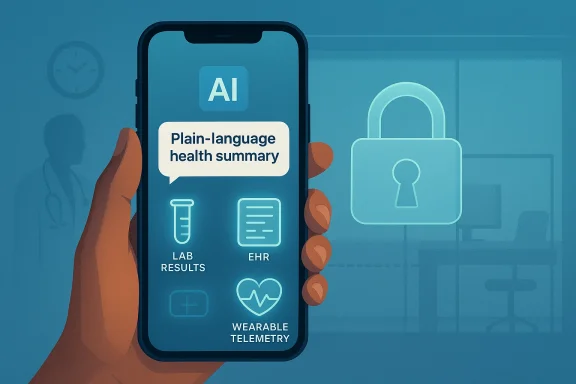
Americans are turning to AI for health advice because it feels faster, more available, and often easier to ask than a doctor, especially for everyday questions that are urgent but not necessarily an emergency. The shift is showing up in usage patterns that make health one of the most emotionally loaded categories in consumer AI, and it is now influencing how major platforms are designing products around medical guidance and personal data. Microsoft’s Copilot Health preview is a vivid example of that trend: it aims to combine medical records, lab results, and wearable telemetry into a single AI-driven experience that explains findings in plain language and suggests next steps .
The rise of AI as a health-advice destination did not happen in a vacuum. It emerged from a familiar mix of healthcare frustration, digital habit, and product design. Americans have long complained about short appointment windows, fragmented records, confusing test results, and the cost of getting simple questions answered through traditional channels. AI assistants now sit on top of that friction and offer something that looks like instant triage, translation, and reassurance.
That convenience matters because health questions are often context-heavy and time-sensitive. A person who sees an abnormal lab result may not want to wait days for a callback. A parent with a child’s symptoms may want an immediate sense of whether to watch, worry, or seek care. An AI assistant can feel like a low-stakes first stop, even if it cannot replace a clinician.
The current wave is also being accelerated by product convergence. Consumer AI tools are no longer just chatbots that answer general questions; they are becoming data hubs that can ingest records, connect to wearables, and generate summaries tailored to the user’s own situation. Microsoft’s Copilot Health preview is one of the clearest signs of that shift, promising to gather EHR data, lab results, and device telemetry into a private health workspace, then translate it into understandable guidance .
At the same time, the trend raises a hard question: why are people so willing to ask software about something as sensitive as their health? The answer is not simply that AI is trendy. It is because the healthcare system is already hard to navigate, and AI is being positioned as the interface that makes it feel less opaque, less bureaucratic, and more personal.
The appeal is also psychological. People often do not want a diagnosis from AI; they want orientation. They want to know whether a symptom sounds minor, whether a test result is worth following up, or what language to use when they call a clinic. A generative model can often do that well enough to feel useful, which is why health advice is increasingly one of the categories where users return repeatedly.
That convenience can lower the barrier for people who might otherwise do nothing. A user who would ignore a lab report or avoid a call to a doctor may ask an AI assistant what it means. In that sense, AI can function as a nudge toward care, even if it does not deliver care itself.
The problem is that reassurance is not always the right product. A system that is too eager to calm people down may miss warning signs. One that is too cautious may send too many people to emergency care unnecessarily. The sweet spot is narrow, and it is one reason health AI remains high-value but high-risk.
Microsoft’s Copilot Health preview reflects that logic directly. It is designed to pull in medical records and wearable data, then explain findings, highlight trends, and provide practical guidance in a separate Copilot health space . That is not just a feature add; it is a bet that the value of AI in healthcare lies in synthesis.
AI steps into that gap by becoming a sort of consumer-grade interpreter. It can summarize documents, surface patterns, and recast raw medical language into plain text. For people with chronic conditions, multiple providers, or lots of wearable data, that synthesis can feel transformative.
That is a powerful product story, but it comes with a caveat. More data does not automatically mean better understanding. If the AI overreads a temporary spike or draws a conclusion from incomplete signals, it can create unnecessary concern. In medicine, context is everything.
The trust is also built through repeated utility. If an AI assistant consistently explains lab terms clearly, helps users organize symptoms, or produces a good prep sheet for an appointment, it earns a practical credibility that abstract warnings cannot easily erase. The relationship is transactional and incremental.
That makes AI especially appealing for people who feel intimidated by medical systems. It gives them language they can use with a doctor and helps them avoid walking into a visit unprepared. In that role, AI becomes a confidence amplifier.
This does not make the advice medically reliable by itself. But it does explain why users keep coming back. Emotional accessibility is now part of the product value in health AI, not just a nice-to-have.
The competitive implication is broader than Microsoft alone. Once one platform proves that users are willing to bring in medical records and wearable data, others will push harder to do the same. The prize is not just search traffic; it is the role of trusted interpreter in a domain people care about intensely.
It also deepens platform lock-in. If a user stores records, preferences, and history in an AI workspace, switching becomes harder. The company that wins the health interface may not just win a query; it may win the relationship.
That is why Microsoft’s emphasis on separating health interactions into a distinct, privacy-focused space matters. It signals recognition that health guidance cannot be treated like general chat. Still, a consumer-facing assistant feels more authoritative than a general-purpose chatbot, and that perception can outpace the safeguards.
This is why health AI must be judged differently from ordinary consumer AI. The standard should not be whether the tool is clever. It should be whether it is safely constrained, honest about uncertainty, and designed to steer people toward appropriate care when needed.
That does not mean AI has no place in medicine. It means the design must acknowledge the stakes. Systems need guardrails, escalation language, and clear boundaries around when to seek professional help. They also need to avoid presenting speculation as diagnosis.
Microsoft’s decision to keep health interactions separate from general Copilot workflows reflects an effort to manage that boundary . But separation alone does not solve the liability question. If users rely on the assistant and later suffer harm, the public will ask whether the product design encouraged misplaced trust.
Copilot Health’s privacy-segmented structure is an acknowledgment of that reality . The company is signaling that medical information needs separate handling from general assistant data, and that health-specific workflows require stronger boundaries.
Users may tolerate data sharing with a clinic because they see medical privacy rules and care relationships as part of the deal. They are less comfortable handing the same information to a general-purpose tech platform unless they clearly understand who can access it and how it will be used.
That tension will shape adoption. A health AI product that is too vague may fail to deliver value. One that is too invasive may trigger privacy backlash. The winners will likely be the services that make data use legible and keep the trust story as strong as the feature story.
Doctors may benefit when patients come prepared. They may lose time when they need to correct misleading AI output. Health systems may also face more pressure to make records, lab results, and portal data easier to understand because users will compare those experiences with AI’s conversational interface.
That could be especially valuable for chronic disease management. Patients with complex histories often struggle to keep track of trends, medication changes, and multiple specialist opinions. A well-designed AI summary can act as a memory aid and planning tool.
Health systems may need to respond by improving their own patient education tools. Otherwise, the AI assistant becomes the more understandable interpreter, even when it is not the more accurate one. In medicine, clarity without correctness is not a win.
At the same time, major platforms are looking for the next layer of utility that can justify deeper engagement. Health is a category where the payoff from personalization is obvious, and where users may be willing to exchange more data for better service. Microsoft’s Copilot Health is one visible expression of that strategic logic .
AI does not solve the healthcare system’s structural problems. But it does solve a smaller, more immediate problem: interpreting the mess. That is enough to generate adoption, and adoption is enough to attract more investment.
Competition will probably center on three things: trust, data integration, and ecosystem reach. The companies that can combine all three will have a strong advantage. Those that cannot may still win users, but only for shallow use cases.
The big test will be whether platforms can keep trust ahead of ambition. Consumers clearly want help understanding their health, but they will not tolerate products that feel invasive, careless, or misleading. The winners will be the companies that combine useful interpretation with visible restraint.
Source: Henry Herald Why many Americans are turning to AI for health advice
 Overview
The rise of AI as a health-advice destination did not happen in a vacuum. It emerged from a familiar mix of healthcare frustration, digital habit, and product design. Americans have long complained about short appointment windows, fragmented records, confusing test results, and the cost of getting simple questions answered through traditional channels. AI assistants now sit on top of that friction and offer something that looks like instant triage, translation, and reassurance.That convenience matters because health questions are often context-heavy and time-sensitive. A person who sees an abnormal lab result may not want to wait days for a callback. A parent with a child’s symptoms may want an immediate sense of whether to watch, worry, or seek care. An AI assistant can feel like a low-stakes first stop, even if it cannot replace a clinician.
The current wave is also being accelerated by product convergence. Consumer AI tools are no longer just chatbots that answer general questions; they are becoming data hubs that can ingest records, connect to wearables, and generate summaries tailored to the user’s own situation. Microsoft’s Copilot Health preview is one of the clearest signs of that shift, promising to gather EHR data, lab results, and device telemetry into a private health workspace, then translate it into understandable guidance .
At the same time, the trend raises a hard question: why are people so willing to ask software about something as sensitive as their health? The answer is not simply that AI is trendy. It is because the healthcare system is already hard to navigate, and AI is being positioned as the interface that makes it feel less opaque, less bureaucratic, and more personal.
Why AI Feels Like the First Stop
For many users, AI health advice is less about trust in artificial intelligence and more about inconvenience with everything else. A chatbot is available late at night, does not require insurance, and does not make people feel judged for asking what they consider “basic” questions. That combination of speed and privacy is powerful, even if the underlying advice should be treated cautiously.The appeal is also psychological. People often do not want a diagnosis from AI; they want orientation. They want to know whether a symptom sounds minor, whether a test result is worth following up, or what language to use when they call a clinic. A generative model can often do that well enough to feel useful, which is why health advice is increasingly one of the categories where users return repeatedly.
Convenience Over Ceremony
Traditional healthcare often requires ceremony: scheduling, waiting, checking in, repeating history, and hoping the clinician has the full picture. AI strips that away. It delivers immediate feedback in a conversational style that feels closer to texting a knowledgeable friend than entering a medical system.That convenience can lower the barrier for people who might otherwise do nothing. A user who would ignore a lab report or avoid a call to a doctor may ask an AI assistant what it means. In that sense, AI can function as a nudge toward care, even if it does not deliver care itself.
- It is available 24/7.
- It is usually conversational and nonjudgmental.
- It can translate jargon into plain English.
- It feels cheaper than an appointment.
- It reduces the social friction of asking “embarrassing” questions.
The Search for Reassurance
A large share of health questions are really anxiety questions. Users often want confirmation that a symptom is harmless, that an issue is common, or that the next step is not urgent. AI is uniquely good at providing that kind of narrative quickly, which helps explain why it is becoming a substitute for late-night searching and doom-scrolling.The problem is that reassurance is not always the right product. A system that is too eager to calm people down may miss warning signs. One that is too cautious may send too many people to emergency care unnecessarily. The sweet spot is narrow, and it is one reason health AI remains high-value but high-risk.
The Data Problem Behind the Trend
One reason AI is gaining traction in health is that people’s medical information is scattered across too many systems. Test results may live in one portal, prescriptions in another, wearable data on a phone, and specialist notes in a separate hospital record. AI tools promise to stitch all of that together into a usable narrative, which is a genuinely compelling product proposition.Microsoft’s Copilot Health preview reflects that logic directly. It is designed to pull in medical records and wearable data, then explain findings, highlight trends, and provide practical guidance in a separate Copilot health space . That is not just a feature add; it is a bet that the value of AI in healthcare lies in synthesis.
Fragmentation Creates Demand
Healthcare data fragmentation is not a minor inconvenience. It is one of the main reasons ordinary people struggle to understand their own care. When records are scattered, patients become the integration layer, and most patients are not trained for that job.AI steps into that gap by becoming a sort of consumer-grade interpreter. It can summarize documents, surface patterns, and recast raw medical language into plain text. For people with chronic conditions, multiple providers, or lots of wearable data, that synthesis can feel transformative.
- Records are often locked in separate portals.
- Patients are expected to reconcile conflicting instructions.
- Lab results are frequently hard to interpret without context.
- Wearables generate more data than people can reasonably parse.
- AI offers a single view, even if imperfect.
Wearables Change the Conversation
The arrival of consumer wearables has added another layer of complexity. Smartwatches and health bands create a stream of heart-rate, sleep, and activity data that most users do not know how to interpret on their own. AI can convert that stream into trends and suggestions, making the data feel actionable instead of noisy.That is a powerful product story, but it comes with a caveat. More data does not automatically mean better understanding. If the AI overreads a temporary spike or draws a conclusion from incomplete signals, it can create unnecessary concern. In medicine, context is everything.
Why Trust Is Forming Around AI Anyway
Trust in AI health advice is not absolute, but it is growing in a very specific way: users trust it for preliminary interpretation, not final authority. That distinction matters. The model is often seen as a helper that prepares questions, not the clinician that closes the case.The trust is also built through repeated utility. If an AI assistant consistently explains lab terms clearly, helps users organize symptoms, or produces a good prep sheet for an appointment, it earns a practical credibility that abstract warnings cannot easily erase. The relationship is transactional and incremental.
“Good Enough” Is Sometimes Enough
For many health questions, users are not seeking a definitive answer. They are looking for the next sensible action. AI tends to perform best in those middle layers of decision-making, where the task is to summarize, compare, or suggest what information is missing.That makes AI especially appealing for people who feel intimidated by medical systems. It gives them language they can use with a doctor and helps them avoid walking into a visit unprepared. In that role, AI becomes a confidence amplifier.
- It can help users organize symptoms before a visit.
- It can explain the difference between similar terms.
- It can turn medical history into a concise summary.
- It can suggest follow-up questions.
- It can highlight missing context.
The Emotional Component
Health advice is rarely just technical. It is often wrapped in fear, uncertainty, embarrassment, or exhaustion. AI’s conversational tone can soften those edges. Users may feel that they can ask “stupid” questions without stigma, and that matters more than many observers realize.This does not make the advice medically reliable by itself. But it does explain why users keep coming back. Emotional accessibility is now part of the product value in health AI, not just a nice-to-have.
The Commercial Race to Own Health Conversations
Big tech companies understand that health is one of the most valuable and sensitive categories in consumer AI. If a platform becomes the place people go for medical questions, it can gain long-term engagement, deeper data relationships, and a stronger place in the user’s daily routine. That is why Microsoft’s move into Copilot Health is strategically significant .The competitive implication is broader than Microsoft alone. Once one platform proves that users are willing to bring in medical records and wearable data, others will push harder to do the same. The prize is not just search traffic; it is the role of trusted interpreter in a domain people care about intensely.
Why Platforms Want the Health Layer
Health is sticky. People do not ask a health-related question once and leave. They return after test results, symptom changes, medication questions, or follow-up visits. That makes it one of the best categories for habit formation in consumer AI.It also deepens platform lock-in. If a user stores records, preferences, and history in an AI workspace, switching becomes harder. The company that wins the health interface may not just win a query; it may win the relationship.
- Health queries recur over time.
- Medical context builds user dependence.
- Data integration creates switching costs.
- Personalization improves retention.
- Trust compounds when the system feels useful.
Consumer Versus Enterprise Stakes
Consumer health AI and enterprise clinical AI are not the same game. In enterprise settings, the goal is often workflow support, documentation, and record summarization under institutional rules. In consumer settings, the AI may be seen as a quasi-adviser, which dramatically raises expectations and liability concerns.That is why Microsoft’s emphasis on separating health interactions into a distinct, privacy-focused space matters. It signals recognition that health guidance cannot be treated like general chat. Still, a consumer-facing assistant feels more authoritative than a general-purpose chatbot, and that perception can outpace the safeguards.
The Safety Question
The more people rely on AI for health advice, the more dangerous confident mistakes become. A wrong answer about a symptom, medication interaction, or urgent condition can have real consequences. Unlike entertainment or productivity errors, these are not just annoying; they can be clinically meaningful.This is why health AI must be judged differently from ordinary consumer AI. The standard should not be whether the tool is clever. It should be whether it is safely constrained, honest about uncertainty, and designed to steer people toward appropriate care when needed.
Hallucination Is Not an Academic Problem
In general AI use, a hallucination may simply be an inconvenience. In health, it can be a risk multiplier. If the model invents a plausible-sounding explanation for chest pain or misreads a medication name, the user may act on bad information.That does not mean AI has no place in medicine. It means the design must acknowledge the stakes. Systems need guardrails, escalation language, and clear boundaries around when to seek professional help. They also need to avoid presenting speculation as diagnosis.
- AI should flag uncertainty clearly.
- It should avoid definitive diagnosis language.
- It should recommend urgent care when symptoms warrant it.
- It should not overstate confidence.
- It should encourage clinician verification.
Medical Advice and Liability
Health guidance sits in a complicated legal and ethical zone. The moment a tool appears to interpret symptoms or medical records, users may treat it like advice rather than information. That can create expectations the product is not prepared to meet.Microsoft’s decision to keep health interactions separate from general Copilot workflows reflects an effort to manage that boundary . But separation alone does not solve the liability question. If users rely on the assistant and later suffer harm, the public will ask whether the product design encouraged misplaced trust.
Privacy Becomes the Price of Convenience
Health data is among the most sensitive data people have. It includes not just diagnoses but biometrics, prescriptions, family history, and behavioral patterns. AI health products often promise convenience by centralizing that data, but the tradeoff is obvious: the more useful the system becomes, the more intimate it must be.Copilot Health’s privacy-segmented structure is an acknowledgment of that reality . The company is signaling that medical information needs separate handling from general assistant data, and that health-specific workflows require stronger boundaries.
Why Users Worry
Consumers are increasingly aware that a health profile can reveal more than a search history ever could. It can disclose chronic illness, fertility concerns, mental health issues, medication use, and patterns in daily life. That makes privacy anxiety almost inevitable.Users may tolerate data sharing with a clinic because they see medical privacy rules and care relationships as part of the deal. They are less comfortable handing the same information to a general-purpose tech platform unless they clearly understand who can access it and how it will be used.
- Health data is highly revealing.
- People want separation from advertising.
- Users are wary of secondary data use.
- Breaches can cause lasting harm.
- Trust requires explicit governance.
The Trust Paradox
The paradox is simple: the more personal the assistant becomes, the more useful it feels, but also the more risky it becomes. Users may want AI to understand their bodies in detail, yet they may not want that same intimacy stored indefinitely in a large platform ecosystem.That tension will shape adoption. A health AI product that is too vague may fail to deliver value. One that is too invasive may trigger privacy backlash. The winners will likely be the services that make data use legible and keep the trust story as strong as the feature story.
What This Means for Doctors and Health Systems
AI health advice is not just changing consumer behavior; it is changing the expectations patients bring into appointments. People increasingly arrive with AI-generated summaries, follow-up questions, and a sense that they already have a preliminary interpretation of what might be going on. That can be helpful, but it can also complicate the clinician-patient relationship.Doctors may benefit when patients come prepared. They may lose time when they need to correct misleading AI output. Health systems may also face more pressure to make records, lab results, and portal data easier to understand because users will compare those experiences with AI’s conversational interface.
A Better-Told Medical Story
One of the most promising aspects of AI in health is that it can help patients understand the story of their care. Medical records often read like a sequence of disconnected events. AI can organize those events into a narrative, which may improve follow-through and reduce confusion.That could be especially valuable for chronic disease management. Patients with complex histories often struggle to keep track of trends, medication changes, and multiple specialist opinions. A well-designed AI summary can act as a memory aid and planning tool.
- It can turn scattered notes into one coherent timeline.
- It can help patients compare prior and current results.
- It can generate visit prep lists.
- It can surface issues that need clarification.
- It can reduce the burden of record-keeping.
The Risk of Friction
There is also a friction risk. If patients come in primed by AI explanations that are wrong or incomplete, clinicians may need to spend time unwinding those assumptions. That could create a new form of digital busywork for an already strained system.Health systems may need to respond by improving their own patient education tools. Otherwise, the AI assistant becomes the more understandable interpreter, even when it is not the more accurate one. In medicine, clarity without correctness is not a win.
Why This Trend Is Accelerating Now
Several forces are converging at once. Generative AI models are now better at summarizing complex text, consumer wearables are producing more health-related data, and public comfort with AI has increased through everyday use. That makes health advice one of the most natural frontier applications for the technology.At the same time, major platforms are looking for the next layer of utility that can justify deeper engagement. Health is a category where the payoff from personalization is obvious, and where users may be willing to exchange more data for better service. Microsoft’s Copilot Health is one visible expression of that strategic logic .
The Product-Market Fit Is Real
The product-market fit is real because the pain is real. People do not need to be convinced that healthcare is complicated. They live it every time they log into a portal, compare lab values, or try to make sense of a bill.AI does not solve the healthcare system’s structural problems. But it does solve a smaller, more immediate problem: interpreting the mess. That is enough to generate adoption, and adoption is enough to attract more investment.
- Users want immediate interpretation.
- Platforms want deeper engagement.
- Wearables create constant data streams.
- Records remain fragmented.
- AI can bridge the gap conversationally.
The Broader Market Effect
The market effect will likely extend beyond standalone health products. Search engines, operating systems, and device makers will all be pushed to make their AI assistants more medically useful, whether through symptom guidance, record integration, or appointment support. That means health AI will become a differentiator across multiple consumer platforms, not just a specialty app category.Competition will probably center on three things: trust, data integration, and ecosystem reach. The companies that can combine all three will have a strong advantage. Those that cannot may still win users, but only for shallow use cases.
Strengths and Opportunities
The strongest case for AI health advice is that it meets people where they already are: on their phones, in their portals, and inside their day-to-day worries. It can turn fragmented health information into something legible, and that alone is a meaningful service.- Faster answers for low-acuity questions.
- Better interpretation of lab results and records.
- Reduced friction for follow-up questions.
- More informed doctor visits.
- Stronger patient engagement.
- Potentially improved adherence through reminders and summaries.
- A more human-feeling interface for stressful topics.
Risks and Concerns
The same qualities that make AI health advice attractive also make it dangerous if deployed carelessly. A system that sounds confident, remembers personal data, and acts like a helper can easily be overtrusted.- Hallucinated or oversimplified medical guidance.
- Privacy exposure from sensitive health data.
- Users delaying care because AI sounded reassuring.
- Overreliance on AI instead of clinician judgment.
- Confusing or incomplete advice during urgent symptoms.
- Bias or blind spots in training data.
- Regulatory and liability uncertainty.
Looking Ahead
The next phase of AI health advice will likely be defined by integration rather than novelty. The tools that matter will not just answer questions; they will connect to records, devices, and appointment workflows in ways that make the experience feel continuous. That is where Microsoft’s Copilot Health direction is especially revealing, because it treats medical data as a structured part of the assistant experience rather than a separate app silo .The big test will be whether platforms can keep trust ahead of ambition. Consumers clearly want help understanding their health, but they will not tolerate products that feel invasive, careless, or misleading. The winners will be the companies that combine useful interpretation with visible restraint.
- Better symptom triage guardrails.
- More transparent handling of health data.
- Deeper integration with records and wearables.
- Stronger clinician-facing handoff tools.
- Clearer boundaries between information and advice.
Source: Henry Herald Why many Americans are turning to AI for health advice
Last edited:
