

Artificial intelligence is no longer a theoretical talking point for marina operators — it showed up in force at the Association of Marina Industries Conference & Expo in Daytona Beach, drawing packed rooms and sparking practical conversations about how AI can cut paperwork, improve safety, and turn scattered systems into a single source of operational truth. What took shape across sessions and vendor booths was not a promise of replacing dockhands with robots, but a clear roadmap for using AI as a productivity multiplier: automating repetitive tasks, surfacing actionable patterns from operational data, and restoring frontline staff to the docks where human relationships still win loyalty. ([marinaassociation.sociation.org/2026sag)
Marinas face a distinctive set of operational challenges: seasonal demand swings, a mix of transient and long-term customers, multiple revenue streams (slips, fuel, retail, services), and the perennial need to convert on-the-water interest into on-site revenue. Their technical stacks are often a patchwork of reservation systems, accounting, access control, and point-of-sale tools. That fragmentation creates the very friction AI promises to resolve: missed messages, inconsistent guest experiences across facilities, and opaque performance metrics that make it hard to know where to invest next.
At AMI 2026, organizers and exhibitors reflected that broader context — the conference program included dedicated sessions such as "From Docks to Data: Unlocking AI's Power in Marinas," confirming that AI has become a mainstream topic for marina professionals seeking tangible returns from digitization.
Key benefits:
The broader research on speed-to-lead is clear: response time matters. Studies going back to the MIT / Harvard Business Review line of work show that contacting an inbound lead quickly — ideally within minutes — dramatically increases the chance of connection and qualification; conversely, delays of hours or days reduce conversion sharply. In practice that means AI tools that shorten the time to first contact (automated acknowledgements, prioritized callbacks) can materially improve revenue outcomes.
Caveat on metrics: some conference anecdotes — for example, a claim that calls returned within two hours produce a 60% close rate while waits of 24 hours drop to 40% — are operator-specific observations and should be treated as illusniversal. They’re valuable as internal benchmarks but not a one‑size‑fits‑all industry standard. Operators should replicate such measurements on their own call data before using them as targets. Anecdote ≠ industry average.
Vendors building these platforms emphasize a central design principle: keep data inside the customer’s environment. Microsoft‑backed solutions and Azure-hosted offerings are being marketed to marinas with enterprise-grade controls to avoid allowing prompts or documents to be recycled into public model training sets. That separation matters for operators handling contract terms, customer PII, and financial records.
Why it matters:
Example pilot steps:
Key risk areas and practical mitigations:
AI’s strengths for marinas are clear: automation of repetitive tasks, improved responsiveness through call intelligence, and data-driven operational insights that enable smarter staffing and revenue capture. The hospitality-oriented vendors represented at AMI made a persuasive case that AI will improve wayfinding, booking accuracy, and the guest experience — low-hanging fruit for most operations.
But there are serious caveats:
AI for marinas is not hype when it’s small, targeted, and measured. Fix the call handling, get the booking and billing systems talking to each other, and use AI to close the gaps that keep managers behind screens instead of on the docks. Do that, and marinas will find that technology becomes the enabler of better hospitality rather than a replacement for it.
Source: Trade Only Today AI for Marinas: Hype, Hope & Help - Trade Only Today
 Background / Overview
Marinas face a distinctive set of operational challenges: seasonal demand swings, a mix of transient and long-term customers, multiple revenue streams (slips, fuel, retail, services), and the perennial need to convert on-the-water interest into on-site revenue. Their technical stacks are often a patchwork of reservation systems, accounting, access control, and point-of-sale tools. That fragmentation creates the very friction AI promises to resolve: missed messages, inconsistent guest experiences across facilities, and opaque performance metrics that make it hard to know where to invest next.At AMI 2026, organizers and exhibitors reflected that broader context — the conference program included dedicated sessions such as "From Docks to Data: Unlocking AI's Power in Marinas," confirming that AI has become a mainstream topic for marina professionals seeking tangible returns from digitization.
Where AI Is Already Helping Marinas
Marina operators at the conference described five practical categories where AI is delivering value today. Each one is operationally focused and oriented toward time savings, better decisions, or improved customer service.1. Operational dashboards and occupancy forecasting
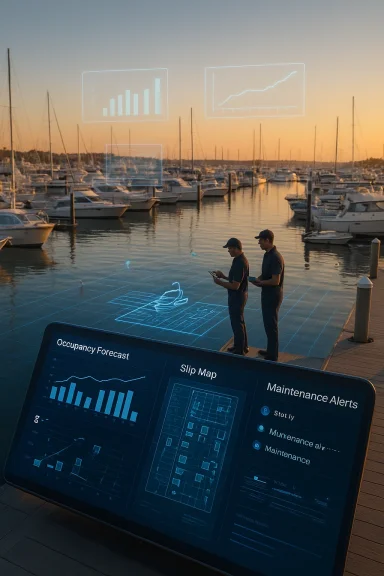
AI-driven dashboards that combine booking systems, sensor feeds, and historical occupancy data can forecast slip usage, flag potential double-bookings, and present a real‑time map of vessel movements. Vendors and specialist integrators showed how a consolidated view reduces last-minute scramble and improves staffing decisions for peak periods. These product categories are evolving rapidly; specialized marina dashboard vendors now offer live slip maps, historical trend analysis, and alerting for conflicts.Key benefits:
- Real-time visibility across slips, work orders, and scheduled maintenance.
- Better staffing and scheduling from occupancy forecasts.
- Faster check-in and reduced double-bookings.
2. Call tracking, conversation intelligence, and response SLAs
Marinas still rely heavily on phone calls. AI-enabled call tracking tools transcribe incoming calls, classify intent, and surface missed opportunities so staff can act quickly. Operators reported that call‑management systems revealed surprising operational gaps — unanswered voicemails, poor routing, and slow follow-up — and that simply quantifying those problems produced measurable improvements once processes were fixed.The broader research on speed-to-lead is clear: response time matters. Studies going back to the MIT / Harvard Business Review line of work show that contacting an inbound lead quickly — ideally within minutes — dramatically increases the chance of connection and qualification; conversely, delays of hours or days reduce conversion sharply. In practice that means AI tools that shorten the time to first contact (automated acknowledgements, prioritized callbacks) can materially improve revenue outcomes.
Caveat on metrics: some conference anecdotes — for example, a claim that calls returned within two hours produce a 60% close rate while waits of 24 hours drop to 40% — are operator-specific observations and should be treated as illusniversal. They’re valuable as internal benchmarks but not a one‑size‑fits‑all industry standard. Operators should replicate such measurements on their own call data before using them as targets. Anecdote ≠ industry average.
3. Reservation, billing, and compliance automation
Integrated management platforms are folding AI overlays into reservation, billing, and compliance workflows. That means automatic invoice generation, late-payment reminders, simplified check-in/check-out documentation, and rule‑based compliance checks (insurance, safety certifications). Integration reduces manual reconciliation and cuts the “desk work” that pulls managers away from guest service.Vendors building these platforms emphasize a central design principle: keep data inside the customer’s environment. Microsoft‑backed solutions and Azure-hosted offerings are being marketed to marinas with enterprise-grade controls to avoid allowing prompts or documents to be recycled into public model training sets. That separation matters for operators handling contract terms, customer PII, and financial records.
4. Safety and traffic-flow insights
AI can be applied to operational safety by analyzing incident reports, CCTV metadata, and movement patterns to identify high-risk routes on a marina map. The promise here is not to replace human judgment but to augment it: AI highlights routes where incidents cluster, suggests changes to channel markers or traffic routing, and helps staffing teams deploy Boating Safety Officers or dock hands when and where they’ll have maximum effect.5. Marketing, reputation, and customer discovery
AI also touches the front end of customer acquisition. Tools that synthesize reviews, generate localized marketing copy, maintain social posting cadence, or summarize the sentiment of online mentions change how prospective boaters discover a marina. Search engines and AI-driven review summarizers can paggregated sentiment snapshot rather than raw reviews — a subtle but meaningful shift that elevates the need for consistent reputation management. That means marinas must now be intentional about online review strategy and presence management.Vendors and Platforms: What Operators Heard in Daytona
Elite Dynamics and integrated marina management
Elite Dynamics — the company behind the EliteMarinas product family — positions itself as a Microsoft-stack partner building an integrated platform for reservations, billing, maintenance, and guest records. Elite’s approach is the classic enterprise pattern: unify operational systems, then add an AI overlay (for example, Microsoft Copilot) to surface insights and automate routine actions within the tenant’s secure environment. Operators heard standard vendor counsel at the show: implement a data strategy first; AI is only as effective as the data that feeds it.Why it matters:
- Consolidation reduces reconciliation work and manual errors.
- Using a platform built on Microsoft technologies can make it easier to adopt enterprise Copilot variants that respect tenant boundaries.
Admiral and hospitality-focused automation
Admiral — co‑founded by John Howie — is an example of a company explicitly targeting the hospitality dimension of marinas: streamlined member management, automated communications, and a strong focus on member experience. At AMI, Admiral’s message was consistent with many hospitality firms: use AI to automate low-value admin while preserving and enhancing human interactions that matter to repeat customers. John Howie’s public statements and company positioning emphasize that AI should scale hospitality — not replace it.Call tracking and conversation intelligence vendors
Call tracking vendors such as CallRail, Invoca and a wave of newer AI-first providers promote features many marinas are now prioritizing: real-time transcription, keyword spotting, attribution to marketing campaigns, and smart routing. These systems are already playing the role of "digital receptionist" for multi-site operators, reducing missed messages and delivering measurable improvements in lead conversion when paired with SLA-driven follow-up workflows.Implementation Reality: Steps, Pitfalls, and Practical Guidance
AI projects fail most often for the same three reasons: poor data hygiene, lack of clear use cases, and insufficient staff training. Marinas — many of which are family-run or small chains — can avoid common mistakes by following a pragmatic, three‑phase approach.1. Phase 1 — Prepare: inventory, clean, and govern your data
- Audit the systems that store customer records, bookings, contracts, and financials.
- Identify the canonical source for each key data element (who owns the customer record, who owns billing).
- Implement access controls and classify sensitive fields (PII, bank data, insurance details).
2. Phase 2 — Pilot: pick one high‑ROI workflow and instrument it
Choose a narrowly scoped pilot that solves a specific pain point: missed calls, slow invoice generation, or occupancy forecasting. Design measurable KPIs (time to first contact, invoice processing time, double-booking rate) and instrument the pilot to collect before/after metrics.Example pilot steps:
- Configure call tracking numbers on your website and connect to CRM.
- Set an SLA: automated acknowledgement within 60 seconds; human follow-up within two hours.
- Measure conversion and closure rates before and after.
3. Phase 3 — Scale and institutionalize
If the pilot yields improvement, plan a phased rollout across locations. Standardize playbooks, train staff on new workflows, and publish monitoring dashboards so regional managers can spot deviations. Make change management a core part of the roll‑out — in many marinas the cultural barrier is not a lack of interest but resistance to changing who does what and when.Security, Privacy, and Vendor Selection — The Risks You Must Manage
AI’s upside is real, but so are the risks. Conference sessions dedicated meaningful time to data governance because marinas collect sensitive information (payment details, contract terms, customer PII) and are often small enough that a data leak could be catastrophic.Key risk areas and practical mitigations:
- Data leakage via public AI tools: Public chatbots and free consumer AI services commonly retain prompts and may use them for model improvement. For business use, choose enterprise-tier solutions that explicitly do not use your tenant data to train public models and keep processing inside a managed tenant boundary. Microsoft — as an example — states that Copilot for commercial and public-sector customers does not use customer data to train underlying foundation models and that enterprise deployments operate inside tenant-specific processing boundaries. Operators should verify contractual language and deployment architecture before sending confidential data to a third party.
- Vendor model training and terms: Not all AI vendors have the same data-retention or training policies. Consumer-grade AI services can be set to opt-out or opt-in for training, so operators must read the terms and prefer enterprise plans where available. Industry guides increasingly advise: “Don’t put confidential financial or operational information into free or consumer AI chat windows.”
- Compliance with GDPR/CCPA and payment-data protections: If you handle EU customers or store payment data, discuss residency and processing controls with vendors. Some enterprise AI offerings allow processing within specified regions for customers with strict data sovereignty needs. Make these requirements part of procurement checklists.
- Accuracy and hallucination risk: Generative systems produce fluent text but can invent facts. Use AI outputs for drafts, summaries, or suggestions — not final compliance documents — and maintain human-in-the-loop review for critical content (contracts, legal notices, safety procedures). Both vendors and security practitioners stressed vigilance: AI assists, humans verify.
- Operational dependency and vendor lock-in: Relying on a single provider’s closed APIs for mission-critical workflows carries vendor dependency risk. Where possible, adopt modular designs (separate identity, booking, billing, and AI overlay) so you can replace components without a ground-up rebuild.
A Real-World Illustration: What Alliance Marine Learned (and Why it Matters)
Alliance Marine (operator profile and leadership publicly available) shared a candid account of what call-tracking revealed across multiple properties: significant missed opportunities and inconsistent customer response practices. Their experience underlines two truths:- Measurement precedes improvement. When you instrument the operation, previously invisible gaps become visible and solvable.
- Small process fixes — consistent voicemail monitoring, automatic routing, measurable SLAs — can deliver outsized gains quickly.
Business Cases and ROI: Where Money Is Likely to Be Saved or Earned
AI projects in marinas typically create ROI through a few repeatable channels:- Labor savings: Automating billing, FAQs, and routine communications reduces administrative hours and lowers seasonal overtime.
- Revenue optimization: Faster follow-up on leads and better attribution of marketing spend improve sales conversion and reduce wasted ad dollars.
- Secondary services: AI can analyze customer data to identify cross-sell opportunities (storage, memberships, hotel packages) and automate personalized offers.
- Risk reduction: Automated compliance checks and digital recordkeeping reduce the chance of fines, holdbacks, or denied claims.
Checklist: Practical Questions Every Marina Should Ask Before Buying AI
- What exactly will the AI do? (Define the use case and 1–3 KPIs.)
- Where will data be processed and stored? (Tenant-only processing vs. public cloud inference.)
- Will our data be used to train the vendor’s models? (Prefer contractual guarantees that it will not.)
- How will you verify accuracy? (Human-in-the-loop checkpoints for critical outputs.)
- What are the failover plans if the vendor service is degraded? (Operational continuity.)
- Can the solution integrate with our booking, POS, and accounting systems? (APIs and data mapping.)
- What is the total cost of ownership (licensing, implementation, training, support)? (Include change management.)
AI’s strengths for marinas are clear: automation of repetitive tasks, improved responsiveness through call intelligence, and data-driven operational insights that enable smarter staffing and revenue capture. The hospitality-oriented vendors represented at AMI made a persuasive case that AI will improve wayfinding, booking accuracy, and the guest experience — low-hanging fruit for most operations.
But there are serious caveats:
- Data quality determines outcomes. Garbage in, garbage out remains an immutable rule; dirty, siloed records limit what AI can do.
- Privacy and contractual clarity matter. A marina’s customer list is an asset; operators must not inadvertently expose PII or proprietary pricing/contract details to consumer AI services.
- Organizational change is harder than the tech. New tools fail where people aren’t trained, or processes aren’t redesigned to take advantage of the automation.
Next Steps for Marina Operators — A Practical Roadmap
- Convene a cross-functional team (operations, front-desk, finance, IT) and map your top five pain points.
- Perform a data audit: where is customer, reservation, billing, and maintenance data stored today?
- Select a pilot with measurable KPIs (example: reduce time-to-first-contact from 24 hours to under 2 hours).
- Choose vendors that offer enterprise data protections and regionally appropriate processing.
- Run the pilot for 4–8 weeks, measure results, and iterate — don’t attempt a fleetwide rollout without evidence.
- If successful, standardize the playbook and roll out in phases, keeping human oversight at critical control points.
Conclusion
The AMI conference made one thing plain: marinas are ready to move from curiosity about generative AI to concrete deployments that reduce administrative friction and improve guest experience. The early adopters emphasized a pragmatic view — AI that augments staff, enforces consistent processes, and unlocks hidden operational data will produce the most durable benefits. But that upside comes with responsibilities: solid data governance, clear vendor commitments about privacy and model training, and disciplined change management.AI for marinas is not hype when it’s small, targeted, and measured. Fix the call handling, get the booking and billing systems talking to each other, and use AI to close the gaps that keep managers behind screens instead of on the docks. Do that, and marinas will find that technology becomes the enabler of better hospitality rather than a replacement for it.
Source: Trade Only Today AI for Marinas: Hype, Hope & Help - Trade Only Today
