

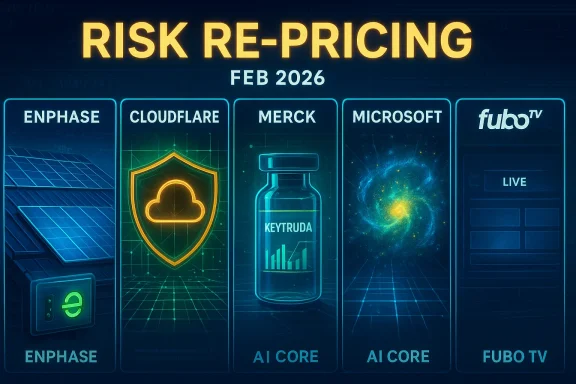
Wall Street turned sharply active in early February 2026, with analysts rotating through five very different stories — Enphase Energy, Cloudflare, Merck & Co., Microsoft, and fuboTV — issuing upgrades, downgrades and much‑debated price targets that together illuminate how investors are re‑pricing risk across renewable energy, cloud/security software, big pharma, AI‑infrastructure and streaming aggregation.
Background / Overview
Investor attention is clustering where structural change meets near‑term inflection points. In each case below, an analyst call or research note — published in the first week of February 2026 and informed by company guidance, field checks, or post‑merger readouts — has forced markets to reassess how durable revenue paths and margin trajectories actually are.- Enphase (ENPH) has a fresh beat‑and‑raise tone to Q1 guidance that suggests the residential solar trough may be behind it, but the company still faces policy and market headwinds tied to the U.S. 25D tax credit and changing state rules.
- Cloudflare (NET) is being reframed by bullish field checks into a broadened security + networking + developer platform story, with BTIG arguing that investors underappreciate secular share wins in web application protection, Zero Trust/SASE and Developer Services.
- Merck (MRK) is again a story of patent cliffs and pipeline optionality: analysts are banking on timing extensions and late‑stage data to cushion the eventual Keytruda loss of exclusivity.
- Microsoft (MSFT) is the tale of AI opportunity colliding with the near‑term reality of massive capex and Azure capacity constraints — a dynamic that prompted at least one high‑profile downgrade.
- fuboTV (FUBO) has morphed from takeover buzz to a speculative restructuring play after completing its business combination with Hulu + Live TV; the stock now sits at the crossroads of content licensing, a pending reverse split and investor lockups.
Enphase Energy: Guidance‑led relief, but structural questions remain
What changed
In early February 2026, Enphase issued Q1 revenue guidance that was materially better than some street expectations: management guided to a range that — on the midpoint — implies revenue noticeably above select analyst estimates. That guidance prompted BMO to move Enphase from Underperform to Market Perform and lift a price target materially (the upgrade was driven by the clearer Q1 outlook and an explicit directional call toward higher Q2 revenue).The verified numbers
- Company guidance for Q1 (excluding “safe harbor” volumes) sits in a mid‑hundreds‑of‑millions range whose midpoint beats at least one pre‑release analyst model.
- Reported Q4 results and commentary indicated U.S. sell‑through strength and inventory normalization after a prolonged residential slowdown.
Why analysts upgraded
Analysts who upgraded point to three bullish signals:- Q1 guidance that suggests the cyclical trough in installer demand is passing;
- Management commentary explicitly noting better sell‑through and improvement heading into Q2; and
- Visible demand for Enphase batteries and system integrations that can materially raise average revenue per customer if adoption continues.
Structural headwinds that didn’t disappear
Despite the more optimistic near‑term tone, the bigger structural factors remain:- The U.S. Section 25D residential tax credit expiration materially changed demand economics for many homeowners and is a secular headwind.
- State policy changes (for example, California’s net energy metering reforms) and a shift toward third‑party ownership models have already shifted market share dynamics.
- Competition from integrated inverter + storage players and vertically integrated installers may compress price and margin over time.
Paths to durable recovery
Enphase’s plausible paths back to consistent growth include:- Higher battery and storage penetration per install, lifting average selling price and recurring revenue potential.
- International expansion into markets with longer policy tails or faster residential electrification.
- Expanding services and software to increase lifetime customer value and reduce reliance on one‑time hardware sales.
Risks and investor takeaways
- The upgrade is near‑term guidance driven, not a guarantee of durable structural turnaround.
- Investors should watch installer channel sell‑through, geographic mix, and the company’s conversion of battery backlog into stable revenue.
- For IT and energy procurement teams, a recovery in inverter and battery supply/delivery cadence could influence procurement lead times and cost projections over the next 6–12 months.
Cloudflare: From CDN and WAF to a full security + developer platform
What analysts are saying
BTIG’s research team put a strong Buy call on Cloudflare, arguing that field checks with large partners show accelerating momentum across several product axes: web application protection, Zero Trust/SASE, and developer platforms. The research note projects high‑twice‑digit growth in certain segments and a conservative overall revenue CAGR in the high‑20s through 2028.The bullish thesis, verified
Key elements of the bullish case that appeared in analyst notes and market coverage:- Customers and channel partners report broad, multi‑product adoption rather than single‑point wins.
- Cloudflare is gaining share from legacy CDN/security vendors in web application protection.
- Zero Trust, SASE and developer services (the so‑called “Act 3” or Workers/Serverless stack) represent multi‑year revenue expansion opportunities.
Plausible upside drivers
- Displacement of legacy vendors: Cloudflare combines global edge infrastructure with integrated security in ways that many buyers find simpler to operate.
- AI‑driven security demand: rising web and app attack surface combined with generative AI vectors makes modern, cloud‑native WAFs and bot management more valuable.
- Platform plays: embedding Workers and Developer Services inside partner stacks creates sticky, recurring revenue and expands TAM.
Valuation and risk
- The patent‑clear concern: Cloudflare’s stock pulled back significantly in late 2025; the upgrade treats the pullback as an entry point while acknowledging valuation remains elevated versus some peers.
- Competitive landscape: Large incumbents (Akamai, AWS + Shield services, Fastly historically) and point security vendors are not idle; Cloudflare must prove sustained cross‑sell and margin expansion.
- Execution risk: Developer platform revenue can be lumpy, and returns on platform investments can be multi‑year.
Why IT leaders should care
- Cloudflare’s multi‑product momentum is relevant to network and security architects evaluating consolidation of edge, CDN, WAF and Zero Trust vendors.
- Rapid growth in Developer Services suggests potential vendor lock‑in for serverless edge compute and storage — a factor to weigh when designing cloud‑native applications.
Merck: Patent timing and pipeline optionality dominate the narrative
The core issue
Merck’s valuation swings are dominated by the Keytruda patent cliff. Analysts who upgraded Merck are basing their call on two interlocking ideas: the possibility of patent protection stacking that extends effective exclusivity into 2029, and a pipeline of near‑term data and launches that could blunt the post‑exclusivity revenue erosion.Verified IP timeline and strategic maneuvers
- Keytruda’s primary patents are widely quoted as expiring in 2028 in the U.S., but the company and filings point to additional patent assets and regulatory exclusivities that could extend protections into 2029 in certain formulations or indications.
- Merck is accelerating life‑cycle management, including subcutaneous formulations and combination indications, which are typical industry tactics to sustain market share after biosimilar entry.
Pipeline and commercial offsets
- Merck’s positioning rests not just on Keytruda but on a basket of newer assets: vaccine programs, HIV regimens (including islatravir combinations), and other late‑stage cardiovascular and eye disease candidates with potential data readouts in 2026.
- Analysts argue that measured patent extensions plus successful launches could materially compress the expected revenue cliff.
Risks and headwinds
- Vaccines such as Gardasil and new vaccine products still face demand variability in regions like China, and that creates short‑term revenue volatility.
- Even with patents extended by a year, the structural long‑term trajectory is toward biosimilar competition that will put pressure on pricing and volumes.
- Public policy and drug pricing dynamics (including negotiated Medicare pricing frameworks) remain material unknowns and can change the net revenue calculus.
What long‑term investors should monitor
- Timing and scope of any patent term extensions or new formulation exclusivities.
- Readouts from Phase 3 HIV and oncology combinations that materially change peak sales trajectories.
- Real world adoption and payer behavior for new Keytruda formulations and any biosimilar entries after 2028–2029.
Microsoft: AI promise vs. near‑term capital intensity
The analyst pivot
A major Wall Street house moved Microsoft from Buy to Hold, citing a recalibration of how fast Azure can accelerate relative to the company’s planned capital spending ramp to support AI infrastructure. The central tension: massive capex to build AI datacenter capacity risks compressing margins before the revenue upside fully materializes.Confirmed figures and the squeeze
- Analysts flagged a near‑term capex figure on the order of hundreds of billions across Microsoft’s fiscal 2027 planning horizon; public analyst models referenced a capex figure approaching $200 billion in FY2027 in aggregate modeling terms.
- Gross margin assumptions were trimmed in some models to the low‑to‑mid 60s percentage points for FY2027 — a notable step down from higher Street assumptions — driven primarily by higher AI infrastructure costs and elevated spend on AI R&D and talent.
Competition and capacity constraints
- Azure faces intensifying competition from Google Cloud (including Gemini AI) and from AI‑native players like Anthropic who are partnering directly with cloud providers to optimize model serving.
- Reported capacity constraints in Azure — and the lag between building new capacity and filling it with high‑margin AI workloads — are material to near‑term revenue acceleration expectations.
Long‑term vs. near‑term
- The downgrade is not a commentary that Microsoft loses in the long AI race; rather, it’s about timing: the market may have priced in too‑fast revenue acceleration while underestimating the cash intensity required to get there.
- If Microsoft can slow the rate of capex growth relative to Azure’s revenue growth — or if Azure shows a clear and sustained acceleration in high‑margin AI workloads — the valuation narrative could re‑accelerate.
Practical implications for IT buyers and enterprise decision makers
- Expect Microsoft to be aggressive in securing enterprise AI workloads; that likely means richer enterprise contracts but also potential pricing complexity as Azure optimizes for model serving economics.
- Enterprises planning to adopt cloud AI services need to weigh vendor roadmaps, availability of dedicated inference capacity, and the tradeoffs between short‑term cost and long‑term vendor lock‑in.
fuboTV: Merger aftermath, reverse split and a speculative turnaround
Recent developments
After the business combination that folded Hulu + Live TV programming sourcing into Fubo, market reaction has been volatile: the company announced a potential reverse stock split (ratios discussed in the 1:8 to 1:12 range), and investors digested uncertainty on guidance and post‑merger economics. An upgrade from Seaport (to Buy, with a $3 target from recent lows near $1.60) framed the sell‑off as an overreaction to short‑term noise.The structural view
- The merger created a combined entity positioned as a vMVPD (virtual multichannel video programming distributor) with complementary sports and entertainment portfolios.
- Disney’s stake and a contractual lockup on Disney shares (multi‑year in nature) were cited as calming elements; analysts arguing for upside believe early fears about Disney offloading stock are overstated because of explicit lockup terms.
Financial engineering and real risks
- A reverse split is typically intended to reduce share count and raise per‑share price — but it does not create underlying value. The upgrade to $3 relies on assumptions around synergy realization, content packaging, and improved profitability post‑integration.
- Key risks include content licensing negotiations (especially with third parties), the timing and size of any Disney share sales post‑lockup, and customer churn during transition or service migration phases.
Why speculative investors are interested
- The base case upgrade assumes the market has priced in excessive execution risk and that a cleaner, capitalized combined company can realize revenue and cost synergies.
- Much of the upside in the upgrade model comes from conservative DCF assumptions and simple revenue‑multiple arguments; both approaches assume some execution certainty that remains to be proven.
What corporate customers and rights‑holders should note
- The combined Fubo/Hulu LiveTV negotiating posture with rights holders could change content fees and carriage arrangements industry‑wide.
- For advertisers and distribution partners, the combined entity’s cross‑platform reach may open new bundling opportunities — but that depends on subscriber retention and revenue diversification.
Cross‑cutting themes: what these five calls tell us about market positioning
1) Near‑term visibility beats long‑term narratives
Analysts moved quickly when companies provided clearer short‑term guidance or field evidence of demand inflection. Enphase and Cloudflare upgrades were driven largely by fresh, concrete signals that the near term will be better than feared.2) Execution and capital intensity shape valuation more than total addressable market
Microsoft’s downgrade highlights a recurring theme: the promise of AI (huge TAM) is real, but the market is not willing to pay full value for long‑term optionality when the company is burning cash now to capture that optionality.3) Patent timing and policy remain huge value drivers for pharma
Merck’s case is a textbook example: timing matters. A year or two of additional exclusivity — if credible — can materially change DCF outcomes and justify upgrades despite a looming structural shift.4) Consolidation and integration risk in streaming are alive and well
fuboTV’s story is a reminder that M&A / business combinations in media often create transitional value but also a period of heightened execution risk that can swamp near‑term valuation.Checklist: what to watch next (concrete dates and datapoints)
- Enphase — Monitor quarterly sell‑through metrics and Q2 directional commentary; watch inventory and channel health indicators over the next two quarters.
- Cloudflare — Look for official quarterly results and management commentary on Developer Services and Zero Trust traction; earnings calls will test field‑check claims.
- Merck — Track regulatory filings and patent announcements; watch any Phase 3 readouts or regulatory actions tied to Keytruda life‑cycle management in 2026.
- Microsoft — Follow official fiscal 2027 capex guidance and Azure capacity metrics; look for earnings‑call metrics on AI workload mix and margin impact.
- fuboTV — Review filings related to the reverse split, management guidance on integration synergies, and the timing of any investor lockup expirations.
Practical recommendations for investors and IT decision‑makers
- For growth investors: Cloudflare’s story is attractive for exposure to network + security platform expansion, but valuation and execution risk argue for a staged investment or risk‑managed tranche approach.
- For value‑oriented investors: Merck’s upgrade highlights how derisked near‑term expectations plus credible IP timelines can open an asymmetric upside; however, monitor policy and biosimilar timing carefully.
- For cyclical/commodity watchers: Enphase’s upgrade is a reminder that policy and installer economics drive hardware cycles; don’t buy the trough without a channel‑level confirmation.
- For enterprise buyers of cloud or security services: Watch Cloudflare’s enterprise case studies and proof points for multi‑product deployments before committing to large migrations; evaluate vendor lock‑in risks with Workers and other proprietary developer services.
- For high‑risk contrarian traders: fuboTV offers a classic high‑risk/high‑reward turnaround motif — but the reverse split and integration execution make it unsuitable for all but the most risk tolerant.
Final analysis: balancing optimism and realism
The spate of analyst moves in early February 2026 is a useful barometer of how market participants are parsing certainty. Where companies provide crisp operational signals — clearer guidance, corroborating partner field checks, or visible merger milestones — analysts reward them with upgraded ratings and higher price targets. Where uncertainty around timing, capital intensity, or structural demand persists, ratings are pulled back.Key takeaways:
- Short‑term confirmation matters. Upgrades for Enphase and Cloudflare were grounded in updated guidance and partner feedback that are verifiable and actionable.
- Timing of investment matters. Microsoft’s downgrade underscores that even the largest, most strategically advantaged firms can be range‑bound if capital spending outpaces revenue realization.
- Structural shifts require multi‑vector mitigation. Merck, Enphase and fuboTV all illustrate that companies facing structural change must simultaneously manage IP/timing, new product adoption, and integration execution to preserve or grow value.
Ultimately, these analyst calls are invitations to look beneath headline ratings and price targets. A constructive approach is to parse the assumptions driving each research note, track a short list of verifiable metrics (sell‑through, field checks, capex guidance, patent filings, lockup expirations), and tie investment or procurement decisions to observable milestones rather than aspirational narratives. That disciplined lens will separate the measured opportunit ies from the headline‑driven noise.
Source: TipRanks Enphase, Cloudflare, Merck, Microsoft, fuboTV Trending Among Analysts - TipRanks.com
