
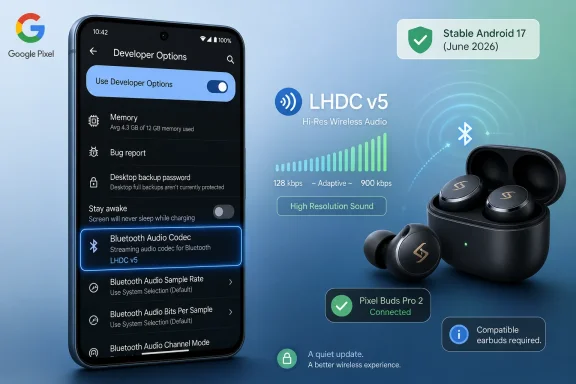
Google’s stable Android 17 update for Pixel phones, released to supported Pixel devices in June 2026, appears to add LHDC v5 Bluetooth audio codec support even though Google’s own public Android 17 feature messaging does not call it out. That omission is the story as much as the codec itself. A feature that matters most to headphone buyers, lossless-streaming subscribers, and latency-sensitive listeners arrived not as a keynote moment but as a Developer Options discovery. For WindowsForum readers, the lesson is familiar: platform upgrades often change the hardware experience in ways the marketing page never bothers to explain.
Android 17’s headline pitch is not about audiophile Bluetooth. Google has been selling the release around productivity, gaming, security, multitasking, and Pixel Drop polish, with the usual emphasis on visible features that make better screenshots than better signal chains. LHDC v5 does not fit that story neatly, because it lives in the negotiation between phone, operating system, Bluetooth stack, earbuds, companion app, and source audio.
That is exactly why it matters. The Bluetooth codec menu has long been one of Android’s most quietly consequential control panels, sitting in Developer Options where ordinary users rarely go and where enthusiasts spend too much time trying to determine whether their expensive earbuds are actually using the mode advertised on the box. Pixel owners have historically had access to mainstream codecs such as SBC, AAC, LDAC, and aptX variants depending on hardware and software support, but LHDC has been a conspicuous gap for users of earbuds from brands that leaned into that ecosystem.
The Android 17 change appears to close that gap for at least some Pixel owners. Reports began appearing during the Android 17 beta cycle, including sightings around beta 3, and the stable release has now put the option in front of users who never enrolled in the beta. GSMArena’s report frames it accurately: Google did not trumpet the change, but users are finding LHDC v5 in the Bluetooth Audio Codec selector after updating.
The silence is probably not an accident in the dramatic sense. It is more likely product triage. Google’s public release notes are written for the median phone owner; LHDC v5 is a codec detail whose real benefit depends on compatible earbuds, app toggles, source quality, radio conditions, and user expectations. Still, the absence of official emphasis leaves a vacuum that Reddit, spec sheets, and device forums are now filling.
That distinction matters. Seeing LHDC v5 in Developer Options is not the same thing as guaranteeing that every audio session will use it. Bluetooth audio is a chain, and every link gets a vote. The phone must support the codec, the headphones must support the codec, the earbuds may need a “Hi-Res Audio” or similar toggle enabled in their companion app, and the radio environment must be stable enough for the bitrate the user expects.
LHDC v5’s headline numbers are attractive. The codec supports adaptive bitrates reportedly ranging from 128Kbps up to 900Kbps, can operate at sampling rates up to 96kHz, and is marketed around lower-latency performance, with an 80ms figure often attached to the v5 profile. Those numbers put it in the same conversation as other premium Bluetooth codecs rather than the basic compatibility layer represented by SBC.
But numbers on a codec chart do not automatically become audible improvements. A user streaming a compressed podcast in a noisy subway car will not experience the same benefit as someone listening to lossless music in a quiet room with well-sealed earbuds. A gamer or video watcher may care more about latency than sampling rate. A commuter may care more about dropouts than theoretical bitrate.
That is why this kind of feature lives awkwardly between spec upgrade and experiential upgrade. It is real, but conditional. It can make compatible earbuds more useful, but it does not magically turn Pixel Bluetooth into a universal hi-fi transport.
That mismatch has always been one of Android’s stranger annoyances. The platform is open enough to support a zoo of hardware choices but fragmented enough that a feature printed on one box may disappear when paired with another. A pair of earbuds can be “Hi-Res” in one vendor’s ecosystem and ordinary AAC or LDAC-adjacent in another. Users end up reverse-engineering compatibility through forum posts and Developer Options rather than relying on clean platform promises.
Android 17’s LHDC v5 support therefore has a practical consumer effect. It may make certain earbuds better purchases for Pixel owners, and it may extend the value of earbuds that previously made more sense with OnePlus, Oppo, Xiaomi, or Nothing phones. That is not a small shift in a market where the phone-earbud bundle has become a soft form of ecosystem lock-in.
Google has its own Pixel Buds line, of course, and that complicates the optics. Pixel Buds have tended to emphasize Google integration, Assistant/Gemini features, spatial tricks, and convenience rather than chasing every audiophile codec. By adding LHDC v5 at the platform level, Google makes Pixels friendlier to third-party earbuds that may compete with its own accessories on raw audio features.
That is a good move for users, even if Google did not put it on a billboard. Platform owners earn trust when they make competing hardware work better. They lose trust when accessory features become artificially trapped inside brand pairings.
Audio codecs fall into all three categories. They are technical, compatibility-dependent, and easy to oversell. If Google says “Android 17 adds LHDC v5,” the next question is obvious: which Pixels, which earbuds, which regions, which firmware, which apps, which latency modes, which bitrates, and under what conditions? A clean blog bullet can become a support burden in minutes.
So Google’s quiet approach is understandable. It is also not ideal. Enthusiasts should not need a Reddit breadcrumb trail to understand whether a stable OS release changed a meaningful hardware capability. Nor should accessory buyers have to rely on trial-and-error to know whether a codec that exists in Android 17 actually works on their Pixel-and-earbud combination.
The deeper problem is that Android’s Bluetooth audio story still lacks a simple user-facing truth layer. A phone can show a codec option in Developer Settings, a headphone app can show a Hi-Res toggle, a music app can offer lossless tracks, and the user still may not have a clear, durable indication of what is happening during playback. That is not just an enthusiast complaint. It is a transparency problem in a market where “hi-res,” “lossless,” and “low latency” are used as buying signals.
Windows has its own version of this with display HDR, USB4 capabilities, Wi-Fi link rates, driver paths, and audio endpoint formats. The capability exists, but the truth is scattered across Settings, vendor utilities, driver panels, and forums. Android 17’s LHDC v5 surprise is another reminder that modern platforms need better ways to expose negotiated reality, not just supported features.
For users, the practical question is less theological than experiential. Does LHDC v5 sound better than AAC or SBC with a given pair of earbuds? Does it hold a stable connection at higher bitrates? Does it reduce latency enough to make videos, games, or music production apps feel better? Does enabling a high-res mode reduce battery life or connection reliability in daily use?
Those answers will vary. Some earbuds implement premium codecs gracefully; others put the logo on the box and deliver marginal differences. Some users can hear codec artifacts in familiar tracks; others will get a much bigger improvement from better ear tips, a proper seal, or turning off badly implemented audio enhancement modes. Bluetooth audio is one of those markets where the spec sheet is useful but insufficient.
The more defensible claim is that LHDC v5 gives Pixel owners another high-quality path when paired with compatible hardware. That is worth having. It makes Android 17 more flexible. It reduces the penalty for choosing earbuds outside Google’s own accessory ecosystem. It also gives buyers one more reason to examine codec support before purchasing their next pair.
But the feature should not be treated as a universal upgrade for every Pixel owner. If your earbuds do not support LHDC v5, nothing changes. If your streaming service is set to a low-quality mode, little changes. If your Bluetooth environment is crowded and unstable, pushing higher bitrates may make the experience worse rather than better.
Yet Android enthusiasts have learned to treat it as the only place where the platform tells the truth about Bluetooth codecs. That is not healthy. If a consumer buys LHDC-capable earbuds and pairs them with an Android 17 Pixel, the normal Bluetooth device panel should be able to show the active codec, available quality modes, and any constraints in plain language. The user should not have to unlock a developer menu to confirm whether a premium feature is working.
Some vendors try to solve this through companion apps. Those apps may show a Hi-Res mode, codec preference, game mode, or latency setting. But vendor apps are inconsistent, often overdesigned, and sometimes require permissions or account flows that feel disproportionate to the task. Worse, they can imply that a codec is active without making it obvious whether Android has actually negotiated that codec at the system level.
A better model would be boring and transparent. The Bluetooth device page should say, for example, “Connected using LHDC v5,” with a quality or latency preference if the hardware supports one. It should indicate when a mode is unavailable because of multipoint, microphone use, battery constraints, or app limitations. Android already knows enough of this state to expose pieces of it; it simply does not present it as a coherent consumer feature.
That is the difference between adding a capability and productizing it. Android 17 appears to have done the former. Google should still do the latter.
Pixels have occupied an odd place in that landscape. They are Google’s reference Android phones, but they have not always been the most codec-complete Android phones. That left some users in the strange position of buying the “Google phone” and discovering that a codec available on other Android handsets was not available on theirs. Android 17 narrows that gap.
This is good for the broader Android accessory market. Earbud makers can sell to Pixel owners with fewer caveats. Pixel owners can shop more broadly. Reviewers can evaluate earbuds across Android devices with one fewer compatibility footnote. The market becomes slightly less tribal, even if proprietary and semi-proprietary audio paths remain everywhere.
There is also a standards-adjacent point here. Bluetooth LE Audio and LC3 are supposed to give the industry a cleaner next-generation baseline, but adoption and user-facing clarity remain uneven. In the meantime, premium classic Bluetooth codecs continue to matter because they are what many existing earbuds actually use. LHDC v5 support is not a substitute for a better universal future, but it improves the messy present.
For Google, this is the pragmatic move. Pixels should be excellent general-purpose Android phones, not just gateways to Google-branded accessories. Quietly adding codec support is a small but meaningful act of platform stewardship.
A driver update can unlock a feature. A firmware change can break a workflow. A new OS release can expose a codec, hide a toggle, improve battery behavior, or alter latency without a retail box changing at all. The device is the same object in your hand, but the platform contract has shifted underneath it.
For sysadmins and IT pros, that matters because mobile fleets are not just email terminals anymore. They are MFA devices, softphones, conference endpoints, field-work tools, and accessibility devices. Bluetooth audio behavior affects calls, training videos, remote support, translation tools, and hands-free workflows. A codec addition may sound like consumer trivia until it changes the reliability or quality of the headset experience for a subset of users.
For enthusiasts, the lesson is more personal. Do not assume the feature list at launch is the final word on your hardware. A Pixel phone that did not support a codec last year may support it today. Earbuds that seemed tied to one vendor’s phones may become more attractive after an OS update. Conversely, a feature that appears in a beta may not always arrive cleanly in stable form, and a feature that exists in software may still depend on firmware and app support.
Windows users have been living this reality for decades. Android is simply becoming more visibly similar: a layered platform where the official changelog is only the start of the investigation.
If Android 17 supports LHDC v5, Google should eventually say so in a support document that defines the scope. Which Pixel models support it? Does support depend on Tensor generation? Are there known limitations with multipoint connections, microphone use, or specific profiles? Is this part of the Android Open Source Project base, a Pixel-specific integration, or a broader compatibility layer OEMs can adopt with Android 17?
Those are not unreasonable questions. They are the questions users ask after spending real money on phones and earbuds. They are also the questions reviewers and IT buyers need answered to separate platform capability from anecdotal success.
The risk of silence is not merely that users miss the feature. It is that the information ecosystem becomes rumor-shaped. One Redditor sees LHDC v5 on a Pixel 9. Another does not see it with a FiiO adapter. Someone else finds a Hi-Res toggle in a companion app but cannot force the expected codec. Without official scoping, every edge case becomes a mystery.
Google does not need to turn every codec into a keynote segment. It does need to treat hidden hardware enablement as documentation-worthy. That is the difference between an enthusiast discovery and a supported platform improvement.
The check should be done with the earbuds connected, their firmware updated, and any companion-app high-quality audio mode enabled. Then Developer Options can confirm whether LHDC v5 appears as an active or selectable codec. It is not elegant, but it is currently the clearest route for users who want to verify the change.
The more cautious advice is not to buy on codec alone. Earbuds are tiny computers with drivers, microphones, radios, batteries, firmware, ANC systems, and apps all competing inside a sealed pebble. A good codec cannot rescue bad tuning, poor fit, weak connection stability, or a terrible microphone. It can only improve the transport layer when the rest of the product is already competent.
Still, transport matters. Android 17 has made Pixels more compatible with a wider slice of the premium earbud market. That is good news, even if it arrived in the least glamorous possible place: a buried settings menu.
 Google Ships a Real Audio Upgrade Without the Usual Victory Lap
Android 17’s headline pitch is not about audiophile Bluetooth. Google has been selling the release around productivity, gaming, security, multitasking, and Pixel Drop polish, with the usual emphasis on visible features that make better screenshots than better signal chains. LHDC v5 does not fit that story neatly, because it lives in the negotiation between phone, operating system, Bluetooth stack, earbuds, companion app, and source audio.That is exactly why it matters. The Bluetooth codec menu has long been one of Android’s most quietly consequential control panels, sitting in Developer Options where ordinary users rarely go and where enthusiasts spend too much time trying to determine whether their expensive earbuds are actually using the mode advertised on the box. Pixel owners have historically had access to mainstream codecs such as SBC, AAC, LDAC, and aptX variants depending on hardware and software support, but LHDC has been a conspicuous gap for users of earbuds from brands that leaned into that ecosystem.
The Android 17 change appears to close that gap for at least some Pixel owners. Reports began appearing during the Android 17 beta cycle, including sightings around beta 3, and the stable release has now put the option in front of users who never enrolled in the beta. GSMArena’s report frames it accurately: Google did not trumpet the change, but users are finding LHDC v5 in the Bluetooth Audio Codec selector after updating.
The silence is probably not an accident in the dramatic sense. It is more likely product triage. Google’s public release notes are written for the median phone owner; LHDC v5 is a codec detail whose real benefit depends on compatible earbuds, app toggles, source quality, radio conditions, and user expectations. Still, the absence of official emphasis leaves a vacuum that Reddit, spec sheets, and device forums are now filling.
The Codec Menu Is Where Marketing Claims Go to Be Tested
To check the feature, Pixel owners need to do the old Android ritual: enable Developer Options by tapping Build Number repeatedly under About phone, then inspect the Bluetooth Audio Codec setting while compatible headphones are connected. If the device and earbuds negotiate LHDC v5 properly, the codec should appear as an available option. If it does not, the reason may be the earbuds, firmware, regional software, companion app settings, or the simple fact that Android’s codec menus can be more diagnostic than declarative.That distinction matters. Seeing LHDC v5 in Developer Options is not the same thing as guaranteeing that every audio session will use it. Bluetooth audio is a chain, and every link gets a vote. The phone must support the codec, the headphones must support the codec, the earbuds may need a “Hi-Res Audio” or similar toggle enabled in their companion app, and the radio environment must be stable enough for the bitrate the user expects.
LHDC v5’s headline numbers are attractive. The codec supports adaptive bitrates reportedly ranging from 128Kbps up to 900Kbps, can operate at sampling rates up to 96kHz, and is marketed around lower-latency performance, with an 80ms figure often attached to the v5 profile. Those numbers put it in the same conversation as other premium Bluetooth codecs rather than the basic compatibility layer represented by SBC.
But numbers on a codec chart do not automatically become audible improvements. A user streaming a compressed podcast in a noisy subway car will not experience the same benefit as someone listening to lossless music in a quiet room with well-sealed earbuds. A gamer or video watcher may care more about latency than sampling rate. A commuter may care more about dropouts than theoretical bitrate.
That is why this kind of feature lives awkwardly between spec upgrade and experiential upgrade. It is real, but conditional. It can make compatible earbuds more useful, but it does not magically turn Pixel Bluetooth into a universal hi-fi transport.
Pixel Owners Just Got More Value From Earbuds They Already Bought
The most immediate winners are not necessarily buyers of brand-new headphones. They are people who already own LHDC-capable earbuds and have been using them below their advertised potential on Pixel phones. Nothing Ear (2), OnePlus Buds models, and several products from Chinese Android-adjacent ecosystems have supported LHDC modes before Pixels did, creating a familiar mismatch: the earbuds had the feature, the phone did not.That mismatch has always been one of Android’s stranger annoyances. The platform is open enough to support a zoo of hardware choices but fragmented enough that a feature printed on one box may disappear when paired with another. A pair of earbuds can be “Hi-Res” in one vendor’s ecosystem and ordinary AAC or LDAC-adjacent in another. Users end up reverse-engineering compatibility through forum posts and Developer Options rather than relying on clean platform promises.
Android 17’s LHDC v5 support therefore has a practical consumer effect. It may make certain earbuds better purchases for Pixel owners, and it may extend the value of earbuds that previously made more sense with OnePlus, Oppo, Xiaomi, or Nothing phones. That is not a small shift in a market where the phone-earbud bundle has become a soft form of ecosystem lock-in.
Google has its own Pixel Buds line, of course, and that complicates the optics. Pixel Buds have tended to emphasize Google integration, Assistant/Gemini features, spatial tricks, and convenience rather than chasing every audiophile codec. By adding LHDC v5 at the platform level, Google makes Pixels friendlier to third-party earbuds that may compete with its own accessories on raw audio features.
That is a good move for users, even if Google did not put it on a billboard. Platform owners earn trust when they make competing hardware work better. They lose trust when accessory features become artificially trapped inside brand pairings.
The Quiet Rollout Says Something About Android’s Priorities
There is a pattern here that will feel familiar to Windows administrators. The big public changelog describes the surface of the release; the actual release changes the operating system’s behavior in dozens of ways that matter to specialists. Sometimes those changes are buried because they are too technical. Sometimes they are under-explained because they are not fully productized. Sometimes the marketing team simply does not think the audience is large enough.Audio codecs fall into all three categories. They are technical, compatibility-dependent, and easy to oversell. If Google says “Android 17 adds LHDC v5,” the next question is obvious: which Pixels, which earbuds, which regions, which firmware, which apps, which latency modes, which bitrates, and under what conditions? A clean blog bullet can become a support burden in minutes.
So Google’s quiet approach is understandable. It is also not ideal. Enthusiasts should not need a Reddit breadcrumb trail to understand whether a stable OS release changed a meaningful hardware capability. Nor should accessory buyers have to rely on trial-and-error to know whether a codec that exists in Android 17 actually works on their Pixel-and-earbud combination.
The deeper problem is that Android’s Bluetooth audio story still lacks a simple user-facing truth layer. A phone can show a codec option in Developer Settings, a headphone app can show a Hi-Res toggle, a music app can offer lossless tracks, and the user still may not have a clear, durable indication of what is happening during playback. That is not just an enthusiast complaint. It is a transparency problem in a market where “hi-res,” “lossless,” and “low latency” are used as buying signals.
Windows has its own version of this with display HDR, USB4 capabilities, Wi-Fi link rates, driver paths, and audio endpoint formats. The capability exists, but the truth is scattered across Settings, vendor utilities, driver panels, and forums. Android 17’s LHDC v5 surprise is another reminder that modern platforms need better ways to expose negotiated reality, not just supported features.
LHDC v5 Is Not a Lossless Fairy Wand
The article that sparked the current attention mentions trying the feature with high-quality music, including streaming services with lossless modes. That is sensible advice, but it also risks blurring a line worth keeping sharp. LHDC v5 can support higher-bitrate Bluetooth transmission than basic codecs, but Bluetooth audio remains constrained by codec behavior, radio conditions, implementation quality, and the fact that “lossless source” does not necessarily mean “lossless end-to-end wireless playback.”For users, the practical question is less theological than experiential. Does LHDC v5 sound better than AAC or SBC with a given pair of earbuds? Does it hold a stable connection at higher bitrates? Does it reduce latency enough to make videos, games, or music production apps feel better? Does enabling a high-res mode reduce battery life or connection reliability in daily use?
Those answers will vary. Some earbuds implement premium codecs gracefully; others put the logo on the box and deliver marginal differences. Some users can hear codec artifacts in familiar tracks; others will get a much bigger improvement from better ear tips, a proper seal, or turning off badly implemented audio enhancement modes. Bluetooth audio is one of those markets where the spec sheet is useful but insufficient.
The more defensible claim is that LHDC v5 gives Pixel owners another high-quality path when paired with compatible hardware. That is worth having. It makes Android 17 more flexible. It reduces the penalty for choosing earbuds outside Google’s own accessory ecosystem. It also gives buyers one more reason to examine codec support before purchasing their next pair.
But the feature should not be treated as a universal upgrade for every Pixel owner. If your earbuds do not support LHDC v5, nothing changes. If your streaming service is set to a low-quality mode, little changes. If your Bluetooth environment is crowded and unstable, pushing higher bitrates may make the experience worse rather than better.
The Developer Options Detour Is a Bad User Experience
The fact that users may need to inspect or toggle LHDC v5 through Developer Options is a problem hiding in plain sight. Developer Options is not designed as a consumer audio dashboard. It is a diagnostic and testing area full of settings that can confuse users, degrade experience, or create support noise when changed casually.Yet Android enthusiasts have learned to treat it as the only place where the platform tells the truth about Bluetooth codecs. That is not healthy. If a consumer buys LHDC-capable earbuds and pairs them with an Android 17 Pixel, the normal Bluetooth device panel should be able to show the active codec, available quality modes, and any constraints in plain language. The user should not have to unlock a developer menu to confirm whether a premium feature is working.
Some vendors try to solve this through companion apps. Those apps may show a Hi-Res mode, codec preference, game mode, or latency setting. But vendor apps are inconsistent, often overdesigned, and sometimes require permissions or account flows that feel disproportionate to the task. Worse, they can imply that a codec is active without making it obvious whether Android has actually negotiated that codec at the system level.
A better model would be boring and transparent. The Bluetooth device page should say, for example, “Connected using LHDC v5,” with a quality or latency preference if the hardware supports one. It should indicate when a mode is unavailable because of multipoint, microphone use, battery constraints, or app limitations. Android already knows enough of this state to expose pieces of it; it simply does not present it as a coherent consumer feature.
That is the difference between adding a capability and productizing it. Android 17 appears to have done the former. Google should still do the latter.
The Accessory Ecosystem Gets a Little Less Tribal
Codec support has become one of the quieter ways phone makers steer users toward their own accessory ecosystems. Apple has its integrated AirPods experience. Samsung has its Samsung Seamless Codec path. Qualcomm-backed devices often lean on aptX variants. Sony has made LDAC a recognizable badge. LHDC has been more visible in parts of the Android market where Chinese OEMs and their accessory partners have shaped the experience.Pixels have occupied an odd place in that landscape. They are Google’s reference Android phones, but they have not always been the most codec-complete Android phones. That left some users in the strange position of buying the “Google phone” and discovering that a codec available on other Android handsets was not available on theirs. Android 17 narrows that gap.
This is good for the broader Android accessory market. Earbud makers can sell to Pixel owners with fewer caveats. Pixel owners can shop more broadly. Reviewers can evaluate earbuds across Android devices with one fewer compatibility footnote. The market becomes slightly less tribal, even if proprietary and semi-proprietary audio paths remain everywhere.
There is also a standards-adjacent point here. Bluetooth LE Audio and LC3 are supposed to give the industry a cleaner next-generation baseline, but adoption and user-facing clarity remain uneven. In the meantime, premium classic Bluetooth codecs continue to matter because they are what many existing earbuds actually use. LHDC v5 support is not a substitute for a better universal future, but it improves the messy present.
For Google, this is the pragmatic move. Pixels should be excellent general-purpose Android phones, not just gateways to Google-branded accessories. Quietly adding codec support is a small but meaningful act of platform stewardship.
Why WindowsForum Readers Should Care About an Android Codec
At first glance, this is not a Windows story. It is a Pixel story, an Android story, and an earbud story. But the underlying issue is one every WindowsForum reader recognizes: operating systems increasingly define the capabilities of hardware people already own.A driver update can unlock a feature. A firmware change can break a workflow. A new OS release can expose a codec, hide a toggle, improve battery behavior, or alter latency without a retail box changing at all. The device is the same object in your hand, but the platform contract has shifted underneath it.
For sysadmins and IT pros, that matters because mobile fleets are not just email terminals anymore. They are MFA devices, softphones, conference endpoints, field-work tools, and accessibility devices. Bluetooth audio behavior affects calls, training videos, remote support, translation tools, and hands-free workflows. A codec addition may sound like consumer trivia until it changes the reliability or quality of the headset experience for a subset of users.
For enthusiasts, the lesson is more personal. Do not assume the feature list at launch is the final word on your hardware. A Pixel phone that did not support a codec last year may support it today. Earbuds that seemed tied to one vendor’s phones may become more attractive after an OS update. Conversely, a feature that appears in a beta may not always arrive cleanly in stable form, and a feature that exists in software may still depend on firmware and app support.
Windows users have been living this reality for decades. Android is simply becoming more visibly similar: a layered platform where the official changelog is only the start of the investigation.
The Pixel Update Hides a Useful Test for Google’s Platform Maturity
The LHDC v5 rollout is small enough to ignore and revealing enough not to. Mature platforms are judged not only by the features they add, but by how clearly they communicate the conditions under which those features work. Google has improved Android’s update cadence, Pixel feature delivery, and security posture over the years, but hardware capability transparency remains a weak spot.If Android 17 supports LHDC v5, Google should eventually say so in a support document that defines the scope. Which Pixel models support it? Does support depend on Tensor generation? Are there known limitations with multipoint connections, microphone use, or specific profiles? Is this part of the Android Open Source Project base, a Pixel-specific integration, or a broader compatibility layer OEMs can adopt with Android 17?
Those are not unreasonable questions. They are the questions users ask after spending real money on phones and earbuds. They are also the questions reviewers and IT buyers need answered to separate platform capability from anecdotal success.
The risk of silence is not merely that users miss the feature. It is that the information ecosystem becomes rumor-shaped. One Redditor sees LHDC v5 on a Pixel 9. Another does not see it with a FiiO adapter. Someone else finds a Hi-Res toggle in a companion app but cannot force the expected codec. Without official scoping, every edge case becomes a mystery.
Google does not need to turn every codec into a keynote segment. It does need to treat hidden hardware enablement as documentation-worthy. That is the difference between an enthusiast discovery and a supported platform improvement.
The Small Codec Switch That Changes the Buying Advice
For Pixel owners, the practical advice now changes, but only carefully. If you are buying earbuds and care about high-bitrate Bluetooth audio or lower-latency modes, LHDC v5 support should be part of the checklist alongside LDAC, aptX variants, battery life, microphone quality, multipoint behavior, and fit. If you already own LHDC-capable earbuds, Android 17 is worth checking because it may unlock a mode you could not use before.The check should be done with the earbuds connected, their firmware updated, and any companion-app high-quality audio mode enabled. Then Developer Options can confirm whether LHDC v5 appears as an active or selectable codec. It is not elegant, but it is currently the clearest route for users who want to verify the change.
The more cautious advice is not to buy on codec alone. Earbuds are tiny computers with drivers, microphones, radios, batteries, firmware, ANC systems, and apps all competing inside a sealed pebble. A good codec cannot rescue bad tuning, poor fit, weak connection stability, or a terrible microphone. It can only improve the transport layer when the rest of the product is already competent.
Still, transport matters. Android 17 has made Pixels more compatible with a wider slice of the premium earbud market. That is good news, even if it arrived in the least glamorous possible place: a buried settings menu.
The Android 17 Audio Surprise Leaves Pixel Users With a Short Checklist
The hidden nature of the change means users should verify before celebrating. A few minutes of checking can separate a real upgrade from a spec-sheet misunderstanding.- Pixel owners should update to stable Android 17 before expecting LHDC v5 to appear outside the beta channel.
- Compatible earbuds must support LHDC v5 themselves, and some models may require a companion-app setting before Android can use the codec.
- Developer Options remains the most direct place to inspect the Bluetooth Audio Codec setting, even though it is a poor substitute for a normal user-facing status panel.
- A lossless or high-quality music source makes codec differences easier to evaluate, but it does not guarantee lossless wireless playback end to end.
- Users should test stability, latency, battery life, and call behavior rather than assuming the highest bitrate setting is always the best daily choice.
- Google should document the scope of Pixel LHDC v5 support so that buyers are not forced to rely on forum archaeology.
References
- Primary source: gsmarena.com
Published: Mon, 22 Jun 2026 18:00:02 GMT
Loading…
www.gsmarena.com - Related coverage: androidcentral.com
Android 17 is finally here — here's what's new and who's getting it | Android Central
Android 17 is now available, and here's what's new along with which devices are eligible.www.androidcentral.com - Related coverage: techradar.com
7 of the best Android 17 features available now — from Bubbles to Screen Reactions | TechRadar
Expect new tools and upgraded abilitieswww.techradar.com - Related coverage: techcrunch.com
Android 17 launches with new multitasking tools as Google expands Gemini features | TechCrunch
Google has released Android 17 and Wear OS 7, introducing new multitasking features, parental controls, security tools, and smartwatch upgrades. The launch is also accompanied by a Pixel Drop that brings Google’s latest AI models to its devices.techcrunch.com - Related coverage: tomsguide.com
Android 17 officially rolls out to Pixel devices with new features — screen reactions, bubbles, gaming mode, and more | Tom's Guide
Google's massive June 2026 software drop delivers Android 17's productivity and security overhauls to Pixel devices, alongside new Wear OS 7 features.www.tomsguide.com - Related coverage: phonearena.com
Android 17 just dropped for Pixel phones and Watch all at once - the biggest update of the year - PhoneArena
From real multitasking to better battery life, here is what landed today.www.phonearena.com
- Related coverage: androidauthority.com
Android 17 stable is officially rolling out to Google Pixels, here's what's new!
Google launches Android 17 stable for Pixel 6 and newer, bringing App Bubbles, enhanced privacy controls, and security improvements.www.androidauthority.com - Related coverage: blog.google
Android 17 has new features for productivity, gaming and security
Explore the latest features in Android 17, including enhanced productivity, gaming and security.blog.google - Official source: support.google.com
Loading…
support.google.com - Related coverage: gadgets360.com
Loading…
www.gadgets360.com - Related coverage: developer.android.com
Loading…
developer.android.com - Related coverage: android-developers.googleblog.com
Android Developers Blog: Android 17 is here
News and insights on the Android platform, developer tools, and events.android-developers.googleblog.com
- Related coverage: cincodias.elpais.com
Android 17 ya está aquí: esto es lo más importante que ofrece y los Pixel compatibles | Smartphones | Smartlife | Cinco Días
Ya ha comenzado el despliegue de esta iteración del sistema operativo de la firma de Mountain View para sus teléfonos Pixel.cincodias.elpais.com - Related coverage: los40.com
Android 17 ya es oficial: la ambiciosa revolución que rompe las barreras con el iPhone | Dispositivos | LOS40
Google rediseña por completo las reglas de su sistema operativo. Analizamos las funciones más radicales, el inédito calendario de lanzamiento para este verano y los primeros móviles que se actualizarán.los40.com