

Android 17 began rolling out to supported Pixel devices in June 2026 with app bubbles, privacy refinements, expanded dark-theme controls, foldable improvements, and the usual security plumbing, but its most revealing feature is how little it feels like an old-fashioned Android milestone. That is not a failure of ambition so much as evidence that the operating system has become infrastructure. The magic has not vanished; Google has moved it out of the annual version number and into a rolling services machine that changes phones continuously, unevenly, and often invisibly.
There was a time when an Android release could redraw the emotional map of owning a phone. A new dessert name, a new lock screen, a new navigation model, a new design language: these were not just release notes but visible proof that the device in your pocket had crossed a threshold. Android updates felt like events because the platform was still deciding what it wanted to be.
Android 17 lands in a different world. The phone is no longer waiting for an annual operating-system update to become modern. Its assistant, search box, camera tools, malware defenses, app store experience, messaging features, and cloud-linked conveniences are already being adjusted by Google Play services, Pixel Drops, Android Drops, app updates, server-side switches, and AI model deployments.
That makes Android 17 easy to underrate. If you install it and expect the kind of jolt that came with Material Design or gesture navigation, the update feels almost bashful. If you look at it as a platform release for an ecosystem spanning phones, tablets, foldables, cars, watches, TVs, and eventually glasses, its caution makes more sense.
The annual Android version is no longer where Google stages every major idea. It is where Google hardens the floor beneath ideas that now arrive on their own schedule.
But app bubbles do not transform the identity of Android in the way that Material Design did. They do not teach users a new mental model for the phone in the way gesture navigation did. They are a refinement: useful, overdue, and most obvious to people who already push their phones beyond single-app use.
The same is true of the other user-facing changes. Hiding app labels on the home screen is a small but welcome concession to people who treat their launchers as visual spaces rather than directories. Expanded dark-theme controls help paper over the stubborn reality that some apps still refuse to behave like good citizens. Temporary precise-location sharing is exactly the kind of privacy improvement mature operating systems should make routine.
These are not trivial changes. They are just not theatrical ones. Android 17’s problem, if we want to call it that, is that the improvements most worth having are the least likely to sell the update.
That is what maturity looks like in platform software. The more essential the operating system becomes, the more its best work happens below the surface. Users want better battery life, fewer permission abuses, faster app launches, more consistent security enforcement, and less friction when moving between devices. None of that produces the dopamine hit of a new home-screen redesign.
Today, the cadence is messier but more effective. Pixel Drops deliver features to Google’s own phones. Android Drops push some capabilities more broadly across the ecosystem. Google Play system updates can revise core components without requiring a full operating-system upgrade. Individual apps, from Photos to Messages to the Play Store, now carry features that would once have been described as platform-level.
This is better engineering and worse theater. The software improves more often, but the user gets fewer ceremonial moments. Instead of one dramatic annual package, there are dozens of small arrivals, many of them enabled quietly and explained after the fact.
That shift changes how people perceive progress. A phone that improves every month can paradoxically feel less exciting than one that changes once a year, because the user never gets the contrast of before and after. The absence of drama becomes mistaken for the absence of development.
Google is not alone here. Windows, iOS, macOS, ChromeOS, and major cloud platforms have all moved toward rolling updates, feature flags, and service-delivered capabilities. But Android’s version number still carries the cultural baggage of the smartphone era’s early years, when a major OS update meant visible reinvention.
Android 17 exposes the mismatch. Users still expect fireworks from the version number. Google is increasingly using the version number to certify the scaffolding.
That is not because every AI feature is useful, polished, or wanted. It is because Google clearly sees Gemini as the new interaction layer across Android. The assistant is no longer just a voice query box bolted onto the side of the phone; it is becoming a broker between users, apps, media, search, shopping, productivity, and personal context.
That has profound consequences for Android updates. If Gemini can summarize, edit, search, automate, generate, identify, and eventually act inside apps, then the annual OS version becomes less important as the place where user-facing novelty appears. The model, the cloud service, the app integration, and the permission framework matter more.
This also explains why the excitement feels displaced. A new AI editing feature in Photos, a shopping assist in Search, a smarter dictation system, or an agentic Gemini action may change how a person uses the phone more than the Android 17 version bump does. But those features may arrive through app updates, subscription tiers, server-side rollouts, or device-specific hardware requirements.
The result is a fragmented kind of magic. Some users get the new thing. Some users get it later. Some users discover that their phone is technically on the latest Android version but lacks the silicon, model access, region support, or account eligibility required for the advertised future.
That is the bargain Google is making. AI lets Android evolve faster than the annual release cycle. It also makes Android feel less like a common platform and more like a set of entitlements.
When Google ships Android 17 alongside a Pixel Drop, the user experience merges two separate things: the platform update and the device-family update. A Pixel owner sees the bundle and reasonably concludes that this is “Android 17.” A Samsung or OnePlus owner later receives Android 17 and may find that the most talked-about experiences are absent, delayed, redesigned, or replaced by the manufacturer’s own equivalents.
This is not new, but AI makes it more consequential. Hardware differences already mattered for camera processing and on-device speech recognition. Now they may determine whether a phone gets the most advanced assistant behavior, local model execution, or app automation. The Android version number becomes a weaker proxy for capability.
That matters for buyers. A consumer may see “seven years of Android updates” and assume the phone will remain functionally current for the full support window. Security and compatibility may hold up, but feature parity is a different promise. The AI era gives vendors more ways to say a device is supported while withholding the features that make newer devices feel meaningfully different.
For enthusiasts, that is annoying. For regulators and enterprise buyers, it may become a sharper question. If AI features become central to accessibility, productivity, or security, the distinction between “supported” and “fully capable” will need more scrutiny.
Android 17 answers that world. It is not a revolution because the phone no longer needs annual revolution. The modern smartphone is a utility, wallet, authenticator, car key, medical alert device, work terminal, camera, boarding pass, and communications hub. Reinventing that interface every year would be reckless.
This is where Android’s trajectory starts to resemble Windows. Microsoft learned, painfully, that users may say they want innovation but revolt when the Start menu, taskbar, settings model, or default apps change too aggressively. Platform owners eventually discover that stability is not creative defeat. It is the price of ubiquity.
Android is now in that club. Its job is less to surprise and more to avoid betrayal. The best update is often the one that makes yesterday’s habits safer, faster, and more durable.
That does not mean Google should stop taking risks. It means the risks will increasingly live above Android rather than inside its core interaction model.
Most users do not care whether a feature arrived through Android 17, a Pixel Drop, Google Play services, or the Gemini app. They care whether their phone is better today than it was yesterday. The technical delivery mechanism is invisible until it creates confusion, delay, or exclusion.
That is why the Android Authority argument resonates even if the headline overstates the case. Android updates have lost some of their magic because magic, in this context, meant legibility. The user could point to one update and say: this is when my phone changed.
Now the change is distributed. The system becomes more capable in small increments, and the most important features may be announced at I/O, enabled in a Drop, restricted to certain Pixels, updated through Gemini, and later copied or modified by OEM skins. The experience improves, but the story blurs.
For publications, forums, and power users, that blurring is frustrating. It makes coverage harder. It makes advice harder. It makes troubleshooting harder. “Are you on Android 17?” is no longer enough; the better question is which device, which launcher, which Play system update, which app version, which region, which account tier, and which server-side flags.
That is not romantic. It is, however, the reality of a mature mobile platform run like a cloud service.
But fragmentation did not disappear. It evolved.
The new fragmentation is feature fragmentation. Two phones can run the same Android version while offering different AI capabilities, different multitasking implementations, different privacy surfaces, different camera intelligence, different assistant integrations, and different update timing. The version number tells only part of the story.
Android 17’s app bubbles are a useful example. On Pixels, they arrive as a fresh multitasking feature. On Samsung devices, they will land in a world where One UI already has years of floating-window and split-screen behavior. On foldables, the feature has a different practical value than on slab phones. On tablets, it may feel like a small step toward desktop-style productivity. The same platform feature has different meaning depending on the device class and OEM layer.
This is not necessarily bad. Android’s diversity is still one of its strengths. But it makes Google’s platform narrative harder to sustain. “Android 17” is not one experience. It is a baseline from which manufacturers and Google’s own services diverge.
The same will be true of AI, only more so. Model availability, on-device acceleration, privacy settings, subscription status, and regional regulation will shape what Android can actually do. The version number will matter less than the capability matrix.
Yet this is where operating-system updates still earn their keep. A mature Android release should make abuse harder. It should reduce the blast radius of bad apps, tighten default behaviors, and give users meaningful control without burying them in prompts they will blindly accept.
Temporary precise-location sharing is a small example of the right instinct. Not every app needs ongoing access to exact coordinates, and not every user wants to manage a permissions audit after trying a one-off travel, delivery, or event app. The best privacy features are the ones that match real behavior: people grant permissions in the moment, forget about them later, and need the system to limit the consequences.
Contact access is another area where mobile operating systems are finally catching up to common sense. Users should not have to hand an app their entire address book just to invite one person or fill one field. Granular, temporary, user-selected sharing is less flashy than a new lock screen, but it is more important.
This is the kind of Android improvement that will never restore the old excitement. It will simply prevent future damage. That is a different kind of value, and one the industry should have learned to respect by now.
That pressure comes from hardware. Foldables need better multitasking to justify their size and price. Tablets need more than blown-up phone apps. Desktop modes need a clearer reason to exist. AI assistants need surfaces where they can act alongside the user rather than simply replacing one full-screen app with another.
App bubbles are not the final answer, but they are a signal. Google is making Android more comfortable with persistent, overlapping tasks. That matters because the next phase of mobile computing may be less about opening apps and more about orchestrating them.
The irony is that this could become genuinely exciting, but not all at once. Android’s desktop-adjacent future will likely arrive through a sequence of dull-sounding platform primitives: windowing APIs, input handling, display modes, task persistence, app continuity, permission boundaries, and developer guidelines. The visible payoff may lag the plumbing by years.
Windows users know this story well. The features that reshape computing often begin as awkward infrastructure. Only later does the interface catch up.
A developer building for Android 17 has to think about app bubbles, large-screen behavior, privacy prompts, dark-theme compatibility, contact and location access, and whatever AI-mediated interactions Google encourages next. But the same developer also has to account for OEM variations, Play services dependencies, older Android versions, and feature availability that may not map neatly to the OS version.
The problem is not merely technical. It is strategic. If Gemini can take actions inside apps, developers must decide how much of their experience should be exposed to the assistant layer. If Android emphasizes floating multitasking, developers must make interfaces that remain coherent in resized or partial-window contexts. If users expect privacy-limited sharing, developers must stop designing around broad permissions.
This is healthier than the old model in which apps grabbed too much access and assumed one screen size. But it raises the cost of doing Android well. The more mature the platform becomes, the less forgiving it is of lazy assumptions.
That may be good for users. It may also widen the gap between polished, well-funded apps and everything else.
Of course the updates felt dramatic. They were fixing foundational problems.
Today’s Android has fewer obvious holes. That makes progress harder to dramatize. A platform cannot introduce a once-in-a-generation design language every few years without becoming incoherent. It cannot repeatedly reinvent navigation without training users to distrust muscle memory. It cannot move fast forever without eventually deciding which parts should stand still.
There is also a marketing problem. Google has trained users to associate excitement with AI, not Android. The company’s demos now center on what Gemini can understand, generate, automate, or summarize. Android is the stage, not the actor.
That is a risky arrangement. If AI features impress, Android gets less credit than it once would have. If AI features annoy, fail, or feel invasive, Android may absorb the blame. The operating system becomes both more important and less visible.
This is the platform owner’s paradox: success turns the OS into plumbing, and nobody applauds plumbing until the house floods.
There are still areas where Android needs visible ambition. Tablet software remains inconsistent. Foldables still require more cohesive app behavior. Desktop mode still feels like a promise that has been deferred for too long. Notifications, settings, backups, cross-device continuity, and family management could all be more coherent. The Play Store remains a battleground of quality, advertising, subscriptions, scams, and discovery problems.
Google also needs to be clearer about what belongs to Android and what belongs to Pixel. If Android Drops are meant to broaden access, they should be explained as such. If Pixel Drops are exclusive showcases, Google should stop letting the distinction blur into marketing fog. If Gemini features require specific chips, accounts, subscriptions, or regions, users deserve plain language before they buy hardware.
Maturity should mean trust. Trust requires predictability, not just stability. It requires knowing what your device will get, when it will get it, and which features are part of the platform rather than the sales pitch for next year’s phone.
Android 17 does many reasonable things. The question is whether Google can make reasonable feel reliable instead of merely quiet.
That is why Android 17 can be both important and underwhelming. It can deliver necessary APIs and system behaviors while leaving the biggest user-facing changes to Gemini, Pixel software, Google apps, and cloud-side switches. The system update becomes a gate, not the whole journey.
For IT pros, this matters. Managing Android devices is no longer only about OS patch levels. It is about Play system updates, app versions, OEM firmware, enterprise policy controls, assistant availability, data-handling settings, and the growing role of AI features that may interact with corporate apps or sensitive content.
For enthusiasts, it means the old ritual of obsessing over the next major Android version is less rewarding. The more interesting work may happen in betas, feature drops, developer APIs, and AI rollouts that do not line up with the number on the About screen.
For ordinary users, it means a phone can improve without explanation. That is convenient until it becomes confusing. Google’s challenge is to make continuous delivery feel like care rather than randomness.
That trade has practical consequences.
The report also points to Android 17’s screen-reaction recording feature, which lets users overlay their selfie-camera reaction on top of an image or clip with only a few taps. It is a small social-media-oriented addition, but it underlines the article’s larger point: some of Android 17’s most visible changes are practical workflow conveniences rather than platform reinventions.
More consequential for families and device security, Mashable notes that Android 17 expands parental controls beyond their earlier Pixel rollout, including Google Play download filtering, bedtime lock schedules, and screen-time limits. It also highlights Mark as Lost in Find Hub, which can remotely lock a missing phone and require biometrics even if someone knows the PIN.
For WindowsForum readers managing Android fleets or family devices, those last two items are the most practical additions: Android 17 is not just about multitasking polish, but also tighter recovery and supervision tools that may reduce support headaches when devices are lost, shared, or used by children.
 Android’s Big Reveal Is That the Big Reveal Is Over
There was a time when an Android release could redraw the emotional map of owning a phone. A new dessert name, a new lock screen, a new navigation model, a new design language: these were not just release notes but visible proof that the device in your pocket had crossed a threshold. Android updates felt like events because the platform was still deciding what it wanted to be.Android 17 lands in a different world. The phone is no longer waiting for an annual operating-system update to become modern. Its assistant, search box, camera tools, malware defenses, app store experience, messaging features, and cloud-linked conveniences are already being adjusted by Google Play services, Pixel Drops, Android Drops, app updates, server-side switches, and AI model deployments.
That makes Android 17 easy to underrate. If you install it and expect the kind of jolt that came with Material Design or gesture navigation, the update feels almost bashful. If you look at it as a platform release for an ecosystem spanning phones, tablets, foldables, cars, watches, TVs, and eventually glasses, its caution makes more sense.
The annual Android version is no longer where Google stages every major idea. It is where Google hardens the floor beneath ideas that now arrive on their own schedule.
The Incremental Update Is a Symptom, Not the Disease
Calling Android 17 incremental is accurate, but it is not especially damning. The marquee addition, app bubbles, is meaningful for multitasking, especially on large screens and foldables. The ability to turn apps into floating windows gives Pixel users a system-level taste of behavior Samsung owners have enjoyed in various forms for years.But app bubbles do not transform the identity of Android in the way that Material Design did. They do not teach users a new mental model for the phone in the way gesture navigation did. They are a refinement: useful, overdue, and most obvious to people who already push their phones beyond single-app use.
The same is true of the other user-facing changes. Hiding app labels on the home screen is a small but welcome concession to people who treat their launchers as visual spaces rather than directories. Expanded dark-theme controls help paper over the stubborn reality that some apps still refuse to behave like good citizens. Temporary precise-location sharing is exactly the kind of privacy improvement mature operating systems should make routine.
These are not trivial changes. They are just not theatrical ones. Android 17’s problem, if we want to call it that, is that the improvements most worth having are the least likely to sell the update.
That is what maturity looks like in platform software. The more essential the operating system becomes, the more its best work happens below the surface. Users want better battery life, fewer permission abuses, faster app launches, more consistent security enforcement, and less friction when moving between devices. None of that produces the dopamine hit of a new home-screen redesign.
Google Has Turned Android Into a Release Train
The old Android story was built around scarcity. Google would spend a year developing a major release, push preview builds to enthusiasts, polish the thing for Pixel phones or Nexus devices, and then watch the ecosystem take months or years to distribute it. That lag made the release feel more precious, even when it was frustrating.Today, the cadence is messier but more effective. Pixel Drops deliver features to Google’s own phones. Android Drops push some capabilities more broadly across the ecosystem. Google Play system updates can revise core components without requiring a full operating-system upgrade. Individual apps, from Photos to Messages to the Play Store, now carry features that would once have been described as platform-level.
This is better engineering and worse theater. The software improves more often, but the user gets fewer ceremonial moments. Instead of one dramatic annual package, there are dozens of small arrivals, many of them enabled quietly and explained after the fact.
That shift changes how people perceive progress. A phone that improves every month can paradoxically feel less exciting than one that changes once a year, because the user never gets the contrast of before and after. The absence of drama becomes mistaken for the absence of development.
Google is not alone here. Windows, iOS, macOS, ChromeOS, and major cloud platforms have all moved toward rolling updates, feature flags, and service-delivered capabilities. But Android’s version number still carries the cultural baggage of the smartphone era’s early years, when a major OS update meant visible reinvention.
Android 17 exposes the mismatch. Users still expect fireworks from the version number. Google is increasingly using the version number to certify the scaffolding.
AI Has Become the New Operating-System Layer
The biggest Android story in 2026 is not Android 17. It is Gemini.That is not because every AI feature is useful, polished, or wanted. It is because Google clearly sees Gemini as the new interaction layer across Android. The assistant is no longer just a voice query box bolted onto the side of the phone; it is becoming a broker between users, apps, media, search, shopping, productivity, and personal context.
That has profound consequences for Android updates. If Gemini can summarize, edit, search, automate, generate, identify, and eventually act inside apps, then the annual OS version becomes less important as the place where user-facing novelty appears. The model, the cloud service, the app integration, and the permission framework matter more.
This also explains why the excitement feels displaced. A new AI editing feature in Photos, a shopping assist in Search, a smarter dictation system, or an agentic Gemini action may change how a person uses the phone more than the Android 17 version bump does. But those features may arrive through app updates, subscription tiers, server-side rollouts, or device-specific hardware requirements.
The result is a fragmented kind of magic. Some users get the new thing. Some users get it later. Some users discover that their phone is technically on the latest Android version but lacks the silicon, model access, region support, or account eligibility required for the advertised future.
That is the bargain Google is making. AI lets Android evolve faster than the annual release cycle. It also makes Android feel less like a common platform and more like a set of entitlements.
The Pixel Is Now Both Showcase and Warning
Pixel phones have always played a strange role in Android. They are Google’s reference devices, consumer products, AI showcases, camera laboratories, and ecosystem levers. Android 17 continues that tradition, but the line between Android and Pixel has become harder for ordinary users to parse.When Google ships Android 17 alongside a Pixel Drop, the user experience merges two separate things: the platform update and the device-family update. A Pixel owner sees the bundle and reasonably concludes that this is “Android 17.” A Samsung or OnePlus owner later receives Android 17 and may find that the most talked-about experiences are absent, delayed, redesigned, or replaced by the manufacturer’s own equivalents.
This is not new, but AI makes it more consequential. Hardware differences already mattered for camera processing and on-device speech recognition. Now they may determine whether a phone gets the most advanced assistant behavior, local model execution, or app automation. The Android version number becomes a weaker proxy for capability.
That matters for buyers. A consumer may see “seven years of Android updates” and assume the phone will remain functionally current for the full support window. Security and compatibility may hold up, but feature parity is a different promise. The AI era gives vendors more ways to say a device is supported while withholding the features that make newer devices feel meaningfully different.
For enthusiasts, that is annoying. For regulators and enterprise buyers, it may become a sharper question. If AI features become central to accessibility, productivity, or security, the distinction between “supported” and “fully capable” will need more scrutiny.
Boring Is What Users Asked For
The uncomfortable truth is that many of the people mourning the loss of Android’s old excitement also spent years asking Google to stop breaking things. They wanted longer support windows, fewer regressions, better standby battery life, less OEM meddling, stricter privacy controls, and more reliable background behavior. Those are the demands of a platform that has grown up.Android 17 answers that world. It is not a revolution because the phone no longer needs annual revolution. The modern smartphone is a utility, wallet, authenticator, car key, medical alert device, work terminal, camera, boarding pass, and communications hub. Reinventing that interface every year would be reckless.
This is where Android’s trajectory starts to resemble Windows. Microsoft learned, painfully, that users may say they want innovation but revolt when the Start menu, taskbar, settings model, or default apps change too aggressively. Platform owners eventually discover that stability is not creative defeat. It is the price of ubiquity.
Android is now in that club. Its job is less to surprise and more to avoid betrayal. The best update is often the one that makes yesterday’s habits safer, faster, and more durable.
That does not mean Google should stop taking risks. It means the risks will increasingly live above Android rather than inside its core interaction model.
The Enthusiast Lens Is Getting Less Useful
Android enthusiasts helped define the platform’s culture. They flashed ROMs, chased beta builds, compared launchers, argued about navigation bars, and treated every update as a statement of identity. That culture still matters, but it is no longer the center of Android’s gravity.Most users do not care whether a feature arrived through Android 17, a Pixel Drop, Google Play services, or the Gemini app. They care whether their phone is better today than it was yesterday. The technical delivery mechanism is invisible until it creates confusion, delay, or exclusion.
That is why the Android Authority argument resonates even if the headline overstates the case. Android updates have lost some of their magic because magic, in this context, meant legibility. The user could point to one update and say: this is when my phone changed.
Now the change is distributed. The system becomes more capable in small increments, and the most important features may be announced at I/O, enabled in a Drop, restricted to certain Pixels, updated through Gemini, and later copied or modified by OEM skins. The experience improves, but the story blurs.
For publications, forums, and power users, that blurring is frustrating. It makes coverage harder. It makes advice harder. It makes troubleshooting harder. “Are you on Android 17?” is no longer enough; the better question is which device, which launcher, which Play system update, which app version, which region, which account tier, and which server-side flags.
That is not romantic. It is, however, the reality of a mature mobile platform run like a cloud service.
Fragmentation Has Changed Its Shape
Android’s original fragmentation problem was blunt: some phones did not get the new version, or got it late. Google responded with years of architectural work, modularization, Play services expansion, Project Mainline, longer support commitments, and closer pressure on device makers. The situation is much better than it was in the bad old days.But fragmentation did not disappear. It evolved.
The new fragmentation is feature fragmentation. Two phones can run the same Android version while offering different AI capabilities, different multitasking implementations, different privacy surfaces, different camera intelligence, different assistant integrations, and different update timing. The version number tells only part of the story.
Android 17’s app bubbles are a useful example. On Pixels, they arrive as a fresh multitasking feature. On Samsung devices, they will land in a world where One UI already has years of floating-window and split-screen behavior. On foldables, the feature has a different practical value than on slab phones. On tablets, it may feel like a small step toward desktop-style productivity. The same platform feature has different meaning depending on the device class and OEM layer.
This is not necessarily bad. Android’s diversity is still one of its strengths. But it makes Google’s platform narrative harder to sustain. “Android 17” is not one experience. It is a baseline from which manufacturers and Google’s own services diverge.
The same will be true of AI, only more so. Model availability, on-device acceleration, privacy settings, subscription status, and regional regulation will shape what Android can actually do. The version number will matter less than the capability matrix.
Security Is the Quiet Star of the Modern Update
If Android 17 feels boring, part of the reason is that security work is rarely glamorous until it fails. Users do not cheer for permission refinements, malware detection improvements, safer contact sharing, or location controls. They notice only when an app overreaches, a scam succeeds, or a compromise becomes public.Yet this is where operating-system updates still earn their keep. A mature Android release should make abuse harder. It should reduce the blast radius of bad apps, tighten default behaviors, and give users meaningful control without burying them in prompts they will blindly accept.
Temporary precise-location sharing is a small example of the right instinct. Not every app needs ongoing access to exact coordinates, and not every user wants to manage a permissions audit after trying a one-off travel, delivery, or event app. The best privacy features are the ones that match real behavior: people grant permissions in the moment, forget about them later, and need the system to limit the consequences.
Contact access is another area where mobile operating systems are finally catching up to common sense. Users should not have to hand an app their entire address book just to invite one person or fill one field. Granular, temporary, user-selected sharing is less flashy than a new lock screen, but it is more important.
This is the kind of Android improvement that will never restore the old excitement. It will simply prevent future damage. That is a different kind of value, and one the industry should have learned to respect by now.
The Desktop Keeps Haunting the Phone
Android 17’s bubbles also point to a larger tension: phones are still trying to borrow from the desktop without becoming desktop computers. Floating windows, resizable panes, taskbars, external displays, foldable layouts, and cross-device continuation all suggest that the single-app phone model is no longer enough for the high end.That pressure comes from hardware. Foldables need better multitasking to justify their size and price. Tablets need more than blown-up phone apps. Desktop modes need a clearer reason to exist. AI assistants need surfaces where they can act alongside the user rather than simply replacing one full-screen app with another.
App bubbles are not the final answer, but they are a signal. Google is making Android more comfortable with persistent, overlapping tasks. That matters because the next phase of mobile computing may be less about opening apps and more about orchestrating them.
The irony is that this could become genuinely exciting, but not all at once. Android’s desktop-adjacent future will likely arrive through a sequence of dull-sounding platform primitives: windowing APIs, input handling, display modes, task persistence, app continuity, permission boundaries, and developer guidelines. The visible payoff may lag the plumbing by years.
Windows users know this story well. The features that reshape computing often begin as awkward infrastructure. Only later does the interface catch up.
Developers Are Being Asked to Build for a Moving Target
For developers, Android’s shift from annual spectacle to continuous evolution is a mixed blessing. Faster feature delivery means new APIs, surfaces, and user expectations can emerge without waiting for a once-a-year platform reset. It also means developers must track more layers of change.A developer building for Android 17 has to think about app bubbles, large-screen behavior, privacy prompts, dark-theme compatibility, contact and location access, and whatever AI-mediated interactions Google encourages next. But the same developer also has to account for OEM variations, Play services dependencies, older Android versions, and feature availability that may not map neatly to the OS version.
The problem is not merely technical. It is strategic. If Gemini can take actions inside apps, developers must decide how much of their experience should be exposed to the assistant layer. If Android emphasizes floating multitasking, developers must make interfaces that remain coherent in resized or partial-window contexts. If users expect privacy-limited sharing, developers must stop designing around broad permissions.
This is healthier than the old model in which apps grabbed too much access and assumed one screen size. But it raises the cost of doing Android well. The more mature the platform becomes, the less forgiving it is of lazy assumptions.
That may be good for users. It may also widen the gap between polished, well-funded apps and everything else.
The Magic Was Always Partly a Marketing Trick
Nostalgia is useful, but it lies by omission. The old days of Android updates were exciting partly because Android had so much unfinished business. Design was inconsistent. Performance was uneven. OEM skins were chaotic. Tablet support was neglected. Updates were slow. Permissions were crude. Navigation changed because the old model had limits.Of course the updates felt dramatic. They were fixing foundational problems.
Today’s Android has fewer obvious holes. That makes progress harder to dramatize. A platform cannot introduce a once-in-a-generation design language every few years without becoming incoherent. It cannot repeatedly reinvent navigation without training users to distrust muscle memory. It cannot move fast forever without eventually deciding which parts should stand still.
There is also a marketing problem. Google has trained users to associate excitement with AI, not Android. The company’s demos now center on what Gemini can understand, generate, automate, or summarize. Android is the stage, not the actor.
That is a risky arrangement. If AI features impress, Android gets less credit than it once would have. If AI features annoy, fail, or feel invasive, Android may absorb the blame. The operating system becomes both more important and less visible.
This is the platform owner’s paradox: success turns the OS into plumbing, and nobody applauds plumbing until the house floods.
Google Should Not Confuse Maturity With Permission to Coast
The strongest defense of Android 17 is that boring updates are good. The strongest criticism is that “mature” can become a convenient word for underwhelming. Google should not assume users will accept every thin annual release simply because the platform is old.There are still areas where Android needs visible ambition. Tablet software remains inconsistent. Foldables still require more cohesive app behavior. Desktop mode still feels like a promise that has been deferred for too long. Notifications, settings, backups, cross-device continuity, and family management could all be more coherent. The Play Store remains a battleground of quality, advertising, subscriptions, scams, and discovery problems.
Google also needs to be clearer about what belongs to Android and what belongs to Pixel. If Android Drops are meant to broaden access, they should be explained as such. If Pixel Drops are exclusive showcases, Google should stop letting the distinction blur into marketing fog. If Gemini features require specific chips, accounts, subscriptions, or regions, users deserve plain language before they buy hardware.
Maturity should mean trust. Trust requires predictability, not just stability. It requires knowing what your device will get, when it will get it, and which features are part of the platform rather than the sales pitch for next year’s phone.
Android 17 does many reasonable things. The question is whether Google can make reasonable feel reliable instead of merely quiet.
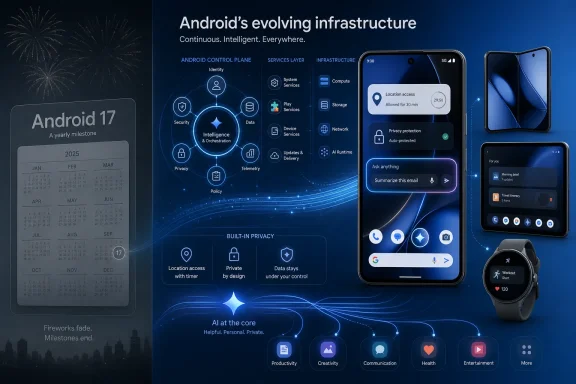
The Annual Version Number Now Matters Less Than the Control Plane
The deeper shift is architectural. Android is no longer just an operating system installed on a device; it is a control plane for services, models, app frameworks, security policies, and hardware capabilities. The version number tells you the base layer, not the complete experience.That is why Android 17 can be both important and underwhelming. It can deliver necessary APIs and system behaviors while leaving the biggest user-facing changes to Gemini, Pixel software, Google apps, and cloud-side switches. The system update becomes a gate, not the whole journey.
For IT pros, this matters. Managing Android devices is no longer only about OS patch levels. It is about Play system updates, app versions, OEM firmware, enterprise policy controls, assistant availability, data-handling settings, and the growing role of AI features that may interact with corporate apps or sensitive content.
For enthusiasts, it means the old ritual of obsessing over the next major Android version is less rewarding. The more interesting work may happen in betas, feature drops, developer APIs, and AI rollouts that do not line up with the number on the About screen.
For ordinary users, it means a phone can improve without explanation. That is convenient until it becomes confusing. Google’s challenge is to make continuous delivery feel like care rather than randomness.
The Android 17 Lesson Is Smaller Than the Version Number
Android 17 is not a bad update. It is a revealing one. It shows a platform that has traded spectacle for continuity, and a company that has shifted much of its creative energy from the operating system to the intelligence layer above it.That trade has practical consequences.
- Android 17’s most visible platform change is app bubbles, but its broader importance lies in preparing Android for more flexible multitasking across phones, tablets, and foldables.
- Google’s feature-drop strategy has made Android improvements more frequent while making the annual OS release feel less decisive.
- Gemini is becoming the main venue for user-facing novelty, which means Android capability will increasingly depend on hardware, account status, region, and service availability.
- The old fragmentation problem has shifted from version delays to feature differences between devices that may technically run the same Android release.
- Security, privacy, and permission refinements are now among the most important Android update benefits, even though they rarely create launch-day excitement.
- Google needs clearer communication about which features are Android-wide, which are Pixel-only, and which depend on AI hardware or subscriptions.
Update: Android 17 Feature Roundup Highlights Lost-Phone Lockdown and Foldable Gaming (July 7, 2026)
Mashable’s latest Android 17 roundup adds several user-facing details beyond the earlier focus on Android’s broader shift toward quieter, service-driven updates. In addition to app bubbles, it highlights a foldable gaming layout that can place gameplay on one half of a device such as a Galaxy Z Fold while reserving the other half for virtual controls, reducing on-screen clutter during play.The report also points to Android 17’s screen-reaction recording feature, which lets users overlay their selfie-camera reaction on top of an image or clip with only a few taps. It is a small social-media-oriented addition, but it underlines the article’s larger point: some of Android 17’s most visible changes are practical workflow conveniences rather than platform reinventions.
More consequential for families and device security, Mashable notes that Android 17 expands parental controls beyond their earlier Pixel rollout, including Google Play download filtering, bedtime lock schedules, and screen-time limits. It also highlights Mark as Lost in Find Hub, which can remotely lock a missing phone and require biometrics even if someone knows the PIN.
For WindowsForum readers managing Android fleets or family devices, those last two items are the most practical additions: Android 17 is not just about multitasking polish, but also tighter recovery and supervision tools that may reduce support headaches when devices are lost, shared, or used by children.
References
- Primary source: Android Authority
Published: Wed, 01 Jul 2026 10:32:36 GMT
Android 17 proves that Android updates have lost their magic
Android updates used to redefine the experience. Android 17 shows why those days are behind us — and why that's actually a good thing.www.androidauthority.com - Related coverage: androidcentral.com
Android 17 'sneak peek' at a foldable gaming mode has my attention—and then some | Android Central
It's giving me Nintendo 3DS vibes... minus the 3D.www.androidcentral.com - Related coverage: phonearena.com
Android 17 just dropped for Pixel phones and Watch all at once - the biggest update of the year - PhoneArena
From real multitasking to better battery life, here is what landed today.www.phonearena.com - Related coverage: sammobile.com
Stable Android 17 is here with app bubbles, foldable improvements, and more - SamMobile
Google has released the stable version of Android 17 for Pixel devices. It brings app bubbles, improvements for foldable phones, and more. - SamMobilewww.sammobile.com - Related coverage: techcrunch.com
Android 17 launches with new multitasking tools as Google expands Gemini features | TechCrunch
Google has released Android 17 and Wear OS 7, introducing new multitasking features, parental controls, security tools, and smartwatch upgrades. The launch is also accompanied by a Pixel Drop that brings Google’s latest AI models to its devices.techcrunch.com - Related coverage: gizmochina.com
Android 17 Beta 2 Launch: Bubbles Windowing Mode, EyeDropper API, and Connectivity Enhancements - Gizmochina
Google has released Android 17 Beta 2 with new privacy controls, cross-device handoff, advanced ranging technologies, and developer APIs ahead of the stable rollout later this year. www.gizmochina.com
- Related coverage: blog.google
Android 17 has new features for productivity, gaming and security
Explore the latest features in Android 17, including enhanced productivity, gaming and security.blog.google - Related coverage: gadgets360.com
- Related coverage: techradar.com
7 of the best Android 17 features available now — from Bubbles to Screen Reactions | TechRadar
Expect new tools and upgraded abilitieswww.techradar.com - Related coverage: macrumors.com
Google Previews Android 17 With 'Gemini Intelligence' a Month Before Apple's iOS 27 Reveal
Google today previewed Android 17, the next version of Android that it is bringing to smartphones and other devices. Android 17 includes multiple new AI features, and it comes about a month ahead of when Apple plans to unveil iOS 27 with new AI capabilities. Google is now calling the AI features...www.macrumors.com - Related coverage: tomsguide.com
Android 17 officially rolls out to Pixel devices with new features — screen reactions, bubbles, gaming mode, and more | Tom's Guide
Google's massive June 2026 software drop delivers Android 17's productivity and security overhauls to Pixel devices, alongside new Wear OS 7 features.www.tomsguide.com - Related coverage: cincodias.elpais.com
Last edited:

