

On June 24, 2026, Google’s Android Earthquake Alerts system warned 11.4 million users in Venezuela before two major earthquakes, using accelerometers in nearby Android phones to detect early P-waves and push alerts seconds to roughly two minutes before stronger shaking arrived in affected areas. Nearly 1.4 million of those warnings were Google’s highest-level “Take Action” alerts, the kind meant to interrupt whatever you are doing and tell you to protect yourself. The event was not a prediction, and it was not magic. It was a demonstration that the most important disaster-warning network in a lower-resource country may now be the one already sitting in people’s pockets.
The Venezuela quakes turned Android Earthquake Alerts from an interesting safety feature into a public-infrastructure story. For years, Google has described the system as a way to extend early-warning coverage beyond countries rich enough to build dense seismic networks. Venezuela offered the uncomfortable proof case: a large population, serious seismic risk, and no national early-warning system comparable to the purpose-built networks used in places like Japan, Mexico, or the U.S. West Coast.
The numbers are striking because they are not laboratory numbers. Google says Android phones detected the first quake’s faster P-waves within about three seconds and that the first alerts went out six seconds later. A magnitude 7.2 event was followed 39 seconds later by a 7.5 event, close enough in time that the system interpreted the shaking as one overlapping shock.
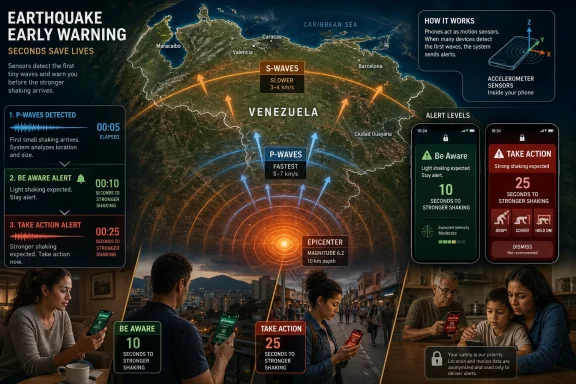
That kind of speed matters because earthquake early warning is a race between two waves. P-waves arrive first and are usually less destructive. S-waves arrive later and do the shaking that throws people off their feet, knocks objects from shelves, and turns glass, masonry, and traffic into hazards.
For people nearest the epicenter, no phone can repeal physics. Many will feel shaking before a warning arrives, or almost simultaneously with it. But for people farther away, the gap between detection and heavy shaking can become time enough to step away from a balcony, stop a car, get under a desk, pull a child away from a window, or simply understand what is happening before panic does the thinking.
That is the genius and the discomfort of the system. Google has effectively turned a consumer operating system into a distributed seismic array. The company says the network now reaches Android users in nearly 100 countries, a huge expansion from the roughly 250 million people who had access to earthquake early-warning systems in 2019 to about 2.5 billion today.
This is not merely a clever Android feature. It is a shift in how public warnings can be delivered when official infrastructure is thin, underfunded, or geographically incomplete. The old model required governments and scientific agencies to install, maintain, and integrate seismic stations, alerting pipelines, telecom relationships, and public-education campaigns. The new model piggybacks on the installed base of smartphones and cloud infrastructure.
That does not make it better in every respect. It makes it scalable. And in disaster response, scale is not a nice-to-have; it is often the difference between a system that exists on a planning document and one that wakes millions of people up.
That distinction matters because overpromising is how warning systems lose public trust. If users think the phone is predicting the future, every late alert looks like a failure and every missed tremor looks like negligence. If users understand that the system is a high-speed detection-and-notification pipeline, the expectations become more realistic.
Google splits alerts into lower-level “Be Aware” messages and more urgent “Take Action” warnings. The higher-level alerts are designed to break through attention, sound loudly, and give simple instructions. That design choice is crucial because an early warning is not useful if it arrives as just another rectangle in the notification shade, somewhere between a shopping app and a social feed.
In Venezuela, the system reportedly sent nearly 1.4 million Take Action alerts. That is the part administrators and platform engineers should pay attention to. The problem is not simply detecting a hazard; it is deciding when software has enough confidence to seize the user’s attention in a moment when false positives can erode trust and false negatives can cost lives.
That history does not negate what happened in Venezuela. It makes the Venezuela performance more meaningful. A system that learns from post-event analysis, tunes its magnitude estimates, and improves its alerting thresholds is behaving like serious infrastructure, not a one-off demo.
But it also raises the accountability question. When a government seismic network misses an alert, there is at least a public agency to interrogate, a budget process to examine, and a formal mandate to debate. When a platform company’s proprietary system makes the call, the accountability is more diffuse.
Google can publish research, disclose aggregate numbers, and explain its design. It can also update algorithms without the kind of transparent public process that would surround a national warning system. That tension is now unavoidable: the Android network may be one of the most effective earthquake-warning systems ever deployed, but it is still operated by a private company whose incentives are broader than civil defense.
In sparsely populated areas, the same architecture becomes weaker. Fewer phones mean fewer detection points, slower confirmation, and potentially less confidence. A rural community near an epicenter may be exactly the place where warning time is shortest and detection density is poorest.
There is also an operating-system divide. Android users in Venezuela could receive Google’s alerts if their devices and settings supported the feature. iPhone users generally did not have an equivalent Apple-operated earthquake-warning layer in the same context. That means disaster warning, at least in some countries, may now depend partly on which phone ecosystem a person can afford or prefers.
The settings matter, too. Users generally need location services and the relevant Android earthquake alert setting enabled, with connectivity available. The system is designed to use approximate location and anonymized signals, but it still depends on the phone being part of Google’s services ecosystem. Devices without Google Mobile Services, phones with settings disabled, dead batteries, poor connectivity, or limited data access can fall outside the safety net.
This is where the story becomes less triumphant and more complicated. The people most likely to benefit from low-cost, scalable warning infrastructure may also be the people most likely to face connectivity gaps, older hardware, battery constraints, and limited digital literacy. A smartphone-based warning system can reduce inequality in access to alerts, but it cannot erase the inequalities baked into smartphone access itself.
“Drop, Cover, and Hold On” is not a slogan for earthquake specialists. It is the muscle memory that makes a few seconds useful. Without that, an alert can become a burst of fear rather than a prompt for action.
Google’s own research has suggested that many users find alerts helpful even when they do not feel shaking, and that higher-priority warnings are more closely associated with stronger shaking. That is encouraging, because public trust is built not only on perfect accuracy but on a sense that the system is usually understandable and proportionate. People can tolerate occasional warnings that do not lead to obvious shaking if the alert gives them useful context and does not constantly cry wolf.
Still, alert fatigue is a real platform problem. Phones already demand attention with too little restraint. Emergency alerts must therefore be treated as sacred interruption space. If users begin to see them as noisy, confusing, or too frequent, they will turn off the feature or mentally demote it.
For IT pros, the lesson is not that Windows should become a seismometer. The lesson is that platform-level defaults now matter beyond productivity and security. A buried toggle can determine whether a user gets a warning. A mobile-device-management policy can affect whether location-based safety features work. A privacy posture can have life-safety implications.
Enterprise administrators have spent years learning that notification channels, device permissions, and location settings are not minor UX details. They shape how people receive phishing warnings, authentication prompts, device-loss alerts, and now potentially disaster notifications. The Venezuela event is an extreme example of the same principle: if the platform is where attention lives, the platform becomes part of emergency management.
There is also a resilience lesson for organizations with workers in earthquake-prone regions. Companies think about backup power, redundant connectivity, endpoint recovery, and incident response. They should also think about whether employee devices are configured to receive local emergency alerts, whether staff know what those alerts mean, and whether travel-risk guidance includes platform safety features.
The network depends on phones sending motion and location signals to centralized servers for analysis. Even if the data is coarse and anonymized, the architecture normalizes an important idea: consumer devices can be recruited into large-scale environmental sensing networks. Today the use case is earthquakes; tomorrow it may be floods, fires, air quality, infrastructure failure, or other hazards.
Some of those uses will be beneficial. Some will be tempting to governments and companies for reasons that are less benign. The right debate is not whether emergency sensing should exist. It is how much transparency, opt-out control, independent review, and public-sector partnership should surround systems that operate at this scale.
The irony is that privacy and trust are not enemies of effective alerting. They are prerequisites. Users are more likely to leave the feature enabled if they understand what is collected, why it is collected, and how to disable it. A safety system that relies on hidden complexity may work technically, but it will remain politically fragile.
That combination should push governments toward partnership rather than abdication. A country without a national early-warning system should welcome a tool that can reach millions quickly. But it should not treat a platform company’s feature as a substitute for seismic science, emergency planning, resilient buildings, public drills, and official alerting capacity.
The best future is hybrid. Dedicated seismic networks remain the gold standard where they exist, especially when integrated with public agencies and emergency broadcasters. Smartphone networks can extend coverage, add redundancy, and bring alerts to places that would otherwise wait years or decades for traditional infrastructure.
Google deserves credit for making a mass-market system that appears to have helped millions of people during a frightening event. The harder question is whether the world can build governance around that success before the next disaster reminds everyone that infrastructure built by convenience can become infrastructure by necessity.
 Google’s Biggest Earthquake Test Was Not in Silicon Valley
The Venezuela quakes turned Android Earthquake Alerts from an interesting safety feature into a public-infrastructure story. For years, Google has described the system as a way to extend early-warning coverage beyond countries rich enough to build dense seismic networks. Venezuela offered the uncomfortable proof case: a large population, serious seismic risk, and no national early-warning system comparable to the purpose-built networks used in places like Japan, Mexico, or the U.S. West Coast.The numbers are striking because they are not laboratory numbers. Google says Android phones detected the first quake’s faster P-waves within about three seconds and that the first alerts went out six seconds later. A magnitude 7.2 event was followed 39 seconds later by a 7.5 event, close enough in time that the system interpreted the shaking as one overlapping shock.
That kind of speed matters because earthquake early warning is a race between two waves. P-waves arrive first and are usually less destructive. S-waves arrive later and do the shaking that throws people off their feet, knocks objects from shelves, and turns glass, masonry, and traffic into hazards.
For people nearest the epicenter, no phone can repeal physics. Many will feel shaking before a warning arrives, or almost simultaneously with it. But for people farther away, the gap between detection and heavy shaking can become time enough to step away from a balcony, stop a car, get under a desk, pull a child away from a window, or simply understand what is happening before panic does the thinking.
Android Has Quietly Become a Civil-Defense Layer
Google’s earthquake system works because modern phones are full of sensors that were never designed primarily for public safety. The accelerometer that helps rotate your screen or count movement can also notice the distinctive motion of an earthquake when the phone is still and charging or lying on a surface. One phone twitching is noise; thousands of phones twitching in a geographically coherent pattern is data.That is the genius and the discomfort of the system. Google has effectively turned a consumer operating system into a distributed seismic array. The company says the network now reaches Android users in nearly 100 countries, a huge expansion from the roughly 250 million people who had access to earthquake early-warning systems in 2019 to about 2.5 billion today.
This is not merely a clever Android feature. It is a shift in how public warnings can be delivered when official infrastructure is thin, underfunded, or geographically incomplete. The old model required governments and scientific agencies to install, maintain, and integrate seismic stations, alerting pipelines, telecom relationships, and public-education campaigns. The new model piggybacks on the installed base of smartphones and cloud infrastructure.
That does not make it better in every respect. It makes it scalable. And in disaster response, scale is not a nice-to-have; it is often the difference between a system that exists on a planning document and one that wakes millions of people up.
The Feature Works Because It Refuses to Pretend It Predicts Earthquakes
The most important thing to understand about Android Earthquake Alerts is also the thing most likely to be misunderstood: it does not predict earthquakes. It detects an earthquake after it has already begun, estimates where damaging shaking is likely to arrive, and sends alerts ahead of the slower, stronger waves where physics allows.That distinction matters because overpromising is how warning systems lose public trust. If users think the phone is predicting the future, every late alert looks like a failure and every missed tremor looks like negligence. If users understand that the system is a high-speed detection-and-notification pipeline, the expectations become more realistic.
Google splits alerts into lower-level “Be Aware” messages and more urgent “Take Action” warnings. The higher-level alerts are designed to break through attention, sound loudly, and give simple instructions. That design choice is crucial because an early warning is not useful if it arrives as just another rectangle in the notification shade, somewhere between a shopping app and a social feed.
In Venezuela, the system reportedly sent nearly 1.4 million Take Action alerts. That is the part administrators and platform engineers should pay attention to. The problem is not simply detecting a hazard; it is deciding when software has enough confidence to seize the user’s attention in a moment when false positives can erode trust and false negatives can cost lives.
The Turkey Failure Still Hangs Over the Success
The Venezuela result lands differently because Google’s system has already been through a more painful public reckoning. After the devastating 2023 Turkey earthquakes, researchers and reporters scrutinized whether Android’s alerting system had underestimated the scale of the event and failed to send enough of the highest-priority warnings. Google later acknowledged in research that magnitude estimation in the earliest seconds is one of the hardest parts of the problem.That history does not negate what happened in Venezuela. It makes the Venezuela performance more meaningful. A system that learns from post-event analysis, tunes its magnitude estimates, and improves its alerting thresholds is behaving like serious infrastructure, not a one-off demo.
But it also raises the accountability question. When a government seismic network misses an alert, there is at least a public agency to interrogate, a budget process to examine, and a formal mandate to debate. When a platform company’s proprietary system makes the call, the accountability is more diffuse.
Google can publish research, disclose aggregate numbers, and explain its design. It can also update algorithms without the kind of transparent public process that would surround a national warning system. That tension is now unavoidable: the Android network may be one of the most effective earthquake-warning systems ever deployed, but it is still operated by a private company whose incentives are broader than civil defense.
The Smartphone Network Is Powerful Because It Is Uneven
A dense smartphone network can do something extraordinary in cities. It can notice the first wave of shaking across many devices, filter out random motion, estimate the quake, and notify users before the most dangerous shaking travels outward. In a populated corridor, the phone network becomes dense enough to resemble a sensor grid.In sparsely populated areas, the same architecture becomes weaker. Fewer phones mean fewer detection points, slower confirmation, and potentially less confidence. A rural community near an epicenter may be exactly the place where warning time is shortest and detection density is poorest.
There is also an operating-system divide. Android users in Venezuela could receive Google’s alerts if their devices and settings supported the feature. iPhone users generally did not have an equivalent Apple-operated earthquake-warning layer in the same context. That means disaster warning, at least in some countries, may now depend partly on which phone ecosystem a person can afford or prefers.
The settings matter, too. Users generally need location services and the relevant Android earthquake alert setting enabled, with connectivity available. The system is designed to use approximate location and anonymized signals, but it still depends on the phone being part of Google’s services ecosystem. Devices without Google Mobile Services, phones with settings disabled, dead batteries, poor connectivity, or limited data access can fall outside the safety net.
This is where the story becomes less triumphant and more complicated. The people most likely to benefit from low-cost, scalable warning infrastructure may also be the people most likely to face connectivity gaps, older hardware, battery constraints, and limited digital literacy. A smartphone-based warning system can reduce inequality in access to alerts, but it cannot erase the inequalities baked into smartphone access itself.
The Alert Is Only as Good as the Human Response
The value of a warning is not the sound; it is the action it triggers. A phone can say “take cover,” but people need to know what that means before the room starts moving. The best early-warning systems pair technology with boring, repetitive public education.“Drop, Cover, and Hold On” is not a slogan for earthquake specialists. It is the muscle memory that makes a few seconds useful. Without that, an alert can become a burst of fear rather than a prompt for action.
Google’s own research has suggested that many users find alerts helpful even when they do not feel shaking, and that higher-priority warnings are more closely associated with stronger shaking. That is encouraging, because public trust is built not only on perfect accuracy but on a sense that the system is usually understandable and proportionate. People can tolerate occasional warnings that do not lead to obvious shaking if the alert gives them useful context and does not constantly cry wolf.
Still, alert fatigue is a real platform problem. Phones already demand attention with too little restraint. Emergency alerts must therefore be treated as sacred interruption space. If users begin to see them as noisy, confusing, or too frequent, they will turn off the feature or mentally demote it.
Windows People Should Care Because This Is a Platform Story
At first glance, this looks like Android news, not Windows news. But WindowsForum readers should recognize the deeper pattern immediately: operating systems are becoming civic infrastructure whether vendors admit it or not. The same device platforms that manage identity, notifications, location, encryption, endpoint policy, and app distribution are increasingly mediating public safety.For IT pros, the lesson is not that Windows should become a seismometer. The lesson is that platform-level defaults now matter beyond productivity and security. A buried toggle can determine whether a user gets a warning. A mobile-device-management policy can affect whether location-based safety features work. A privacy posture can have life-safety implications.
Enterprise administrators have spent years learning that notification channels, device permissions, and location settings are not minor UX details. They shape how people receive phishing warnings, authentication prompts, device-loss alerts, and now potentially disaster notifications. The Venezuela event is an extreme example of the same principle: if the platform is where attention lives, the platform becomes part of emergency management.
There is also a resilience lesson for organizations with workers in earthquake-prone regions. Companies think about backup power, redundant connectivity, endpoint recovery, and incident response. They should also think about whether employee devices are configured to receive local emergency alerts, whether staff know what those alerts mean, and whether travel-risk guidance includes platform safety features.
Privacy Is Not a Footnote When the Sensor Grid Is Global
Google says Android Earthquake Alerts uses anonymized data and approximate location. That is reassuring as far as it goes, and the system’s purpose is hard to argue with when the alternative is no warning at all. But privacy cannot be waved away simply because the use case is noble.The network depends on phones sending motion and location signals to centralized servers for analysis. Even if the data is coarse and anonymized, the architecture normalizes an important idea: consumer devices can be recruited into large-scale environmental sensing networks. Today the use case is earthquakes; tomorrow it may be floods, fires, air quality, infrastructure failure, or other hazards.
Some of those uses will be beneficial. Some will be tempting to governments and companies for reasons that are less benign. The right debate is not whether emergency sensing should exist. It is how much transparency, opt-out control, independent review, and public-sector partnership should surround systems that operate at this scale.
The irony is that privacy and trust are not enemies of effective alerting. They are prerequisites. Users are more likely to leave the feature enabled if they understand what is collected, why it is collected, and how to disable it. A safety system that relies on hidden complexity may work technically, but it will remain politically fragile.
The Lesson From Venezuela Is Practical, Not Utopian
The Venezuela quakes show that Android Earthquake Alerts can work at enormous scale under real pressure. They also show the boundaries of the model. The system is fast, but not faster than shaking at the epicenter. It is broad, but not universal. It is automated, but not infallible. It is public-safety infrastructure, but not publicly owned.That combination should push governments toward partnership rather than abdication. A country without a national early-warning system should welcome a tool that can reach millions quickly. But it should not treat a platform company’s feature as a substitute for seismic science, emergency planning, resilient buildings, public drills, and official alerting capacity.
The best future is hybrid. Dedicated seismic networks remain the gold standard where they exist, especially when integrated with public agencies and emergency broadcasters. Smartphone networks can extend coverage, add redundancy, and bring alerts to places that would otherwise wait years or decades for traditional infrastructure.
Google deserves credit for making a mass-market system that appears to have helped millions of people during a frightening event. The harder question is whether the world can build governance around that success before the next disaster reminds everyone that infrastructure built by convenience can become infrastructure by necessity.
The Phone in Your Pocket Just Joined the Emergency Plan
The most concrete lesson from Venezuela is not that everyone should trust technology blindly. It is that users, administrators, and policymakers should treat phone-based emergency alerts as real systems worthy of configuration, testing, and scrutiny.- Android users in earthquake-prone regions should verify that Earthquake Alerts are enabled and that location services are configured in a way that allows the feature to work.
- Organizations with staff in seismic zones should include mobile emergency-alert readiness in travel guidance, onboarding, and business-continuity planning.
- Governments should treat smartphone alerting as a supplement to official seismic networks, not as a reason to delay investment in public infrastructure.
- Platform vendors should publish clear post-event performance data after major disasters, including misses, late alerts, false alarms, and alert-level decisions.
- Users should learn the recommended response before an alert arrives, because a warning measured in seconds rewards preparation, not improvisation.
References
- Primary source: en.softonic.com
Published: 2026-06-30T08:50:10.537977
Android Earthquake Alerts warned 11.4 million before Venezuela quakes - Softonic
Wednesday’s earthquakes in Venezuela gave Google’s Android Earthquake Alerts network a real-world test. Google says the system warned 11.4 million useen.softonic.com - Independent coverage: TechRadar
Published: Mon, 29 Jun 2026 15:31:55 GMT
- Independent coverage: TechRound
Published: Mon, 29 Jun 2026 20:30:06 GMT
Your Android Is A Seismometer – How Google Warned 11 Million People Of An Earthquake - TechRound
Google’s Android earthquake alert system warned 11.4 million people ahead of Venezuela’s June 24 earthquakes. Here’s how it works and what comes next.techround.co.uk - Independent coverage: TechRepublic
Published: Mon, 29 Jun 2026 18:23:04 GMT
Android Phones Warned 11.4M People Before Venezuelan Earthquakes
Google says Android Earthquake Alerts warned millions in Venezuela before powerful quakes, showing how phones can support early warnings.www.techrepublic.com
- Independent coverage: Android Authority
Published: Mon, 29 Jun 2026 18:22:36 GMT
Here’s how Android phones helped Venezuelans escape the devastating earthquake
Several users from Venezuela detail how they were alerted early to the recent earthquakes courtesy of Android’s Earthquake Alerts system.www.androidauthority.com - Related coverage: thenextweb.com
Google earthquake alerts warned 11.4M in Venezuela
Google earthquake alerts reached 11.4 million Android users seconds before Venezuela's quakes, turning phone sensors into a seismic warning network.thenextweb.com
- Related coverage: phonearena.com
Venezuela's quakes proved Android's earthquake alerts matter. What about iPhone? - PhoneArena
The alert leans on a sensor you already carry, but Apple takes a different path.www.phonearena.com - Related coverage: blog.google
Android earthquake alerts now available everywhere in the U.S.
Android Earthquake Alerts is expanding to all 50 U.S. states, using phones to detect earthquakes and send early warnings to users.blog.google - Related coverage: tech.yahoo.com
Got an Android phone? You probably have the built-in earthquake alert feature that warned 11.4m people about the Venezuela earthquake — here's how to find it
Android's Earthquake Alerts System is now in place on more than 2.5 billion phones worldwide, Google says.tech.yahoo.com - Official source: support.google.com

Get help during an emergency with your Android phone - Android Help
You can use the Personal Safety app to save and share your emergency info. Your phone can also contact emergency services automatically in some countries and regions and with certain carriers.
support.google.com
- Related coverage: theyeshivaworld.com
How Google’s Android Earthquake Alert System Warned Millions Before Venezuela’s Deadly Quake – The Yeshiva World
As powerful earthquakes struck Venezuela, Google’s Android Earthquake Alerts system detected the seismic activity within seconds and sent warnings to approximately 11.4 million users, giving many people several seconds—and in some cases up to two minutes—to prepare before the strongest...www.theyeshivaworld.com - Related coverage: livemint.com
Google alerted users seconds before Venezuela's earthquake. Here's how Android phones detect tremors | Mint
As two powerful earthquakes struck Venezuela within minutes of each other, several Android users reported receiving Google earthquake alerts before the tremors reached them. The warnings were made possible by Google's Android Earthquake Alerts System. www.livemint.com
- Related coverage: uol.com.br
Google alertou 11 milhões de pessoas antes de terremoto na Venezuela
O Google enviou alertas de terremoto para 11,4 milhões de pessoas antes dos fortes tremores que atingiram a Venezuela nesta semana, segundo a empresa ao jornal americano The New York Times.O que aconteceuGoogle tem sistema de detecção de terremotos e ewww.uol.com.br - Related coverage: benton.org
How Phones Alerted Millions Before Quakes Shook Venezuela
Jose Flores was driving with his family to see “Toy Story 5” in Caracas, Venezuela, when a loud earthquake alert went off on his wife’s Google Android phone. Six seconds later, he felt the earth starting to shake. Venezuela does not have a national early warning system of its own, but people... www.benton.org
- Related coverage: eweek.com
Android Phones Proven as Pocket Seismologists 📳📉 - eWeek
Daily Tech Insider Newsletter from June 30, 2026 www.eweek.com
- Related coverage: elpais.com
Así usó Google los móviles para detectar el terremoto y avisar a millones en Venezuela | Tecnología | EL PAÍS
El gigante tecnológico emplea desde 2021 los sensores de los teléfonos Android para generar avisos tan rápidos y precisos como los de los sistemas oficiales que emplean sofisticadas redes sismológicaselpais.com - Related coverage: androidcentral.com
Google admits its alert system failed to accurately warn people in Turkey's 2023 quake | Android Central
The system miscalculated the magnitude of the first earthquake, sending a less severe notification to many.www.androidcentral.com - Related coverage: cadenaser.com
Google logró detectar y avisar a la población de los terremotos en Venezuela segundos antes de la catástrofe | Ciencia y tecnología | Cadena SER
Dos expertos detallan cómo la tecnología es capaz de anticiparse a los sismos para dar margen de cara a una evacuación y salvar vidascadenaser.com - Related coverage: livescience.com
Google has turned 2 billion smartphones into a global earthquake warning system — it's just as effective as seismometers | Live Science
Google's earthquake early-warning system has used phone accelerometers to increase quake alerts by tenfold across 98 countries.www.livescience.com - Related coverage: caloes.ca.gov
- Related coverage: phys.org
- Related coverage: research.google
Android Earthquake Alerts: A global system for early warning
 research.google
- Related coverage: sites.research.google
