

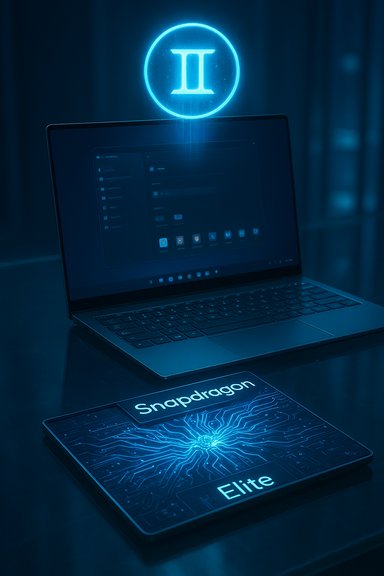
A quietly explosive engineering signal — internal Android 16 build manifests and a public stage-level pact between Google and Qualcomm — has renewed the prospect that Android as a laptop OS may arrive in earnest on Qualcomm’s Snapdragon X family, with engineering previews and silicon availability lining up for 2026. The leak centers on a repository snapshot that names “purwa” (allegedly the Snapdragon X device tree) inside Android 16’s private manifests, and it sits alongside public commitments from Google and Qualcomm to bring Android’s AI stack (including Gemini) and a desktop-capable Android to PC-class ARM silicon. This development is plausible, technically coherent, and strategically consequential — but it is also not a product launch: the repo entries represent engineering work, not shipping SKUs, and multiple missing pieces remain before consumers and enterprises will see Android-first laptops in stores.
Source: Пепелац Ньюс https://pepelac.news/en/posts/id10464-android-16-comes-to-laptops-on-snapdragon-x-chips-in-2026/
 Background
Where the story begins: Snapdragon X and the PC push
Qualcomm’s Snapdragon X family (X, X Plus, X Elite) was designed from the start as PC-oriented Arm silicon: higher memory bandwidth, laptop-class I/O, and enlarged NPUs intended to accelerate on-device AI workloads. Qualcomm’s public roadmap and the Snapdragon Summit follow-ups in 2025 repositioned the X-series as a serious alternative to x86 in thin-and-light and creator laptops, while the new X2 generation doubles down with larger NPUs (advertised around 80 TOPS in vendor materials), higher single-core boosts and expanded core counts. That hardware runway explains why Android being prepped for X silicon is now credible — the chips exist that can host a desktop-grade Android experience.Google and Qualcomm: an explicit technical alignment
At Qualcomm’s Snapdragon Summit, Google and Qualcomm publicly described a joint project to unify the technical foundations that run phones and PCs, with Google emphasising plans to bring the Android AI stack (Gemini included) and Android’s app ecosystem to desktop hardware. Qualcomm’s leadership described seeing working engineering builds and praised the prototype work. Those on-stage remarks are strategy statements rather than ship dates, but they do confirm a coordinated engineering path that makes Android-on-PC a concerted effort rather than a back-room experiment.The leak: what exactly was found in the Android 16 repo
The artifact: “purwa” and SC8380
A widely circulated screenshot (origin traced to a tech analyst post on X) shows an Android 16 private manifest listing that includes an entry labelled “purwa”, with module paths for camera, audio_handset, btfm (Bluetooth/FM), and computer vision — a layout consistent with Qualcomm device trees in Android. Observers noted that the same snapshot references the SC8380 part number, a designation that has been associated with Snapdragon X Elite-class silicon. Multiple outlets reproduced the image and independently described the same manifest entries. This pattern — a chipset codename appearing inside an OEM/vendor manifest — is exactly how chipset vendors prepare Android support during engineering; it is strong evidence of internal development effort but not proof of finished consumer hardware.What the manifest implies (and what it does not)
The presence of a device manifest implies work on kernel drivers, hardware abstraction layers (HALs) and subsystem integrations necessary for Android to boot and operate on new silicon. The captured entries show components that matter for a laptop experience (camera, audio, Bluetooth, computer vision). What the screenshot does not show are bootable system images, certification records, OEM SKUs, benchmarking proofs or retail device sightings — all of which are needed before trusting a retailer’s product page. In short: the repo entry is a convincing engineering signal; it is not a commercial guarantee.Why Android 16 is the plausible base for laptop-grade Android
Desktop-friendly features already in Android 16
Android 16 has been developed with larger screens and desktop-style windowing in mind: improved multi-window behavior, better window resizing, keyboard and pointer handling enhancements, and a tablet-first desktop mode that Google has extended toward external-display scenarios. The platform’s ongoing “desktop mode” work and Google’s intent to consolidate ChromeOS features into Android provide the UI substrate that a laptop OS would need. Coupled with a robust NPU and a mature Android app ecosystem, this makes Android 16 a logical candidate for an Android-on-PC product line.Native AI: Gemini and the Android AI stack
Google’s plan is explicit: bring the full Android AI stack and Gemini model integrations to the PC domain. That makes Qualcomm’s investment in larger Hexagon NPUs and higher TOPS figures strategically important — local inference of foundational models and responsive, offline AI experiences are the concrete features that could differentiate Android laptops from Chromebooks and Windows machines. However, on-device model performance depends on software tooling (graph compilers, quantization support), drivers and careful co‑optimization; raw TOPS numbers are necessary but not sufficient.Technical verification: the silicon side of the story
SC8380 and the Snapdragon X lineage
Industry reporting and vendor materials associate SC8380 and related part numbers with the Snapdragon X Elite family and with first-generation Oryon core implementations tuned for laptop-class tasks. Independent coverage and device roadmap leaks have repeatedly referenced SC8380 as the high-end X-series part that OEMs expected to use in premium Windows laptops. This aligns with the repository artifact naming and lends credence to the idea that Qualcomm’s engineers are preparing Android support specifically for the X class.X2 timeline and H1 2026 hardware availability
Qualcomm’s public X2 announcements and press coverage indicate that systems using the X2 family (X2 Elite and X2 Elite Extreme) are expected to ship in the first half of 2026. That hardware window gives Google and OEMs a realistic engineering runway to tune Android 16 for PC-class silicon and produce reference designs or retail devices in 2026—if ecosystem work proceeds on schedule. Again: the hardware timeline and the software readiness timeline are separate; chip availability only enables the software work.Ecosystem and engineering hurdles
Apps and UI adaptation
Android’s app ecosystem is immense, but mobile apps are not desktop apps by default. For an Android laptop to be convincing, Google needs a developer migration toolkit, robust guidelines for keyboard/mouse UX, windowing APIs, and incentives for mainstream app vendors to ship desktop-optimized versions (productivity suites, developer tools, pro creative apps). Without that work, many apps will feel like stretched phone apps on a large display. This adaptation challenge is non-trivial and historically has been the primary constraint on mobile-first OSes becoming true desktop platforms.Drivers, peripherals and enterprise tooling
PCs rely on a sprawling hardware and enterprise management ecosystem: docking stations, pro audio, printers, domain management, VPN clients and legacy enterprise tooling. Android will need vendor-supplied or community drivers for many of these subsystems, and enterprises will want policies and MDM hooks comparable to Windows Group Policy or macOS MDM. Certification for chipsets, peripheral compatibility testing, and enterprise security certifications add months to the timeline and raise the bar for corporate adoption.Legacy Windows application compatibility
A major adoption barrier is Windows-only applications that businesses and many professionals still rely on. Android cannot run Win32/x86 executables natively; any credible alternative would need robust compatibility layers, virtualization options, or cloud-hosted app strategies — none of which are solved at the scale required for an enterprise shift away from Windows. This reality shapes the market segment most likely to adopt Android laptops early: consumers, education, and mobile-first users — not full-enterprise migrations.Strategic implications: who benefits, who loses
Who gains
- OEMs with large Android device businesses (Samsung, Xiaomi, Lenovo) can reuse supply chains and software expertise to build Android-first laptops faster.
- Consumers who prioritize battery life, always-on connectivity and integrated on-device AI will see tangible benefits.
- Google gains a chance to broaden Android’s reach and lock in app and AI usage across more devices.
Who faces pressure
- Microsoft and x86 OEMs must defend Copilot+, Win32 compatibility and enterprise footholds.
- Developers face additional fragmentation choices: target Windows, macOS, ChromeOS, or a new Android PC surface.
- Enterprises must weigh management complexity if user endpoints diversify across OSes.
Roadmap options OEMs and partners may pursue
- Quiet engineering previews: OEMs run Android 16 images on reference Snapdragon X hardware for internal testing and partner demos.
- Dual-boot or multi-image devices: ship hardware that can boot both Windows and Android, enabling trials without abandoning enterprise compatibility.
- Android-first consumer SKUs: lower-cost education and mainstream lines that rely chiefly on Android with Google’s desktop guidance, targeted at mobile-first users.
Security, update cadence and support
Qualcomm & Google support expectations
Qualcomm has signalled longer-term support commitments for its smartphone-class Snapdragon platforms in partnership with Google; adapting that model for laptop-class silicon will be essential to enterprise trust. However, the exact security update cadence, firmware support windows and OEM responsibilities for Android laptop images are not yet defined in public communications — these are policy-level choices OEMs and Google will need to finalize before widespread enterprise deployment. Flagging these details as unresolved is important for procurement decisions.Attack surface considerations
A broader set of peripherals, networking stacks, and enterprise integration points increases the attack surface relative to phones. Android-on-PC must match or exceed enterprise expectations for secure boot, verified updates, TPM-equivalent protections and remote management. Absent clear answers on those primitives, IT teams should treat early Android PCs like additional endpoint classes requiring careful piloting.What to watch next (concrete signals that would move this from “engineering” to “market”)
- Appearance of test builds or factory firmware images tied to known Snapdragon X board IDs in public AOSP or benchmark traces.
- OEM product announcements or developer previews at CES 2026, MWC or other major shows.
- Google developer guidance and SDKs for desktop-optimized Android apps (stable windowing APIs, keyboard/trackpad conventions).
- Certification records (Bluetooth SIG, Wi‑Fi Alliance, FCC) that list an Android OS for thin-and-light SKUs.
Strengths and risks — a concise technical assessment
- Strengths: Qualcomm’s X silicon provides the necessary Arm64 architecture, NPU horsepower and connectivity; Google’s Android 16 adds desktop-friendly primitives and the Gemini AI ambition provides a compelling differentiator. These ingredients together create a technically plausible path to Android laptops that could excel at battery life and on-device AI.
- Risks: app ecosystem maturity for large screens, driver/peripheral support, enterprise management features, legacy Windows app gaps, and the practicalities of support lifecycles remain open and could delay or limit adoption. Repo entries show work in progress; they do not remove these crucial barriers.
Practical guidance for stakeholders
- OEMs: begin dual-OS reference programs, invest in desktop UX toolkits for Android apps, and prioritize enterprise security primitives.
- Developers: prepare to test apps on larger displays, implement keyboard and pointer accessibility, and follow any Google desktop UI guidelines as they appear.
- IT and procurement teams: run pilot programs only after verifying MDM and security features, and avoid full migrations until legacy app compatibility and driver ecosystems are validated.
Unverified and flagged claims
Several repeated claims in public reporting remain unverified and should be treated cautiously: the existence and role of a Qualcomm codename “mahua” described as a Windows-on-Arm part was visible in some leak threads but lacks corroborating documentation beyond the initial screenshot; the precise mapping ofpurwa to every Snapdragon X SKU and the presence of complete, bootable Android images are likewise unproven by the manifest alone. These points must be confirmed by additional artifacts — firmware images, certification records, or OEM demonstrations — before being treated as factual.Conclusion
The convergence of three forces — Qualcomm’s more powerful, AI‑centric Snapdragon X/X2 silicon, Google’s strategic push to extend Android (and Gemini) to larger screens, and repository evidence that Qualcomm engineers are adding Android 16 manifests for X-series board targets — makes the engineering case for Android laptops on Snapdragon X compelling and timely. The available evidence points to a plausible arrival window in 2026 for early hardware and limited-market SKUs, but the leap from engineering branch to retail-ready, enterprise-supportable product remains significant. Important gaps — app optimization for desktop workflows, peripheral driver maturity, enterprise management features, and formal OEM commitments — must be closed before Android laptops can be considered a broad alternative to Chromebooks, Windows, or macOS notebooks. For now, the manifest named “purwa” is a clear signal of intent and capability; it is not yet the consumer product announcement that will appear on store shelves.Source: Пепелац Ньюс https://pepelac.news/en/posts/id10464-android-16-comes-to-laptops-on-snapdragon-x-chips-in-2026/
