

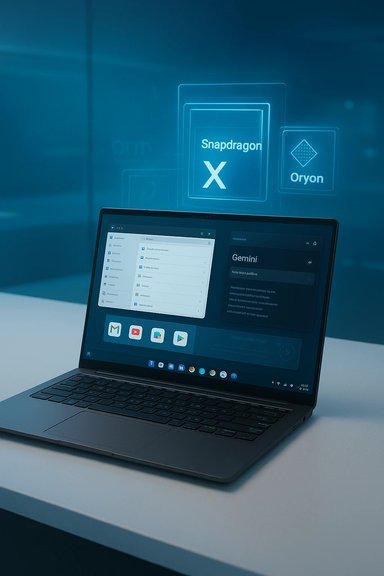
Google’s onstage tease at Qualcomm’s Snapdragon Summit has moved from industry whisper to a concrete roadmap: the company is formally re-basing ChromeOS on Android and pushing a unified, Android-powered desktop platform that brings Gemini AI, native Android apps, and Arm-first hardware to laptops and desktops — with the first devices targeted for 2026.
Background
Google’s dual-OS strategy—Android for phones and tablets, ChromeOS for laptops and desktops—has shaped the PC and mobile landscape for more than a decade. ChromeOS carved out a niche in education and low-cost laptops, while Android dominated mobile. Persistent limitations—Android apps on Chromebooks running inside virtual machines, ChromeOS’ web-first design, and fragmented AI capabilities—have long suggested the two platforms might be better served by a single technical foundation.At the Snapdragon Summit, Google executives confirmed that the company is moving from theory to execution. The new approach places Android at the base of both mobile and desktop experiences, with ChromeOS’s user-facing experience reimplemented on top of Android’s kernel and runtime. The result is a single technical foundation intended to support phones, tablets, laptops, and desktop form factors while unlocking deeper AI integration, native app performance, and a new partnership emphasis on Arm silicon — particularly Qualcomm’s Snapdragon family.
This shift comes at a consequential moment: Microsoft’s Windows 10 reached end of support on October 14, 2025, creating a window of opportunity as consumers and businesses evaluate upgrades and replacements. That timing increases the strategic stakes of any new desktop OS that can credibly position itself as an alternative to Windows and macOS.
What Google actually announced at Snapdragon Summit
- Google will re-baseline ChromeOS on Android, making Android the technical foundation for its desktop efforts.
- Google intends to bring Gemini and the broader Android AI stack to laptops and desktops as a first-class capability.
- Qualcomm’s leadership previewed a working demo; Qualcomm CEO expressed enthusiasm and said the experience “delivers on the vision of convergence of mobile and PC.”
- Google executives signaled a timeframe: the company is targeting a first wave of Android-based desktop devices in 2026.
- The hardware push will prioritize Arm-based Snapdragon processors (including Qualcomm’s Oryon CPU designs in Snapdragon X and X2 family chips) to deliver native app performance and energy efficiency.
Why the move matters: a technical and product overview
Android as a single technical foundation
Re-basing ChromeOS on Android changes the stack in practical ways:- Android’s runtime and app model become the native environment for desktop apps, removing the need for Android containers or virtual machines that currently host Play Store apps on Chromebooks.
- Developers can target a single set of APIs and a single OS foundation that scales across phone, tablet, laptop, and desktop form factors.
- Google can implement AI features — voice assistants, generative tools, model acceleration — once on Android and have them work across device classes.
Gemini and on-device AI become integral
Google is explicitly tying its AI strategy to the unified platform. Expect:- Deeper, native integration of the Gemini family and Google Assistant capabilities for desktop workflows.
- Local AI acceleration via on-device NPUs and CPU/NPU combinations in Snapdragon X-series chips, allowing offline or hybrid AI experiences (e.g., local model inference with cloud fallback).
- New productivity features that blend UI affordances of a desktop with generative shortcuts and contextual assistance from Gemini.
Native Android apps on big screens — finally without emulation
One of the longstanding limits of ChromeOS has been Android apps running inside a VM or container, which brought performance and compatibility compromises. A native Android foundation promises:- Smoother performance for Android apps on laptops and desktops.
- Better resource and battery management because apps speak directly to the OS rather than running inside translation layers.
- The potential for improved window management, multi-window support, and keyboard/mouse optimization in Android apps designed for larger displays.
Hardware: Qualcomm, Oryon cores, and the Arm-first PC
Qualcomm as the strategic silicon partner
Qualcomm’s presence on stage was more than ceremonial. The plan centers on Snapdragon PC-class chips — the Snapdragon X family and its successors — as the first wave of silicon for Android-powered PCs. Qualcomm’s PC roadmap now includes high-performance Oryon CPU cores and NPUs tuned for on-device AI.Key hardware expectations:
- Snapdragon X2 Elite and X2 Elite Extreme-class chips are designed to hit PC power and performance targets, with Oryon core counts and boost clocks that narrow the gap with x86 for many consumer workloads.
- On-chip NPUs delivering tens of TOPS (trillions of operations per second) for local AI inference, enabling on-device Gemini features and privacy-sensitive processing.
- Improvements in thermal and power efficiency compared with many x86 designs, promising thin-and-light designs with long battery life.
Oryon CPU cores and performance claims
Qualcomm’s Oryon-derived CPU cores (from the Nuvia acquisition lineage) are central to the argument that Arm silicon can deliver a viable PC experience. Recent PC-class Snapdragon chips include high-core-count Oryon clusters, and manufacturers are touting high single-threaded speeds in specific configurations.Those claims are significant: they suggest Arm-based Snapdragon PCs may finally be able to handle everyday productivity, web workloads, media editing, and some intensive tasks while doing so at a lower power envelope than comparable x86 options. However, raw CPU metrics don’t tell the whole story — GPU, memory bandwidth, driver maturity, and software ecosystem support remain differentiators for professional and creative workloads.
How this affects apps, developers, and compatibility
What runs natively — and what doesn’t
- Android apps: Will run natively on the new Android-based desktop, benefiting from better performance and deeper integration.
- Chrome web apps and PWAs: Should continue to work, likely with better system-level hooks and AI integration.
- Windows/x86-native applications: Will not run natively. Legacy Windows applications and many large commercial software suites will require vendor ports, runtime layers, or virtualization.
- Linux containers and developer tools: The story is mixed. ChromeOS has a well-developed Linux container story; the Android base may replicate or adapt these capabilities, but details are not fully public.
The developer opportunity and migration path
For app developers, the single Android foundation will simplify cross-device support and reduce maintenance overhead. The biggest challenge will be UI/UX adaptation: Android apps often assume touch-first interaction and limited windowing; redesigning interfaces for keyboard/mouse and resizable windows will be important.Platforms and tools that help port Windows apps (e.g., progressive web apps, Electron wrappers, or cloud-hosted Windows desktops) will remain crucial for enterprise adoption while native ports are developed.
Enterprise, security, and management implications
Enterprise IT will scrutinize any new desktop OS on several fronts:- Security and update model: Google’s approach to long-term servicing, patch cadence, and enterprise-grade security controls will determine adoption in business environments.
- Management tooling: Existing ChromeOS management consoles and Android enterprise controls provide a baseline, but enterprises will want parity with Microsoft Intune, Group Policy-like controls, and robust device lifecycle tools.
- Compatibility and legacy support: Many businesses run legacy Windows applications. Without reliable application compatibility or mature virtualization ecosystems, migration friction will remain high.
Strategy and market impact: Windows, macOS — and where users fit
Is this a direct threat to Windows and macOS?
The unified Android desktop is a credible alternative in specific segments:- Education and budget laptops: Chromebooks already dominate education in many regions. A more capable Android-based desktop could extend ChromeOS’ lead and retain students as they transition out of school.
- Consumers seeking simplicity and long battery life: Users who prioritize portability, battery, and integrated AI may find Android-powered laptops attractive.
- Regions and OEM partners: Google’s ability to rally OEMs (Acer, Lenovo, HP, Samsung, etc. and price aggressively will determine scale.
- Deep application ecosystems for x86-native professional software.
- Superior gaming ecosystems tied to DirectX and mature GPU drivers.
- Enterprise reliance on Windows-only tooling and business apps.
A plausible path to relevance
A practical route to broader adoption is gradual: start with education and consumer notebooks that prioritize battery life and integrated AI, then add higher-performance tiers as software and drivers mature. If OEMs ship compelling hardware and key applications arrive or are made available via cloud solutions, the platform can expand beyond niche use cases.Risks, unresolved questions, and potential roadblocks
- Hardware fragmentation and driver maturity
- Arm PC drivers for GPUs, Wi‑Fi, and specialized peripherals must be robust. Device-class drivers have historically been a weak point for non-x86 platforms.
- Application compatibility and user expectations
- The absence of native x86 Windows apps limits enterprise and professional adoption. Workarounds (cloud-hosted apps, virtualization, or runtime translation) create friction.
- Developer investment and UX redesign
- Android apps will need desktop-grade UI/UX, windowing, and multitasking support to meet user expectations on laptops and desktops.
- Enterprise trust and management parity
- IT departments will demand proven security, management, and compliance features before broad rollouts.
- Market inertia and brand trust
- Consumers and businesses weigh migration costs. Microsoft and Apple retain loyalty and developer ecosystems that won’t disappear overnight.
- Timelines and rollout risks
- Google’s target of 2026 for first-wave devices is ambitious and subject to delay. Hardware availability, OEM readiness, and ecosystem support could extend that timeline.
Strengths and opportunities
- Integrated AI at the OS level: Native Gemini integration across devices offers unique productivity features and a compelling user experience differentiator.
- Native Android app performance: Removing VM overhead is a meaningful win for app responsiveness and battery life.
- Arm efficiency: Snapdragon X-class chips can enable fanless, thin-and-light designs with extended battery life.
- OEM flexibility and pricing: Google can work with many hardware partners to supply competitive device pricing, especially in education and low-cost consumer segments.
- Unified developer target: One foundation reduces fragmentation and lowers the barrier for app creators to support multiple device types.
What consumers and IT buyers should watch next
- Hardware announcements and review units: Evaluate early devices for CPU/GPU performance, battery life, thermal behavior, and driver stability.
- Application availability: Check whether key productivity and enterprise apps appear natively, via web, or through reliable virtualization.
- Management and security features: Enterprises should pilot the platform to validate patching, management, and compliance workflows.
- Dual-OS transition options: See how Google plans to migrate existing ChromeOS users and whether ChromeOS branding and management tools remain supported.
- Timeline signals from OEMs and retailers: Availability windows, price points, and retail distribution will be decisive for market penetration.
Practical advice for users considering the new platform
- If the primary usage is web, cloud, or Android apps: Consider waiting for the first generation of Android-powered PCs — they may deliver excellent battery life and AI features at attractive prices.
- If a mission-critical Windows-only application is required: Stay with Windows 11 or plan a gradual migration strategy using virtualization or cloud-hosted app services.
- For enterprises: Set up controlled pilot programs focused on knowledge workers, education settings, and departments with web-first workflows to gauge readiness.
- For developers: Start prototyping responsive Android apps with desktop UX considerations and test windowed multi-tasking, keyboard shortcuts, and high-DPI support now.
Conclusion
Google’s decision to unify Android and ChromeOS into a single, Android-based desktop platform is a strategic pivot that matter-of-factly reshapes the competitive landscape. By placing Android at the heart of a cross-device technical foundation and pairing it with Qualcomm’s Arm-first silicon — Oryon cores and Snapdragon X-class NPUs — Google is betting that integrated AI, native Android app performance, and energy-efficient hardware can carve a meaningful alternative to Windows and macOS.The plan is neither trivial nor guaranteed. Device and driver maturity, app compatibility, enterprise management, and real-world performance will determine success. Yet the move answers long-standing technical shortcomings in the ChromeOS-Android interplay and lays the groundwork for a genuinely unified ecosystem anchored by Gemini and on-device AI.
For consumers, educators, and OEMs, the promise is compelling: more capable, AI-augmented laptops that behave like extensions of the Android phone experience. For enterprises and power users, adoption will require careful vetting and likely additional layers of compatibility. The next year will reveal whether the vision translates to devices that deliver the polish, performance, and app support needed to challenge incumbents — and whether Android on the desktop becomes a mainstream, viable third pillar of personal computing.
Source: Brand Icon Image Google Signals Unified Android–ChromeOS Desktop Platform to Take on Windows and macOS
