

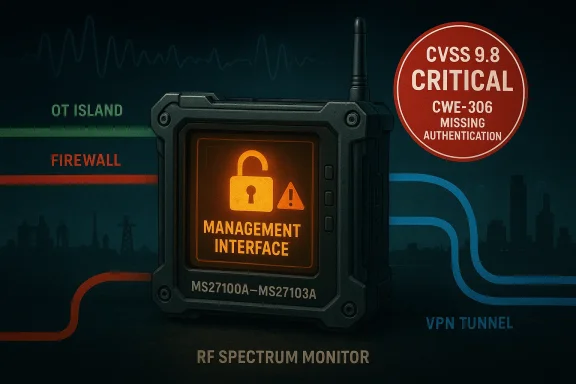
Anritsu’s Remote Spectrum Monitor has landed in the crosshairs of a critical ICS security advisory because the device family exposes its management interface without authentication, opening the door to unauthorized configuration changes, sensitive signal-data exposure, and service disruption. CISA says the issue affects MS27100A, MS27101A, MS27102A, and MS27103A across all versions, and rates the flaw CVSS 3.1 9.8 Critical under CWE-306: Missing Authentication for Critical Function. The key operational detail is that Anritsu reportedly has no plan to fix the issue, so defenders are being told to rely on segmentation and other compensating controls instead of waiting for a patch
Industrial and communications monitoring gear often sits in a strange security category: it is neither a generic IT appliance nor a classic PLC, yet it can still influence highly sensitive operations. Remote spectrum monitors are used to observe RF environments, identify interference, and support mission-critical communications workflows, which makes them relevant to sectors where reliability and visibility are non-negotiable. CISA’s advisory places Anritsu’s devices inside the Communications, Defense Industrial Base, Emergency Services, and Transportation Systems sectors, underscoring that the impact is not limited to one niche deployment model
The current advisory also highlights a familiar but unforgiving failure mode: missing authentication on a management surface that should never have been left open to the network. In this case, CISA says the vulnerability is not merely a bad deployment choice or a misconfiguration that operators can correct; rather, the device has no mechanism to enable or configure authentication, meaning the weakness is embedded in the product design itself
That distinction matters. When a product flaw is architectural, remediation options shrink dramatically. Administrators cannot simply flip a setting, apply a small policy update, or wait for a firmware patch that never arrives. The practical outcome is that operators must treat the device like an exposed control asset and build defense in depth around it, because the product itself is not offering a native trust boundary.
CISA’s guidance in the advisory reflects that reality. Instead of describing a clean fix, it recommends minimizing exposure, isolating control-system networks, and using secure remote-access methods only where necessary. That is a very different posture from ordinary enterprise patch management, and it signals that the agency views this as a design-level operational risk rather than a routine bug
The affected product set is straightforward but important. CISA lists Remote Spectrum Monitor MS27100A, MS27101A, MS27102A, and MS27103A as affected under **vers:all/*, meaning no version is currently considered safe based on the advisory language. That broad scope suggests administrators should not assume that newer firmware equals a protected state unless the vendor later publishes a separate fix statement
The advisory also says that no known public exploitation specifically targeting this vulnerability has been reported to CISA at the time of publication. That is reassuring only in a narrow sense. For a flaw scored 9.8**, the absence of public exploitation is not the same as low risk; it often just means the issue is newly disclosed or not yet widely observed in the wild
A flaw like this is also dangerous because management interfaces tend to be trusted by design. They are built to be convenient for operators, not adversarially hardened for direct exposure to hostile networks. That convenience becomes a liability when authentication is absent, because the device has no native way to distinguish a legitimate engineer from an opportunistic attacker.
This is especially risky in operational technology and infrastructure-adjacent systems, where access paths can be more permissive than in conventional enterprise environments. Devices are often placed on engineering VLANs, temporary lab networks, vendor support segments, or remote-access enclaves that may not be as tightly controlled as production servers. If such a device is reachable from a broader internal network, the threat actor does not need to break in; they only need to find it.
The advisory’s wording about altering operational settings and extracting signal data suggests more than a nuisance exposure. In a spectrum-monitoring context, data itself may reveal communications patterns, channel occupancy, and the timing of operational activity. That can be valuable for reconnaissance even when the attacker does not intend immediate sabotage.
When a product is deployed worldwide, as CISA notes here, the attack surface becomes distributed across many organizations with different security maturity levels. Some will segment properly, some will rely on inherited flat networks, and some will have remote access paths that were never intended to expose the management interface to hostile scanning. In practice, the weakest deployment often determines the real-world risk posture.
CISA also identifies the company headquarters as Japan and notes that the relevant sectors are globally deployed. That combination matters because vulnerabilities in industrial or communications equipment do not respect geography; they tend to follow the product into any environment where the device is installed and reachable. For multinational operators, governance and asset inventory become as important as the advisory itself.
That position is particularly stark because CISA’s remediation section does not list a vendor patch or a clean firmware upgrade path. Instead, it gives a mitigation recommendation: deploy the Remote Spectrum Monitor inside secure network environments. That is sensible advice, but it is also a tacit admission that the product’s core design is unlikely to change soon.
This kind of no-fix outcome is not unheard of in embedded or industrial gear, especially when the vulnerable behavior is integral to the way the device was built. But it creates a long tail of operational burden. Security teams must decide whether to isolate, firewall, or retire a device that may still be functionally useful to engineering staff.
For buyers, the lesson is clear: authentication support is not optional. If a critical-function management interface can’t be protected, the product inherits a structural weakness that may outlive several budget cycles. That raises the bar for vendor evaluation and contract language in future procurements.
This is standard ICS guidance, but it becomes especially important when a device cannot authenticate users. Segmentation is the next-best gate after authentication, and in some environments it is the only enforceable one left. If the device cannot verify the user, the network must do as much of that trust work as possible.
The advisory also advises that when remote access is required, organizations should use more secure methods such as VPNs, while recognizing that VPNs can have vulnerabilities and must be kept current. That caveat is important because it avoids the false comfort of assuming that “VPN equals secure.” A VPN is only as trustworthy as the endpoints, the credentials, and the segmentation policy behind it.
The advisory recommends that organizations observing suspected malicious activity follow their established internal procedures and report findings to CISA for tracking and correlation. That is a reminder that visibility is a response mechanism, not just a preventive one. If the device is being probed or abused, those logs may help determine whether the issue is isolated or part of a broader campaign.
Because the flaw involves a management interface, defenders should also review whether access logs, firewall records, and identity logs can prove whether someone reached the device. If the interface has no authentication, the absence of login failures does not imply safety; it may simply mean the attacker never had to log in.
CISA’s publication of this advisory also illustrates how modern critical-infrastructure security operates through a shared ecosystem of vendor disclosures, government advisories, and operator response. In practice, the government often becomes the amplifier for a product issue that vendors cannot or will not fully remediate. That makes the advisory ecosystem itself a key part of the defense chain.
What stands out here is that the issue does not depend on exotic exploitation. There is no mention of memory corruption, chained RCE, or credential theft from a complex attack flow. Instead, the problem is simpler and arguably more sobering: the device trusts the network too much, and the network is not trustworthy enough.
It also gives security teams a concrete case study for improving control-system segmentation and vendor-risk review. The lack of a fix means leaders can justify budget for isolation work, inventory cleanup, and replacement planning without waiting for a breach to prove the need.
There is also a real possibility of operational disruption if compensating controls are applied carelessly. Blocking the wrong traffic or over-isolating a monitor can create blind spots that hinder troubleshooting, compliance checks, or incident response. In ICS and communications environments, security changes can have their own availability costs.
Over the coming weeks, the key question will be whether additional guidance emerges from Anritsu, CISA, or industry partners about safer deployment patterns, compensating controls, or retirement strategies. If more operators report exposure or operational impact, the advisory may broaden from a product warning into a wider discussion about authentication expectations for specialty RF equipment.
Source: CISA Anritsu Remote Spectrum Monitor | CISA
 Background
Industrial and communications monitoring gear often sits in a strange security category: it is neither a generic IT appliance nor a classic PLC, yet it can still influence highly sensitive operations. Remote spectrum monitors are used to observe RF environments, identify interference, and support mission-critical communications workflows, which makes them relevant to sectors where reliability and visibility are non-negotiable. CISA’s advisory places Anritsu’s devices inside the Communications, Defense Industrial Base, Emergency Services, and Transportation Systems sectors, underscoring that the impact is not limited to one niche deployment modelThe current advisory also highlights a familiar but unforgiving failure mode: missing authentication on a management surface that should never have been left open to the network. In this case, CISA says the vulnerability is not merely a bad deployment choice or a misconfiguration that operators can correct; rather, the device has no mechanism to enable or configure authentication, meaning the weakness is embedded in the product design itself
That distinction matters. When a product flaw is architectural, remediation options shrink dramatically. Administrators cannot simply flip a setting, apply a small policy update, or wait for a firmware patch that never arrives. The practical outcome is that operators must treat the device like an exposed control asset and build defense in depth around it, because the product itself is not offering a native trust boundary.
CISA’s guidance in the advisory reflects that reality. Instead of describing a clean fix, it recommends minimizing exposure, isolating control-system networks, and using secure remote-access methods only where necessary. That is a very different posture from ordinary enterprise patch management, and it signals that the agency views this as a design-level operational risk rather than a routine bug
What CISA Said
CISA’s advisory is blunt about the likely consequences of successful exploitation. An attacker with network access could alter operational settings, obtain sensitive signal data, or disrupt device availability. Those three outcomes matter because they map directly to the core purposes of the product: visibility, integrity, and uptimeThe affected product set is straightforward but important. CISA lists Remote Spectrum Monitor MS27100A, MS27101A, MS27102A, and MS27103A as affected under **vers:all/*, meaning no version is currently considered safe based on the advisory language. That broad scope suggests administrators should not assume that newer firmware equals a protected state unless the vendor later publishes a separate fix statement
The advisory also says that no known public exploitation specifically targeting this vulnerability has been reported to CISA at the time of publication. That is reassuring only in a narrow sense. For a flaw scored 9.8**, the absence of public exploitation is not the same as low risk; it often just means the issue is newly disclosed or not yet widely observed in the wild
Why the Score Is So High
The CVSS vector, AV:N/AC:L/PR:N/UI:N/S:U/C:H/I:H/A:H, is the kind of profile defenders dread. Network reachability, low attack complexity, no privileges, no user interaction, and full impact on confidentiality, integrity, and availability create the textbook shape of a critical remote attack surface. In plain English: if an attacker can reach the device, the door is already most of the way openA flaw like this is also dangerous because management interfaces tend to be trusted by design. They are built to be convenient for operators, not adversarially hardened for direct exposure to hostile networks. That convenience becomes a liability when authentication is absent, because the device has no native way to distinguish a legitimate engineer from an opportunistic attacker.
Why Missing Authentication Matters
Missing authentication for a critical function is one of the most consequential classes of embedded-device weakness because it strikes at the first control a system should enforce: who is allowed to touch it. If that gate does not exist, every downstream security assumption becomes fragile. CISA’s classification under CWE-306 is therefore not just a taxonomy label; it is a warning that the product’s trust model is incompleteThis is especially risky in operational technology and infrastructure-adjacent systems, where access paths can be more permissive than in conventional enterprise environments. Devices are often placed on engineering VLANs, temporary lab networks, vendor support segments, or remote-access enclaves that may not be as tightly controlled as production servers. If such a device is reachable from a broader internal network, the threat actor does not need to break in; they only need to find it.
The advisory’s wording about altering operational settings and extracting signal data suggests more than a nuisance exposure. In a spectrum-monitoring context, data itself may reveal communications patterns, channel occupancy, and the timing of operational activity. That can be valuable for reconnaissance even when the attacker does not intend immediate sabotage.
Operational Implications
- Unauthorized configuration changes could cause blind spots in monitoring workflows.
- Signal data exposure could reveal operational rhythms or communications usage.
- Availability disruption could deny visibility during incidents.
- Lack of authentication removes a critical layer of operator validation.
- Design-level weakness means local settings alone cannot solve the problem.
Affected Products and Deployment Realities
The advisory’s product list is narrow but operationally meaningful. The affected models—MS27100A, MS27101A, MS27102A, and MS27103A—suggest a family of specialized monitoring appliances, not general-purpose software that can be replaced with a quick virtual update. That matters because hardware-adjacent devices are usually embedded in workflows, installed in fixed locations, and tied to specific engineering or compliance dutiesWhen a product is deployed worldwide, as CISA notes here, the attack surface becomes distributed across many organizations with different security maturity levels. Some will segment properly, some will rely on inherited flat networks, and some will have remote access paths that were never intended to expose the management interface to hostile scanning. In practice, the weakest deployment often determines the real-world risk posture.
CISA also identifies the company headquarters as Japan and notes that the relevant sectors are globally deployed. That combination matters because vulnerabilities in industrial or communications equipment do not respect geography; they tend to follow the product into any environment where the device is installed and reachable. For multinational operators, governance and asset inventory become as important as the advisory itself.
What Operators Should Verify
- Confirm exactly which MS271xxA models are present.
- Identify whether the management interface is reachable from non-operator networks.
- Check whether the device is exposed to any routed or wireless internal segment.
- Determine whether remote-access tooling or vendor support paths touch the interface.
- Verify whether the device appears in any asset-management, SOC, or SIEM inventory.
No Planned Vendor Fix
One of the most consequential details in the advisory is Anritsu’s reported stance that it has no plans to fix this issue. That instantly changes the conversation from patch management to risk acceptance, compensating controls, and possibly product replacement planning. In other words, defenders are not waiting for remediation; they are deciding how long they can live with the exposureThat position is particularly stark because CISA’s remediation section does not list a vendor patch or a clean firmware upgrade path. Instead, it gives a mitigation recommendation: deploy the Remote Spectrum Monitor inside secure network environments. That is sensible advice, but it is also a tacit admission that the product’s core design is unlikely to change soon.
This kind of no-fix outcome is not unheard of in embedded or industrial gear, especially when the vulnerable behavior is integral to the way the device was built. But it creates a long tail of operational burden. Security teams must decide whether to isolate, firewall, or retire a device that may still be functionally useful to engineering staff.
Why “No Fix” Is a Strategic Problem
A no-fix decision is not merely a technical footnote. It affects procurement, lifecycle planning, remote support contracts, and capital replacement cycles. It can also force organizations to treat an otherwise stable device as a security exception that requires recurring review rather than a one-time remediation.For buyers, the lesson is clear: authentication support is not optional. If a critical-function management interface can’t be protected, the product inherits a structural weakness that may outlive several budget cycles. That raises the bar for vendor evaluation and contract language in future procurements.
Network Segmentation as the Primary Control
CISA’s recommended mitigations lean heavily on network exposure reduction. The agency says organizations should minimize network exposure for control system devices and ensure they are not accessible from the Internet. It also recommends placing control system networks and remote devices behind firewalls and isolating them from business networksThis is standard ICS guidance, but it becomes especially important when a device cannot authenticate users. Segmentation is the next-best gate after authentication, and in some environments it is the only enforceable one left. If the device cannot verify the user, the network must do as much of that trust work as possible.
The advisory also advises that when remote access is required, organizations should use more secure methods such as VPNs, while recognizing that VPNs can have vulnerabilities and must be kept current. That caveat is important because it avoids the false comfort of assuming that “VPN equals secure.” A VPN is only as trustworthy as the endpoints, the credentials, and the segmentation policy behind it.
Segmentation Checklist
- Place the device on a dedicated control network.
- Block Internet access to the management interface.
- Restrict access to known engineering hosts only.
- Use firewall rules that limit source addresses and ports.
- Review remote-access pathways for necessity and scope.
- Treat vendor support access as a temporary exception, not a permanent rule.
Detection, Monitoring, and Incident Readiness
CISA also reminds organizations to perform proper impact analysis and risk assessment before deploying defensive measures. That matters because some mitigations can break legitimate operational workflows if they are applied too aggressively or without testing. In ICS environments, security changes can produce safety, maintenance, or availability side effects, so the order of operations mattersThe advisory recommends that organizations observing suspected malicious activity follow their established internal procedures and report findings to CISA for tracking and correlation. That is a reminder that visibility is a response mechanism, not just a preventive one. If the device is being probed or abused, those logs may help determine whether the issue is isolated or part of a broader campaign.
Because the flaw involves a management interface, defenders should also review whether access logs, firewall records, and identity logs can prove whether someone reached the device. If the interface has no authentication, the absence of login failures does not imply safety; it may simply mean the attacker never had to log in.
Monitoring Priorities
- Track inbound connections to the device management surface.
- Alert on unusual source IPs or geography.
- Review network telemetry for unexpected management sessions.
- Preserve logs before making segmentation changes.
- Correlate device events with firewall and VPN records.
- Escalate any evidence of configuration drift immediately.
How This Fits the Broader ICS Pattern
This advisory fits a pattern that has become increasingly common across industrial and embedded systems: a product ships with a management function that assumes trust, only for that assumption to collapse under modern threat models. The more specialized the device, the more likely its designers optimized for field utility and not for hostile-network exposure. That tradeoff is understandable, but it is no longer acceptable for internet-reachable or broadly reachable systems.CISA’s publication of this advisory also illustrates how modern critical-infrastructure security operates through a shared ecosystem of vendor disclosures, government advisories, and operator response. In practice, the government often becomes the amplifier for a product issue that vendors cannot or will not fully remediate. That makes the advisory ecosystem itself a key part of the defense chain.
What stands out here is that the issue does not depend on exotic exploitation. There is no mention of memory corruption, chained RCE, or credential theft from a complex attack flow. Instead, the problem is simpler and arguably more sobering: the device trusts the network too much, and the network is not trustworthy enough.
Industry Implications
- Security-by-architecture matters more than security-by-policy.
- Device management planes should never assume implicit trust.
- Procurement teams need authentication requirements up front.
- Operators need asset inventories that include specialty appliances.
- Lifecycle planning should account for products that may never be fixed.
Strengths and Opportunities
The immediate downside of this advisory is obvious, but there are also practical opportunities for organizations to improve their operational security posture. A vulnerability this severe often exposes weaknesses in network design, asset management, and remote-access governance that were already present, even if they had not yet been exploited. Used correctly, the advisory can become a forcing function for broader hardening.It also gives security teams a concrete case study for improving control-system segmentation and vendor-risk review. The lack of a fix means leaders can justify budget for isolation work, inventory cleanup, and replacement planning without waiting for a breach to prove the need.
- Strong catalyst for asset discovery and inventory cleanup.
- Clear justification for tighter network segmentation.
- Opportunity to revise vendor onboarding requirements.
- Chance to test incident-response procedures for ICS assets.
- Useful precedent for demanding authentication support in future purchases.
- Better visibility into which engineering tools actually need network reachability.
- Reason to align OT and IT security governance more closely.
Risks and Concerns
The risks are not limited to direct exploitation. The bigger problem is that devices like these are often quietly embedded in operations and therefore easy to overlook during routine vulnerability management. If a team assumes “specialty gear” falls outside standard review cycles, a critical exposure can linger long after publication.There is also a real possibility of operational disruption if compensating controls are applied carelessly. Blocking the wrong traffic or over-isolating a monitor can create blind spots that hinder troubleshooting, compliance checks, or incident response. In ICS and communications environments, security changes can have their own availability costs.
- Unauthenticated access could allow silent tampering.
- Signal-data exposure could aid reconnaissance or targeting.
- Availability loss could impair monitoring during incidents.
- Flat internal networks could make exposure worse than expected.
- No vendor fix means the exposure may persist indefinitely.
- Misapplied segmentation could break legitimate operational workflows.
- Incomplete asset inventories may leave devices unprotected.
Looking Ahead
The most important next step is whether organizations treat this as a routine bulletin or as a signal to reassess their control-system exposure model. A critical advisory with no vendor remediation should trigger more than firewall tuning; it should prompt a lifecycle conversation about the long-term viability of the device in its current role. That is the real story here, not just the CVSS score.Over the coming weeks, the key question will be whether additional guidance emerges from Anritsu, CISA, or industry partners about safer deployment patterns, compensating controls, or retirement strategies. If more operators report exposure or operational impact, the advisory may broaden from a product warning into a wider discussion about authentication expectations for specialty RF equipment.
- Confirm whether the device is reachable from any nonessential network segment.
- Restrict management access to known administrative hosts.
- Review firewall and VPN rules for least-privilege alignment.
- Document whether the product can be replaced or isolated long term.
- Track for any later vendor statement, firmware note, or security bulletin.
- Escalate if evidence suggests the device has already been exposed externally.
Source: CISA Anritsu Remote Spectrum Monitor | CISA
