

Overview
The vulnerability is identified as CVE-2026-6284, and CISA’s summary is blunt about the exploit path: an attacker with network access to the PLC can brute-force passwords and gain unauthorized access to systems and services because the product family lacks strong password complexity enforcement and does not rate-limit password attempts. That combination is especially problematic in industrial environments, where control systems are often built to prioritize uptime and operational continuity over frequent authentication friction.
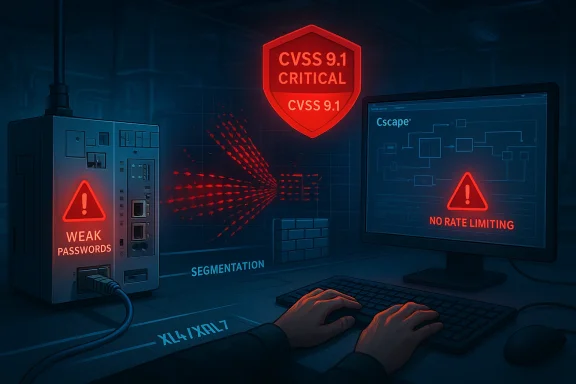
Horner Automation’s affected stack sits in a category that is easy to underestimate from the outside. PLC programming environments like Cscape and field controllers like XL4 and XL7 are not general-purpose office applications; they are part of the machinery that can keep production lines moving, regulate equipment, and coordinate industrial processes. When the authentication layer is weak, the consequence is not merely unauthorized login. It can become a foothold into the operational technology environment itself.
What makes the advisory notable is that the remediation story is already available. CISA relays Horner Automation’s guidance to move to Cscape v10.2 SP2 or later and to update the firmware for both XL4 and XL7 PLCs to the latest versions. That means defenders are not waiting for an upcoming fix cycle; they have a concrete patch path and should be using it.
The broader context matters as much as the specific bug. Weak-password findings remain a recurring theme in industrial advisories because the attack surface often spans engineering workstations, remote maintenance workflows, and field-deployed controllers. Once those systems are reachable on a network segment, “just a password issue” can become a full compromise scenario, especially where there is no login throttling, no lockout policy, and no compensating control at the network edge.
What CISA Actually Disclosed
CISA’s advisory is organized around a straightforward but dangerous control failure. The agency says the issue allows password brute force enumeration because of limited password complexity and no password input limiters, which means an attacker can keep trying credentials until one works. This is not a subtle logic bug buried deep in a parser; it is a classic access-control failure with direct operational consequences.
The affected products are narrowly named, which helps defenders scope exposure faster. CISA lists Cscape v10.0, XL7 PLC v15.60, and XL4 PLC v16.32.0 as known-affected versions, with the product status marked known_affected. That makes inventory work essential: if a site uses Horner Automation equipment but has not mapped exact software and firmware versions, it cannot know whether it is exposed or already protected.
The Exploit Mechanism
The exploit does not require malware delivery, code injection, or a public proof-of-concept chain. According to the advisory, an attacker only needs network access to the PLC and enough patience to brute-force the credential space. In practical terms, that means perimeter exposure and weak identity controls are the real enablers, not some exotic protocol flaw.
This is why authentication design matters so much in OT. If a device accepts unlimited guesses, then password complexity alone becomes a partial defense, not a real one. And if the password policy is weak as well, the system effectively invites automated guessing. The result is a security boundary that looks present on paper but is fragile in practice.
Why the CVSS Score Is So High
A 9.1 Critical score makes sense once you read the vector: AV:N/AC:L/PR:N/UI:N/S:U/C:H/I:H/A:N. That combination tells you the issue is remotely reachable, low in complexity, requires no privileges, and can yield high confidentiality and integrity impact. The lack of availability impact does not make the bug less serious; in industrial environments, unauthorized access to logic and configurations can be enough to create cascading consequences later.
That is the key analytical point. A flaw can be “only” about passwords and still be severe when the target is a control system. In a PLC context, unauthorized access can alter settings, disrupt operations, or provide the attacker with intelligence about how the environment is wired and controlled. Confidentiality and integrity are often the gateways to physical disruption.
Why Weak Password Controls Still Matter in 2026
It is tempting to think of password brute force as a tired attack class, but that attitude ignores how often industrial devices still rely on simplistic authentication assumptions. In IT, repeated failed logins often trigger account lockouts, adaptive risk scoring, or central monitoring. In OT, especially on embedded or specialized systems, those controls are sometimes absent, inconsistent, or impractical to deploy without vendor support.
The advisory’s wording suggests precisely that type of environment. There are no input limiters, and the password rules are weak enough that brute-force discovery remains viable. That means the real problem is not only the password itself, but the absence of basic mechanical friction that would slow down automated attacks.
The Operational Difference Between IT and OT
In a corporate application, a login weakness might expose records or administrative functions. In a PLC environment, the same weakness can expose process logic, equipment behavior, or remote management interfaces that are intertwined with production. That is why seemingly modest access-control flaws deserve more attention in manufacturing than they might in a consumer web app.
Another operational difference is patch cadence. Industrial sites often schedule updates carefully because downtime is expensive, testing must be extensive, and vendor compatibility matters. Attackers know this. They understand that even after a vulnerability is disclosed, many plants will spend time validating fixes before applying them, which creates a window of exposure.
The advisory’s timing also reinforces a familiar pattern in ICS security: disclosure does not equal remediation. The longer a password weakness remains on a network-reachable controller, the more likely it is to be tested by opportunistic scanning, internal misuse, or targeted intrusion attempts. The fact that CISA says no public exploitation is known right now should not be read as a durable safety guarantee.
The Industrial Control System Context
Industrial control systems are not defended the same way as typical enterprise endpoints, and that distinction shapes how a weakness like CVE-2026-6284 should be interpreted. PLCs are often reachable only from specialized engineering subnets, but those subnets are not always as isolated as architects assume. Remote support, shared management tooling, and legacy network design can all widen the attack surface.
This is one reason CISA always emphasizes defense-in-depth in ICS advisories. The agency recommends minimizing network exposure, segmenting control system networks from business networks, and using more secure methods such as VPNs when remote access is required. Those recommendations are not generic boilerplate; they are compensating controls that directly reduce the likelihood that a network-based brute-force attempt will even reach the device.
Segmentation Is Not Optional
If a PLC is reachable from a flat internal network, then any compromised workstation or misused maintenance account can become an attack springboard. That is why industrial segmentation needs to be treated as a control requirement rather than a nice-to-have design goal. The advisory’s network-access condition makes that especially relevant here.
Firewalls and isolation are valuable, but they are not enough by themselves if administrative services remain exposed to large internal trust zones. A brute-force attack can be noisy, but it can also be persistent and low-and-slow enough to blend into routine traffic if monitoring is weak. This is where logging, alerting, and authentication telemetry become crucial.
The fact that the target is a PLC also means defenders should think beyond the login screen. If an attacker gets in, the next question is what they can read, modify, or export, and whether those actions can be detected quickly. In many OT environments, the answer determines whether a security incident becomes a safety or uptime incident later.
Remediation and Vendor Guidance
Horner Automation’s remediation path is straightforward on paper: upgrade Cscape to v10.2 SP2 or later and deploy the latest firmware for the affected XL4 and XL7 PLCs. CISA specifically points defenders to Horner’s release notes for more detail. That means the immediate task is not debating the severity of the issue; it is confirming which assets need update planning.
The best remediation strategy will depend on operational tolerance for change. Some sites may be able to patch quickly if they have strong change windows and non-production testing. Others may need a staged approach that begins with inventory, then lab validation, then scheduled deployment. Either way, leaving a network-accessible brute-force surface in place is not a sustainable option.
Practical Steps for Defenders
A useful response plan should be concrete and sequenced. The most effective teams will do more than “apply updates”; they will verify exposure, narrow access, and confirm that the hardened state is real. In ICS, verification matters almost as much as patching because version drift and backported firmware can make assumptions unreliable.
- Identify every deployment of Cscape v10.0, XL7 PLC v15.60, and XL4 PLC v16.32.0.
- Confirm whether each device is reachable from any network segment beyond the minimum required control path.
- Apply the vendor update to Cscape v10.2 SP2 or later where relevant.
- Update the latest firmware on all affected XL4 and XL7 PLCs.
- Review authentication exposure and restrict management access behind segmentation and firewall rules.
- Monitor for abnormal login activity, repeated authentication failures, or unexpected administrative access attempts.
The emphasis on network exposure is important because patching alone may not be immediate in all environments. CISA’s recommended practices include isolating control networks from business networks and using VPNs carefully for remote access, with the caveat that VPNs themselves must be kept current and are only as secure as the devices they connect to. That is a nuanced but realistic view of industrial defense.
Why This Is More Than a Password Bug
In ordinary software, a weak password policy can be frustrating but survivable if the data or functionality exposed is limited. In PLC and automation environments, access can be much more consequential because the device is part of the control plane itself. That is why a 9.1-rated issue based on password brute force should not be mentally downgraded just because it lacks a flashy exploit primitive.
The advisory’s impact statement is simple: successful exploitation could allow an attacker to gain unauthorized access to systems and services. That wording is broad, and in OT broad is bad. It suggests the attacker may be able to move from authentication weakness into functions that were never intended for an untrusted user, which is often how a low-level weakness becomes a real-world intrusion.
Unauthorized Access Is the Beginning, Not the End
Once an attacker has a valid session, the next phase often involves enumeration, persistence, configuration changes, or operational reconnaissance. Even if the immediate vulnerability does not directly cause downtime, it can create the conditions for later disruption. That is why defenders should avoid thinking in narrow, one-step exploit terms.
This is especially true in environments where engineering workstations, PLCs, and supervisory systems share trust relationships. A compromised authentication path on one device can expose credentials, configuration data, or trust anchors that help an adversary pivot. In that sense, the password bug is not just an endpoint issue; it is a network and trust-boundary issue.
There is also a governance lesson here. Industrial sites that rely on default credentials, minimal password rules, or unaudited remote access are accepting a security debt that eventually gets paid with interest. The CISA advisory makes that debt visible, which is useful because visibility is the first step toward budget, prioritization, and ownership.
Threat Model and Likely Attack Scenarios
The most likely threat actor is not necessarily a nation-state operator with custom malware. More mundane adversaries can already do a lot with brute force if a device is reachable, weakly protected, and unmonitored. That includes opportunistic attackers, insider threats, and less sophisticated intruders who are scanning for exposed industrial gear.
That matters because industrial organizations sometimes assume only highly targeted campaigns matter. In reality, if a device is accessible and the authentication controls are weak, the exposure can be discovered by automation or low-skill probing just as easily as by advanced tooling. That lowers the barrier to exploitation.
Attack Scenarios Defenders Should Consider
A network-facing PLC with weak password controls can be abused in a few different ways. One scenario is external reconnaissance followed by credential brute forcing if the device is reachable from an unintended network path. Another is internal misuse after a workstation or VPN account is compromised. A third is maintenance-path abuse where trust is granted too broadly.
- Opportunistic scanning of exposed management interfaces.
- Password spraying or brute forcing from an internal foothold.
- Abuse of remote access paths that were meant for technicians only.
- Unauthorized access to configuration or logic management functions.
- Lateral movement from a compromised engineering asset.
The advisory’s lack of public exploitation reports does not eliminate any of these scenarios. It simply means CISA has not yet seen reports tying this specific CVE to confirmed abuse. Security teams should treat that as a brief window for action, not a reason to wait.
Strengths and Opportunities
The good news is that this is a vulnerability with a clear fix path and a clear policy lesson. The vendor has already released remediations, CISA has published a direct advisory, and the mitigation guidance is straightforward enough for both engineering and security teams to operationalize. That creates an opportunity to improve not only this specific device family, but the broader authentication posture around industrial assets.
- The affected version list is specific, which simplifies inventory work.
- Vendor remediation is already available.
- The exploit path is understandable to non-specialists, which helps with stakeholder buy-in.
- Network segmentation can materially reduce exposure.
- The issue creates a chance to audit remote access and password policy across OT.
- Stronger monitoring can catch brute-force behavior earlier.
- The advisory reinforces defense-in-depth for critical manufacturing environments.
There is also a larger organizational opportunity. Many industrial operators still treat identity controls as an afterthought compared with availability and process uptime. This advisory is a useful reminder that access control is part of operational resilience, not separate from it.
Risks and Concerns
The biggest concern is that this kind of issue may be dismissed as merely a password problem and therefore assigned a lower priority than it deserves. That would be a mistake, because a network-reachable password weakness in a PLC can be the front door to control logic and operational services. In ICS, the impact of unauthorized access is often indirect, delayed, and still severe.
- Some environments may not know exactly where affected Horner assets are deployed.
- Firmware and software updates may require careful downtime coordination.
- Remote support channels may keep the exposure alive even after perimeter hardening.
- Weak credentials can persist in shared maintenance workflows.
- Monitoring may not be tuned for repeated authentication attempts against OT devices.
- Patch deferral can leave assets exposed for longer than operators expect.
- Legacy segmentation mistakes can make an apparently internal device effectively reachable.
There is also a governance risk. If remediation ownership is split between operations, controls engineering, IT, and security, everyone may assume someone else is handling the update. That kind of diffusion is common in industrial environments and is one reason simple vulnerabilities sometimes linger far longer than they should.
What to Watch Next
The next step is to see how quickly operators move from advisory awareness to actual patch deployment. For industrial teams, the hard part is often not understanding the risk; it is aligning maintenance windows, testing cycles, and vendor validation in a way that keeps production stable. If Horner’s firmware updates prove easy to deploy, the remediation curve could be relatively fast.
The other major question is whether defenders discover broader password and access-control weaknesses in adjacent controller families. CISA’s notice is about one product set, but the underlying lesson—weak complexity plus no input limiting—is widely relevant across OT. If one vendor ships this class of weakness, others may have similar exposure hiding in plain sight.
Indicators Worth Monitoring
- Vendor confirmation that the latest firmware is being adopted successfully.
- Signs of brute-force activity against exposed OT services.
- Whether organizations discover unmanaged or forgotten Cscape installations.
- Changes in remote-access policy for engineering and maintenance users.
- Any follow-on advisories involving related Horner product lines or similar access-control defects.
There is also a subtle strategic issue worth watching. Industrial operators are increasingly being forced to treat authentication and network exposure as first-class safety concerns, not merely IT hygiene. Advisories like this one push the market in that direction by making the cost of weak controls impossible to ignore.
The most useful takeaway from this disclosure is not that Horner Automation made a mistake, though it did. It is that simple weaknesses can be genuinely dangerous when they sit at the edge of critical manufacturing systems. If defenders use this advisory to tighten access control, harden segmentation, and clean up remote management exposure, the industry will be better off than it was before the alert landed.