

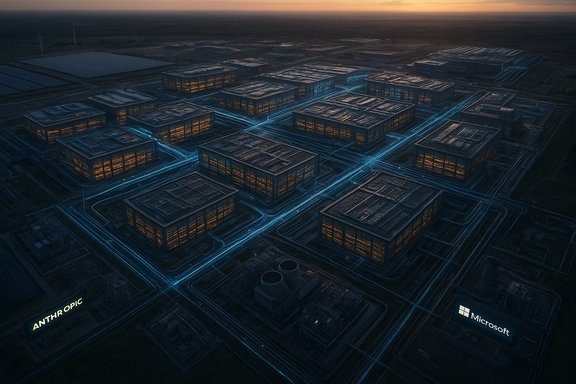
Anthropic’s and Microsoft’s twin announcements mark an unmistakable escalation in the AI arms race: a newly declared $50 billion buildout by Anthropic to erect custom data centers in Texas and New York, coupled with Microsoft’s ongoing rollout of massive AI-optimized campuses — including the so-called Fairwater complex in Wisconsin and additional expansions in Georgia. Together these moves underscore a blunt reality: the next generation of generative AI is being decided not just in model research labs, but in the steel, power lines, and cooling loops of purpose-built data centers. The investments promise jobs, local economic stimulus, and a leap in national computing capacity — while raising sharply practical questions about power, water, supply chains, competition, and long-term sustainability.
This wave of construction is not incremental. Capital commitments now run into the tens of billions for single companies in single years, and the facility designs mirror supercomputing thinking: tightly coupled NVLink/NVSwitch domains, pooled GPU memory to host massive model weights, and exabyte‑scale storage architectures to feed training datasets.
Caution: some elements of the plan — exact site coordinates, firm timelines for each campus, and final operational power draws — remain company‑reported projections and have not been independently verified down to meter‑level detail at the time of publication.
Caution: the precise count of deployed GPUs, peak sustained power consumption once all campuses are fully populated, and some performance claims such as “X times the throughput of the fastest supercomputer” are company statements tied to specific hardware configurations and benchmarking assumptions. Where companies report rounded or promotional figures (for example, “hundreds of thousands of GPUs”), independent verification requires on‑site inventory and operational telemetry that is typically proprietary.
Anthropic’s partner selection emphasizes agility and rapid delivery of gigawatts of power. The announced partner specializes in neocloud deployments — smaller, highly automated, and optimized for specific workloads — rather than generalized colocation. The partnership model aims to combine Anthropic’s AI operational profile with a partner’s site‑development expertise.
Caution: water‑use and power‑draw estimates vary across reporting and depend heavily on final cooling approach and local grid measures. Independent environmental analyses will be required for precise end‑state numbers.
Tax incentives and utility negotiations are central to realizing these projects. Municipalities often offer property tax breaks, infrastructure support, or zoning adjustments to attract campus investment, which complicates simple benefit calculations. Some local leaders tout long‑term payroll and supplier engagements, while critics point to the temporary nature of construction work and the limited direct tax revenue from highly computerized, capital‑intensive facilities.
For smaller AI firms, the capital and supply barriers create a structural divide: either partner with hyperscalers, lease specialized capacity, or face the economics of underprovisioned compute.
Mitigation measures include long‑term PPAs for renewables, on‑site battery storage, negotiated curtailment rights, and agreements to co‑fund grid upgrades. But those solutions have costs and lead times that can complicate the timeline for bringing capacity online.
The next 18–36 months will tell whether these massive bets deliver proportional returns in societal and business value, or whether they create an overhang of underused infrastructure and concentrated market power. For now, the industry’s focus has shifted decisively from models alone to the physical infrastructure that makes them real. The winners will be those who marry model innovation with disciplined infrastructure planning, transparent community engagement, and resilient, sustainable operations.
Source: WebProNews AI Titans Bet Billions: Inside Anthropic and Microsoft’s Massive Data Center Surge
 Background
The infrastructure imperative: why AI needs bespoke datacenters
Modern large‑scale AI models demand three hallmark resources in abundance: dense GPU compute, ultra‑low latency network fabric, and vast storage throughput. General cloud regions, built for flexible multi‑tenant workloads, struggle with the thermal density, distributed memory needs, and sustained power draws that training and inference at frontier scale require. That mismatch has driven a shift toward purpose-built AI campuses: sites designed around GPU racks, liquid cooling, high‑capacity electrical feeds, and bespoke networking that stitches thousands — potentially hundreds of thousands — of accelerators into unified clusters.This wave of construction is not incremental. Capital commitments now run into the tens of billions for single companies in single years, and the facility designs mirror supercomputing thinking: tightly coupled NVLink/NVSwitch domains, pooled GPU memory to host massive model weights, and exabyte‑scale storage architectures to feed training datasets.
Where Anthropic and Microsoft fit in
Anthropic’s announcement — a $50 billion commitment to build custom data centers in the United States, starting with Texas and New York and executed with a specialized infrastructure partner — signals a move from cloud‑reliant consumption toward vertical control of compute. Microsoft, long an investor and partner in AI startups, is pushing its own fleet of Fairwater‑class campuses that are explicitly engineered to operate as contiguous AI supercomputers. Both companies are optimizing for the same constraint set: compute density, energy efficiency, and operational scale.Anatomy of the announcements
Anthropic’s $50 billion pledge: scope and stated goals
Anthropic framed the plan as an infrastructure investment to scale its Claude family of models and to sustain frontier research. The company has committed to:- Building multiple bespoke data center campuses across the U.S., with initial sites in Texas and New York.
- Partnering with a specialized infrastructure provider to deliver gigawatts of power and AI‑optimized designs.
- Phasing capacity online during 2026 and creating both construction and permanent technical jobs.
Caution: some elements of the plan — exact site coordinates, firm timelines for each campus, and final operational power draws — remain company‑reported projections and have not been independently verified down to meter‑level detail at the time of publication.
Microsoft’s parallel buildout: Fairwater and beyond
Microsoft’s multi‑campus strategy continues to scale. Its flagship Fairwater facility is described as a unified AI supercomputer campus with:- A footprint measured in hundreds of acres and more than a million square feet of data hall space.
- Designs that host tens to hundreds of thousands of GPU accelerators in tightly coupled racks (racks described in vendor and company materials as containing 72 GPUs each in single NVLink domains).
- Infrastructure capable of delivering terabytes‑scale internal bandwidth per rack and extreme interconnectivity across racks.
- Heavy emphasis on closed‑loop liquid cooling systems and significant on‑site or contracted renewable energy supplies.
Caution: the precise count of deployed GPUs, peak sustained power consumption once all campuses are fully populated, and some performance claims such as “X times the throughput of the fastest supercomputer” are company statements tied to specific hardware configurations and benchmarking assumptions. Where companies report rounded or promotional figures (for example, “hundreds of thousands of GPUs”), independent verification requires on‑site inventory and operational telemetry that is typically proprietary.
Strategic partnerships and site choice
Why Texas and New York for Anthropic?
Site selection is rarely accidental. Texas offers attractive land availability, favorable tax and incentive regimes, and ample grid capacity in certain regions — attributes that make it alluring for large energy consumers. New York provides proximity to dense financial, academic, and enterprise customer bases, enabling lower latency to major markets and an accessible talent pool for engineering and operations hires.Anthropic’s partner selection emphasizes agility and rapid delivery of gigawatts of power. The announced partner specializes in neocloud deployments — smaller, highly automated, and optimized for specific workloads — rather than generalized colocation. The partnership model aims to combine Anthropic’s AI operational profile with a partner’s site‑development expertise.
Microsoft’s geography: Wisconsin, Georgia and national scale
Microsoft’s Fairwater campus repurposes a high‑visibility greenfield parcel and ties into broader regional energy planning to sustain multi‑hundred‑megawatt loads. Additional projects in Georgia and other locations expand a national fabric, enabling geographic redundancy, regulatory diversification, and proximity to different customer segments. Microsoft’s strategy shows a dual approach: large centralized “supercampuses” for maximal coupling, and distributed nodes to support regional services and compliance requirements.Technology under the hood
GPU clusters, NVLink fabrics, and pooled memory
Modern AI performance gains come as much from system architecture as from raw device counts. Key technical features repeated across these projects include:- High‑density GPU racks: multiple accelerator boards packed per rack with local NVLink/NVSwitch fabrics to pool memory and reduce cross‑server latency.
- Rack‑scale accelerators: design patterns that treat a rack as a single large accelerator by aggregating GPU memory and interconnect bandwidth.
- High‑speed spine/leaf networking: InfiniBand or 800 Gbps+ Ethernet topologies to sustain multi‑TB/s flows between racks during model parallel training.
- Exabyte‑class storage backends: tiered storage systems with very high read throughput and deterministic latency for large dataset streaming.
Cooling and power engineering
A defining feature of AI‑optimized sites is thermal management. Anthropic and Microsoft plan to deploy:- Closed‑loop liquid cooling to extract heat at the source and enable higher power per rack without prohibitive ambient airflow requirements.
- Dry cooling and evaporative systems to minimize continuous grid water withdrawals; many designs use a fraction of older evaporative methods but trade off higher electrical load in chillers.
- On‑site substations and high‑capacity feeders to deliver hundreds of megawatts to campus gates, often under long‑term power purchase agreements (PPAs) to source renewables and stabilize pricing.
Caution: water‑use and power‑draw estimates vary across reporting and depend heavily on final cooling approach and local grid measures. Independent environmental analyses will be required for precise end‑state numbers.
Economic impacts: jobs, supply chains, and localities
Jobs and regional stimulus
Both companies are promising substantial local employment: construction jobs at scale during buildout phases and hundreds to low‑thousands of permanent technical and operations positions at mature campuses. Ancillary economic effects include growth for local suppliers, construction trades, and regional services.Tax incentives and utility negotiations are central to realizing these projects. Municipalities often offer property tax breaks, infrastructure support, or zoning adjustments to attract campus investment, which complicates simple benefit calculations. Some local leaders tout long‑term payroll and supplier engagements, while critics point to the temporary nature of construction work and the limited direct tax revenue from highly computerized, capital‑intensive facilities.
Supply‑chain concentration and the Nvidia choke point
The projects highlight a structural reality: procurement of AI‑class GPUs — the latest generation of accelerators — is a bottleneck. Large companies can secure hardware by the truckload, straining vendor backlogs and consolidating competitive advantage. A small set of hardware vendors and interconnect suppliers now govern the cadence at which model training capacity can scale.For smaller AI firms, the capital and supply barriers create a structural divide: either partner with hyperscalers, lease specialized capacity, or face the economics of underprovisioned compute.
Environmental, grid and regulatory risks
Power systems and grid capacity
Adding multi‑hundred‑megawatt campuses creates real challenges for local grids. States and utilities must contemplate upgrades, new transmission, and resilience planning. In several jurisdictions where large AI campuses are being built, analysts have estimated that aggregated data center demand could outstrip regionally available generation or require new long‑lead infrastructure projects.Mitigation measures include long‑term PPAs for renewables, on‑site battery storage, negotiated curtailment rights, and agreements to co‑fund grid upgrades. But those solutions have costs and lead times that can complicate the timeline for bringing capacity online.
Water usage and cooling tradeoffs
Liquid cooling conserves evaporative water use but often increases electrical loads for pumping and chilling. Closed‑loop systems reduce continuous withdrawals, yet the embodied energy cost and the upstream impacts of additional generation remain concerns. Environmental groups and utility planners emphasize full lifecycle accounting — from marginal grid emissions to regional hydrology impacts — before declaring a build sustainable.Community and economic equity concerns
Large campuses can shift local tax bases, stress municipal services, and change land use patterns. Some localities gain stable tax revenues and high‑paying jobs; others pay for upgraded grid and water infrastructure without commensurate community benefits. Policy debates are emerging around tax deals, local hiring requirements, workforce training investments, and accountability for environmental outcomes.Regulatory and antitrust scrutiny
Consolidation of compute power — when a few firms control vast GPU fleets and specialized campuses — raises competition questions. Regulators are beginning to examine whether preferential access to hardware and co‑located infrastructure creates anti‑competitive moats that inhibit a healthy AI ecosystem. Energy regulators also scrutinize large load additions for grid reliability and consumer impact.Competitive landscape and industry implications
Barrier to entry and consolidation risk
These multi‑billion dollar deployments widen the moat around deep‑pocketed incumbents. Startups and mid‑sized AI firms face increasingly sharp choices: rely on expensive public cloud time, negotiate complex partnerships, or accept delayed model timelines. This dynamic risks accelerating consolidation as capital‑rich firms scoop up talent, partners, and long‑term compute commitments.Market ripple effects: chipmakers, colo vendors, and financial markets
High‑profile buildouts typically move markets. Chipmakers and specialized hardware suppliers benefit from large OEM orders. Colocation providers adapt by offering AI‑specific halls or leasing GPU clusters. Investors treat the scale of announced commitments as both a vote of confidence in AI’s commercial potential and a bet on whose capital is best allocated.Geo‑political and supply chain considerations
Domestic buildouts, particularly in the U.S., have a strategic dimension: securing a domestic compute base reduces exposure to foreign supply constraints and aligns with broader national technology strategies. However, raw materials, semiconductor fabrication, and high‑speed networking still depend on global supply chains, raising geopolitical sensitivities.Technical and operational challenges
- Site development and permitting: converting greenfield land into a live data center takes multiple years and requires environmental reviews, transmission easements, and water rights negotiations.
- Power procurement: delivering reliable gigawatt‑scale power requires grid upgrades and long‑term contracts with generation partners.
- Cooling and density management: sustaining high rack power densities without sacrificing uptime demands advanced thermal engineering and redundant systems.
- Workforce: recruiting or training data center engineers, HPC operators, and specialized technicians is a multi‑year commitment.
- Security and compliance: physical and cyber controls must scale with the concentration of strategic compute assets.
Strengths and potential upsides
- Scale that enables new science: higher compute throughput and lower latency can speed model training cycles and enable larger, more capable models that might accelerate discovery in medicine, materials science, and climate modeling.
- Economic stimulus: construction cycles and ongoing operations can generate significant local economic activity and specialized job creation.
- Technological co‑design: combining hardware, software, and facilities engineering enables efficiency gains that are difficult to replicate in generic cloud regions.
- Strategic autonomy: owning bespoke capacity gives model owners flexibility, tailored security postures, and performance optimizations.
Risks and downside scenarios
- Overcapacity and stranded assets: rapid buildouts could overshoot demand, leaving capital sitting idle if model growth slows or if efficiency gains reduce required capacity.
- Environmental and social backlash: local communities and environmental groups may resist projects that stress grids or water resources, complicating builds and increasing costs.
- Supply chain fragility: concentrated demand for advanced accelerators risks bottlenecks and could be destabilized by geopolitical or manufacturing disruptions.
- Competitive consolidation: smaller firms without access to comparable compute could be marginalized, reducing the diversity of innovators in the AI space.
- Regulatory clampdown: energy and antitrust regulators may impose constraints that alter project economics or slow deliveries.
What to watch next
- Capacity timelines vs. demand: the industry must demonstrate not only investment but efficient utilization. Watch for telemetry on utilization rates as campuses come online.
- Grid and environmental approvals: conditional permits, renewable energy PPAs, and water usage disclosures are early indicators of how responsibly projects are being integrated into local systems.
- Supply channel signals: ordering patterns and vendor backlog reports from accelerator manufacturers and networking suppliers will reveal whether supply will keep pace.
- Pricing and margins for AI services: if infrastructure costs outstrip revenue realization for AI products, firms will recalibrate their capital deployment.
- Policy responses: expect states and federal agencies to revisit incentives, tax treatments, and energy planning in reaction to concentrated AI load growth.
Practical recommendations for stakeholders
- For policymakers: require transparent environmental impact assessments for gigawatt‑scale builds and tie incentives to verifiable local benefits such as workforce development and grid upgrades.
- For utilities and grid operators: plan transmission and generation upgrades proactively, and negotiate PPAs and demand‑response arrangements with large consumers to protect residential customers.
- For investors and boards: stress‑test capital plans against conservative utilization scenarios; consider staged rollouts and lease‑back options to reduce stranded‑asset risk.
- For smaller AI firms: explore multi‑tenant AI platforms and GPU leasing markets; invest in model and software efficiency to reduce dependence on raw compute scale.
- For local communities: negotiate community benefit agreements, local hiring pledges, and environmental monitoring commitments before approving incentives.
Conclusion
Anthropic’s $50 billion bid to build U.S. data centers and Microsoft’s continuing expansion of Fairwater‑class campuses represent a pivotal phase in AI’s industrialization. The technical ambition is clear: move from elastic cloud commodity compute to highly optimized, tightly coupled AI supercomputing campuses. The potential upside is enormous — faster research cycles, new enterprise services, and economic stimulus. Yet the scale also magnifies the familiar tensions of the modern tech economy: environmental footprints, grid impacts, supply‑chain concentration, and competitive imbalance.The next 18–36 months will tell whether these massive bets deliver proportional returns in societal and business value, or whether they create an overhang of underused infrastructure and concentrated market power. For now, the industry’s focus has shifted decisively from models alone to the physical infrastructure that makes them real. The winners will be those who marry model innovation with disciplined infrastructure planning, transparent community engagement, and resilient, sustainable operations.
Source: WebProNews AI Titans Bet Billions: Inside Anthropic and Microsoft’s Massive Data Center Surge
