

Anthropic’s latest push into the workplace is not another flashy chatbot — it’s a practical redesign of how an AI assistant plugs into the systems people already use every day, and that shift changes the calculus for enterprise IT, legal, and productivity teams alike.
Anthropic introduced Claude Cowork as a workplace-focused agent designed to function as a "thinking partner" inside established productivity stacks. The company’s February product updates expand Cowork’s reach by adding deep connectors to major workplace platforms — notably Google Drive, Gmail, and DocuSign — and by giving IT admins new controls to manage plugins, connectors, and private marketplaces across teams. What looks like another integration announcement is, in fact, a strategic pivot: Anthropic is betting the race for enterprise AI will be won by the assistants that minimize disruption and maximize fit inside existing workflows.
Beyond the headline integrations, Anthropic’s recent roadmap emphasizes multi-step orchestration (for example, moving context from a spreadsheet into a slide deck), private plugin marketplaces for organizations, per-team governance, and commercial pricing tiers intended to meet the needs of individual knowledge workers as well as large enterprise deployments. These moves come at a time when Anthropic has been building commercial partnerships and signing large implementations, and when competitors are pressing hard — Microsoft with its Copilot strategy, Google with its Gemini integrations, and OpenAI via platform partners.
This matters because much of knowledge work requires gluing together many small steps — the kind of repetitive handoffs where measured productivity gains are most likely to appear.
This is an attack on two fronts:
However, the market reaction will depend on execution. Competitors with deeper native integration into their own productivity suites (for example, a vendor controlling both the OS and office applications) will continue to have advantages in the tightest security and management scenarios. Conversely, Anthropic’s open connectors and private plugin capability could accelerate adoption among organizations that already embraced multi-vendor cloud architectures.
One practical question remains: can Anthropic operationalize the level of governance enterprises require at scale, and can it retain the trust of security teams when assistants are given access to mission-critical data? The answer will determine whether Claude becomes an enterprise standard or another useful but niche tool.
The upside is clear: measurable productivity gains, faster pilot-to-production velocity, and the ability to orchestrate multi-application workflows without forcing a rip-and-replace of core systems. The downside is also clear: the greater the integration, the greater the need for rigorous governance, contract clarity around data usage, and well-defined human oversight processes.
For CIOs, legal counsels, and security teams, the prudent path is to pilot with strict guardrails, insist on contractual clarity for training and data retention, instrument outcomes carefully, and maintain human review where outputs carry legal or compliance risk. Organizations that follow that blueprint will be best positioned to reap productivity gains while managing the real — but manageable — risks that come with embedding AI directly into how people work.
Anthropic’s Cowork is not a silver bullet, but it does raise the bar for what enterprise AI looks like: less about inventing new workflows, and more about amplifying the ones you already have.
Source: The Tech Buzz https://www.techbuzz.ai/articles/anthropic-rolls-out-claude-cowork-for-office-productivity/
 Background
Anthropic introduced Claude Cowork as a workplace-focused agent designed to function as a "thinking partner" inside established productivity stacks. The company’s February product updates expand Cowork’s reach by adding deep connectors to major workplace platforms — notably Google Drive, Gmail, and DocuSign — and by giving IT admins new controls to manage plugins, connectors, and private marketplaces across teams. What looks like another integration announcement is, in fact, a strategic pivot: Anthropic is betting the race for enterprise AI will be won by the assistants that minimize disruption and maximize fit inside existing workflows.Beyond the headline integrations, Anthropic’s recent roadmap emphasizes multi-step orchestration (for example, moving context from a spreadsheet into a slide deck), private plugin marketplaces for organizations, per-team governance, and commercial pricing tiers intended to meet the needs of individual knowledge workers as well as large enterprise deployments. These moves come at a time when Anthropic has been building commercial partnerships and signing large implementations, and when competitors are pressing hard — Microsoft with its Copilot strategy, Google with its Gemini integrations, and OpenAI via platform partners.
What Claude Cowork brings to the desk
Seamless connectors, not walled gardens
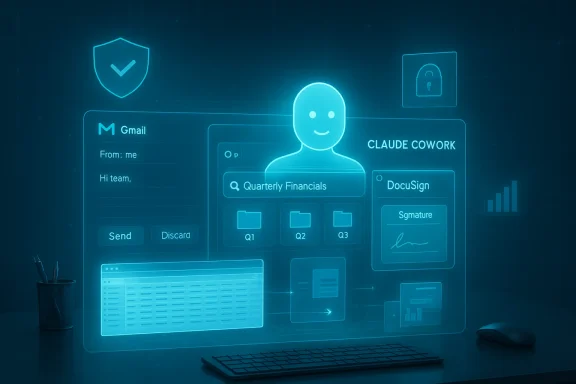
Claude Cowork’s new connectors are built to work inside Google Workspace and DocuSign rather than replacing them. Practically, that means:- Drafting or revising emails directly in Gmail using natural-language prompts.
- Searching, summarizing, and extracting relevant passages from documents stored in Google Drive.
- Managing signature workflows in DocuSign: drafting, preparing packets, routing for review, and triggering downstream steps once a contract is signed.
Context continuity across apps
One of the most important technical capabilities here is context passing: Claude can retain relevant document or spreadsheet context and apply it across subsequent tasks. A typical example is moving from an Excel-based financial model into a PowerPoint investor deck — Claude can read cells or named ranges, synthesize a narrative, and populate slides that match the numbers, all while preserving the chain of context for follow-up questions.This matters because much of knowledge work requires gluing together many small steps — the kind of repetitive handoffs where measured productivity gains are most likely to appear.
Admin controls and private plugin marketplaces
Enterprises get more than end-user convenience. Anthropic’s management surface now includes:- Admin-level enablement and domain-wide controls for integrations.
- The ability to create private plugin marketplaces so companies can curate approved bot behaviors and connectors.
- Role-based controls, audit logging, and scoped authorizations to limit what any given connector or plugin can do with corporate data.
Why this matters now: market context
The enterprise AI stack is no longer a set of isolated experiments. CIOs are looking for demonstrable ROI: shortening contract lifecycles, reducing time spent on rote drafting and summarization, speeding up report generation, and freeing specialists for higher-value judgment work. Anthropic’s playbook is to reduce the friction of adopting an AI assistant by minimizing the need to change tools or retrain workflows.This is an attack on two fronts:
- Against first-party incumbents that try to lock assistants inside their ecosystems by claiming "the only safe way is our suite."
- Against third-party assistants that require heavy migration or that sit outside core productivity apps and therefore compete for users’ attention.
Strengths and likely wins
1. Lower switching cost for users
People stick with what works. Claude Cowork’s “work where you are” approach reduces the cognitive and operational cost of adopting AI. This is arguably the single biggest lever for rapid usage because it removes the biggest adoption friction: learning a new app.2. Faster time-to-value for pilots
Proof-of-value in enterprise pilots is usually measured in weeks, not months. The ability to connect into existing repositories of truth (email, Drive files, signed-agreement records) means teams can rapidly measure improvements in throughput — e.g., contract review turnaround time, legal triage time, or email-response latency.3. Enterprise-grade governance features (when implemented)
Private plugin marketplaces and admin toggles allow security and compliance teams to set granular constraints, which is a prerequisite for scaled rollouts. Combined with existing enterprise deployment playbooks, these features should make pilot-to-production easier.4. Partnerships and enterprise traction
Anthropic has been landing strategic partnerships and large-scale pilots, and the new integrations make it easier for systems integrators and in-house automation teams to build production workflows that tie Claude to the rest of the stack. That partner ecosystem accelerates implementation velocity.Risks, limitations, and unanswered questions
An enterprise-grade assistant still faces a long checklist before it can be trusted across regulated, privacy-sensitive, or legally consequential workflows.1. Data governance and model training policy
Anthropic’s stated approach is that commercial and enterprise customer data is not used to train models by default, and that connections to external services are bound to user/organization credentials. That is a meaningful promise, but it must be verified contractually and operationally.- Companies must demand clear contractual language about training, retention, and derivative usage of data.
- For regulated sectors (healthcare, finance, government), teams should require documented data flow diagrams, encryption-at-rest and in-transit guarantees, and assurances about transient storage in intermediate systems.
2. Hallucinations and legal exposure
AI drafting or reviewing contracts reduces time — but it also raises the risk that a generated clause contains an incorrect assumption or a legally hazardous formulation. For workflows that culminate in signed agreements:- Human-in-the-loop review must remain mandatory for legal language.
- Contract automation should be restricted to drafting, summarization, and routing until organizations have matured their validation and liability frameworks.
3. Identity, access, and the attack surface
Connecting an assistant to Gmail, Drive, and DocuSign centralizes a lot of privileges. The enterprise must treat Cowork connectors like any other privileged integration.- Use least-privilege OAuth scopes.
- Enforce multi-factor authentication, conditional access, and service account separation where available.
- Monitor connectors with dedicated detection rules and audit logs.
4. Supply-chain and third-party risk
Integrations rely on both Anthropic and the third-party providers (Google, DocuSign). Outages, API changes, or policy shifts by either party can break workflows. Enterprises need contingency plans and SLAs that map to business-critical processes.5. Regulatory and compliance uncertainty
Different jurisdictions have different rules about automated decision-making, data residency, and consumer protections. Enterprises operating cross-border must ensure their legal teams review any deployment for local regulatory compliance and that data residency options are enforced when required.6. Overautomation and human deskilling
The productivity gain from automating repetitive tasks can create a long-term risk if institutional knowledge transfer is neglected. Organizations must pair automation with explicit training and documentation so expertise is preserved.Practical guidance for IT and procurement teams
If you're evaluating Claude Cowork for your organization, treat this like any major platform integration: pilot, measure, govern, and scale.Quick-start pilot checklist
- Identify a narrow, measurable use case:
- Example: reduce contract turnaround time for standard NDAs by 30%.
- Establish baseline KPIs:
- Average time to draft, review cycles, number of manual edits, user satisfaction.
- Choose the right subscription and sandbox:
- Use an enterprise or team tier with admin controls; do not run production data on consumer-tier accounts.
- Define governance guardrails:
- Minimum review levels, data retention rules, allowed connectors, and DLP integration points.
- Configure identity and access:
- Per-user OAuth, conditional access, and logging.
- Run red-team tests for data exfiltration and prompt injection:
- Simulate malicious prompts and verify audit and detection.
Security and legal controls to demand in a contract
- Clear, auditable guarantees that enterprise data will not be used to train public models unless explicitly consented.
- Data deletion and retention windows aligned with corporate policy.
- Minimum security standards: SOC 2 Type II / ISO 27001 evidence, pen-test reports, vulnerability disclosure policy.
- Defined incident notification timelines and responsibilities.
- Right to audit or third-party attestation for data handling.
Operational best practices
- Gate production access behind an approval flow managed by IT and legal.
- Limit plugins to those approved in a private marketplace.
- Keep humans in the loop for decisions that have legal, financial, or reputational impact.
- Instrument usage and business metrics from day one; measure time saved and error rates.
A rollout roadmap for teams (30/60/90 day plan)
- First 30 days — Pilot design and setup
- Select a single team (e.g., legal ops or corporate development).
- Configure connectors with minimal scopes and audit log forwarding.
- Run training sessions and collect baseline KPIs.
- Day 31–60 — Pilot expansion and governance
- Expand to adjacent teams if pilot goals are met.
- Harden controls: DLP integration, conditional access, and plugin curation.
- Begin crafting contractual terms for a broader deployment.
- Day 61–90 — Scale and integrate with RPA/automation
- Connect Cowork-run workflows to RPA and ticketing systems for end-to-end automation.
- Publish standard operating procedures and human oversight protocols.
- Evaluate ROI, revise guardrails, and prepare for enterprise-wide rollout.
Competitive positioning and market impact
Claude Cowork’s approach is designed to compete on fit rather than pure novelty. Where other platforms push a single-vendor stack, Anthropic’s connectors aim to make the assistant the bridge rather than the replacement. If enterprises prefer composability and vendor diversity, this strategy has significant upside.However, the market reaction will depend on execution. Competitors with deeper native integration into their own productivity suites (for example, a vendor controlling both the OS and office applications) will continue to have advantages in the tightest security and management scenarios. Conversely, Anthropic’s open connectors and private plugin capability could accelerate adoption among organizations that already embraced multi-vendor cloud architectures.
One practical question remains: can Anthropic operationalize the level of governance enterprises require at scale, and can it retain the trust of security teams when assistants are given access to mission-critical data? The answer will determine whether Claude becomes an enterprise standard or another useful but niche tool.
Use cases that will likely see the quickest wins
- Legal operations: draft/triage agreements, populate standard clauses, and summarize redlines for faster review cycles.
- Sales and procurement: auto-generate standard quote emails, prepare contract packages in DocuSign, and track signature status with follow-ups.
- Finance and investor relations: convert spreadsheet outputs into narrative summaries and presentation decks for executive briefings.
- Customer support and knowledge management: summarize long email threads or technical documents and draft templated responses.
- HR: speed up offer letters, policy updates, and onboarding document preparation.
Final assessment: pragmatic potential with governance caveats
Anthropic’s Claude Cowork is a pragmatic play that recognizes what enterprises have long known: adoption is won or lost by lowering friction and preserving existing investments. By building connectors into Gmail, Google Drive, and DocuSign and by offering admin-oriented plugin controls, Anthropic has made a credible move to reduce the upfront cost of adopting AI.The upside is clear: measurable productivity gains, faster pilot-to-production velocity, and the ability to orchestrate multi-application workflows without forcing a rip-and-replace of core systems. The downside is also clear: the greater the integration, the greater the need for rigorous governance, contract clarity around data usage, and well-defined human oversight processes.
For CIOs, legal counsels, and security teams, the prudent path is to pilot with strict guardrails, insist on contractual clarity for training and data retention, instrument outcomes carefully, and maintain human review where outputs carry legal or compliance risk. Organizations that follow that blueprint will be best positioned to reap productivity gains while managing the real — but manageable — risks that come with embedding AI directly into how people work.
Anthropic’s Cowork is not a silver bullet, but it does raise the bar for what enterprise AI looks like: less about inventing new workflows, and more about amplifying the ones you already have.
Source: The Tech Buzz https://www.techbuzz.ai/articles/anthropic-rolls-out-claude-cowork-for-office-productivity/
