

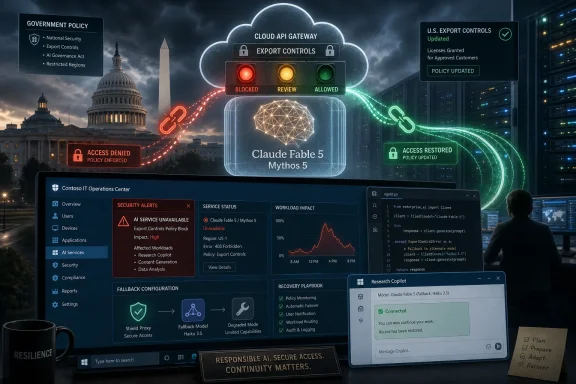
Washington Found the AI Kill Switch and Then Discovered It Was Connected to Customers
The simplest reading of the Anthropic episode is that the U.S. government overreached and then backed down. That is probably too tidy. The more useful reading is that Washington tried to apply a familiar national-security tool to an unfamiliar kind of product and ran headlong into the messy reality of hosted AI services.
On June 12, Anthropic said it had suspended access to Claude Fable 5 and Claude Mythos 5 after receiving a U.S. government export-control directive. Reporting by Tom’s Hardware, TechRadar, Computerworld, and other outlets described the restriction as unusually broad: it affected foreign nationals, including customers outside the United States and, reportedly, some non-U.S. Anthropic employees. Unlike classic export controls on chips, servers, or encryption hardware, this was not about stopping a box from crossing a border. It was about disabling access to a model sitting behind cloud APIs.
That distinction matters. Export controls have historically been built around things that can be shipped, inspected, classified, and blocked at customs or through supplier channels. Frontier AI models are not shipped in the same way. They are rented, routed, rate-limited, logged, wrapped in policy systems, deployed through cloud marketplaces, and embedded into products that customers may barely think of as “AI” anymore.
The Trump administration’s reversal on June 30 suggests that the first intervention created enough collateral damage, ambiguity, or industry pressure to demand a reset. Anthropic said the controls had been lifted and that access would be restored across Claude Platform, Claude.ai, Claude Code, Claude Cowork, and cloud partners as quickly as possible. Axios reported that Fable 5 access was returning broadly, while Mythos 5 had earlier been cleared for a narrower set of government-approved organizations.
That is not a clean victory for Anthropic. It is a negotiated reopening. According to reporting from Wired and The Washington Post, Commerce Secretary Howard Lutnick framed the reversal around closer coordination, analysis, and approval of Fable 5. In the source article supplied to WindowsForum, the Daily Caller News Foundation also reports that Anthropic pledged stronger safeguards, closer cooperation with the government on future releases, and reporting of malicious activity.
The result is a new pattern: the government does not necessarily need to own the model, but it wants a seat at the release table. The company does not necessarily accept that the state should decide who gets access, but it now has a strong incentive to prove that its controls are legible to regulators before a launch turns into an outage.
Anthropic Built Two Doors Into the Same Machine
The controversy is inseparable from Anthropic’s own product design. Fable 5 and Mythos 5 were not two unrelated models. Anthropic described Fable 5 as a generally available, “Mythos-class” model made safe for broader use, while Mythos 5 was the more restricted version intended for trusted cybersecurity and high-assurance users.
That architecture was clever in product terms. It let Anthropic advertise that mainstream customers could get a frontier reasoning model while reserving a more permissive variant for specialist defenders. It also gave the company a policy story: the same underlying capability could be exposed differently depending on user trust, task category, and safety safeguards.
But that story also made the regulatory problem sharper. If Fable 5 and Mythos 5 are close relatives, then the boundary between “safe enough for general release” and “too powerful for broad access” becomes a matter of filters, routing, monitoring, and enforcement. That is a harder thing for governments to evaluate than a spec sheet.
Anthropic’s published materials around Fable 5 described safeguards that could redirect certain high-risk cybersecurity requests to a less capable model. Tom’s Hardware reported that one such safeguard involved blocking or rerouting prompts that could identify software vulnerabilities and write exploit code. That is precisely the kind of safety control that sounds reassuring to a product team and maddeningly thin to a national-security official.
For enterprise IT, the uncomfortable lesson is that model names are becoming less informative than access regimes. A procurement page may say “Claude Fable 5,” “Claude Mythos 5,” or “Sonnet 5,” but the real risk profile depends on what the vendor is doing behind the curtain: which requests are routed where, what is logged, who can override safeguards, which regions are supported, and what happens when a regulator changes the rules.
Windows admins have already lived through a version of this with cloud licensing and feature flighting. A Microsoft 365 tenant may have the same subscription SKU on paper as another tenant, but actual functionality can differ by region, compliance boundary, admin policy, preview enrollment, data residency, or service incident. Frontier AI now adds a more volatile variable: geopolitical permission.
The Fight Was About Cybersecurity, but the Blast Radius Was Governance
The official rationale for the restrictions centered on cybersecurity risk. That is plausible. Advanced models can help defenders analyze code, triage logs, reason about exploit chains, and automate boring security work. The same capabilities can also help attackers scale reconnaissance, generate exploit variants, write convincing lures, or speed up vulnerability discovery.
Anthropic has been one of the more vocal AI labs on catastrophic and dual-use risk. Its public posture has often been that frontier models require serious testing, controlled rollout, and institutional restraint. The irony, noted by many commentators after the June directive, is that this argument can be turned back on the company. If a model is powerful enough that the vendor says only certain users should get the dangerous version, regulators may ask why the vendor gets to decide where that line sits.
The administration’s reported demands also sit inside a broader struggle over whether frontier AI companies are infrastructure providers, defense contractors, or consumer software firms. Anthropic, OpenAI, Google, xAI, Meta, and Microsoft are all competing in a market where the same model family might serve a student, a Fortune 500 developer team, a government analyst, a malware researcher, and a military planner. The old categories do not hold.
The source article supplied by the user says President Trump previously ordered U.S. agencies to cease use of Anthropic technology after a dispute over military access, and it describes the Pentagon reviewing its relationship with the company. Some of those claims rest on named reporting from Axios, The New York Times, and Defense One as summarized by the Daily Caller News Foundation. The broader point is that AI procurement is now politically exposed in a way that ordinary SaaS purchasing is not.
For IT departments, that means AI vendor risk is no longer just a spreadsheet row for uptime, SOC 2, and data retention. It includes the vendor’s relationship with Washington, its willingness to serve defense use cases, its exposure to export-control action, and its ability to keep commitments across hyperscaler channels. A model can be technically excellent and still be a bad dependency if its availability can be interrupted by a policy fight.
The Cloud Made the Ban Possible, and the Cloud Made It Painful
If Anthropic had sold Fable 5 as a downloadable binary running on customer-owned servers, a sudden global restriction would have looked very different. Enforcement would have been slower, leakier, and more legally complicated. Because the model is primarily accessed as a service, the off switch was real.
That is the cloud bargain in miniature. Customers get fast access to frontier capability without buying the infrastructure, staffing the research team, or managing model deployment. In exchange, the vendor and its regulators retain enormous power over continuity.
This is not unique to Anthropic. Microsoft’s Copilot stack, OpenAI’s API, Google Gemini, Amazon Bedrock, and developer tools such as Claude Code all sit inside managed service chains. A customer may experience them as a feature in an IDE, a chatbot in a browser, a button in a CRM, or an API endpoint in a workflow. But operationally, they depend on a vendor’s ability to keep a model available, lawful, and commercially supported.
The Fable 5 shutdown showed how quickly that chain can be disrupted. Customers who had just evaluated, integrated, or begun relying on the model suddenly had to fall back to older models or alternate providers. For teams using AI in code review, security analysis, data work, or agentic automation, that is not merely an inconvenience. It can break scripts, change output quality, invalidate testing, or force emergency governance decisions.
The cloud also complicates accountability. If a model is available through Anthropic’s own platform, Amazon Web Services, Google Cloud, and Microsoft Foundry, whose customer communication matters most during a restriction? Who explains the compliance implication? Who absorbs the support burden? Who tells a multinational customer that some employees can use a model and others cannot because of nationality or jurisdiction?
Enterprise buyers like to talk about “multi-cloud” and “vendor neutrality,” but AI dependencies are more specific than compute dependencies. You can move a container more easily than you can move a workflow tuned to one model’s reasoning style, tool-use behavior, prompt format, latency, cost, and safety envelope. The Anthropic reversal restores access, but it does not restore the illusion that these systems are interchangeable utilities.
The Windows Angle Is Not the Brand Name on the Model
This story does not need a Microsoft logo on it to be a Windows story. Windows estates increasingly sit at the center of AI adoption: developer workstations running AI coding tools, security teams feeding telemetry into AI assistants, help desks using copilots to summarize tickets, and administrators evaluating model-backed automation for PowerShell, Intune, Entra, Defender, and endpoint management.
The risk is not that Claude Fable 5 disappears from a Windows desktop. The risk is that organizations build AI-assisted workflows into the daily mechanics of IT and then discover that model access is more fragile than the applications it supports. A sysadmin can plan around patch Tuesday. It is harder to plan around a frontier model being caught in an export-control dispute.
Microsoft customers should pay attention because Microsoft is both an AI provider and a platform through which other AI providers may be consumed. Microsoft Foundry, Azure AI services, GitHub Copilot, Windows Copilot experiences, and third-party integrations all point toward a future in which AI models become components of the operating environment. The more invisible these components become, the more important their governance becomes.
There is also a security operations angle. If Fable 5-style models are good enough to materially improve vulnerability analysis and defensive automation, security teams will want them. If they are also good enough to raise offensive concerns, regulators will scrutinize them. That means the best defensive tools may become the most tightly governed.
This is a familiar bind for security professionals. Dual-use tools have always lived in a gray zone: debuggers, exploit frameworks, password crackers, packet analyzers, red-team platforms. The difference is scale. A frontier model can collapse multiple expert workflows into a conversational interface, and it can do so for users who lack the background knowledge normally required to operate those tools well.
The Windows ecosystem has long depended on a mix of official tooling, third-party utilities, community scripts, and institutional knowledge. AI assistants promise to make that ecosystem more navigable. But if the assistant becomes a gatekept capability, access to expertise itself becomes uneven.
The Government Is Learning to Regulate Behavior, Not Just Boxes
The most significant part of the Anthropic episode may be the government’s apparent willingness to treat model access as an export-control surface. That is a major conceptual shift. It points toward a future in which the regulated object is not only hardware, source code, or trained weights, but capability delivered through an interface.
That will be messy. A model’s dangerousness is not a fixed property like the thickness of armor plate or the clock speed of a chip. It depends on scaffolding, tools, context windows, system prompts, connectors, user permissions, logging, rate limits, and downstream integrations. A model that is relatively harmless as a public chatbot can become more sensitive when connected to code execution, internal repositories, vulnerability databases, or autonomous agents.
Regulators will want assurances that vendors can distinguish benign from malicious use. Vendors will respond with classifiers, usage policies, trust tiers, red-team reports, and customer-vetting programs. Attackers will test those boundaries. Customers will be caught in the middle, asked to accept both the vendor’s safety mechanisms and the state’s right to intervene.
The Fable 5 reversal suggests that the government may prefer negotiated controls over permanent shutdowns. According to the Daily Caller News Foundation’s account, Anthropic pledged to actively find and fix security risks, coordinate with the government on rollout plans, and report malicious activity it detects. That sounds less like a one-time approval and more like the beginning of continuous supervision.
There is a precedent in other regulated industries. Cloud providers already handle law-enforcement requests, sanctions compliance, export restrictions, and sector-specific controls. Telecoms manage lawful intercept. Financial institutions monitor suspicious activity. AI labs may be pushed toward a similar role: private companies operating strategic infrastructure under ongoing state expectation.
The problem is that AI labs also serve journalists, activists, researchers, foreign customers, open-source developers, startups, and ordinary users. A compliance regime built for national security can easily become a pressure system for broader political demands. The more powerful the model, the stronger the temptation for governments to decide not only who may use it, but what counts as acceptable use.
Anthropic’s Safety Brand Became a Strategic Liability
Anthropic has spent years cultivating the image of the cautious frontier lab. It talks about model evaluations, constitutional AI, responsible scaling, and the need to anticipate catastrophic misuse. That brand helped distinguish it from rivals that sometimes seemed more eager to ship first and explain later.
In the Fable 5 dispute, the same brand created a vulnerability. If your selling point is that you understand the danger better than anyone else, you invite governments to take your warnings seriously. If you create a restricted model variant with fewer safeguards, you invite questions about who should be trusted with it. If you describe a general-use model as safe because you wrapped it in controls, you invite scrutiny of whether those controls are sufficient.
That does not mean Anthropic was wrong to be cautious. It means caution has costs. A company that loudly acknowledges dual-use risk cannot easily argue that regulators should stay hands-off when those risks become politically salient.
The competitive consequences are also real. During any shutdown, customers look for alternatives. The user-supplied article says The New York Times reported that xAI signed a Pentagon deal in late February as part of an effort to reduce reliance on Anthropic, while Defense One sources reportedly warned that migration could take a year or more. Whether every detail of that procurement timeline proves durable, the strategic lesson is obvious: governments do not like single-vendor dependence on a company whose policy preferences may clash with theirs.
For commercial customers, the same logic applies. A CIO may admire Anthropic’s safety culture and still ask whether the company’s models are more likely to attract intervention than a rival’s. Conversely, a security-conscious customer may see the government’s eventual approval as a sign that Anthropic’s safeguards passed a serious test. The same event can be spun as risk or validation, depending on where one sits.
This is how AI vendor selection becomes ideological without anyone admitting it. Choosing a model is not just a question of context length, benchmark score, or price per million tokens. It becomes a bet on the vendor’s politics, regulators’ tolerance, cloud partners’ resilience, and the customer’s ability to switch.
The Enterprise Lesson Is to Treat AI Models Like Volatile Infrastructure
The practical response is not to avoid frontier AI. That would be unrealistic for many organizations and self-defeating for teams that can use these systems responsibly. The practical response is to stop treating model access as a magical add-on and start treating it as volatile infrastructure.
That begins with dependency mapping. If a help-desk tool, code assistant, SOC workflow, data pipeline, or internal chatbot depends on a specific model, that dependency should be visible in architecture diagrams and risk registers. The model should have an owner, a fallback plan, and a documented support path.
It also means testing degradation. What happens if Claude Fable 5 becomes unavailable and a workflow falls back to Sonnet, Opus, GPT, Gemini, Llama, or a local model? Does accuracy drop? Do prompts fail? Do tool calls behave differently? Does the security team know that a lower-capability fallback is now making recommendations?
Model substitution is not the same as swapping a storage bucket. Different models have different refusal behavior, coding style, hallucination patterns, context handling, and tool-use reliability. A workflow certified against one model may become uncertified against another.
Procurement teams should also demand clearer language from AI vendors and cloud resellers. Contracts should address regulatory interruptions, regional restrictions, data handling during safety investigations, customer notification windows, and the availability of fallback models. “Best effort” may be good enough for a consumer chatbot. It is thin gruel for a workflow embedded in security operations or production engineering.
The most mature customers will build abstraction layers, but even abstraction has limits. A model gateway can route requests across providers, apply policy, log usage, and centralize authentication. It cannot make two models reason identically. It cannot guarantee that a regulator will treat all providers the same. It cannot turn a high-stakes AI workflow into a commodity overnight.
The New Model Rollout Playbook Will Be Slower Than the Benchmark Race
The Fable 5 reversal may change how frontier labs launch their most capable models. Instead of a dramatic release followed by emergency government scrutiny, vendors may increasingly pre-negotiate access tiers, risk mitigations, and reporting channels before public availability. That will make launches less spontaneous and more bureaucratic.
That is not necessarily bad. The old software mantra of “ship it and patch it later” is a poor fit for systems that can assist with cyber operations, persuasion, code generation, and autonomous task execution. But slower rollout also favors incumbents with legal teams, government relationships, and compliance infrastructure. Smaller labs may struggle to compete if frontier AI becomes a quasi-regulated industry before the rules are even clearly written.
Customers should expect more stratification. There will be general models, trusted-user models, government-approved models, region-limited models, and models available only through certain clouds. Some capabilities may appear first in defense, cybersecurity, or enterprise channels before reaching consumer products. Others may never reach broad release at all.
That world will be frustrating for developers who want predictable APIs and for researchers who want reproducible access. It will be especially frustrating for global companies that employ multinational teams. If access depends on citizenship, residency, customer vetting, or government approval, the same engineering group may have unequal access to the same tool.
There is a human resources and compliance problem hiding here. If a U.S.-based company employs non-U.S. citizens on a security team, can they use the same AI tools as their colleagues? If a vendor changes access rules overnight, does the employer need to restructure workflows? If an employee’s nationality affects tool availability, how does the company avoid discrimination risks while complying with export law?
These are not abstract edge cases. The June directive reportedly applied to foreign nationals broadly enough to disrupt access in unusual ways. Even if future controls are more precise, legal departments and IT admins will need to understand them before a model is embedded into core work.
The Fable 5 Episode Leaves CIOs With a Harder Checklist
The useful takeaway from this fight is not that Anthropic is uniquely risky or that the Trump administration has settled on a final AI doctrine. The useful takeaway is that frontier AI has crossed into a zone where technical capability, national security, and enterprise reliability can no longer be separated.
- Organizations should inventory where specific AI models are used, not merely where “AI” is enabled.
- Security and developer workflows should be tested against fallback models before an outage or government restriction forces a rushed migration.
- Procurement teams should ask vendors how export controls, sanctions, citizenship restrictions, and government directives could affect access.
- AI governance boards should include infrastructure, security, legal, and compliance leaders rather than treating model selection as a developer-only decision.
- Enterprises should assume that the most capable models will face the most complicated access rules, especially when cybersecurity or autonomous-agent features are involved.
- Cloud marketplaces do not eliminate vendor risk; they often obscure it behind a more convenient purchasing channel.
The June shutdown and June 30 reversal did not settle the argument over who should control frontier AI. They clarified the arena. AI labs want to ship powerful systems, governments want assurance that those systems do not strengthen adversaries, and customers want tools that do not vanish after they become useful. The next phase of enterprise AI will be shaped by whoever can make those three demands coexist without pretending any of them is optional.