

Microsoft, NVIDIA and Anthropic’s new alliance is a landmark shift in the AI infrastructure landscape: Anthropic will scale its Claude models on Azure, commit to buying roughly $30 billion of Azure compute capacity and contract as much as 1 gigawatt of compute powered by NVIDIA hardware, while NVIDIA and Microsoft pledge up to $10 billion and $5 billion of investment in Anthropic respectively — and Anthropic’s frontier models will be made available to Azure enterprise customers through Azure AI Foundry.
Anthropic emerged in 2021 as one of the fastest-growing makers of large language models (LLMs) and has aggressively expanded its model family — Claude Sonnet 4.5, Claude Opus 4.1 and Claude Haiku 4.5 among them — across multiple cloud platforms. The new announcements, made jointly by Anthropic CEO Dario Amodei, Microsoft Chairman and CEO Satya Nadella, and NVIDIA CEO Jensen Huang, formalize a three-way strategic alignment that ties model development, cloud capacity, and chiproadmap collaboration together. This deal follows months of rapid consolidation and capital flows in AI: Anthropic already runs major contracts with cloud providers and hardware vendors; Microsoft and NVIDIA meanwhile have pursued vertical integration strategies around cloud services and AI accelerators. The move is best understood as an industry-scale attempt to ensure predictable capacity, faster co‑engineering of model‑to‑hardware stacks, and broader distribution of Anthropic’s Claude family on enterprise cloud platforms.
At the same time, the arrangement concentrates power and risk. The headline figures — $30 billion of compute commitments and GW‑scale capacity — are real economic signals that will shape vendor negotiations, regional grid planning, and the capital intensity of AI product roadmaps. Valuation estimates tied to the deal should be treated cautiously; reporting varies and depends on deal mechanics that may not yet be public. Regulatory, sustainability, and governance questions remain pressing and deserve careful scrutiny by customers and policymakers alike.
Enterprises and IT leaders should respond pragmatically: pilot the new Claude variants via Foundry, insist on transparent contractual and governance terms, and factor energy and vendor risk into total cost calculations. The industry is moving into an era where model performance is inseparable from hardware and power infrastructure — and where strategic alliances among cloud, chip, and model vendors will materially shape who wins and who pays in the next wave of AI adoption.
Every major cloud and vendor shift brings both immediate gains and longer‑term tradeoffs; this is one of the largest such shifts yet — and its real impact will show up as businesses build, measure, and pay the bills for truly at‑scale AI.
Source: India Education Diary https://indiaeducationdiary.in/microsoft-nvidia-and-anthropic-announce-strategic-partnerships/
 Background
Anthropic emerged in 2021 as one of the fastest-growing makers of large language models (LLMs) and has aggressively expanded its model family — Claude Sonnet 4.5, Claude Opus 4.1 and Claude Haiku 4.5 among them — across multiple cloud platforms. The new announcements, made jointly by Anthropic CEO Dario Amodei, Microsoft Chairman and CEO Satya Nadella, and NVIDIA CEO Jensen Huang, formalize a three-way strategic alignment that ties model development, cloud capacity, and chiproadmap collaboration together. This deal follows months of rapid consolidation and capital flows in AI: Anthropic already runs major contracts with cloud providers and hardware vendors; Microsoft and NVIDIA meanwhile have pursued vertical integration strategies around cloud services and AI accelerators. The move is best understood as an industry-scale attempt to ensure predictable capacity, faster co‑engineering of model‑to‑hardware stacks, and broader distribution of Anthropic’s Claude family on enterprise cloud platforms. What was announced — the facts, plainly
Financial and capacity commitments
- Anthropic has committed to purchasing about $30 billion of Microsoft Azure compute capacity over the coming years, and to contract additional Azure capacity that could reach 1 gigawatt of power-equivalent compute capacity.
- NVIDIA agreed to a deep technology partnership with Anthropic — a co‑design and optimization pact intended to tune future NVIDIA architectures to Anthropic workloads — and committed to invest up to $10 billion in Anthropic. Microsoft committed to invest up to $5 billion.
Product and platform outcomes
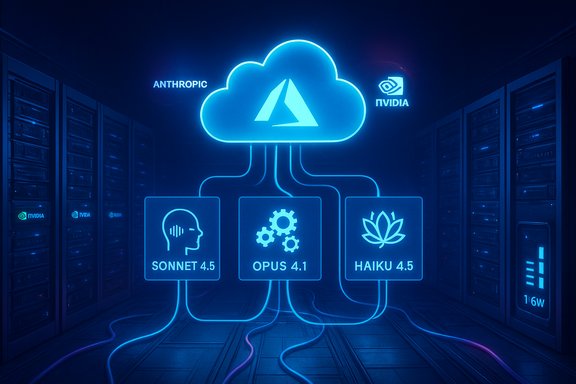
- Anthropic will scale Claude on Azure, and Anthropic’s frontier models — Claude Sonnet 4.5, Claude Opus 4.1, and Claude Haiku 4.5 — will be available to Azure customers through Azure AI Foundry (also noted as Microsoft Foundry in some materials). Claude will also continue to be supported across Microsoft’s Copilot product family, including GitHub Copilot and Copilot Studio.
- NVIDIA and Anthropic will collaborate on model/hardware optimization and will initially target NVIDIA Grace Blackwell and Vera Rubin systems for large-scale deployments.
Why this matters: the strategic anatomy
For Microsoft: model choice, enterprise lock-in, and compete-with-openAI resourcing
Microsoft has been broadening its AI supply chain beyond any single provider. Offering Anthropic’s frontier Claude models in Azure AI Foundry gives enterprises direct access to an alternative frontier LLM alongside OpenAI models. This strengthens Microsoft’s position as a neutral (or multi‑model) platform for enterprise AI, which reduces single‑vendor risk for customers and makes Azure more attractive for organizations seeking model choice and governance at scale. The $30 billion compute commitment also secures long‑term capacity for Microsoft’s cloud business and extends the rationale for enterprise customers to deploy workloads on Azure.For NVIDIA: lock in customers and shape architectures
NVIDIA’s involvement is both strategic and technical. The company’s pledge to co‑engineer with Anthropic — and its planned investment — aligns NVIDIA’s roadmap with one of the major model consumers of its next‑generation accelerators (the Grace Blackwell family today and Vera Rubin platforms ahead). Close engineering collaboration can deliver higher utilization, better performance-per-dollar, and faster time-to-deployment for both parties. For NVIDIA, this strengthens the business case for its high‑end data‑center products and helps cement a steady demand curve for future chip generations.For Anthropic: capacity scale and commercial expansion
For Anthropic, guaranteed access to massive compute on Azure — plus capital from leading infrastructure vendor NVIDIA and software/cloud partner Microsoft — lowers an enormous operational variable for building frontier models: reliable, high‑performance compute capacity. It also broadens Anthropic’s enterprise distribution by making Claude easily reachable to Microsoft customers and enabling Claude to be embedded in Microsoft productivity and developer experiences. That distribution is a powerful commercial accelerant.Technical sketch: what “1 gigawatt” and Grace Blackwell / Vera Rubin mean in practice
What “1 gigawatt” likely represents
The phrase “up to 1 gigawatt of compute capacity” is shorthand for a scale of installed power draw across data‑center facilities required to host Anthropic’s fleet of accelerators and supporting infrastructure. In AI infra terms, gigawatt describes electrical capacity, not a direct measure of FLOPS or model parameters. One gigawatt of IT load is a very large figure by current standards — equivalent to the electrical capacity of a medium‑sized power plant and comparable to the electricity consumption of tens of thousands to a few hundred thousand homes, depending on assumptions. That quantum of capacity signals both the size of Anthropic’s intended expansion and the energy footprint implications. Enterprises and policymakers should note that “1 GW” can mean different deployment shapes: a single hyperscale campus, many distributed sites, or reserved provisioning across global regions. It also implies significant ongoing costs for electric power, cooling, and the supporting network and storage stacks. Canary Media and research into data‑center electricity use show AI-driven growth is already pushing hyperscalers to plan for dramatically larger energy consumption in the coming years.Grace Blackwell and Vera Rubin — the hardware story
Grace Blackwell is NVIDIA’s advanced CPU+GPU “superchip” platform (an evolution of the Grace + Blackwell family) that pairs Nvidia’s high‑bandwidth compute with memory for large‑context models. Vera Rubin is the next‑generation rack/system architecture — combining NVIDIA’s custom Vera CPU with Rubin GPU dies in new NVL rack formats — optimized for massive‑scale inference and long‑context workloads. These platforms promise major increases in memory capacity, throughput for inference, and energy efficiency per token, which is precisely why Anthropic’s workloads would be mapped to them. Expect closer software/hardware co‑tuning (compiler/runtime changes, tensorization, memory engineering) as part of the Anthropic–NVIDIA partnership.Model availability and enterprise implications
Claude in Azure AI Foundry
Azure AI Foundry will surface Claude Sonnet 4.5, Opus 4.1, and Haiku 4.5 as marketplace models with enterprise deployment options, governance controls, and pricing tiers managed inside Foundry’s model catalog and agent services. That means customers can choose Claude models for production agents and copilots inside the same environment that hosts GPT family models and other third‑party offerings. The practical upside is a unified operational plane for model selection, governance, routing, and billing.Copilot integration
Microsoft’s commitment to continue Claude access across its Copilot family — including GitHub Copilot and Copilot Studio — signals a productization of Claude for developer productivity and enterprise automation. For developers, this will likely show up as an alternate backend for coding assistance, documentation generators, and automation agents, with potentially different cost/performance trade-offs versus existing Copilot backends.Competitive and market dynamics
Diversification away from a single-supplier model
This alliance visibly reduces dependence on a single major model supplier in the Microsoft ecosystem and signals a competitive multi‑cloud strategy among major providers. Anthropic becoming available across AWS, Google Cloud, and Azure (with Anthropic historically linked to Amazon and Google relationships) creates an industry where models are commodity-like resources accessible via multiple hyperscalers — intensifying model‑level competition.Valuations and investor dynamics — caution advised
Media reports cite wildly different valuations for Anthropic in the wake of these announcements; some places reference a valuation near $183 billion while other reporting describes a potential valuation rising toward $350 billion as the new investments are priced in. These figures reflect fast-moving private funding estimates and should be treated with caution; valuation reports are often based on partial or anonymous sources and can change as rounds close. This is particularly important because the $30 billion compute commitment and the $15 billion of potential investor capital create strong headline optics that can, in the short term, inflate market expectations.Risks, tradeoffs and regulatory considerations
1) Concentration and interdependence
The three-way deal creates a circular dependence: Anthropic depends on Azure and NVIDIA hardware; Microsoft and NVIDIA gain economic and operational exposure to Anthropic. While this can improve performance and reliability, it also consolidates control and interdependence in a few large players — a dynamic that can raise regulatory scrutiny and amplify systemic risk if one element of the chain falters.2) Energy and sustainability footprint
Committing up to 1 GW of compute capacity has material implications for electricity consumption and carbon footprints. Adding GW‑scale compute requires new data‑center capacity, energy procurement strategies (including renewables or long‑term power purchase agreements), and local grid coordination. The sustainability question is not hypothetical: academic and industry analyses forecast rapidly rising data‑center electricity demand as AI adoption grows, and the industry will face increasing pressure to balance performance with decarbonization. Enterprises embedding Claude‑driven agents must account for the energy‑driven cost components in total cost of ownership (TCO).3) Vendor lock‑in and commercial terms
Although the headline emphasizes model choice, the commercial reality can include contractual lock‑ins: capacity commitments, preferential access to hardware, or pricing incentives tied to long-term deals. Customers should scrutinize the fine print around model SLAs, data residency, model retraining access, and escape clauses should commercial or regulatory conditions change.4) Antitrust and national security scrutiny
Large, intertwined investments between hyperscalers, chipmakers, and AI model houses raise antitrust flags in multiple jurisdictions. Regulators are watching cross‑ownership, preferential platform treatment, and the potential for exclusionary practices that limit competition. Given the criticality of compute and models for national infrastructure and commercial systems, oversight is now a material operational risk.5) Model governance and safety
Anthropic and Microsoft both emphasize “responsible AI” guardrails, but wide distribution of frontier models multiplies attack surfaces for misuse, data leakage, and supply‑chain risk. Enterprises must rely on strong model governance, auditing, and observability tooling to ensure that deployed Claude instances adhere to compliance, privacy, and safety requirements. Foundry’s governance features will help, but operational diligence is required.Technical and operational consequences for IT leaders
- Short‑term: expect new procurement options for high‑performance inference and training; anticipate mixed pricing models where throughput/latency tradeoffs determine which Claude variant is routed to production. Claude Haiku 4.5 will be attractive for low‑latency, cost‑sensitive use cases, while Sonnet 4.5 and Opus 4.1 will target heavy agentic and coding workloads.
- Mid‑term: closer hardware–model co‑engineering with NVIDIA may shift optimization work from the software layer into hardware-aware compilation and deployment tooling. Expect investments in model runtime orchestration, memory management, and bespoke kernels to maximize throughput on Blackwell/Vera Rubin hardware.
- Long‑term: capacity commitments and large-scale placements will influence regional availability, price curves, and the ease of obtaining long‑context inference at scale. IT budgets must include not only unit compute costs but also the networking, storage, and energy costs that scale with GW‑class deployments.
Five practical takeaways and recommended actions for enterprise buyers
- Evaluate model choice as part of platform strategy — test Sonnet, Opus, and Haiku variants for your specific workloads (agents, coding, real‑time chat) and measure cost/performance tradeoffs under realistic workloads.
- Insist on clear SLAs and governance controls — require explicit terms for model behavior, data handling, privacy, logs, and incident response when contracting via Foundry or cloud marketplaces.
- Model operationalization matters — invest in model routing, A/B testing, and observability that can switch between model backends depending on latency, cost, or safety needs.
- Factor energy into TCO — incorporate energy and cooling estimates for at‑scale deployments and insist on carbon accounting for model usage where sustainability targets exist.
- Plan for vendor and regulatory risk — design multi‑cloud escape plans and ensure contractual flexibility in the event of regulatory action, capacity shifts, or changes to investment structures.
Questions the market still needs answered
- How will Microsoft and NVIDIA structure the $5 billion / $10 billion investments in Anthropic (equity, convertible debt, preferred equity, or some hybrid instruments)? Public reporting cites committed figures but terms and closing mechanics remain to be disclosed. Early press coverage suggests the investments are up to those amounts and subject to final documentation. This is a material detail because transaction structure determines governance, dilution, and strategic influence.
- What precisely is being measured by the “1 GW” commitment — nameplate power, sustained IT load, or reserved capacity across multiple regions? The practical delivery model (single campus vs. distributed provisioning) will shape resilience, latency, and local permitting/regulatory implications. This phrasing is common in headline reporting but requires careful operational unpacking.
- Will regulatory bodies in the U.S., EU and other major markets review the three‑way alignment for competition concerns or national‑security implications? The transaction’s scale and the intertwining of IP and capacity could attract scrutiny.
Final analysis: opportunities and systemic cautions
This three‑way alliance is consequential: it institutionalizes a model‑to‑cloud‑to‑chip pathway that accelerates production‑grade AI while creating a predictable demand stream for hyperscale compute and next‑generation accelerators. For enterprises, the upside is immediate: more model choice inside a single cloud platform, operational tooling for agentic applications, and the prospect of Claude being embedded into familiar Microsoft productivity tools.At the same time, the arrangement concentrates power and risk. The headline figures — $30 billion of compute commitments and GW‑scale capacity — are real economic signals that will shape vendor negotiations, regional grid planning, and the capital intensity of AI product roadmaps. Valuation estimates tied to the deal should be treated cautiously; reporting varies and depends on deal mechanics that may not yet be public. Regulatory, sustainability, and governance questions remain pressing and deserve careful scrutiny by customers and policymakers alike.
Enterprises and IT leaders should respond pragmatically: pilot the new Claude variants via Foundry, insist on transparent contractual and governance terms, and factor energy and vendor risk into total cost calculations. The industry is moving into an era where model performance is inseparable from hardware and power infrastructure — and where strategic alliances among cloud, chip, and model vendors will materially shape who wins and who pays in the next wave of AI adoption.
Every major cloud and vendor shift brings both immediate gains and longer‑term tradeoffs; this is one of the largest such shifts yet — and its real impact will show up as businesses build, measure, and pay the bills for truly at‑scale AI.
Source: India Education Diary https://indiaeducationdiary.in/microsoft-nvidia-and-anthropic-announce-strategic-partnerships/
