

Microsoft, Nvidia and Anthropic have struck a sweeping three‑way pact that ties Anthropic’s Claude models to Microsoft Azure at massive scale, deepens Anthropic’s engineering relationship with Nvidia’s next‑generation hardware, and brings fresh multibillion‑dollar investments from Nvidia and Microsoft into Anthropic’s roadmap.
Anthropic’s Claude family has been one of the fastest‑growing challengers in the frontier large‑language‑model (LLM) market, positioning itself as a direct competitor to other leading conversational AI systems. Over the past year, Anthropic has pursued multi‑cloud distribution for Claude, making the models available through various cloud marketplaces and vendor platforms to reduce single‑vendor dependency.
Microsoft and Nvidia have long collaborated on cloud‑scale AI infrastructure, but this arrangement marks a jump from platform integrations to a formal commercial and co‑engineering alliance that includes capital commitments, compute purchase agreements, and product integration across enterprise surfaces. Microsoft’s push to make Copilot a multi‑model orchestration fabric is a central business driver for this deal.
Nvidia systems referenced for Anthropic’s initial deployments include Grace Blackwell and Vera Rubin‑class systems, and Azure’s rack‑scale GB300/GB200 NVL72 families (the “rack as accelerator” approach) are the likely operational target. These rack designs bundle dozens of Blackwell‑family GPUs with Grace CPUs under high‑bandwidth NVLink/NVSwitch fabrics to present a coherent, shared memory domain per rack — an architecture that matters for training and serving very large models and long‑context inference.
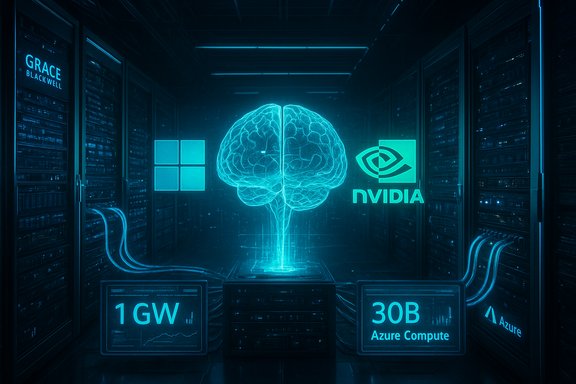
The headlines — $30 billion in Azure purchases, up to 1 GW of compute, $10 billion and $5 billion investment caps — are real signals of scale, but they are reported as company commitments that will be phased and conditioned in execution. Enterprises should treat them as strategic indicators, then proceed with the pragmatism of rigorous benchmarking, tight contract language, and governance controls that preserve choice and portability while capturing the productivity gains this new alliance promises.
Source: Moneycontrol https://www.moneycontrol.com/techno...n-compute-collaboration-article-13683938.html
 Background
Anthropic’s Claude family has been one of the fastest‑growing challengers in the frontier large‑language‑model (LLM) market, positioning itself as a direct competitor to other leading conversational AI systems. Over the past year, Anthropic has pursued multi‑cloud distribution for Claude, making the models available through various cloud marketplaces and vendor platforms to reduce single‑vendor dependency.Microsoft and Nvidia have long collaborated on cloud‑scale AI infrastructure, but this arrangement marks a jump from platform integrations to a formal commercial and co‑engineering alliance that includes capital commitments, compute purchase agreements, and product integration across enterprise surfaces. Microsoft’s push to make Copilot a multi‑model orchestration fabric is a central business driver for this deal.
What was announced — the essentials
- Anthropic has committed to purchase roughly $30 billion of Azure compute capacity over time and to contract additional dedicated capacity of up to one gigawatt for its workloads.
- Nvidia will make a strategic investment in Anthropic of up to $10 billion and enter a deep technology partnership to co‑engineer model‑to‑silicon optimizations.
- Microsoft has agreed to invest up to $5 billion in Anthropic and to expand Anthropic’s Claude models across Azure, Microsoft Foundry and Microsoft’s Copilot ecosystem (including GitHub Copilot and Microsoft 365 Copilot).
Why the numbers matter: $30B and 1 GW explained
The two figures that dominate the headlines — $30 billion of Azure capacity and up to 1 gigawatt of dedicated compute — are shorthand for very different realities.- The $30 billion figure signals a large, multi‑year reserved spend with Azure. In cloud procurement terms, that amount converts into long‑term capacity guarantees, preferred pricing economics, and the ability to schedule very large contiguous training and inference workloads without the rent‑by‑hour uncertainty of spot markets. It also reshapes Microsoft’s capacity planning and could accelerate rack‑scale expansions.
- The 1 GW figure is an electrical and facilities metric, not a GPU‑count. One gigawatt of sustained IT power implies multiple AI‑dense data halls or campuses, each with specialized power delivery, liquid cooling and fiber networks — an engineering scale comparable to major hyperscale projects. Turning a 1 GW commitment into usable racks takes permitting, utility contracts, and phased hardware deliveries. Expect staged rollouts rather than instant availability.
The technology axis: Nvidia co‑engineering and hardware targets
A key element of the deal is the explicit technical collaboration between Anthropic and Nvidia. For the first time the companies agreed to co‑engineer model and hardware interactions — optimizing Claude for Nvidia’s architectures while feeding Anthropic’s workload requirements into future Nvidia designs. That work aims to improve performance, energy efficiency and total cost of ownership (TCO) for large‑scale deployments.Nvidia systems referenced for Anthropic’s initial deployments include Grace Blackwell and Vera Rubin‑class systems, and Azure’s rack‑scale GB300/GB200 NVL72 families (the “rack as accelerator” approach) are the likely operational target. These rack designs bundle dozens of Blackwell‑family GPUs with Grace CPUs under high‑bandwidth NVLink/NVSwitch fabrics to present a coherent, shared memory domain per rack — an architecture that matters for training and serving very large models and long‑context inference.
What co‑engineering looks like in practice
Anthropic‑Nvidia collaboration will likely include:- Kernel and operator optimization to leverage Nvidia tensor cores and sparse/dense mixes.
- Quantization and precision strategies validated against Nvidia hardware features.
- Custom compilation and runtime orchestration to maximize NVLink/NVSwitch fabrics.
- Joint benchmarking for latency, throughput (tokens/sec), and energy per inference metrics.
Product and distribution changes: Claude across Microsoft surfaces
A commercial consequence of the arrangement is broader availability of Anthropic’s Claude models on Azure and deeper integration into Microsoft product surfaces.- Claude variants named in public materials — Sonnet 4.5, Opus 4.1 and Haiku 4.5 — will be available through Microsoft Foundry and the Azure catalog, and will be selectable inside Microsoft’s Copilot ecosystem (GitHub Copilot, Microsoft 365 Copilot, Copilot Studio).
- Microsoft positions this as expanded model choice inside its Copilot orchestration fabric, letting organizations route tasks to the model best suited for coding, synthesis, reasoning, or scale‑sensitive inference. Anthropic says these models will remain available across multiple clouds, making Claude one of the few frontier models accessible across the three major public cloud providers.
Strategic and market implications
This three‑way pact is notable for several reasons:- It reduces the industry’s absolute dependence on a single dominant model provider by deepening an alternative frontier model’s access to hyperscale distribution channels. That matters politically and commercially in boardrooms and procurement desks.
- It tightens the hardware ↔ model feedback loop. Nvidia now becomes not only a supplier of accelerators but also a material investor in a model company — a dynamic that accelerates co‑design but raises portability questions (models optimized for a vendor’s hardware may perform best on that vendor’s stacks).
- Microsoft is positioning Copilot as an orchestration and governance layer that supports multi‑model choice; the company’s strategy shifts from hosting a single flagship model to providing the platform where customers select the most suitable model for the job. That approach aims to retain enterprise customers who demand flexibility and vendor diversification.
What’s strong about the deal — the upside
- Faster enterprise adoption: Bundling Claude into Microsoft’s productivity and developer surfaces drastically lowers friction for enterprise pilots and production deployments.
- Performance and cost gains from co‑design: Joint engineering with Nvidia can materially reduce training time and inference TCO, particularly for long‑context, memory‑hungry models.
- Capacity predictability: A multi‑year compute commitment (the $30B headline) gives Anthropic predictable capacity at negotiated economics, which can stabilize unit costs for large inference volumes.
- Multi‑cloud availability: Anthropic’s continued presence across AWS, Google Cloud and Azure preserves customer choice at the orchestration level and reduces the risk of single‑cloud lock‑in for model access.
Key risks and what enterprises should watch
- Vendor lock and concentration risk
- Large reserved purchases with one hyperscaler can rebalance bargaining power. Enterprises should demand regional and evacuation clauses and verify multi‑region SLAs in procurement.
- Portability and optimization drift
- Models tuned to specific Nvidia microarchitectures may see performance or cost regressions on other hardware types. Enterprises that prioritize portability should insist on cross‑platform benchmarks.
- Contractual ambiguity around headline numbers
- “Up to” investment caps and multi‑year purchase commitments can include phased tranches and conditionality. Treat these figures as starting points for negotiation, not fixed deliveries.
- Operational complexity of multi‑model governance
- Routing, telemetry, billing, and data residency become harder when production environments use multiple models across clouds. Invest in automation and auditing upfront.
- Supply chain and facility realism
- Converting a 1 GW target into active racks can take months or years because of permitting, utility hookups and procurement. Don’t assume capacity is immediately available on day one.
Practical guidance for IT and procurement teams
Enterprises that rely on Microsoft ecosystems and are evaluating how this deal affects their AI strategy should consider the following actions.- Audit workloads and classify by model fit.
- Map tasks to sensitivity (PII), latency tolerance, and cost per inference. Identify which workloads benefit from Sonnet (high‑capability coding), Opus (reasoning), or Haiku (high‑volume, cost‑sensitive) variants where applicable.
- Require contractual clarity up front.
- Insist on explicit SLAs for latency, regionally guaranteed hosting, data retention/deletion terms, and incident response for any cross‑cloud processing. Ask how the $30B commitment and 1 GW target translate into regional allocations and phasing.
- Benchmark across hardware and clouds.
- Demand representative A/B tests for key workloads on Azure‑Nvidia stacks and on alternate clouds (TPUs, other GPU vendors). Measure tokens/sec, latency P95/P99, and cost per 1,000 tokens.
- Build governance for multi‑model orchestration.
- Implement model routing rules, telemetry, cost allocation and per‑request provenance (which model, which cloud, which data) inside Copilot or your orchestration fabric.
- Plan for phased adoption.
- Expect staged rollouts of large rack capacity. Use hybrid hooks (on‑prem Azure Local, Foundry templates) for latency‑sensitive or regulated workloads in the near term.
- Negotiate exit and portability terms.
- Require clear data export rights and portability guarantees to avoid being locked into a hardware‑optimized model that’s expensive to move.
Broader market context
This announcement comes at a moment of intensified competition and capacity consolidation in the AI ecosystem. Other major model builders and cloud providers are simultaneously announcing large capacity plans and deep vendor integrations. Nvidia’s role as both supplier and investor in model builders can accelerate co‑design innovation, but it also raises questions about neutrality and the long‑term economics of running models that are tightly bound to a single hardware family. The market reaction will be shaped by execution: whether these commitments translate to delivered racks, validated performance gains, and cost improvements.Conclusion
The Microsoft–Nvidia–Anthropic agreement is an industrial‑scale play that ties model engineering, capital investment and cloud distribution into a single commercial package. For enterprises, it promises faster access to Anthropic’s Claude models inside Microsoft’s Copilot and Foundry surfaces and the possibility of lower TCO through Nvidia‑driven co‑engineering. At the same time, the deal amplifies the practical challenges every IT organization faces today: negotiating clear contracts, validating cross‑platform performance claims, and building robust governance for multi‑model, multi‑cloud AI deployments.The headlines — $30 billion in Azure purchases, up to 1 GW of compute, $10 billion and $5 billion investment caps — are real signals of scale, but they are reported as company commitments that will be phased and conditioned in execution. Enterprises should treat them as strategic indicators, then proceed with the pragmatism of rigorous benchmarking, tight contract language, and governance controls that preserve choice and portability while capturing the productivity gains this new alliance promises.
Source: Moneycontrol https://www.moneycontrol.com/techno...n-compute-collaboration-article-13683938.html
