

Microsoft, NVIDIA and Anthropic have struck a coordinated, high‑stakes partnership that bundles long‑term cloud commitments, deep chip‑to‑model co‑engineering, and multibillion‑dollar strategic investments — a move that could reshape enterprise AI procurement, datacenter planning, and how organizations select foundation models for production.
Anthropic, the San Francisco AI lab behind the Claude family of large language models, has moved from multi‑cloud experimentation to a formal, large‑scale alignment with Microsoft Azure and NVIDIA’s hardware roadmap. The companies publicly framed the arrangement as an integrated industrial strategy combining three pillars: long‑term compute purchase commitments, hardware ↔ model co‑engineering, and commercial distribution of Claude inside Microsoft’s enterprise product stack.
This announcement is notable not only for the technical collaboration it promises but for the headline figures attached: Anthropic’s substantial Azure compute commitment, NVIDIA’s co‑design and investment pledge, and Microsoft’s strategic investment and distribution play. The trio’s messaging repeatedly describes many of the headline numbers as “up to” commitments or multi‑year reserved contracts, indicating staged execution rather than single‑day cash transfers.
Key technical focuses include:
Implications for enterprises:
That promise carries trade‑offs: potential vendor concentration, portability costs for models optimized to a narrow hardware topology, and execution‑level uncertainty tied to staged investments and multi‑year facility builds. Enterprises should treat the public headlines as strategic signals and proceed with disciplined pilots, contractual guardrails, and an eye toward governance and contingency planning.
This announcement marks a new chapter where compute, chips and models are intertwined at industrial scale — a development likely to accelerate enterprise AI adoption while raising the stakes for procurement, legal review, and operational resilience.
Source: Menafn.com NVIDIA, Microsoft, Anthropic Team Up to Fast‑Track AI Growth
 Background
Anthropic, the San Francisco AI lab behind the Claude family of large language models, has moved from multi‑cloud experimentation to a formal, large‑scale alignment with Microsoft Azure and NVIDIA’s hardware roadmap. The companies publicly framed the arrangement as an integrated industrial strategy combining three pillars: long‑term compute purchase commitments, hardware ↔ model co‑engineering, and commercial distribution of Claude inside Microsoft’s enterprise product stack.This announcement is notable not only for the technical collaboration it promises but for the headline figures attached: Anthropic’s substantial Azure compute commitment, NVIDIA’s co‑design and investment pledge, and Microsoft’s strategic investment and distribution play. The trio’s messaging repeatedly describes many of the headline numbers as “up to” commitments or multi‑year reserved contracts, indicating staged execution rather than single‑day cash transfers.
Overview: What the deal says — the headline facts
- Anthropic has committed to purchase approximately $30 billion of Azure compute capacity over a multi‑year period.
- Anthropic will contract additional dedicated hardware capacity up to an electrical scale described as “one gigawatt” (an electrical/facilities metric, not a GPU count).
- NVIDIA will enter a deep co‑engineering partnership with Anthropic and has pledged up to $10 billion in staged investment.
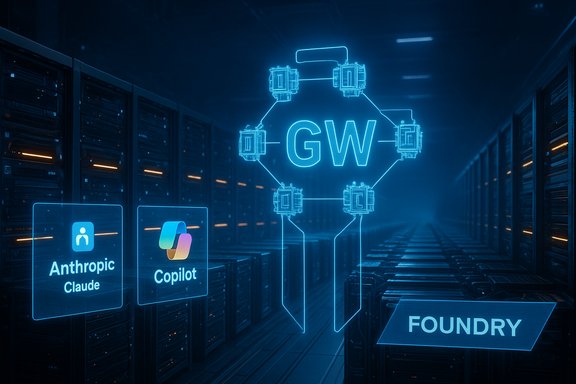
- Microsoft will make Anthropic’s Claude variants available across Azure AI Foundry, Microsoft Foundry, and the Copilot family, and has signaled an investment of up to $5 billion.
Why those headline numbers matter
$30 billion in compute: commercial scale and predictability
A multi‑year reserved compute purchase at the scale of tens of billions of dollars does three things for Anthropic and Microsoft:- It converts Anthropic’s model roadmap into predictable capacity and unit economics, enabling large training runs and high‑volume inference with reduced exposure to spot market volatility.
- It provides Microsoft with a stable, long‑term revenue anchor that can justify targeted data‑center investments and priority access to next‑generation accelerators.
- It materially influences capacity planning and procurement cycles at hyperscale; long‑term reserved spend is functionally different from on‑demand consumption because it changes how utilities, construction, and hardware vendors plan deliveries.
“One gigawatt”: facilities, not GPUs
The oft‑cited “one gigawatt” figure is an electrical capacity metric rather than a count of accelerators. Putting that into practical terms:- One gigawatt of IT load implies multiple AI‑dense data halls, advanced power delivery (substations and transformers), liquid cooling or high‑capacity HVAC, and rack‑scale interconnect fabrics such as NVLink/NVSwitch.
- Converting electrical headroom into usable GPU capacity requires months to years of permitting, utility contracts, and sequential hardware deliveries. That’s why the public language around the 1 GW ceiling signals long‑term operational planning rather than an instantaneous hardware roll‑out.
Technical implications: NVIDIA co‑engineering and model tuning
A central technical plank of the alliance is a deep engineering collaboration between Anthropic and NVIDIA. The framing is explicit: tune models to extract maximum performance from NVIDIA’s current and next‑generation accelerator families, and feed Anthropic’s workload profiles back into NVIDIA’s architecture and systems design.Key technical focuses include:
- Kernel and operator optimizations tailored to tensor cores and custom instruction pipelines.
- Quantization schemes and precision strategies aligned to maximize throughput while retaining model quality.
- Runtime and compiler improvements (operator fusion, memory scheduling) that reduce synchronization overhead and improve tokens‑per‑second.
Product and distribution: Claude in Microsoft’s enterprise stack
Microsoft’s contribution to the partnership is primarily commercial distribution and integration. The announcement positions Claude variants — including named releases in Anthropic’s 4.x family — as selectable models inside Azure AI Foundry, Microsoft Foundry offerings, and Microsoft 365/GitHub Copilot surfaces. This makes Claude an enterprise‑grade option within the same orchestration and governance layers customers use for other Copilot and Azure AI services.Implications for enterprises:
- Model choice becomes a configuration decision inside a centralized Copilot orchestration fabric rather than an ad‑hoc vendor selection.
- Enterprises gain a practical path to test and adopt Claude variants at scale within existing Microsoft tenancy and billing relationships.
- The expanded availability also increases governance complexity — routing, telemetry, data confidentiality, and chargeback systems must accommodate multi‑model orchestration.
Competitive and market consequences
This tripartite alignment is not merely a supplier contract; it is an ecosystem realignment with competitive ramifications.- It accelerates a compute‑first model for AI market power: companies that can lock compute at scale effectively shape who can train and serve frontier models cost‑effectively.
- NVIDIA gains a marquee co‑design partner and a pathway to validate and accelerate adoption of Blackwell‑era hardware and rack‑scale NVLink topologies.
- Microsoft expands its multi‑model strategy inside Copilot, reducing single‑vendor reliance and increasing the defensive value of Azure for enterprise AI workloads.
Risks, trade‑offs and governance challenges
While the deal brings clear benefits, it also introduces material risks and trade‑offs that enterprises and regulators will want to monitor closely.Vendor concentration and potential lock‑in
A very large compute commitment to a single cloud provider can rebalance competitive leverage and increase operational dependence on one vendor’s hardware and architectural choices. That concentration raises questions about contractual portability, regional service guarantees, and exit strategies.Portability vs. performance
Models co‑engineered for a specific vendor’s rack‑scale topology will likely deliver the best performance and cost metrics on that vendor’s platforms. Porting those models to alternative accelerators or cloud environments will typically require additional engineering and re‑profiling, which has both time and money costs.Execution risk
Headline figures labelled “up to” can mask substantial conditionality. Tranche schedules, milestone‑based funding, and implementation timelines are often proprietary. The path from announcement to sustained 1 GW operations includes permitting, utility agreements, site construction, and multi‑phase hardware installs — any of which can delay full realization. Treat the public headlines as strategic intent rather than completed transactions.Regulatory and competition scrutiny
Large vertical ties between a dominant accelerator supplier, a hyperscaler, and a high‑value model vendor can attract regulatory attention in multiple jurisdictions. Antitrust and national security reviews may probe whether such integrated arrangements materially foreclose competition or create national strategic dependencies. Enterprises with global footprints should factor such regulatory risk into procurement timelines and contingency planning.Operational and technical guidance for IT leaders
For Windows‑centric enterprises and CIOs, the immediate practical question is how to respond. The partnership expands model choice inside familiar Microsoft tooling but requires careful governance. Actionable priorities:- Inventory current AI dependencies: catalog what models, clouds, and accelerators are already in use and identify single‑point dependencies that could be materially affected if a single supplier changes terms.
- Pilot Claude inside controlled environments: use Microsoft’s preview channels or Azure AI Foundry to perform representative A/B tests against other frontier models. Validate latency, cost per token, contextual quality, and data handling behavior.
- Negotiate explicit portability and data‑handling clauses: ensure contracts specify model provenance, IP rights on fine‑tuning artifacts, data deletion/retention policies, and escape ramps to alternative clouds.
- Demand transparency on performance and billing: insist on sample workload benchmarks and tight auditability for consumption, telemetry and chargebacks when using multi‑model orchestration.
- Harden governance and security: expand model‑level policy controls in Copilot orchestration to tag and route sensitive workloads only to systems that meet compliance and residency requirements.
Financial and valuation nuance (what’s verifiable and what’s not)
The public materials and industry reporting consistently present the $30B, $10B and $5B figures as headline commitments. Independent reporting corroborates their existence, but crucial caveats remain:- The $30 billion figure is a multi‑year reserved compute purchase, not an upfront cash payment. It may be expressed as consumption credits, committed spend, or an agreed cadence of reserved capacity.
- The NVIDIA and Microsoft investment amounts were described as “up to” figures tied to staged investments and possibly to Anthropic’s next financing round; the exact equity terms, dilution and valuation effects were not disclosed in equal detail.
- Some widely circulated valuation estimates for Anthropic that surfaced in secondary reporting are approximations and vary between outlets; these should not be treated as audited market caps without confirmation.
Strategic read: what this means for the industry
This partnership signals an evolution in how frontier AI will be industrialized:- Computation becomes an enforceable strategic asset. Long‑term capacity commitments and co‑design relationships are now central levers to secure performance, cost and scalability advantages.
- Model distribution and product surface integration matter. Putting models inside Copilot and Azure AI orchestration converts model vendors into operating partners for enterprise customers — not just API providers.
- Hardware vendors are repositioning as strategic partners, not mere component suppliers. NVIDIA’s role as investor and co‑designer signals how chip makers aim to lock in workloads that validate future product families.
Scenarios to watch (next 12–24 months)
- Rolling out 1 GW of usable compute. Will the parties convert the electrical ceiling into actual production clusters at the pace signaled? Permitting, utility capacity, and supply chain will determine cadence.
- Model performance and portability metrics. How much performance lift do Anthropic and NVIDIA jointly achieve on Blackwell‑class racks, and at what cost to model portability?
- Competitor responses. Expect other cloud and chip vendors to pursue similar long‑term committed arrangements to secure capacity and model partnerships. This could accelerate consolidation or trigger regulatory scrutiny.
- Enterprise adoption patterns. The real test will be whether Microsoft’s Copilot + Foundry distribution converts pilots into repeatable, measurable business outcomes at scale. Governance and cost management will determine ROI.
Conclusion
The Microsoft–NVIDIA–Anthropic partnership is less a single product launch and more a structural play for the industrialization of frontier AI. It combines financial commitments, hardware co‑design, and enterprise distribution into a single coordinated fabric that promises higher performance, lower TCO on targeted platforms, and simplified enterprise access to Anthropic’s Claude models.That promise carries trade‑offs: potential vendor concentration, portability costs for models optimized to a narrow hardware topology, and execution‑level uncertainty tied to staged investments and multi‑year facility builds. Enterprises should treat the public headlines as strategic signals and proceed with disciplined pilots, contractual guardrails, and an eye toward governance and contingency planning.
This announcement marks a new chapter where compute, chips and models are intertwined at industrial scale — a development likely to accelerate enterprise AI adoption while raising the stakes for procurement, legal review, and operational resilience.
Source: Menafn.com NVIDIA, Microsoft, Anthropic Team Up to Fast‑Track AI Growth
