Microsoft NVIDIA Anthropic Pact: Azure Scales Claude with Co Design

  • Thread Author
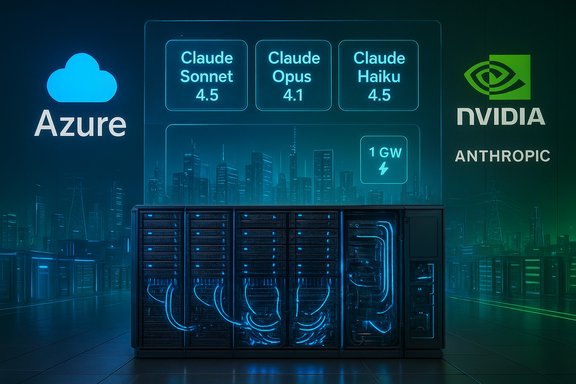
Futuristic data-center rack under Azure and NVIDIA branding showcasing Claude AI models.
Microsoft, NVIDIA and Anthropic announced a sweeping three‑way strategic partnership that binds Anthropic’s Claude models to Microsoft Azure at massive scale, secures deep co‑engineering between Anthropic and NVIDIA on next‑generation hardware, and includes headline investment and compute commitments that together could reshape enterprise AI procurement and infrastructure planning.

Background​

Anthropic, the San Francisco AI lab behind the Claude family of large language models, has moved from startup rapid growth into the center of a compute‑and‑capital arms race. Microsoft is positioning Azure as a multi‑model enterprise platform that can host and surface multiple frontier models inside its Copilot and Foundry toolsets. NVIDIA has evolved from GPU vendor to systems partner, building rack‑scale architectures (Grace Blackwell, Vera Rubin) that target the high memory, high bandwidth needs of today’s largest models. Together, the three companies are turning model development into an industrial‑scale collaboration that spans finance, data‑center engineering and product distribution. Microsoft framed the move as a way to broaden enterprise model choice inside Azure and its Copilot family, while Anthropic gains committed, predictable capacity and deep device‑level optimization for Claude. NVIDIA gains guaranteed demand for its latest systems and a formal co‑design relationship intended to extract performance and efficiency gains for both sides. Those shifts are visible in the topline numbers the companies announced and the product integration commitments that followed.

Deal specifics — what was announced​

Headline commitments (verified)​

  • Anthropic committed to purchase roughly $30 billion of Microsoft Azure compute capacity over multiple years.
  • Anthropic also signaled the option to contract additional dedicated capacity up to one gigawatt of NVIDIA‑powered compute (an electrical‑capacity ceiling, not a literal GPU count).
  • NVIDIA committed to invest up to $10 billion in Anthropic and to establish a deep technology partnership to co‑design hardware and software.
  • Microsoft committed to invest up to $5 billion in Anthropic and to expand Claude availability across Azure AI Foundry and Microsoft’s Copilot family (including GitHub Copilot and Copilot Studio).
These figures repeatedly appear in coordinated announcements and major reporting, and they are explicitly framed by the companies as “up to” or staged, multi‑year commitments rather than immediate one‑time cash transfers. Treat the public numbers as contractual headline ceilings that will be executed over time and tied to tranche schedules, technical milestones and operational readiness.

Product integrations and model availability​

Microsoft said Anthropic’s frontier Claude models — cited publicly as Claude Sonnet 4.5, Claude Opus 4.1 and Claude Haiku 4.5 in partner materials — will be available to Azure AI Foundry customers and integrated across Microsoft’s Copilot offerings. That makes Claude the first frontier model family announced to be intentionally available across all three major cloud providers (AWS, Google Cloud and now Azure) in a single vendor’s enterprise product surfaces. Note: some outlets reported slight variation in version numbers; model versioning showed minor inconsistencies across coverage, and the companies’ product pages should be treated as definitive for exact model names and build numbers.

Technical implications — one gigawatt, Grace Blackwell and Vera Rubin​

What “one gigawatt” really means​

The oft‑cited one gigawatt figure is an electrical capacity metric, not a literal GPU count. Delivering a sustained 1 GW IT load implies multiple AI‑dense data halls, high‑capacity substations, advanced liquid cooling and network fabrics, and multi‑year utility commitments. In practical terms, a 1 GW ceiling maps to tens of thousands — potentially many tens of thousands — of the latest accelerators and a capital outlay measured in the tens of billions of dollars when facility buildout, networking and power are included. That is why the announcement pairs electrical ceilings with multi‑year Azure purchase commitments: the capacity is a planning and procurement footprint rather than an overnight deployment.

Target hardware — Grace Blackwell and Vera Rubin​

The companies named NVIDIA’s Grace Blackwell family and the forthcoming Vera Rubin systems as the initial hardware platforms Anthropic will target. These platforms emphasize large memory pools, high interconnect bandwidth and rack‑scale topologies suited to very large model training and long‑context inference. Optimizing Claude for these architectures can yield measurable gains in throughput, latency and energy per token — but such gains require months of joint profiling, kernel and operator work, quantization strategy alignment and runtime compilation improvements. That co‑engineering is the explicit objective of the Anthropic–NVIDIA tie.

Co‑design: why it matters​

Model‑to‑silicon co‑design can unlock double‑digit efficiency improvements by matching model topologies and numerical formats to hardware primitives (tensor cores, high‑bandwidth memory, NVLink/NVSwitch fabrics). For Anthropic, the payoff is lower inference cost, faster training iterations, and the ability to operate denser, lower‑latency deployments for enterprise applications. For NVIDIA, the payoff is a reference customer that helps validate system designs and shape future architectures around real, large‑scale workloads. That reciprocity is central to the pact — and it changes the vendor‑customer dynamic into a joint engineering program.

Strategic analysis — what each party gains​

Microsoft — diversify and fortify Azure’s AI proposition​

  • Model diversity: Adding Claude to Azure’s model catalog reduces single‑vendor concentration risk and gives enterprises the choice to route workloads to the model best suited for the task.
  • Enterprise integration: Surfacing Claude across Microsoft 365 Copilot, GitHub Copilot and Copilot Studio makes model choice an operational setting inside organizations already standardized on Microsoft tooling.
  • Revenue and capacity justification: A multi‑billion Azure purchase commitment provides predictable demand signals that justify continued investment in purpose‑built AI infrastructure.

NVIDIA — system validation and market capture​

  • Guaranteed demand: An Anthropic compute ceiling and Azure placements translate into priority orders for Grace Blackwell / Vera Rubin systems, validating NVIDIA’s rack‑scale roadmap.
  • Co‑design leverage: Working with a frontier model developer allows NVIDIA to tune upcoming architectures for workloads that will define the next performance bar, reinforcing its market leadership.

Anthropic — scale, predictability and distribution​

  • Scale economics: A long‑term Azure commitment stabilizes Anthropic’s unit economics for large‑scale inference and provides defined capacity windows for deployment.
  • Distribution: Being formally available in Azure (in addition to AWS and Google Cloud) expands enterprise reach and simplifies procurement for customers standardized on Microsoft toolchains.
  • Engineering partnership: Access to co‑design with NVIDIA reduces the technical risk of scaling very large models while improving throughput and TCO.

Strengths of the agreement​

  • Scale and predictability: The $30B Azure commitment anchors Anthropic’s capacity planning and gives Azure multi‑year visibility into enterprise demand.
  • Deep technical alignment: Direct co‑engineering between Anthropic and NVIDIA promises measurable efficiency gains and better TCO for massive model deployments.
  • Enterprise friendliness: Integrating Claude into Azure AI Foundry and Copilot surfaces reduces friction for businesses to adopt different frontier models in a governed, enterprise environment.
  • Industry diversification: The pact reduces over‑reliance on any single model‑cloud pairing and creates a more multi‑sourced model ecosystem inside enterprise stacks.

Risks, unknowns and red flags​

Circularity and concentration risk​

The deal exemplifies a pattern where hyperscalers and chipmakers become investors and customers of model firms — a circular arrangement that tightly binds capital, compute and product roadmaps. That circularity can accelerate innovation but also concentrates power and risk in a small number of interdependent players. Regulators and customers should watch for anti‑competitive effects and escalation of preferential treatment that could distort competition.

Execution risk: time, power and permitting​

Building and operating a 1 GW AI footprint is a multi‑year engineering and permitting project. Utility agreements, substations, liquid‑cooling installs, and phased hardware deliveries are complex and regionally dependent. The one‑gigawatt figure is a planning ceiling, not an instant capability, and delivering sustained capacity at that scale will take years and substantial capital. Enterprises and investors should therefore treat the 1 GW metric as an operational horizon, not a near‑term guarantee.

Financial and valuation uncertainty​

Some outlets have reported wide variance in Anthropic’s valuation and revenue projections, and the $30B compute commitment may be structured as reserved consumption, credits or staged purchases that are conditional on milestones. Public estimates of Anthropic’s valuation have ranged widely, which makes any arithmetic linking investment size to ownership or future revenues imprecise. Treat valuation quotes and revenue run‑rate claims with caution until formal filings or audited disclosures are available.

Vendor lock‑in and portability tradeoffs​

Deep co‑optimization for NVIDIA systems increases performance on those platforms but raises the portability cost of moving models to different accelerators. Enterprises that require cross‑accelerator portability should demand clarity on performance and migration pathways. Model bindings to specific vendor libraries or numerical formats can create long‑term switching costs.

Energy and environmental concerns​

Gigawatt‑scale AI campuses consume substantial power. The growth in dedicated AI capacity intensifies scrutiny around energy sourcing, carbon footprint and local grid impacts. Enterprises and regions hosting such facilities will need transparent energy procurement plans and investments in efficiency and renewable sourcing.

Enterprise impact — what this means for IT leaders​

  • Broader model choice inside Azure: Teams will be able to select Claude variants for tasks where Claude’s safety profile, context length, or behavior suits the workload, while still using Azure governance, identity and compliance tools.
  • Simplified procurement for Microsoft customers: Organizations already invested in Microsoft toolchains will find it easier to trial and adopt Claude models without adding a new cloud vendor for front‑line inference.
  • New negotiation points in cloud contracts: Long‑term committed spend (e.g., reserved capacity, dedicated racks) and exit clauses will become salient — enterprises should negotiate clear SLAs, geo‑residency guarantees and capacity ramp terms.
  • Governance complexity in multi‑model deployments: Routing, telemetry, provenance and liability will become central questions as organizations mix models by capability, cost and risk profile. IT and legal teams must update model governance policies accordingly.

What to watch next — practical milestones and signals​

  1. Contract structures and timelines: Watch for the fine print on the $30B Azure commitment — duration, tranche structure, and exit provisions will determine commercial risk.
  2. Capacity rollouts: Regional and facility announcements tied to specific Vera Rubin or Blackwell builds will indicate how fast the partnership moves from commitment to live capacity.
  3. Model performance and portability benchmarks: Independent benchmarks and enterprise pilot reports showing Claude performance on NVIDIA‑tuned racks will validate co‑design claims.
  4. Regulatory reaction: Antitrust or national security reviews could emerge if the pact is seen to materially reduce competition among cloud, silicon and model vendors.
  5. Energy and sustainability plans: Public commitments on renewable energy sourcing and PUE (power usage effectiveness) for new data halls will be an important operational indicator.

How enterprises should prepare — a checklist​

  1. Review existing cloud contracts to understand exit terms, reserved capacity commitments, and how vendor investments could affect pricing or preferential capacity.
  2. Update model governance: add routing rules, provenance tracking, and risk mitigation for multi‑model, multi‑cloud deployments.
  3. Benchmark models against internal KPIs (latency, cost per token, hallucination rates) before replacing or adding models in production.
  4. Ask vendors for portability guarantees or mitigations if you rely on cross‑accelerator or multi‑cloud redundancy.
  5. Factor energy and sustainability into capacity planning: require transparency on PUE, renewable sourcing and demand‑response arrangements.

Conclusion — measured optimism with cautious oversight​

The Microsoft–NVIDIA–Anthropic pact is a landmark industrialization move for frontier AI. It pairs massive commercial commitments with technical co‑design promises that could materially lower model TCO and broaden enterprise access to cutting‑edge models inside familiar Microsoft tooling. At the same time, the arrangement crystallizes the circular funding and supply patterns that have become characteristic of the AI era, concentrating influence across a handful of large players and raising execution, regulatory and environmental questions that require scrutiny.
For enterprises, the immediate opportunities are real: more model choice, easier procurement inside Azure, and potentially better performance on optimized hardware. The prudent path forward is to treat the headline numbers as strategic intent — not instant guarantees — demand contract clarity, strengthen governance for multi‑model operations, and insist on transparency about timelines, portability and sustainability as the partners execute on their sizable commitments.
Source: it-online.co.za Microsoft, Nvidia, Anthropic in strategic partnership - IT-Online
 

The emergence of a three‑way strategic alignment between Microsoft, Anthropic, and NVIDIA announced at Microsoft Ignite is not a routine partnership announcement — it is an industrial‑scale pact that stitches cloud procurement, advanced silicon, and frontier model development into a single, interdependent commercial fabric that will reshape enterprise AI purchasing, data‑center planning, and competitive strategy across the cloud market.

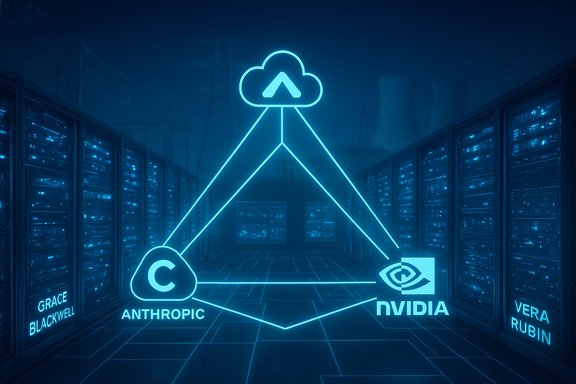
Blue neon triangle links a cloud, Anthropic, and NVIDIA in a data-center server room.Background / Overview​

In coordinated statements delivered around Microsoft’s Ignite developer conference, Anthropic said it would commit to purchasing roughly $30 billion of Microsoft Azure compute capacity over multiple years, with the option to scale dedicated deployments to as much as one gigawatt of AI compute built on NVIDIA platforms. NVIDIA announced an intention to invest up to $10 billion in Anthropic, and Microsoft announced an intention to invest up to $5 billion — figures explicitly worded as staged or “up to” commitments rather than single‑day cash transfers. Anthropic’s Claude family (notably Claude Sonnet 4.5, Claude Opus 4.1, and Claude Haiku 4.5) will be distributed via Azure AI Foundry and integrated across Microsoft Copilot surfaces. Those are the headline facts everyone will debate in boardrooms and regulator briefings. The substance beneath them — how “one gigawatt” translates into racks, what “up to” really means in cash‑flow calendars, and how model custody, telemetry, and governance are handled across three corporate stacks — is what will determine whether this becomes a durable industry architecture or an expensive hype cycle.

Deal anatomy: what the announcements actually say​

Financial commitments and structure​

  • Anthropic: committed to purchasing approximately $30 billion in Azure compute capacity over multiple years; the commitment is structured as long‑term, reserved consumption rather than a single invoice.
  • NVIDIA: pledged up to $10 billion in staged investment in Anthropic (part of a broader financing strategy).
  • Microsoft: pledged up to $5 billion in staged investment and will surface Anthropic’s Claude models across Azure AI Foundry and Copilot products.
Both the language and contemporaneous reporting emphasize the staged, contingent nature of the dollar figures. Treat the $30B, $10B, and $5B numbers as strategic ceilings and headline commitments rather than immediate cash transfers. Multiple outlets and the vendors themselves framed the capital flows as tranche‑based and tied to milestones, regulatory approvals, and commercial schedules.

Compute, racks, and “one gigawatt”​

The term “one gigawatt” is deliberately operational: it denotes electrical capacity for deployed IT load, not a raw GPU count. Delivering 1 GW of AI compute requires multiple data halls, substations, advanced cooling (often liquid cooling), and rack fabrics designed for high‑density, tightly coupled GPU clusters. Industry analysts routinely translate gigawatt‑scale projects into multi‑year capital programs costing tens of billions once facility, networking, and power infrastructure are included. Anthropic’s announcement specifically referenced NVIDIA Grace Blackwell and Vera Rubin systems as the hardware families in the initial buildout.

Product and distribution outcomes​

  • Claude Sonnet 4.5, Claude Opus 4.1, and Claude Haiku 4.5 will be available to Azure customers through Azure AI Foundry and will remain integrated inside Microsoft Copilot offerings (GitHub Copilot, Microsoft 365 Copilot, and Copilot Studio). This makes Claude one of the few “frontier” model families intentionally available across the three major public clouds (AWS, Google Cloud, and now Azure).
  • NVIDIA and Anthropic will enter a “deep technology partnership” to co‑design optimizations between model architectures and GPU/system features, aiming to improve throughput, latency, energy efficiency and total cost of ownership (TCO).

Strategic rationale: why each party signed up​

For Anthropic — scale, distribution, and resilience​

Anthropic gains predictable, reserved capacity and deeper system‑level co‑engineering, both of which materially reduce uncertainty for training and serving frontier models. The Azure commitment opens a new distribution channel to Microsoft’s enterprise customers and folds Claude into Microsoft’s productivity stack, which is crucial for real‑world deployment of agentic copilots and large‑context workloads. At the same time Anthropic retains a multicloud posture: Amazon remains an important training and hosting partner. The net effect is greater scale and more go‑to‑market velocity without necessarily cutting Anthropic off from other cloud partners.

For Microsoft — model plurality and product differentiation​

Microsoft’s play is dual: secure long‑term cloud revenue and expand Azure’s model catalog so enterprises can pick “the right model for the right task” inside Azure AI Foundry and Copilot. The move reduces concentration risk from any single model supplier and positions Azure as a multi‑model platform, a compelling pitch for enterprise customers worried about vendor lock‑in and governance. Folding Claude into Microsoft’s ecosystem also enhances Copilot’s flexibility for developers and business users.

For NVIDIA — workload validation and product pull​

NVIDIA gains both a marquee, committed customer and a close partner to shape the software and model patterns that define future GPU requirements. Co‑design work with Anthropic gives NVIDIA the chance to tune memory hierarchies, interconnect fabrics, precision formats, and software stack optimizations for real production LLM workloads—work that can materially improve throughput and TCO on future Grace Blackwell and Vera Rubin systems. NVIDIA’s investment lines deepen its commercial alignment with model builders, accelerating chip adoption.

What this means for the cloud market and “Cloud Wars”​

The pact crystallizes a new axis of competition in which cloud providers, chipmakers, and model builders can form tightly coupled triads. This structure rewrites procurement dynamics: securing model performance and capacity is no longer just a software negotiation — it’s a packaged negotiation across chips, racks, and cloud services.
  • Enterprises must plan for multi‑model orchestration and increased model‑choice within a single cloud environment.
  • Hyperscalers will continue to voraciously lock down long‑term compute commitments from model vendors.
  • The distinction between supplier and customer blurs: investors become customers, and customers become de‑facto strategic partners. Several commentators have warned that this circularity raises governance and valuation questions.

Technical deep dive: co‑design, optimizations, and real‑world constraints​

Co‑design realities​

“Co‑design” here means a tight feedback loop between model architecture teams (Anthropic) and hardware architects (NVIDIA), with the cloud provider (Microsoft) providing operational and networking context. In practice this covers:
  • Precision and numeric formats tuned to model sensitivity to lower precision.
  • Memory layout and sharding strategies to reduce off‑chip bandwidth.
  • Interconnect fabrics and topology design to support model parallelism.
  • Software stack optimizations, including compiler and runtime changes to exploit new GPU features.
When executed well, co‑design has historically produced step‑function efficiency gains; when misaligned, it can create brittle stacks that are hard to port to other hardware. The promised optimizations for Grace Blackwell and Vera Rubin will be meaningful, but they require thorough benchmark validation in representative workloads.

The logistics of 1 GW​

Deploying 1 GW of AI compute is not plug‑and‑play. It implies:
  • Substation upgrades and long lead times for power procurement.
  • Advanced cooling and facility design for high heat flux densities.
  • Phased hardware deliveries and software validation across clusters.
  • Regulatory and local permitting hurdles in many regions.
Put simply: the headline “1 GW” is a program, not an overnight rack swap. Planning, permitting, and staged rollouts will stretch over multiple years.

Enterprise implications: procurement, governance, and operations​

Enterprises buying AI services from Azure or integrating Claude into Copilot must consider practical operational questions:
  • Model routing and data residency: Where will inference happen, and which model provider will have telemetry? These choices affect compliance, latency, and privacy.
  • SLAs and exit clauses: Multi‑year reserved purchases should include explicit capacity and performance SLAs, and clear exit or migration paths.
  • Benchmarking and proof of value: Independent A/B tests and blind quality comparisons between models must be mandatory to avoid procurement driven solely by vendor decks.
  • Cost modeling: Reserved capacity and tiered pricing for high‑density GPUs can create non‑linear cost curves that must be modeled against token costs, latency requirements, and expected usage patterns.
For IT leaders, the prudent operational stance is pragmatic optimism: pilot early, measure precisely, and insist on governance and observability before scale rollouts.

Risks and red flags​

Circular financing and concentration risk​

When cloud and silicon vendors invest large sums in model builders that then commit to buying compute from them, the resulting circularity can obscure true market signals and raise questions about whether commercial arrangements are sustainable without continuous capital injections. Several analysts have flagged this pattern as a potential fragility in the AI investment ecosystem. Treat headline valuations and projected revenue run‑rates as vendor‑reported until regulatory filings and independent audits confirm them.

Regulatory and antitrust scrutiny​

The deal intentionally concentrates capacity and vertical ties across three major firms. That invites regulatory scrutiny in multiple jurisdictions: competition regulators will want to know whether the arrangement forecloses rivals or disadvantages cloud customers. Data‑protection authorities will examine cross‑tenant telemetry and custody arrangements for enterprise data. Expect pragmatic but close regulatory attention.

Operational and vendor‑lock risks​

A heavy reserved‑capacity commitment to a single cloud creates concentration risk for Anthropic and potential supply leverage for Microsoft. Enterprises must ask for contractual guardrails that preserve portability and fair access to the models they license. From Anthropic’s perspective, maintaining multicloud flexibility will be essential to avoid overdependence on any single hyperscaler.

Energy and ESG concerns​

Gigawatt‑scale AI deployments have major energy and sustainability implications. Large‑scale datacenter builds will need to negotiate supply‑side decarbonization, grid impacts, and local community tradeoffs. Some reporting also notes that Anthropic is pursuing significant datacenter construction plans, which amplify environmental scrutiny. Enterprise sustainability officers should demand transparent energy sourcing and carbon accounting.

Market effects and valuation noise​

Several outlets reported that the investments push Anthropic’s valuation into the hundreds of billions range; these figures are derived from private market chatter and partial disclosures and should be treated cautiously. Valuation estimates reported in press briefings vary and often rely on optimistic forward assumptions about revenue run rates and market share. Any specific dollar valuation should be treated as provisional until confirmed in regulatory filings or formal financing documentation.

Practical guidance for IT and procurement teams​

  • Start with pilots: deploy representative workloads and benchmark Claude variants against alternatives (OpenAI, Google, etc. for cost, quality, and latency.
  • Include governance in contracts: require provenance, audit logs, and explicit model‑routing controls.
  • Insist on realistic SLAs and exit provisions: long‑term reserved buys should have clear migration and capacity‑rebate clauses.
  • Model the economics: run cost scenarios that include reserved capacity, token costs, and unexpected scale.
  • Plan for AgentOps: agentic copilots introduce new operational needs (observability, human oversight, and incident response) that must be funded and staffed.
These steps will reduce procurement risk and convert vendor promises into measurable operational value.

What to watch next​

  • Execution timelines and tranche schedules for the announced investments, which will reveal how aggressive the partners truly are in operationalizing the $30B and $15B headline figures.
  • Regulatory filings and antitrust reviews in the US, EU, and other major jurisdictions. Expect formal notices if the deal materially alters competition for cloud AI capacity.
  • Technical benchmarks published by neutral third parties that validate claimed TCO or performance improvements from NVIDIA/Anthropic co‑design.
  • Contract language detailing data custody, telemetry, and model governance inside Azure AI Foundry and Copilot products.

Conclusion​

The Microsoft–Anthropic–NVIDIA alliance announced at Ignite signals a defining shift in the industrial organization of AI: compute capacity, specialized silicon, and frontier models will increasingly be negotiated as integrated packages rather than discrete line‑items. That has big upside — faster productization of advanced models, deeper hardware‑software co‑optimization, and more model choice inside enterprise stacks — but it also raises profound questions about circular finance, vendor concentration, regulatory oversight, and operational risk.
For enterprise IT leaders the right posture is clear: treat the partnership as an opportunity that must be de‑risked with pilots, rigorous benchmarks, and contractual guardrails. For the industry at large, the deal shifts the frame of competition: the next round of the cloud wars will be defined not only by who has the fastest chips or deepest pockets, but by who can convert complex, co‑engineered partnerships into predictable, governable business value — at scale and within the guardrails that customers and societies now demand.
Source: Cloud Wars Microsoft, Anthropic, and NVIDIA Forge AI Super-Alliance Poised to Shape the Next Era of Innovation
 

Back
Top