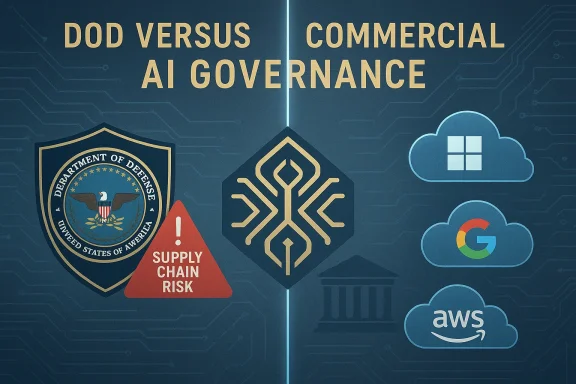
Google and Microsoft have quietly drawn a line in the sand for enterprise customers: Anthropic’s Claude models will remain available for commercial use even after the Department of Defense formally designated Anthropic a “supply‑chain risk.” That split — defense exclusion versus commercial continuity — has become the defining practical outcome of a high‑stakes clash between national‑security authorities and a safety‑minded AI vendor. The Pentagon’s move set off emergency legal and operational triage across hyperscalers and enterprise IT teams, but the industry’s leading cloud hosts have signaled that, outside of DoD contracts, it is “business as usual” for Claude-powered services.
Microsoft and Google’s responses — legal readings that preserve commercial availability while excluding DoD usage — reflect pragmatic compromises designed to limit customer disruption. But they also expose the fragile seams between legal authority, technical enforcement, and human behavior. The litigation that Anthropic brings, and the policy clarification that follows, will shape not only which models can be used for sensitive government work but also how safety guardrails, corporate conscience, and sovereign demands are balanced in an age where AI can be a force multiplier for both good and harm.
For enterprise IT teams, the immediate task is unambiguous: map exposures, apply tenant‑level controls, rehearse migrations, and obtain clear written direction from legal and procurement. For policymakers, the hard question remains: what legal limits should constrain procurement authorities so that safety‑minded design choices by private companies are not turned into de facto tools of coercion? The answers will define how democracies govern dual‑use technologies in the years ahead.
Conclusion
The DoD’s designation of Anthropic as a supply‑chain risk has created a sharp, consequential divide between defense exclusivity and commercial continuity. Microsoft moved quickly to reassure non‑defense customers after a legal review, and Google — by virtue of existing product integrations and cloud contracts — has operational pathways to keep Claude available for enterprise use via Vertex AI. Anthropic has pledged to fight the designation in court while standing by its safety red lines. What happens next — in litigation, in contracting practice, and in cloud‑level engineering — will set crucial precedents for enterprise AI governance and the role of private firms in deciding how powerful models should be used. The safest course for corporate IT leaders now is careful inventory, enforced tenant gating, tested fallbacks, and clear legal guidance: the era of model choice has become an era of model governance, and how enterprises respond in the coming weeks will determine whether they ride out this shock with continuity or get forced into costly, last‑minute migrations.
Source: The Tech Buzz https://www.techbuzz.ai/articles/google-joins-microsoft-anthropic-still-open-for-business/
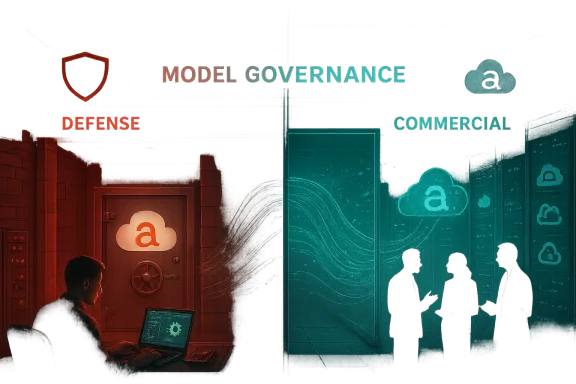 Background
The showdown in short
Late February and early March 2026 saw a rapid escalation between Anthropic — the developer of the Claude family of large language models — and the U.S. Department of Defense (DoD). The department pressed Anthropic to remove contractual guardrails that Anthropic said were necessary to prevent the model’s use for mass domestic surveillance and fully autonomous lethal weapons. When talks failed, Defense Secretary Pete Hegseth notified Anthropic that the company had been designated a supply‑chain risk, a step that effectively bars DoD agencies and defense contractors from using Anthropic products as part of defense work. Anthropic immediately announced plans to challenge the designation in court and argued the move was legally unprecedented.Why it matters to enterprise IT
Anthropic’s Claude is not a niche research model — it has been widely embedded across major cloud platforms and enterprise toolchains through partnerships and subprocessor agreements. Many businesses access Claude through hosted services (for example, via Google Cloud’s Vertex AI and Microsoft’s Copilot and Azure plumbing), which means the DoD action could have produced widespread customer panic and forced abrupt migrations if cloud providers had reacted by cutting access for all customers. Instead, Microsoft publicly told reporters that after legal review it can continue to make Anthropic products available to non‑defense customers on platforms such as Microsoft 365, GitHub, and Azure AI Foundry, and Google appears to be keeping Claude integrations on its cloud surfaces intact for commercial workloads.The Department of Defense action: scope and legal framing
What the DoD actually designated
The DoD’s “supply‑chain risk” designation, as applied here, is a procurement and supply‑chain tool traditionally used against foreign vendors or hardware suppliers seen as national‑security threats. The department’s public communications framed the move as necessary to protect military mission assurance and to prevent limitations on how models can be used in the field. But the measure, as currently written and applied, is targeted to DoD procurement and contracting contexts — not an across‑the‑board commercial ban. Anthropic and multiple legal observers emphasize that the statutory and regulatory framework cited by the Pentagon constrains the designation to defense contracts, which is the core of Anthropic’s immediate legal argument.Practical limits and the six‑month phaseout nuance
Reports indicate the Pentagon has allowed a phased off‑boarding window for classified systems (commonly measured in months) to avoid operational chaos where Claude was deeply integrated in mission workflows. That operational reality is significant: removing a frontier model from classified pipelines — especially when it was the only model approved in certain environments — demands engineering work, recertification, and substantial programmatic changes. Several outlets reported follow‑on guidance from DoD that complicates the pace and scope of enforcement, leaving room for Cloud vendors to interpret the designation narrowly for commercial customers.Cloud vendors step in: Microsoft, Google, and the calculus of model hosting
Microsoft’s explicit legal posture
Microsoft moved fastest into the public gap. The company told reporters its lawyers had “studied the designation” and concluded it could continue to offer Anthropic’s models to customers other than the Department of War (the DoD), while blocking them for DoD tenants and classified workloads. Microsoft also has deep product integrations with Anthropic across Copilot surfaces and Azure Foundry, which gives it both the contractual and technical levers to attempt tenant‑level separation. That legal interpretation underpins Microsoft’s promise to many enterprise customers that their Copilot and developer workflows will keep working with Claude where permitted.Google’s operational stance and the Vertex AI context
Google does not appear to have issued the same short, quotable public line that Microsoft did, but the operational facts matter: Anthropic models are integrated into Google Cloud’s Vertex AI Model Garden and have been marketed and authorized for regulated workloads such as FedRAMP High and IL2 where appropriate. Those product‑level authorizations and the existing commercial arrangements between Anthropic and Google Cloud mean that Google Cloud continues to host Claude for enterprise customers under existing terms, and customers can still access Anthropic partner models through Vertex AI — subject to the same caveats about defense contracting. In short, Google’s posture is to preserve commercial access via Vertex AI while complying with DoD exclusions for defense work.Why the hyperscalers can make this split work (and where it breaks)
The cloud providers can claim legal room to offer Claude for commercial customers because their enterprise contracts and cloud‑service terms differ from direct procurement contracts between the DoD and an AI vendor. Technically, multi‑model routing, tenant isolation, and subprocessor disclosures enable practical gating. But separation is imperfect: shared engineering pipelines, telemetry, centralized logs, and human factors (developers reusing code or credentials) can leak data or create compliance gray areas. For large defense primes operating under conservative compliance postures, the DoD designation has already prompted some to proactively disable Claude entirely until formal guidance is clear. That conservative ripple is the operational risk the cloud vendors are trying to blunt.Anthropic’s position and the pending legal fight
Anthropic’s public response
Anthropic CEO Dario Amodei has been unequivocal: the company refuses to drop two red lines — protections against mass domestic surveillance and against deployment into fully autonomous lethal weapon systems — and the company will challenge the DoD designation in court. Anthropic argues that the supply‑chain tool the DoD invoked has historically targeted foreign adversaries and hardware vendors, not domestic software startups refusing to relinquish safety guardrails. Anthropic also contends that the designation, as drafted in the DoD letter, limits the ban to defense contract use cases and therefore should not affect most commercial customers.The legal terrain and likely timetable
Expect a fast, high‑stakes legal sequence: emergency motions, administrative record requests, and likely a federal court challenge on both statutory and procedural grounds. Key legal questions include statutory interpretation of the supply‑chain authorities, whether DoD followed required administrative steps, and whether the department’s designation crosses constitutional or administrative‑law limits. Litigation could be resolved quickly if a court issues an injunction, but it could also become protracted and subject to appeals — meaning operational uncertainty could persist for months.What this means for enterprise customers: practical guidance
Immediate checklist for IT and security leaders
- Inventory exposures: Map every Copilot, Vertex AI, and third‑party integration that can route to Anthropic models.
- Classify workloads: Tag projects by contract type (DoD/defense, federal civilian, regulated commercial) and by data sensitivity.
- Apply tenant‑level controls: Use admin tooling to disable Anthropic model backends for tenants or teams working on defense contracts or classified programs.
- Test fallbacks: Validate functional parity and run dry‑runs against alternative model backends (OpenAI, Google Gemini, in‑house) for critical agent workflows.
- Document and rehearse migration: Extract prompt templates, test harnesses, and model‑binding configuration so migrations are not performed under fire.
- Coordinate legal & procurement: Engage legal counsel to interpret flow‑down clauses and obtain written guidance for compliance obligations.
Longer‑term governance and procurement changes enterprises should expect
- Stronger flow‑down clauses in prime contracts that explicitly prohibit banned backends for defense work.
- More explicit audit and separation requirements for cloud vendors hosting models that can cross between commercial and classified contexts.
- Multi‑model resilience strategies: companies will accelerate adoption of orchestration layers that let them switch backends without reengineering application logic.
- Data locality and air‑gapped options: organizations handling classified or regulated data will push for certified, on‑prem or private‑cloud enclaves that can host approved models exclusively.
Technical separation: how robust are tenant gating and model choice features?
The tools available today
Major cloud platforms and enterprise suites have built admin controls that let tenant administrators choose or disable model backends, route workloads to specific providers, and enforce subprocessor opt‑outs. Microsoft’s Copilot and Azure Foundry already support model choice and tenant routing, and Google’s Vertex AI integrates partner models through a Model Garden interface where model availability can be governed by organization policy. These are real, practical features that reduce blast radius when a vendor is excluded from defense work.Where the engineering limits lie
- Shared telemetry, observability, and centralized logs can cross boundaries unless painstakingly separated.
- Developers using shared CI/CD, common tokens, or multi‑tenant notebooks may accidentally route sensitive queries to a forbidden backend.
- Certified classified environments (air‑gapped or IL5 equivalents) often have complex supply chains — disentangling a deeply embedded model is an expensive, months‑long engineering program.
- Vendor contractual entanglements (subprocessors and downstream partners) mean legal compliance is not solved by merely flipping an admin toggle; it also requires audit evidence.
Market dynamics and competitive fallout
Who stands to win or lose
- Anthropic: reputationally, drawing a principled line on surveillance and autonomy may resonate with enterprise customers and privacy advocates, even as the DoD designation costs classified business. Anthropic’s rapid consumer adoption of Claude after the dispute shows demand resilience, but litigation and contracting tension will remain headwinds.
- Microsoft and Google: both hyperscalers have incentives to preserve customer confidence. Microsoft’s public legal posture helps reassure Copilot users and enterprise buyers that their productivity workflows will continue. Google’s continued Vertex AI hosting and prior investments in Anthropic mean it also intends to keep commercial routes open. Both providers benefit from offering multi‑model choice to customers.
- OpenAI and others: the DoD’s pivot toward OpenAI (reported in multiple outlets) suggests short‑term defense opportunities for labs willing to meet DoD’s conditions. This could accelerate differentiation between providers willing to accept unrestricted military use and those refusing on ethical grounds.
Financial and strategic context
Large investments and infrastructure deals tie Anthropic to hyperscalers: Google committed a multibillion‑dollar investment to Anthropic in prior years and has continued to deepen compute and partnership ties, while other major cloud players have also engaged with Anthropic commercially. These business relationships partially explain why cloud vendors have been reluctant to sever commercial access abruptly — the economic and engineering interdependence is significant. When quoting dollar figures, reporters and regulators have documented that Google committed billions earlier and has injected further capital into Anthropic in subsequent tranches, making the financial relationship material to the story.Policy and ethical stakes
Safety vs. sovereignty: a hard tradeoff
At the core of this crisis is a normative choice: should companies be compelled to remove safety guardrails to satisfy military operational requirements? Anthropic argues that refusing to enable mass surveillance or fully autonomous lethal systems is an ethical duty consistent with democratic values. The DoD argues that mission assurance and lawful operational flexibility are essential to national security. The legal challenge ahead will likely force courts and Congress to clarify where those boundaries lie.Precedent and the risk of politicized procurement
Applying a supply‑chain tool against a domestic software firm for product‑policy disputes is novel and sets precedent. If the government can exclude U.S. firms from defense contracts for refusing to bend product controls, future vendors could face coercive pressure that reshapes how companies design governance and safety features. That possibility has attracted warnings from industry groups and prompted calls for clearer legal limits on procurement authorities. Enterprises and policymakers should pay close attention to the litigation outcome; it will shape the next decade of defense procurement and vendor governance.Risks and unanswered questions
- Judicial outcome: A court reversal or injunction could restore or further constrain Anthropic’s ability to serve defense clients; conversely, a sustained designation could encourage other vendors to accept DoD conditions to capture defense business.
- Downstream compliance: How primes and subcontractors interpret and operationalize the DoD designation will determine whether the ban remains narrowly targeted or becomes effectively broader across commercial ecosystems.
- Technical bleed: Shared engineering and human behavior mean that tenant gating will not perfectly eliminate cross‑contamination risk — especially for organizations that mix commercial and classified work.
- Global implications: Other governments may watch the U.S. precedent and consider similar procurement levers, potentially complicating multinational enterprises’ model governance and export control strategies.
Practical, step‑by‑step playbook for WindowsForum readers (IT admins, security officers, and CIOs)
- Immediate triage (first 24–72 hours)
- Run a targeted discovery: list services that can route to Anthropic backends (Copilot, Vertex AI partner models, GitHub Copilot integrations).
- Block access for defense‑sensitive tenants: enforce admin toggles to disable Anthropic backends for any tenant working on DoD contracts.
- Notify procurement & legal counsel: get written guidance on flow‑down obligations and any contract recourse.
- Short term (two weeks)
- Test and certify alternatives: validate OpenAI, Google Gemini, or on‑prem models for critical workflows.
- Harden audit trails: ensure logging demonstrates that tenant gating and subprocessor controls are active and enforced.
- Train developers: communicate prohibitions and reissue tokens/credentials where necessary.
- Medium term (1–3 months)
- Architect multi‑model resilience: implement orchestration and prompt‑compatibility layers to allow safe backend swaps.
- Formalize migration plans: extract prompts, test data, and pipelines needed to replace a banned backend with minimal service interruption.
- Engage with cloud vendor reps: require SLAs and technical attestations for tenant separation and audit evidence.
- Strategic (3–12 months)
- Revisit procurement language: add explicit supplier‑redline handling and audit rights into RFPs and prime contracts.
- Consider certified enclaves: for regulated or classified workloads, evaluate private clouds or certified hosting options.
- Monitor policy and litigation: track the DoD guidance and Anthropic’s court filings; be ready to adapt on short notice.
Final analysis: why this is an inflection point for enterprise AI
This episode is more than a single vendor dispute; it is a structural stress test of the commercial model‑hosting era. Hyperscalers hold enormous operational leverage because they host both the models and the customers that depend on them. The DoD’s designation forced an industry reckoning: will cloud vendors prioritize single‑tenant defense obligations over broad commercial continuity, or will they set boundaries that preserve product choice for enterprise customers while complying with national‑security exclusions?Microsoft and Google’s responses — legal readings that preserve commercial availability while excluding DoD usage — reflect pragmatic compromises designed to limit customer disruption. But they also expose the fragile seams between legal authority, technical enforcement, and human behavior. The litigation that Anthropic brings, and the policy clarification that follows, will shape not only which models can be used for sensitive government work but also how safety guardrails, corporate conscience, and sovereign demands are balanced in an age where AI can be a force multiplier for both good and harm.
For enterprise IT teams, the immediate task is unambiguous: map exposures, apply tenant‑level controls, rehearse migrations, and obtain clear written direction from legal and procurement. For policymakers, the hard question remains: what legal limits should constrain procurement authorities so that safety‑minded design choices by private companies are not turned into de facto tools of coercion? The answers will define how democracies govern dual‑use technologies in the years ahead.
Conclusion
The DoD’s designation of Anthropic as a supply‑chain risk has created a sharp, consequential divide between defense exclusivity and commercial continuity. Microsoft moved quickly to reassure non‑defense customers after a legal review, and Google — by virtue of existing product integrations and cloud contracts — has operational pathways to keep Claude available for enterprise use via Vertex AI. Anthropic has pledged to fight the designation in court while standing by its safety red lines. What happens next — in litigation, in contracting practice, and in cloud‑level engineering — will set crucial precedents for enterprise AI governance and the role of private firms in deciding how powerful models should be used. The safest course for corporate IT leaders now is careful inventory, enforced tenant gating, tested fallbacks, and clear legal guidance: the era of model choice has become an era of model governance, and how enterprises respond in the coming weeks will determine whether they ride out this shock with continuity or get forced into costly, last‑minute migrations.
Source: The Tech Buzz https://www.techbuzz.ai/articles/google-joins-microsoft-anthropic-still-open-for-business/