

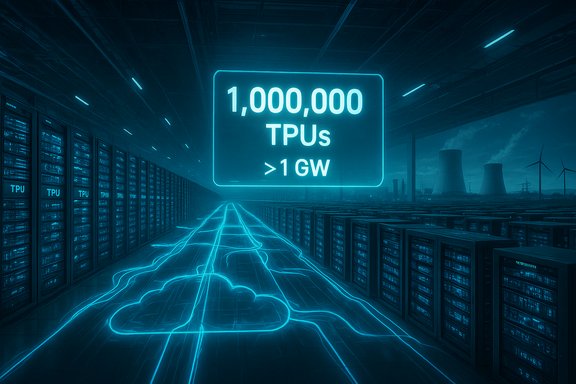
Anthropic’s announcement that it will tap up to one million Google Cloud TPUs — delivering “well over a gigawatt” of dedicated AI compute capacity — is a watershed moment in cloud-based AI infrastructure that reshapes vendor dynamics, energy demands, and the economics of model development. The deal, announced publicly by Anthropic and reported across major outlets, gives the company priority access to Google’s TPU fleet starting in 2026 and is described by Anthropic as worth tens of billions of dollars; Google framed the arrangement as a validation of continued investment in its TPU roadmap, including the seventh‑generation Ironwood TPU.
Background
Anthropic launched Claude as a competitor to other generative AI assistants and has pursued a multi‑vendor compute strategy from the start: mixing Google TPUs, Amazon Trainium accelerators, and NVIDIA GPUs across training and inference workloads. That diversification underpins the company’s operational agility while keeping multiple procurement and engineering paths open. The expanded Google deal formalizes a much larger TPU allocation than Anthropic has used historically and marks the broadest single increase in TPU access the company has announced to date. Google and Anthropic presented the deal as a long‑term partnership: Google will supply large pools of TPU accelerators and associated cloud services, while Anthropic will run future Claude training and serving workloads on that infrastructure. Anthropic’s public statement and Google’s messaging emphasize price‑performance and energy efficiency as key decision drivers — a recurring theme in vendor pitches that position TPUs as an alternative to GPU‑centric stacks.What Anthropic announced — the concrete claims
- Access to up to one million TPUs across Google Cloud, phased into service beginning 2026.
- Aggregate capacity described as “well over a gigawatt” of AI compute capacity. Anthropic’s communications put the financial scope in the tens of billions of dollars over the multi‑year arrangement.
- Continued use of a diversified stack: Anthropic reiterated its multi‑chip strategy (TPUs, Trainium, NVIDIA GPUs) and flagged ongoing work with AWS on Project Rainier while deepening the Google relationship.
Why the scale matters: compute, context windows, and training cadence
Anthropic’s claim of one million TPUs and >1 GW of capacity is not just about headline scale — it changes operational tradeoffs for building large language models.- Training throughput and iteration speed: access to massive TPU pools lets teams parallelize larger portions of a model, reducing wall‑clock time for an experiment sweep. Faster iteration means more model versions, quicker hyperparameter sweeps, and the ability to pursue aggressive architectures that were previously cost‑prohibitive.
- Cost and efficiency: vendors tout TPUs’ price‑performance and energy efficiency for certain workflows; Anthropic says those economics factored into the choice. For companies training at frontier scale, marginal cost per token and cost‑per‑parameter become critical business levers.
- Large context and inference scale: Anthropic has pushed very large context windows for Claude models. A large, fast fabric of TPUs can make single‑request, million‑token (or high‑hundreds‑of‑thousands token) inference more straightforward, reducing the need for brittle multi‑host sharding. That’s valuable in enterprise workflows that ingest whole repositories or document archives in one go.
Technology in play: Google TPUs and Ironwood
Google’s TPU family has evolved toward higher integration and efficiency for matrix‑multiply workloads that dominate transformer models. The company specifically called out the Ironwood TPU (seventh generation) in announcements and marketing around capacity expansions, positioning it as optimized for inference and large‑context workloads with improved TFLOPs per watt and new interconnect characteristics. Independent reporting on Ironwood details the chip’s large HBM footprint and on‑chip reliability and cooling innovations — attributes Google uses to pitch Ironwood as competitive on energy efficiency and performance per dollar. Anthropic’s chosen mix of accelerators — TPUs plus Trainium and NVIDIA GPUs — reflects a pragmatic view that different chips shine in different parts of an ML lifecycle: TPUs for large, disciplined training and inference at scale; Trainium for cost‑effective training phases; GPUs for specialized experiments, transfer learning or vendor‑specific optimizations. That multi‑arch approach reduces single‑vendor risk and lets Anthropic match workloads to the best available price/performance envelope.Energy, facilities, and the real‑world meaning of “one gigawatt”
Describing compute capacity in watts is useful to compare scale, but it’s an imprecise shorthand that mixes instantaneous peak electrical draw, datacenter PUE, and the underlying efficiency of chips and cooling systems.- The companies describe the TPU allocation as “well over a gigawatt” of capacity. That phrasing signals peak or provisioned power footprint rather than sustained average electrical consumption — it’s a capacity planning metric for datacenter operators.
- The common news analogies to “how many homes” a gigawatt powers vary widely in reporting because the conversion depends on whether you use annual average energy usage or instantaneous power metrics. Some outlets and estimates place one gigawatt at a few hundred thousand to nearly a million homes depending on the assumptions used; official agencies and energy analyses publish multiple baselines that lead to different figures. Use caution when translating compute capacity to household equivalents — the numbers are illustrative, not precise.
Economic and contractual implications
Anthropic’s statement values the arrangement in the “tens of billions,” and independent reporting echoes that magnitude as a multi‑year capital and service commitment. Those headline valuations are company‑level estimates based on several inputs: hardware allocation, power and cooling, datacenter footprint, software and management layers, and reserved cloud capacity pricing.Two economic consequences are important for enterprises and platform buyers:
- Capital intensity and vendor leverage. Large, long‑term deals like this create a durable relationship: they lock in supply for the buyer while justifying large hardware investments for the provider. That alignment favors providers capable of heavy upfront CAPEX and gives the buyer predictable capacity scheduling for multi‑year model roadmaps.
- Pricing and opportunity. For Anthropic, shifting more workload to a TPU‑centric stack can lower cost per training iteration if TPUs deliver the advertised price‑performance advantages for the target workloads. That can be a competitive edge that reduces per‑token or per‑parameter operational expense and widens margins as model usage scales. But price advantages are workload dependent and will fluctuate with utilization and energy costs.
Strategic implications across the cloud and chip ecosystem
This agreement has ripple effects that are strategic, not merely commercial.- Google Cloud’s position vs. GPU vendors: By selling large TPU allocations to influential model builders, Google attempts to shift some of the training and serving load away from GPU‑centric vendors. That in turn increases competitive pressure on GPU suppliers and on clouds heavily optimized for NVIDIA hardware.
- Anthropic’s multi‑vendor posture: committing significant spend to Google while publicly maintaining AWS and NVIDIA relationships reduces concentration risk and preserves negotiation leverage. It also gives Anthropic engineering options to route different workloads to the optimal platform.
- A new tier of hyperscale customers for TPUs: if other model vendors follow Anthropic’s path, Google could win more of the frontier model training market — provided TPUs meet the diverse technical needs of model architectures beyond the test suites used in vendor benchmarks.
Risks, governance, and compliance concerns
Large cloud compute deals bring operational and organizational risks that deserve attention from enterprise buyers and CIOs.- Data residency and cross‑cloud paths: Anthropic’s multi‑cloud posture means data and inference traffic can traverse multiple providers. Enterprises using Claude through cloud marketplaces or managed services must map data flows and ensure they meet contractual and regulatory commitments. Anthropic and cloud partners typically publish hosting and privacy terms, but the real‑world path of a Copilot or API request depends on routing and tenant decisions.
- Concentration risk vs. diversification: Anthropic is diversifying across chips, but the scale of any single vendor commitment creates interdependence. Hardware or network outages, sudden price changes, or geopolitical events that affect a single vendor’s capacity could disrupt training or serving across product lines. Multi‑vendor planning reduces but does not eliminate systemic dependency.
- Sustainability and local infrastructure: provisioning for gigawatt‑scale compute increases a company’s exposure to electricity price volatility and grid constraints. Firms must secure reliable power, cooling, and potentially renewable PPAs or on‑site generation to manage risk and reputational scrutiny.
Competitive landscape: where this puts Anthropic relative to OpenAI, Microsoft, and Amazon
Anthropic’s move must be seen inside a broader competitive tableau:- OpenAI and other front‑runners have pursued large, diverse compute commitments — sometimes building proprietary datacenter capacity or locking GPU supply through long term deals. These moves are about securing throughput and negotiating power for model innovation. Anthropic’s Google commitment is another variant of that same strategic calculus.
- Microsoft: already integrating multiple model vendors into Copilot and product stacks, Microsoft’s multi‑model orchestration means Anthropic’s models are a natural fit in heterogeneous scenarios. Microsoft’s product moves make model choice a configurable enterprise control, increasing demand for vendor‑flexible hosting and optimized inference stacks.
- Amazon: Anthropic remains tightly coupled to AWS for certain workloads, and Amazon’s Project Rainier (a large Trainium2‑based initiative) demonstrates that major cloud players are building alternative scale paths that anchor big model vendors regionally and commercially. Anthropic’s simultaneous partnerships with Google and Amazon make it less susceptible to one cloud’s service-level or pricing shocks.
What this means for enterprise Windows‑centric customers and IT teams
WindowsForum readers — many of whom manage Windows‑centric stacks, enterprise Office deployments, or on‑prem integration points — should prioritize several practical considerations:- Governance first: explicitly map where Claude instances will run when integrated into enterprise tools (e.g., whether calls will route to Anthropic’s Google‑hosted endpoints or to Anthropic instances on AWS). Ensure data processing addenda, DPA clauses, and residency guarantees match compliance needs.
- Cost modeling: track not only API per‑call costs but also the downstream licensing and integration expenses associated with large‑context use. Midsize production models (like Claude Sonnet) might be cost‑efficient for high‑volume tasks, while Opus variants will be reserved for high‑value, high‑accuracy workflows. Create A/B governance and cost telemetry to route workloads based on cost‑performance.
- Observability and fallback: instrument latency, accuracy and data flows when routing to Anthropic’s Google TPU pools. Build fallback paths and policies so that if third‑party routing is disabled (for compliance or outage reasons), applications fail gracefully or revert to alternative models.
- Long‑term vendor posture: for organizations that depend on deterministic SLA behavior and data residency guarantees, multi‑cloud vendor deals complicate procurement. Negotiate for contractual clarity on where workloads will run, what audit rights exist, and how incident response will be coordinated across cloud providers.
Open questions and unverifiable elements
- Exact pricing and contractual terms remain private. Public statements cite “tens of billions” or provide headline token counts, but the true per‑unit economics are not public and will vary by usage profile. Treat cost figures as indicative rather than definitive.
- The practical effect of Ironwood and future TPU generations on every workload is workload specific. Benchmarks and vendor posts show strong gains for many transformer workloads, but real‑world improvements depend on model architecture, numeric formats, and compiler/toolchain maturity. Organizations should validate performance on their own workloads before assuming universal uplift.
- The household equivalence of “one gigawatt” is a communication device, not a precise energy accounting statement. Different outlets use different baseline assumptions; energy comparisons should be treated as illustrative.
Bottom line: winners, losers, and the customer
Anthropic’s expansion of TPU access with Google Cloud is a strategic bet that cloud‑based, accelerator‑first procurement can deliver the scale and economics required to stay competitive in the LLM race without the time and capital demands of building and operating a proprietary chip farm. The immediate winners are Anthropic (capacity and optionality), Google Cloud (validation and high‑margin long‑term revenue), and — plausibly — enterprise customers who gain access to larger, faster Claude models as a managed service.Risks remain: energy, governance, and single‑vendor exposure at scale. The real beneficiaries over the medium term will be organizations that take a pragmatic, measured approach: run task‑specific A/B experiments, demand contractual clarity, and design for failover and observability.
Anthropic’s move accelerates the compute arms race and reframes expectations for what cloud partners must deliver: predictable, efficient, and auditable capacity at a scale that previously was the domain of a few hyperscalers. For IT leaders, that means the vendor selection calculus is becoming less about raw performance headlines and more about contractual guarantees, governance, and the ability to operationalize sophisticated, multi‑model strategies without adding untenable compliance or cost risk.
In the coming months, expect additional clarifying details — phased delivery schedules, regional availability, and the granular economics that enterprises care about — to emerge from provider disclosures and regulatory filings. Until then, Anthropic’s announcement is both a technical milestone and a market signal: compute scale is no longer merely a competitive input, it is an enterprise product strategy that will shape the AI landscape for years to come.
Source: Cloud Wars Anthropic Taps Over a Gigawatt of Google Cloud TPUs to Power Next-Gen Claude Models
