

Anthropic is in early talks to rent Microsoft Azure server capacity powered by Microsoft’s Maia AI accelerators, a potential cloud-compute arrangement reported in late May 2026 that would add Microsoft’s custom silicon to the Claude maker’s already sprawling infrastructure commitments with Google Cloud and Amazon Web Services. The deal is not done, and that caveat matters. But the fact that it is even being discussed says something important about where the AI market has landed: the frontier model business is now as much about power, packaging, and chip access as it is about clever architecture. Claude may be a software product, but its future increasingly looks like a real-estate, energy, and semiconductor problem.
The reported Maia talks should not be read as a simple customer win for Azure. Microsoft already has a major relationship with Anthropic, announced in November 2025, that included a $5 billion Microsoft investment and Anthropic’s commitment to buy $30 billion of Azure compute capacity, plus additional capacity of up to one gigawatt. That agreement was framed around Azure infrastructure and Nvidia-powered systems, not necessarily Microsoft’s own silicon.
Maia changes the texture of the relationship. If Anthropic uses Microsoft’s in-house accelerator, Microsoft is no longer merely renting out cloud space and GPU clusters; it is asking one of the most important independent AI labs to validate a chip strategy designed to loosen the grip of Nvidia on hyperscale AI economics. That is a much bigger bet than another Azure spending commitment.
The timing is also awkward in a revealing way. Anthropic has just stacked enormous compute agreements on top of one another: Google Cloud and TPUs, AWS and Trainium, Azure and Nvidia systems, and now potentially Azure and Maia. A company does not diversify that aggressively because it enjoys procurement complexity. It does so because supply is tight, costs are brutal, and dependence on any single cloud provider is strategically dangerous.
For Microsoft, the opportunity is equally clear. OpenAI remains deeply linked to Azure, but Microsoft has spent the past year making obvious moves to avoid being defined by one model partner. Anthropic on Maia would be an unusually public demonstration that Microsoft’s AI infrastructure business can serve the broader market, not just the gravitational pull of OpenAI and Copilot.
Claude’s growth puts pressure on both sides of that ledger. Training future frontier models requires huge clusters operating over long runs. Serving existing models, especially through tools like Claude Code, creates a different but equally relentless demand curve: more users, longer context windows, heavier agentic workflows, and more tokens generated per task.
That distinction is where Maia becomes interesting. Microsoft’s Maia 200 is designed primarily for AI inference, the phase where trained models are run in production. Inference is the meter that keeps spinning after the demo is over. A model that becomes popular with developers, businesses, and automated agents can burn through serving capacity with a consistency that makes training bursts look almost tidy by comparison.
If Claude Code has indeed become more widely used this year, the inference burden is not theoretical. AI-assisted programming tools encourage iterative, high-frequency interaction. Developers ask for code, revisions, tests, explanations, refactors, and debugging help inside loops that can stretch for hours. The more useful the tool becomes, the more compute it consumes.
That is why the old AI story — bigger models need bigger training clusters — is now incomplete. The next bottleneck is whether a company can afford to serve those models at scale without letting every successful product become a margin sink. Custom inference silicon is not glamorous in the way a new frontier model release is glamorous, but it may decide who can sell AI profitably.
Nvidia remains the dominant supplier of advanced AI accelerators, and for good reason. Its GPUs, networking, software ecosystem, and developer mindshare remain formidable. But dominance creates its own discomfort for the cloud providers. If every frontier AI customer wants the same Nvidia hardware, the cloud vendors risk becoming expensive landlords in a business where the hardware supplier captures a large share of the value.
Maia is Microsoft’s answer to that problem. The company has said Maia 200 delivers more than 30 percent better performance per dollar than the latest-generation hardware in its fleet. Microsoft has also said Maia 200 is already running in production in its US Central region near Des Moines, Iowa, with US West 3 near Phoenix expected to follow.
Those claims do not automatically make Maia a Nvidia killer, and Microsoft is not pretending it can replace Nvidia overnight. The more realistic ambition is narrower and more practical: identify workloads where Microsoft’s own silicon can deliver better economics, then route enough internal and external demand to make the investment worthwhile. Inference for Microsoft 365 Copilot, Azure AI services, and possibly Claude is exactly the kind of workload that could make that case.
A potential Anthropic deployment would therefore be more than a chip rental. It would be a proof point for Microsoft’s ability to build a credible alternative accelerator stack inside Azure. The proof would not come from benchmark slides alone. It would come from a demanding customer running real model traffic at meaningful scale.
AWS remains central. Anthropic’s expanded Amazon agreement, announced in April 2026, commits the company to spend more than $100 billion over 10 years on AWS technologies and secures up to five gigawatts of capacity for training and deploying Claude, including Trainium generations. That is not a casual cloud migration. It is an industrial-scale resource claim.
Google is just as important. Anthropic has used Google Cloud infrastructure and TPUs for years, and reports this month put the newest Google Cloud commitment at roughly $200 billion over five years. Separately, Anthropic has described agreements involving Google and Broadcom for multiple gigawatts of next-generation TPU capacity expected to come online starting in 2027.
Microsoft adds a third pillar. The November 2025 deal gave Anthropic a major Azure commitment and a Microsoft investment. A Maia arrangement would deepen that pillar by adding Microsoft’s own silicon into the mix, not just Azure as a place to run Nvidia systems.
This is not vendor neutrality in the old enterprise sense. Anthropic is not spreading a conventional workload across clouds to avoid lock-in. It is reserving scarce industrial capacity wherever it can get it, while preserving leverage among the only companies capable of building AI infrastructure at the required scale.
These chips are sold as cloud capacity. The customer rents the workload, the region, the platform services, the reliability guarantees, and the operational abstraction. The silicon is part of the bargain, but the product is the cloud.
That model gives hyperscalers an advantage and a constraint. They can optimize hardware for their own data centers, networking, power profiles, software stacks, and pricing models. But they also must persuade customers that the custom hardware will not trap them in a brittle ecosystem or lag behind the broader GPU software universe.
Google has had the longest runway with TPUs, and it has turned that early lead into a serious option for large AI labs. AWS has used Trainium as both a cost lever and a strategic anchor for Anthropic. Microsoft is newer to the public custom-accelerator contest, which is why Anthropic’s possible participation would carry symbolic weight.
The cloud providers are not merely trying to save money on chips. They are trying to make their clouds less interchangeable. If the best price-performance for a given model workload lives on a provider’s custom silicon, then the cloud itself becomes stickier, not because of a database API or management console, but because the economics of inference point in that direction.
But Nvidia’s position is evolving from uncontested default to premium backbone. Hyperscalers are not trying to eliminate Nvidia from AI infrastructure; they are trying to reserve Nvidia for the workloads where it is most necessary and use custom silicon where cost, availability, or specialization justify the switch. That is a subtler story than displacement, but it is more plausible.
Inference is the obvious beachhead. Once a model is trained and optimized, serving it repeatedly at scale can be mapped to hardware tuned for throughput, memory bandwidth, and specific numerical formats. If the platform owner controls the model-serving stack, the compiler path, the networking fabric, and the data-center design, custom chips can make economic sense even if they are less flexible than general-purpose GPUs.
That does not mean every model will run everywhere. Porting frontier workloads across Nvidia GPUs, Google TPUs, AWS Trainium, and Microsoft Maia is not as simple as moving a container image. Toolchains, kernels, compilers, memory layouts, model optimizations, and operational practices all matter. The cost of multi-cloud compute resilience is engineering complexity.
Anthropic appears willing to pay that cost. Its infrastructure pattern suggests a belief that compute access is valuable enough to justify fragmentation. In a market where the next model generation may be limited by who has enough chips and power at the right moment, that is a rational trade.
Copilot is the obvious example. Microsoft has put AI assistants into Windows, Microsoft 365, developer tools, security products, and business applications. Each of those experiences depends on inference capacity. Every prompt has a cost, and every successful expansion of usage multiplies that cost.
That makes custom silicon strategically important inside Microsoft even if no external customer ever touches Maia. The company needs a way to reduce the per-token expense of its own AI products. A 30 percent performance-per-dollar improvement, if borne out in production, is not a minor efficiency claim when multiplied across billions of requests.
But internal use alone would leave Maia looking like a defensive maneuver. An Anthropic deal would make it look more like a platform. The difference matters because Azure competes not only on capacity, but on credibility. If a leading independent AI lab trusts Maia for meaningful Claude workloads, enterprise customers will be more inclined to believe Microsoft’s custom silicon story is real.
Microsoft also has to manage the politics of its AI partnerships. Its relationship with OpenAI has been central to Azure’s AI boom, but it has also created concentration risk. Bringing Anthropic deeper into Azure, especially through Microsoft-built chips, gives Redmond another pillar in the model-provider market and another answer to customers who do not want a single-vendor AI future.
That map is messy, but the mess is the point. No single provider has enough cheap, available, perfectly timed compute to satisfy the growth plans of every frontier AI company. The hyperscalers are therefore competing on a bundle of promises: chips, power, regions, capital, cloud credits, model distribution, enterprise access, and long-term roadmap alignment.
The result is a market where infrastructure agreements are almost inseparable from investment agreements. Cloud providers invest in AI labs; AI labs commit to cloud spending; chip roadmaps become negotiating points; and reported dollar figures balloon into the hundreds of billions. It is not always easy to separate commercial demand from circular financing.
That uncertainty should make readers cautious. A headline number attached to a cloud agreement does not necessarily mean cash changes hands immediately, or that all capacity is available today, or that the infrastructure will be used exactly as advertised. These are multi-year commitments, often contingent on buildouts, chip deliveries, power availability, and future model demand.
Still, the direction is unmistakable. Frontier AI companies are pre-buying the future, and hyperscalers are using those commitments to justify the next wave of data-center and silicon spending. Whether all of these deals produce durable profits is a different question. For now, they are producing the infrastructure arms race.
That physicality creates constraints the cloud industry cannot solve with better branding. Data centers need land, substations, transmission lines, water strategies, cooling systems, backup power, and local political acceptance. Chips may be the visible scarce resource, but electricity and grid interconnection are becoming just as consequential.
This is why custom silicon matters beyond benchmark bragging rights. A chip that delivers more useful tokens per dollar may also deliver more useful tokens per watt, depending on the system design and workload. Inference efficiency is not just a margin improvement; it is a capacity multiplier when power is constrained.
Microsoft’s deployment of Maia in specific regions also underscores the geographic reality of AI infrastructure. Capacity does not exist in a generic cloud ether. It exists near Des Moines, near Phoenix, in Google regions, in AWS regions, and in facilities whose availability depends on construction schedules and power contracts.
For enterprises consuming AI through APIs, that may feel distant. But it will eventually show up in latency, regional availability, pricing tiers, data residency options, and service reliability. The industrial layer of AI is already shaping the software layer users see.
If Microsoft can lower inference costs with Maia, it gains more room to bundle AI features into existing subscriptions or make premium tiers less punishing. If it cannot, AI features will remain expensive add-ons, usage caps will stay tight, and organizations will face the familiar problem of promising productivity gains while rationing access.
For developers, the consequences are more immediate. Claude Code, GitHub Copilot, Azure-hosted models, and competing AI coding tools all depend on abundant inference. The more these systems act like always-on collaborators rather than occasional chatbots, the more they require cheap, reliable serving infrastructure.
There is also a governance angle. Enterprises increasingly want model choice, auditability, regional control, and the ability to shift workloads as risk changes. Anthropic’s presence across AWS, Google Cloud, and Azure gives customers more procurement paths to Claude, but it also creates questions about where workloads run, which chips serve them, and how consistent behavior remains across platforms.
That is not a reason to reject the technology. It is a reason for IT leaders to treat AI infrastructure as part of vendor risk management. The model name alone is no longer enough. The cloud, chip, region, data path, and contract terms all matter.
That does not make custom silicon bad. In fact, the opposite may be true. Without custom silicon, AI services may remain too expensive, too capacity-constrained, and too dependent on a single hardware supplier. The challenge is that efficiency and portability often pull in opposite directions.
Anthropic’s apparent strategy is to avoid being trapped by any one version of that bargain. By working across Trainium, TPUs, Nvidia systems, and potentially Maia, the company buys optionality at enormous cost. It can chase capacity where it exists, negotiate across suppliers, and tune different workloads to different platforms.
But only a handful of companies can operate that way. Most enterprises will consume the resulting models through cloud platforms and will inherit the infrastructure choices made upstream. That makes transparency more important. Customers need to know not only which model they are using, but what commitments, regions, and hardware assumptions sit beneath it.
Microsoft, Amazon, and Google will not stop pushing their own silicon. The economics are too compelling, and the strategic upside is too large. The more interesting question is whether customers get meaningful choice from this competition or simply trade one kind of dependency for three different flavors of hyperscaler lock-in.
Anthropic’s possible use of Microsoft Maia is not the end of the Nvidia era, nor is it proof that Microsoft has caught Google or Amazon in custom AI chips. It is something more concrete: evidence that frontier AI has entered an industrial phase where model companies must secure power and silicon years ahead of demand, and where cloud providers must prove that their private chips can carry public workloads. If the talks become a deal, Claude will not just be running on another server; it will be helping decide whether the next phase of AI infrastructure belongs to whoever has the best model, or whoever can serve it most efficiently at planetary scale.
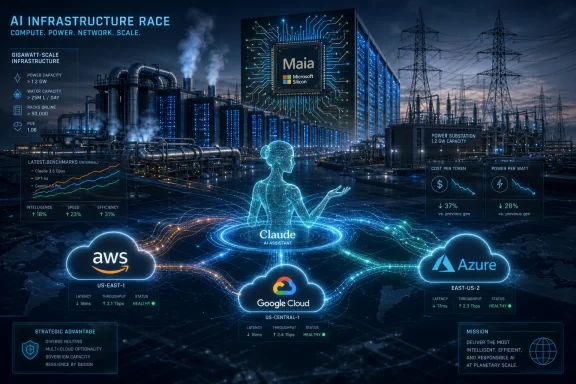 Anthropic’s Next Supplier May Be Microsoft’s Most Strategic Experiment
The reported Maia talks should not be read as a simple customer win for Azure. Microsoft already has a major relationship with Anthropic, announced in November 2025, that included a $5 billion Microsoft investment and Anthropic’s commitment to buy $30 billion of Azure compute capacity, plus additional capacity of up to one gigawatt. That agreement was framed around Azure infrastructure and Nvidia-powered systems, not necessarily Microsoft’s own silicon.Maia changes the texture of the relationship. If Anthropic uses Microsoft’s in-house accelerator, Microsoft is no longer merely renting out cloud space and GPU clusters; it is asking one of the most important independent AI labs to validate a chip strategy designed to loosen the grip of Nvidia on hyperscale AI economics. That is a much bigger bet than another Azure spending commitment.
The timing is also awkward in a revealing way. Anthropic has just stacked enormous compute agreements on top of one another: Google Cloud and TPUs, AWS and Trainium, Azure and Nvidia systems, and now potentially Azure and Maia. A company does not diversify that aggressively because it enjoys procurement complexity. It does so because supply is tight, costs are brutal, and dependence on any single cloud provider is strategically dangerous.
For Microsoft, the opportunity is equally clear. OpenAI remains deeply linked to Azure, but Microsoft has spent the past year making obvious moves to avoid being defined by one model partner. Anthropic on Maia would be an unusually public demonstration that Microsoft’s AI infrastructure business can serve the broader market, not just the gravitational pull of OpenAI and Copilot.
The Compute Crunch Has Become the Product Roadmap
Anthropic CEO Dario Amodei recently acknowledged that the company has had “difficulties with compute,” a blunt admission in an industry where capacity constraints are often disguised as strategic discipline. The statement matters because frontier AI companies have largely stopped talking about compute as a back-office resource. Compute is now the limiting reagent for model training, model serving, coding agents, enterprise rollouts, and pricing experiments.Claude’s growth puts pressure on both sides of that ledger. Training future frontier models requires huge clusters operating over long runs. Serving existing models, especially through tools like Claude Code, creates a different but equally relentless demand curve: more users, longer context windows, heavier agentic workflows, and more tokens generated per task.
That distinction is where Maia becomes interesting. Microsoft’s Maia 200 is designed primarily for AI inference, the phase where trained models are run in production. Inference is the meter that keeps spinning after the demo is over. A model that becomes popular with developers, businesses, and automated agents can burn through serving capacity with a consistency that makes training bursts look almost tidy by comparison.
If Claude Code has indeed become more widely used this year, the inference burden is not theoretical. AI-assisted programming tools encourage iterative, high-frequency interaction. Developers ask for code, revisions, tests, explanations, refactors, and debugging help inside loops that can stretch for hours. The more useful the tool becomes, the more compute it consumes.
That is why the old AI story — bigger models need bigger training clusters — is now incomplete. The next bottleneck is whether a company can afford to serve those models at scale without letting every successful product become a margin sink. Custom inference silicon is not glamorous in the way a new frontier model release is glamorous, but it may decide who can sell AI profitably.
Maia Is Microsoft’s Bid to Make Azure Less Dependent on Nvidia
Microsoft’s Maia effort sits inside a broader custom silicon push that mirrors what Google and Amazon started earlier. Google has TPUs, AWS has Trainium and Inferentia, and Microsoft now has Maia. The strategic logic is obvious: hyperscalers want more control over cost, supply, hardware-software integration, and product differentiation.Nvidia remains the dominant supplier of advanced AI accelerators, and for good reason. Its GPUs, networking, software ecosystem, and developer mindshare remain formidable. But dominance creates its own discomfort for the cloud providers. If every frontier AI customer wants the same Nvidia hardware, the cloud vendors risk becoming expensive landlords in a business where the hardware supplier captures a large share of the value.
Maia is Microsoft’s answer to that problem. The company has said Maia 200 delivers more than 30 percent better performance per dollar than the latest-generation hardware in its fleet. Microsoft has also said Maia 200 is already running in production in its US Central region near Des Moines, Iowa, with US West 3 near Phoenix expected to follow.
Those claims do not automatically make Maia a Nvidia killer, and Microsoft is not pretending it can replace Nvidia overnight. The more realistic ambition is narrower and more practical: identify workloads where Microsoft’s own silicon can deliver better economics, then route enough internal and external demand to make the investment worthwhile. Inference for Microsoft 365 Copilot, Azure AI services, and possibly Claude is exactly the kind of workload that could make that case.
A potential Anthropic deployment would therefore be more than a chip rental. It would be a proof point for Microsoft’s ability to build a credible alternative accelerator stack inside Azure. The proof would not come from benchmark slides alone. It would come from a demanding customer running real model traffic at meaningful scale.
Anthropic Is Turning Multi-Cloud From Slogan Into Survival Strategy
Enterprises have talked about multi-cloud for years, often with more ambition than execution. Anthropic’s version is not a polite architecture diagram; it is a hard-nosed scramble for capacity. The company has relationships with Amazon, Google, and Microsoft, and each relationship now includes infrastructure, investment, or both.AWS remains central. Anthropic’s expanded Amazon agreement, announced in April 2026, commits the company to spend more than $100 billion over 10 years on AWS technologies and secures up to five gigawatts of capacity for training and deploying Claude, including Trainium generations. That is not a casual cloud migration. It is an industrial-scale resource claim.
Google is just as important. Anthropic has used Google Cloud infrastructure and TPUs for years, and reports this month put the newest Google Cloud commitment at roughly $200 billion over five years. Separately, Anthropic has described agreements involving Google and Broadcom for multiple gigawatts of next-generation TPU capacity expected to come online starting in 2027.
Microsoft adds a third pillar. The November 2025 deal gave Anthropic a major Azure commitment and a Microsoft investment. A Maia arrangement would deepen that pillar by adding Microsoft’s own silicon into the mix, not just Azure as a place to run Nvidia systems.
This is not vendor neutrality in the old enterprise sense. Anthropic is not spreading a conventional workload across clouds to avoid lock-in. It is reserving scarce industrial capacity wherever it can get it, while preserving leverage among the only companies capable of building AI infrastructure at the required scale.
The Hyperscalers Are Selling Chips by Selling Clouds
The custom AI chip race is often described as a semiconductor competition, but that understates the role of the cloud platform. Google does not need to sell TPUs like a conventional chip merchant. AWS does not need Trainium to appear in retail server catalogs. Microsoft does not need Maia to become a component that Dell or Supermicro can ship tomorrow.These chips are sold as cloud capacity. The customer rents the workload, the region, the platform services, the reliability guarantees, and the operational abstraction. The silicon is part of the bargain, but the product is the cloud.
That model gives hyperscalers an advantage and a constraint. They can optimize hardware for their own data centers, networking, power profiles, software stacks, and pricing models. But they also must persuade customers that the custom hardware will not trap them in a brittle ecosystem or lag behind the broader GPU software universe.
Google has had the longest runway with TPUs, and it has turned that early lead into a serious option for large AI labs. AWS has used Trainium as both a cost lever and a strategic anchor for Anthropic. Microsoft is newer to the public custom-accelerator contest, which is why Anthropic’s possible participation would carry symbolic weight.
The cloud providers are not merely trying to save money on chips. They are trying to make their clouds less interchangeable. If the best price-performance for a given model workload lives on a provider’s custom silicon, then the cloud itself becomes stickier, not because of a database API or management console, but because the economics of inference point in that direction.
The Nvidia Era Is Not Ending, But Its Shape Is Changing
It would be easy to overstate the threat to Nvidia. The company’s GPUs remain essential to frontier AI, and many of the most demanding training workloads still revolve around Nvidia systems. Even Anthropic’s Microsoft commitment announced in November was tied to Azure capacity powered by Nvidia hardware.But Nvidia’s position is evolving from uncontested default to premium backbone. Hyperscalers are not trying to eliminate Nvidia from AI infrastructure; they are trying to reserve Nvidia for the workloads where it is most necessary and use custom silicon where cost, availability, or specialization justify the switch. That is a subtler story than displacement, but it is more plausible.
Inference is the obvious beachhead. Once a model is trained and optimized, serving it repeatedly at scale can be mapped to hardware tuned for throughput, memory bandwidth, and specific numerical formats. If the platform owner controls the model-serving stack, the compiler path, the networking fabric, and the data-center design, custom chips can make economic sense even if they are less flexible than general-purpose GPUs.
That does not mean every model will run everywhere. Porting frontier workloads across Nvidia GPUs, Google TPUs, AWS Trainium, and Microsoft Maia is not as simple as moving a container image. Toolchains, kernels, compilers, memory layouts, model optimizations, and operational practices all matter. The cost of multi-cloud compute resilience is engineering complexity.
Anthropic appears willing to pay that cost. Its infrastructure pattern suggests a belief that compute access is valuable enough to justify fragmentation. In a market where the next model generation may be limited by who has enough chips and power at the right moment, that is a rational trade.
Microsoft Needs Maia to Be More Than an Internal Copilot Engine
For WindowsForum readers, the Maia story also intersects with Microsoft’s broader platform identity. Microsoft is no longer just the Windows company, or even just the Azure company. It is now a company trying to rebuild its entire software business around AI services whose unit economics are still unsettled.Copilot is the obvious example. Microsoft has put AI assistants into Windows, Microsoft 365, developer tools, security products, and business applications. Each of those experiences depends on inference capacity. Every prompt has a cost, and every successful expansion of usage multiplies that cost.
That makes custom silicon strategically important inside Microsoft even if no external customer ever touches Maia. The company needs a way to reduce the per-token expense of its own AI products. A 30 percent performance-per-dollar improvement, if borne out in production, is not a minor efficiency claim when multiplied across billions of requests.
But internal use alone would leave Maia looking like a defensive maneuver. An Anthropic deal would make it look more like a platform. The difference matters because Azure competes not only on capacity, but on credibility. If a leading independent AI lab trusts Maia for meaningful Claude workloads, enterprise customers will be more inclined to believe Microsoft’s custom silicon story is real.
Microsoft also has to manage the politics of its AI partnerships. Its relationship with OpenAI has been central to Azure’s AI boom, but it has also created concentration risk. Bringing Anthropic deeper into Azure, especially through Microsoft-built chips, gives Redmond another pillar in the model-provider market and another answer to customers who do not want a single-vendor AI future.
Claude’s Infrastructure Map Looks Like the Industry’s Stress Test
Anthropic’s infrastructure map is starting to resemble a stress test for the entire AI economy. AWS contributes Trainium capacity and a long investment relationship. Google contributes TPUs and a long-running technical partnership. Microsoft contributes Azure, capital, and possibly Maia. Nvidia remains woven through the background as the default high-end accelerator supplier.That map is messy, but the mess is the point. No single provider has enough cheap, available, perfectly timed compute to satisfy the growth plans of every frontier AI company. The hyperscalers are therefore competing on a bundle of promises: chips, power, regions, capital, cloud credits, model distribution, enterprise access, and long-term roadmap alignment.
The result is a market where infrastructure agreements are almost inseparable from investment agreements. Cloud providers invest in AI labs; AI labs commit to cloud spending; chip roadmaps become negotiating points; and reported dollar figures balloon into the hundreds of billions. It is not always easy to separate commercial demand from circular financing.
That uncertainty should make readers cautious. A headline number attached to a cloud agreement does not necessarily mean cash changes hands immediately, or that all capacity is available today, or that the infrastructure will be used exactly as advertised. These are multi-year commitments, often contingent on buildouts, chip deliveries, power availability, and future model demand.
Still, the direction is unmistakable. Frontier AI companies are pre-buying the future, and hyperscalers are using those commitments to justify the next wave of data-center and silicon spending. Whether all of these deals produce durable profits is a different question. For now, they are producing the infrastructure arms race.
The Real Bottleneck Is Power, Not Press Releases
The gigawatt figures attached to these agreements deserve attention because they pull the AI conversation out of abstraction. A gigawatt is power-plant language, not software-as-a-service language. When AI labs sign for one, three, or five gigawatts of capacity, they are effectively competing in the same physical world as utilities, factories, and regional grid planners.That physicality creates constraints the cloud industry cannot solve with better branding. Data centers need land, substations, transmission lines, water strategies, cooling systems, backup power, and local political acceptance. Chips may be the visible scarce resource, but electricity and grid interconnection are becoming just as consequential.
This is why custom silicon matters beyond benchmark bragging rights. A chip that delivers more useful tokens per dollar may also deliver more useful tokens per watt, depending on the system design and workload. Inference efficiency is not just a margin improvement; it is a capacity multiplier when power is constrained.
Microsoft’s deployment of Maia in specific regions also underscores the geographic reality of AI infrastructure. Capacity does not exist in a generic cloud ether. It exists near Des Moines, near Phoenix, in Google regions, in AWS regions, and in facilities whose availability depends on construction schedules and power contracts.
For enterprises consuming AI through APIs, that may feel distant. But it will eventually show up in latency, regional availability, pricing tiers, data residency options, and service reliability. The industrial layer of AI is already shaping the software layer users see.
Windows and Enterprise IT Will Feel This Through Pricing and Choice
Most Windows administrators will not buy Maia capacity directly. They will feel the effects indirectly through Microsoft 365 Copilot pricing, Azure AI availability, model choices in Microsoft Foundry, and the speed at which AI features move from preview to production. Infrastructure economics eventually become product policy.If Microsoft can lower inference costs with Maia, it gains more room to bundle AI features into existing subscriptions or make premium tiers less punishing. If it cannot, AI features will remain expensive add-ons, usage caps will stay tight, and organizations will face the familiar problem of promising productivity gains while rationing access.
For developers, the consequences are more immediate. Claude Code, GitHub Copilot, Azure-hosted models, and competing AI coding tools all depend on abundant inference. The more these systems act like always-on collaborators rather than occasional chatbots, the more they require cheap, reliable serving infrastructure.
There is also a governance angle. Enterprises increasingly want model choice, auditability, regional control, and the ability to shift workloads as risk changes. Anthropic’s presence across AWS, Google Cloud, and Azure gives customers more procurement paths to Claude, but it also creates questions about where workloads run, which chips serve them, and how consistent behavior remains across platforms.
That is not a reason to reject the technology. It is a reason for IT leaders to treat AI infrastructure as part of vendor risk management. The model name alone is no longer enough. The cloud, chip, region, data path, and contract terms all matter.
The Maia Talks Expose the New AI Bargain
The reported Anthropic-Microsoft Maia discussions are still early, but they clarify several realities that are already reshaping the market.- Anthropic is not choosing a single cloud winner; it is assembling a capacity portfolio across AWS, Google Cloud, and Microsoft Azure.
- Microsoft’s Maia strategy needs demanding external workloads to prove that its custom silicon can be more than an internal cost-control project.
- Inference economics are becoming as strategically important as training capacity because successful AI products generate continuous serving demand.
- Nvidia remains central to AI infrastructure, but hyperscalers are carving out custom-silicon lanes where they can control cost and supply.
- Enterprise customers should expect AI availability, pricing, and regional options to be shaped by chip roadmaps and power constraints as much as by software releases.
Custom Silicon Is Becoming the New Cloud Lock-In
For more than a decade, cloud lock-in was mostly discussed in terms of managed databases, proprietary APIs, identity systems, and operational tooling. AI adds a deeper layer. If a model is optimized for a particular provider’s accelerator, and the economics only work on that accelerator at scale, then the chip becomes a form of lock-in even if the application interface looks portable.That does not make custom silicon bad. In fact, the opposite may be true. Without custom silicon, AI services may remain too expensive, too capacity-constrained, and too dependent on a single hardware supplier. The challenge is that efficiency and portability often pull in opposite directions.
Anthropic’s apparent strategy is to avoid being trapped by any one version of that bargain. By working across Trainium, TPUs, Nvidia systems, and potentially Maia, the company buys optionality at enormous cost. It can chase capacity where it exists, negotiate across suppliers, and tune different workloads to different platforms.
But only a handful of companies can operate that way. Most enterprises will consume the resulting models through cloud platforms and will inherit the infrastructure choices made upstream. That makes transparency more important. Customers need to know not only which model they are using, but what commitments, regions, and hardware assumptions sit beneath it.
Microsoft, Amazon, and Google will not stop pushing their own silicon. The economics are too compelling, and the strategic upside is too large. The more interesting question is whether customers get meaningful choice from this competition or simply trade one kind of dependency for three different flavors of hyperscaler lock-in.
Anthropic’s possible use of Microsoft Maia is not the end of the Nvidia era, nor is it proof that Microsoft has caught Google or Amazon in custom AI chips. It is something more concrete: evidence that frontier AI has entered an industrial phase where model companies must secure power and silicon years ahead of demand, and where cloud providers must prove that their private chips can carry public workloads. If the talks become a deal, Claude will not just be running on another server; it will be helping decide whether the next phase of AI infrastructure belongs to whoever has the best model, or whoever can serve it most efficiently at planetary scale.
References
- Primary source: Cloud Computing News
Published: 2026-05-25T12:03:09.503439
Loading…
www.cloudcomputing-news.net - Official source: blogs.microsoft.com
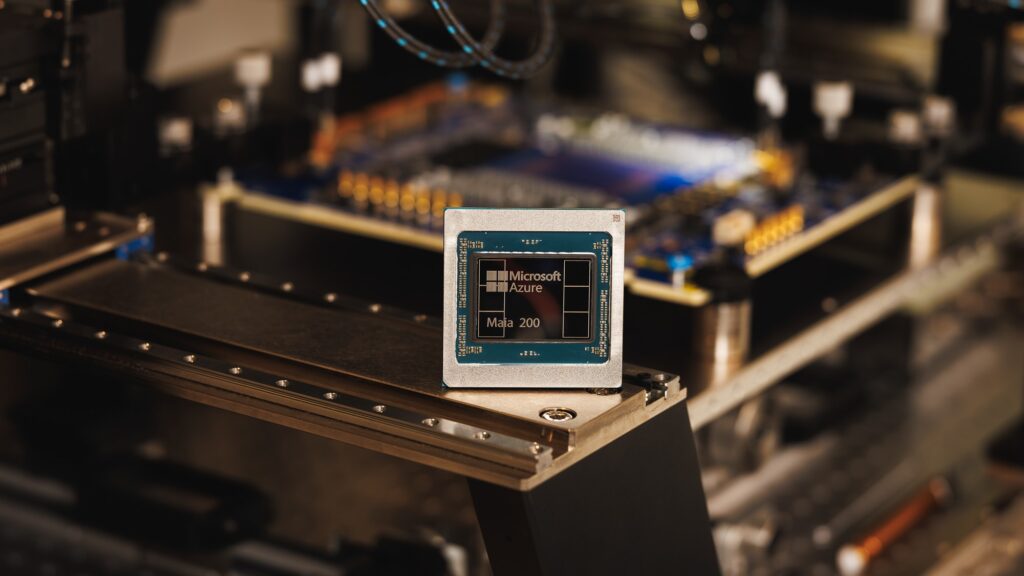
Maia 200: The AI accelerator built for inference - The Official Microsoft Blog
Today, we’re proud to introduce Maia 200, a breakthrough inference accelerator engineered to dramatically improve the economics of AI token generation. Maia 200 is an AI inference powerhouse: an accelerator built on TSMC’s 3nm process with native FP8/FP4 tensor cores, a redesigned memory system... blogs.microsoft.com
- Related coverage: techfastforward.com
Loading…
techfastforward.com - Official source: news.microsoft.com
Loading…
news.microsoft.com - Related coverage: washingtonpost.com
Loading…
www.washingtonpost.com - Related coverage: techcrunch.com
Loading…
techcrunch.com
- Related coverage: techtimes.com
Loading…
www.techtimes.com - Related coverage: investing.com
Loading…
www.investing.com - Related coverage: techradar.com
Microsoft and Nvidia funnel billions into Anthropic as Claude scales
Microsoft and Nvidia funnel billions into Anthropic as Claude scaleswww.techradar.com
- Related coverage: idlen.io
Loading…
www.idlen.io - Related coverage: winbuzzer.com
Loading…
winbuzzer.com - Official source: anthropic.com
Loading…
www.anthropic.com - Related coverage: tomshardware.com
Loading…
www.tomshardware.com - Related coverage: windowscentral.com
Loading…
www.windowscentral.com - Related coverage: itpro.com
Loading…
www.itpro.com - Related coverage: elpais.com
Loading…
elpais.com - Related coverage: techxplore.com
Loading…
techxplore.com