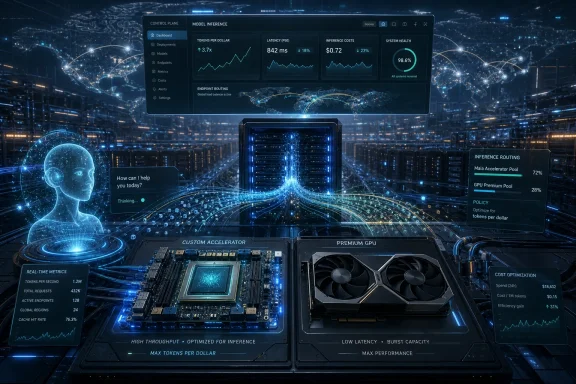
Anthropic is reportedly in early talks with Microsoft to run Claude models on Azure servers powered by Microsoft’s Maia 200 AI accelerator, a custom inference chip introduced in January 2026 for high-volume model serving rather than frontier-model training. The discussion matters because it would move Claude from being merely available on Azure to helping validate Microsoft’s attempt to own more of the AI computing stack. If the deal materializes, it would not dethrone Nvidia overnight. It would, however, mark a serious test of whether hyperscaler silicon can become more than a bargaining chip in the GPU era.
For the past three years, the AI infrastructure story has been narrated as a shortage story. Nvidia GPUs were scarce, cloud capacity was rationed, model companies signed enormous compute commitments, and every hyperscaler tried to persuade Wall Street that it could turn capital expenditure into durable advantage. The rumored Anthropic-Maia talks belong to the next phase of that story: not whether Microsoft can get enough accelerators, but whether it can make inference cheap enough to scale profitably.
That distinction is not academic. Training produces the models that make headlines, but inference is what turns those models into a daily operating expense. Every Copilot prompt, every Claude response in an enterprise workflow, every generated summary in a productivity suite becomes a small compute bill repeated millions or billions of times.
Maia 200 was designed for that less glamorous but commercially decisive workload. Microsoft has described it as an inference accelerator for Azure’s own large-scale AI services, built to improve performance per dollar across products such as Microsoft 365 Copilot and Azure model serving. In plain terms, Microsoft wants fewer of its AI margins flowing out the door as GPU rent.
Anthropic’s interest would therefore be more than a customer choosing a cheaper server type. It would be one frontier-model company allowing Microsoft’s custom silicon to compete for a real production workload, with all the messy implications that come with memory bandwidth, compiler maturity, model compatibility, reliability, and service-level expectations.
Nvidia remains the default platform for frontier AI because it is not just selling chips. It sells a mature hardware platform, a deep software stack, a developer ecosystem, networking, libraries, and a credibility layer that lets model labs move fast. That is why even deals meant to diversify away from Nvidia often still include Nvidia hardware somewhere in the stack.
Maia 200 is aimed at a narrower target. It does not need to be the best chip for every AI workload; it needs to be good enough, efficient enough, and integrated enough for the workloads Microsoft can predict and control. Inference is the natural place to start because a deployed model has more stable operating characteristics than a training run at the edge of research.
That makes Claude an attractive workload if Anthropic and Microsoft can make the economics work. Claude is already a major enterprise model family, and Microsoft has every incentive to make its Azure-hosted Claude capacity less dependent on third-party GPUs over time. But the burden of proof is high: a frontier model served poorly is not cheaper; it is a support incident wearing a spreadsheet’s disguise.
That multi-cloud posture is not indecision. It is leverage. Frontier AI companies need enormous capacity, but they also need resilience against supply constraints, pricing pressure, regulatory shocks, and the possibility that one cloud partner’s product roadmap starts to conflict with their own.
Microsoft, meanwhile, needs Anthropic for reasons that go beyond Azure consumption. Its relationship with OpenAI remains strategically central, but Microsoft has spent the last year making its AI platform look less like a single-vendor dependency. Claude in Microsoft 365 Copilot, GitHub Copilot, Copilot Studio, and Azure gives Microsoft a stronger “model choice” story for enterprises that do not want every AI decision routed through OpenAI.
That is why the Maia talks are strategically interesting. If Anthropic helps shape future Maia designs or ports serious Claude inference onto Microsoft silicon, Microsoft gets a second frontier-model partner feeding its hardware roadmap. Anthropic gets more influence over the compute substrate it may spend tens of billions of dollars using.
That kind of structure is now familiar in AI: capital flows into model companies, model companies commit to cloud spending, cloud providers book future demand, and chipmakers remain embedded in the machinery. Critics call it circular finance; defenders call it the only plausible way to build infrastructure at the speed AI demand requires.
The Maia angle complicates the simple version. If Anthropic’s Azure commitment runs entirely on Nvidia systems, Microsoft is effectively acting as the cloud intermediary for an Nvidia-powered model economy. If some meaningful share eventually runs on Maia, Microsoft captures more of the stack internally.
That is the real prize. Microsoft does not need Anthropic to abandon Nvidia; it needs enough high-volume inference to prove Maia is economically credible. Once a custom chip is validated against production workloads from multiple model providers, it stops looking like an internal science project and starts looking like cloud infrastructure with strategic leverage.
For consumer chatbots, that cost can be disguised by subsidies, subscription bundles, or investor appetite. For enterprise software, it eventually shows up in margins, throttling policies, seat pricing, token limits, or the quiet degradation of features that are too expensive to run at scale. Microsoft knows this because Copilot is not a demo; it is a product line that has to be sold, supported, and renewed.
That gives Maia a practical mission. The chip is not about winning a press-release benchmark. It is about letting Microsoft run massive AI services with enough cost predictability that Copilot can become infrastructure instead of a premium experiment.
Anthropic faces the same arithmetic from the other side. Claude has become a serious enterprise model, especially for coding, analysis, writing, and agentic workflows. Those uses are valuable precisely because they can be long-running and compute-intensive. If Anthropic can reduce serving costs without sacrificing quality or latency, it gains room to compete on both price and capability.
That lock-in risk is not necessarily fatal. Enterprises have lived with cloud-specific services for years because the operational benefits often outweigh portability concerns. But AI intensifies the stakes because model infrastructure is becoming a strategic dependency, not just another backend service.
For Microsoft, this is partly the point. If Azure can offer Claude on a hardware-software stack that is cheaper, better integrated, and easier to operate inside Microsoft’s enterprise ecosystem, it becomes harder for customers to treat model hosting as a commodity. The chip becomes part of the platform moat.
For Anthropic, the calculus is more delicate. It wants access to Microsoft’s enterprise distribution and compute scale, but it cannot afford to let one cloud’s silicon roadmap dictate Claude’s architecture. The likely outcome, if the talks mature, is selective optimization rather than wholesale commitment: run some inference on Maia where it makes sense, keep other workloads on Nvidia or competing cloud accelerators, and use the experience to influence future chips.
That is not hypocrisy; it is capacity planning. Frontier AI demand is too large for ideological purity. Model companies need whatever works, cloud providers need whatever can be deployed, and Nvidia still offers the safest route for the hardest workloads.
But Nvidia’s dominance has created a powerful incentive for customers to find alternatives at the margins. Every inference workload moved to Maia, TPU, Trainium, or another accelerator reduces pressure on scarce GPUs and improves a cloud provider’s negotiating position. Even partial substitution matters when the unit volumes are enormous.
Nvidia can live with that for now because the AI market is still expanding faster than alternatives can displace it. The risk for Nvidia is not a sudden collapse. It is the gradual specialization of the market, where training, high-end research, general-purpose inference, and hyperscaler-controlled production workloads begin to fragment across different architectures.
If Microsoft can lower inference costs, it has more room to make Copilot features faster, more widely available, and less aggressively metered. That could mean more capable local-cloud hybrid workflows, broader access to premium models, or enterprise SKUs that bundle AI more naturally into existing licensing. It could also mean Microsoft becomes more willing to put model choice in front of users because the backend economics are less punishing.
The reverse is also true. If custom silicon underperforms or proves difficult to operate across diverse models, Microsoft’s AI ambitions remain more exposed to Nvidia supply, GPU pricing, and the cost of serving features whose user value is still being tested in the market. The silicon layer may be invisible to an administrator deploying Copilot, but it shapes what Microsoft can afford to promise.
Sysadmins should therefore read the Maia-Anthropic talks as an infrastructure signal. The Copilot era will not be defined only by UI changes and licensing bundles. It will be defined by the backend economics that determine whether those AI features are reliable services or perpetually rationed add-ons.
That makes the operational details more important than the headline. Can Microsoft provide consistent performance across regions? Will Maia-backed Claude deployments support the same model versions, context windows, safety features, logging controls, and data-handling guarantees as Nvidia-backed deployments? Will customers even know which accelerator is serving their workload, or will Azure abstract it away entirely?
There is also a procurement angle. Many enterprises already have Azure commitments, Microsoft 365 agreements, and security tooling tied into Microsoft’s platform. If Claude inference on Maia becomes part of a more cost-effective Azure AI offering, Microsoft can turn hardware optimization into a licensing conversation. That is where custom silicon becomes commercially powerful.
But IT leaders should resist treating this as automatic savings. Cloud providers rarely pass efficiency gains directly to customers in a simple one-to-one fashion. More often, lower internal costs show up as bundled features, capacity availability, promotional pricing, or improved margins for the provider. The practical question is not whether Maia saves Microsoft money; it is whether customers get better service terms because of it.
Microsoft does not have to convince the whole world to adopt Maia on day one. It can feed the chip with Copilot workloads, Azure AI services, GitHub-related inference, and internal model serving. That gives it a base load from which to improve the hardware and software stack.
Anthropic would add an external proving ground. Running Microsoft’s own workloads on Microsoft’s own chips is useful, but it does not settle the question of whether Maia is flexible enough for a leading third-party model lab. Claude would be a more demanding endorsement.
This is also why Anthropic’s reported desire to provide input into future Maia designs matters. The best hyperscaler chips are not generic parts thrown over the wall to customers. They are the result of feedback loops among model architecture, compiler design, memory systems, networking, cooling, and data center operations. If Anthropic becomes part of that loop, Maia becomes less purely Microsoft’s chip and more a negotiated artifact of the frontier-model economy.
Adding Anthropic to the stack helps Microsoft in several ways. It gives enterprise customers model choice, reduces the perception that Microsoft’s AI future depends on a single partner, and creates competitive pressure inside Microsoft’s own model ecosystem. If Claude performs better for some coding, reasoning, or enterprise workflows, Microsoft can still win if those workloads run through Azure and Copilot.
Maia sharpens that logic. Microsoft’s ideal future is not one in which it must bet perfectly on the best model company. It is one in which many leading models run efficiently on Microsoft infrastructure, inside Microsoft enterprise channels, governed by Microsoft security and compliance layers.
That does not make OpenAI less important. It means Microsoft is trying to make the model layer more plural while making the infrastructure layer more proprietary. The company can tolerate competition among models if Azure remains the place those models are consumed.
The Maia talks would not necessarily worsen that concern, but they would add another layer. If a major model company becomes financially tied to a cloud provider, uses that provider’s custom chips, and helps shape future chip design, the relationship begins to look less like ordinary vendor selection and more like vertical integration by contract.
There are legitimate efficiency arguments for that integration. AI systems are now so compute-intensive that separating model design, chip design, and data center design may be economically irrational. The fastest improvements may come from co-design across the stack.
Still, regulators are unlikely to ignore the concentration pattern. The same handful of firms increasingly provide the models, clouds, chips, productivity software, developer platforms, and enterprise identity systems through which AI reaches customers. Even if each deal has a rational business case, the aggregate effect is a market with very high walls.
That kind of success is boring by design. Nobody notices the accelerator when the chatbot responds quickly, the Copilot workflow completes, and the monthly bill does not trigger a finance escalation. Everyone notices when a model is slow, unavailable, or subtly different across deployment targets.
Microsoft’s advantage is that it controls a vast amount of the surrounding platform. It can tune the serving stack, integrate telemetry, manage capacity, and steer workloads in ways a smaller cloud provider cannot. Its disadvantage is that customers will hold it responsible for the entire experience, not just the chip.
Anthropic’s advantage is optionality. It can test Maia without abandoning Nvidia, AWS, or Google. Its disadvantage is complexity: every additional infrastructure target adds engineering overhead, operational variance, and another set of trade-offs for a company already racing to build safer and more capable models.
The most interesting signal would be repetition. A one-off test says Microsoft can attract attention. A sustained production deployment says Maia is useful. Anthropic shaping the next generation of Maia would say the relationship has moved from procurement to co-design.
That progression would matter for the entire Windows and Azure ecosystem. Microsoft’s AI future is being sold through familiar surfaces — Word, Excel, Teams, Windows, Visual Studio Code, GitHub, Defender, and Azure. But the economic feasibility of that future depends on unfamiliar hardware buried in data centers.
This is why custom silicon is becoming part of the software story. In the pre-AI cloud era, infrastructure efficiency mostly influenced gross margins and instance pricing. In the AI era, it influences which features exist, which models are offered, how often users hit limits, and whether enterprise AI feels like a dependable tool or an expensive pilot program.
That ambition creates real benefits if Microsoft executes. Enterprises could get more model options, better capacity, and AI services that fit naturally into existing administrative structures. Developers could get broader access to Claude and other models through Azure tooling. Windows users could eventually see Copilot features become faster or more capable because the backend economics improve.
But the risks are equally real. A more vertically integrated AI stack can reduce portability, obscure cost structures, and deepen dependence on a handful of vendors. If Microsoft’s custom silicon becomes a hidden prerequisite for the best Azure AI economics, customers may find that “model choice” still lives inside a tightly controlled platform.
The reported Anthropic talks therefore deserve attention not because they promise an immediate revolution, but because they expose the direction of travel. The AI market is moving from a race to buy accelerators toward a race to shape the entire system around them.
 Microsoft’s AI Bet Is Moving From Model Access to Margin Control
For the past three years, the AI infrastructure story has been narrated as a shortage story. Nvidia GPUs were scarce, cloud capacity was rationed, model companies signed enormous compute commitments, and every hyperscaler tried to persuade Wall Street that it could turn capital expenditure into durable advantage. The rumored Anthropic-Maia talks belong to the next phase of that story: not whether Microsoft can get enough accelerators, but whether it can make inference cheap enough to scale profitably.That distinction is not academic. Training produces the models that make headlines, but inference is what turns those models into a daily operating expense. Every Copilot prompt, every Claude response in an enterprise workflow, every generated summary in a productivity suite becomes a small compute bill repeated millions or billions of times.
Maia 200 was designed for that less glamorous but commercially decisive workload. Microsoft has described it as an inference accelerator for Azure’s own large-scale AI services, built to improve performance per dollar across products such as Microsoft 365 Copilot and Azure model serving. In plain terms, Microsoft wants fewer of its AI margins flowing out the door as GPU rent.
Anthropic’s interest would therefore be more than a customer choosing a cheaper server type. It would be one frontier-model company allowing Microsoft’s custom silicon to compete for a real production workload, with all the messy implications that come with memory bandwidth, compiler maturity, model compatibility, reliability, and service-level expectations.
Maia 200 Is Not a Nvidia Killer, and That Is the Point
The lazy version of this story is “Microsoft builds AI chip to replace Nvidia.” The more accurate version is that Microsoft is trying to segment the AI compute market before Nvidia’s dominance becomes a permanent tax on every token generated in Azure.Nvidia remains the default platform for frontier AI because it is not just selling chips. It sells a mature hardware platform, a deep software stack, a developer ecosystem, networking, libraries, and a credibility layer that lets model labs move fast. That is why even deals meant to diversify away from Nvidia often still include Nvidia hardware somewhere in the stack.
Maia 200 is aimed at a narrower target. It does not need to be the best chip for every AI workload; it needs to be good enough, efficient enough, and integrated enough for the workloads Microsoft can predict and control. Inference is the natural place to start because a deployed model has more stable operating characteristics than a training run at the edge of research.
That makes Claude an attractive workload if Anthropic and Microsoft can make the economics work. Claude is already a major enterprise model family, and Microsoft has every incentive to make its Azure-hosted Claude capacity less dependent on third-party GPUs over time. But the burden of proof is high: a frontier model served poorly is not cheaper; it is a support incident wearing a spreadsheet’s disguise.
Anthropic’s Cloud Strategy Has Become Deliberately Multi-Polar
Anthropic has spent the past year making sure it is not trapped inside one cloud’s strategic agenda. Amazon remains a critical backer and infrastructure partner, Google has also been part of Anthropic’s cloud footprint, and the company has reportedly continued to secure Nvidia-based capacity from specialist providers such as CoreWeave. The Microsoft relationship adds another pole rather than replacing the existing ones.That multi-cloud posture is not indecision. It is leverage. Frontier AI companies need enormous capacity, but they also need resilience against supply constraints, pricing pressure, regulatory shocks, and the possibility that one cloud partner’s product roadmap starts to conflict with their own.
Microsoft, meanwhile, needs Anthropic for reasons that go beyond Azure consumption. Its relationship with OpenAI remains strategically central, but Microsoft has spent the last year making its AI platform look less like a single-vendor dependency. Claude in Microsoft 365 Copilot, GitHub Copilot, Copilot Studio, and Azure gives Microsoft a stronger “model choice” story for enterprises that do not want every AI decision routed through OpenAI.
That is why the Maia talks are strategically interesting. If Anthropic helps shape future Maia designs or ports serious Claude inference onto Microsoft silicon, Microsoft gets a second frontier-model partner feeding its hardware roadmap. Anthropic gets more influence over the compute substrate it may spend tens of billions of dollars using.
The $30 Billion Azure Commitment Changes the Negotiating Table
The reported backdrop is a very large financial relationship. Microsoft and Nvidia announced plans in November 2025 to invest up to $15 billion combined in Anthropic, with Microsoft’s portion up to $5 billion and Nvidia’s up to $10 billion. Anthropic, in turn, committed to purchase $30 billion in Azure compute capacity and to contract additional capacity up to one gigawatt.That kind of structure is now familiar in AI: capital flows into model companies, model companies commit to cloud spending, cloud providers book future demand, and chipmakers remain embedded in the machinery. Critics call it circular finance; defenders call it the only plausible way to build infrastructure at the speed AI demand requires.
The Maia angle complicates the simple version. If Anthropic’s Azure commitment runs entirely on Nvidia systems, Microsoft is effectively acting as the cloud intermediary for an Nvidia-powered model economy. If some meaningful share eventually runs on Maia, Microsoft captures more of the stack internally.
That is the real prize. Microsoft does not need Anthropic to abandon Nvidia; it needs enough high-volume inference to prove Maia is economically credible. Once a custom chip is validated against production workloads from multiple model providers, it stops looking like an internal science project and starts looking like cloud infrastructure with strategic leverage.
Inference Is Where AI’s Economics Get Ruthless
The public imagination still treats model training as the main event because training is where the giant clusters, record-breaking budgets, and benchmark races live. But the business model of AI lives or dies in inference. The more successful a model becomes, the more expensive it becomes to serve.For consumer chatbots, that cost can be disguised by subsidies, subscription bundles, or investor appetite. For enterprise software, it eventually shows up in margins, throttling policies, seat pricing, token limits, or the quiet degradation of features that are too expensive to run at scale. Microsoft knows this because Copilot is not a demo; it is a product line that has to be sold, supported, and renewed.
That gives Maia a practical mission. The chip is not about winning a press-release benchmark. It is about letting Microsoft run massive AI services with enough cost predictability that Copilot can become infrastructure instead of a premium experiment.
Anthropic faces the same arithmetic from the other side. Claude has become a serious enterprise model, especially for coding, analysis, writing, and agentic workflows. Those uses are valuable precisely because they can be long-running and compute-intensive. If Anthropic can reduce serving costs without sacrificing quality or latency, it gains room to compete on both price and capability.
Custom Silicon Makes the Cloud Less Neutral
There is a subtle trade-off in every hyperscaler chip strategy. Custom silicon can lower costs and improve efficiency, but it also makes the cloud less interchangeable. A workload tuned deeply for Maia is not the same as a workload tuned for Nvidia GPUs, Google TPUs, or AWS Trainium.That lock-in risk is not necessarily fatal. Enterprises have lived with cloud-specific services for years because the operational benefits often outweigh portability concerns. But AI intensifies the stakes because model infrastructure is becoming a strategic dependency, not just another backend service.
For Microsoft, this is partly the point. If Azure can offer Claude on a hardware-software stack that is cheaper, better integrated, and easier to operate inside Microsoft’s enterprise ecosystem, it becomes harder for customers to treat model hosting as a commodity. The chip becomes part of the platform moat.
For Anthropic, the calculus is more delicate. It wants access to Microsoft’s enterprise distribution and compute scale, but it cannot afford to let one cloud’s silicon roadmap dictate Claude’s architecture. The likely outcome, if the talks mature, is selective optimization rather than wholesale commitment: run some inference on Maia where it makes sense, keep other workloads on Nvidia or competing cloud accelerators, and use the experience to influence future chips.
Nvidia Is Still in the Room
The irony of the reported Maia talks is that they sit inside a partnership that also strengthened Nvidia’s position. Nvidia’s planned investment in Anthropic and its role in Azure infrastructure make it both a supplier and a strategic participant. This is what makes the AI infrastructure market so strange: everyone is diversifying away from Nvidia while also buying more Nvidia hardware.That is not hypocrisy; it is capacity planning. Frontier AI demand is too large for ideological purity. Model companies need whatever works, cloud providers need whatever can be deployed, and Nvidia still offers the safest route for the hardest workloads.
But Nvidia’s dominance has created a powerful incentive for customers to find alternatives at the margins. Every inference workload moved to Maia, TPU, Trainium, or another accelerator reduces pressure on scarce GPUs and improves a cloud provider’s negotiating position. Even partial substitution matters when the unit volumes are enormous.
Nvidia can live with that for now because the AI market is still expanding faster than alternatives can displace it. The risk for Nvidia is not a sudden collapse. It is the gradual specialization of the market, where training, high-end research, general-purpose inference, and hyperscaler-controlled production workloads begin to fragment across different architectures.
Windows Users Will Feel This Through Copilot, Not Through Chip Specs
For WindowsForum readers, the Maia story is not about whether a server chip has the most impressive memory bandwidth figure. The relevant question is what happens to the AI features Microsoft keeps threading through Windows, Microsoft 365, Edge, GitHub, and the broader Azure ecosystem.If Microsoft can lower inference costs, it has more room to make Copilot features faster, more widely available, and less aggressively metered. That could mean more capable local-cloud hybrid workflows, broader access to premium models, or enterprise SKUs that bundle AI more naturally into existing licensing. It could also mean Microsoft becomes more willing to put model choice in front of users because the backend economics are less punishing.
The reverse is also true. If custom silicon underperforms or proves difficult to operate across diverse models, Microsoft’s AI ambitions remain more exposed to Nvidia supply, GPU pricing, and the cost of serving features whose user value is still being tested in the market. The silicon layer may be invisible to an administrator deploying Copilot, but it shapes what Microsoft can afford to promise.
Sysadmins should therefore read the Maia-Anthropic talks as an infrastructure signal. The Copilot era will not be defined only by UI changes and licensing bundles. It will be defined by the backend economics that determine whether those AI features are reliable services or perpetually rationed add-ons.
Enterprise IT Should Watch the Operational Fine Print
Enterprises will not choose Claude on Maia because the chip is interesting. They will choose it if it improves latency, availability, cost, compliance posture, or integration with existing Microsoft contracts. Custom silicon succeeds in the enterprise only when it disappears behind service quality.That makes the operational details more important than the headline. Can Microsoft provide consistent performance across regions? Will Maia-backed Claude deployments support the same model versions, context windows, safety features, logging controls, and data-handling guarantees as Nvidia-backed deployments? Will customers even know which accelerator is serving their workload, or will Azure abstract it away entirely?
There is also a procurement angle. Many enterprises already have Azure commitments, Microsoft 365 agreements, and security tooling tied into Microsoft’s platform. If Claude inference on Maia becomes part of a more cost-effective Azure AI offering, Microsoft can turn hardware optimization into a licensing conversation. That is where custom silicon becomes commercially powerful.
But IT leaders should resist treating this as automatic savings. Cloud providers rarely pass efficiency gains directly to customers in a simple one-to-one fashion. More often, lower internal costs show up as bundled features, capacity availability, promotional pricing, or improved margins for the provider. The practical question is not whether Maia saves Microsoft money; it is whether customers get better service terms because of it.
Microsoft Is Learning From Google and Amazon, but Playing a Different Hand
Google proved with TPUs that custom AI silicon can become a real platform advantage when paired tightly with internal workloads and cloud services. Amazon has pushed Trainium and Inferentia as part of its own effort to offer alternatives to Nvidia, especially for customers already invested in AWS. Microsoft arrived later to the modern AI accelerator race, but it has one unusually potent asset: a massive first-party AI application layer.Microsoft does not have to convince the whole world to adopt Maia on day one. It can feed the chip with Copilot workloads, Azure AI services, GitHub-related inference, and internal model serving. That gives it a base load from which to improve the hardware and software stack.
Anthropic would add an external proving ground. Running Microsoft’s own workloads on Microsoft’s own chips is useful, but it does not settle the question of whether Maia is flexible enough for a leading third-party model lab. Claude would be a more demanding endorsement.
This is also why Anthropic’s reported desire to provide input into future Maia designs matters. The best hyperscaler chips are not generic parts thrown over the wall to customers. They are the result of feedback loops among model architecture, compiler design, memory systems, networking, cooling, and data center operations. If Anthropic becomes part of that loop, Maia becomes less purely Microsoft’s chip and more a negotiated artifact of the frontier-model economy.
The OpenAI Shadow Still Hangs Over Everything
Microsoft’s AI strategy cannot be discussed without OpenAI, even when the subject is Anthropic. For years, Microsoft’s privileged access to OpenAI models gave Azure and Copilot a differentiated story. It also created concentration risk.Adding Anthropic to the stack helps Microsoft in several ways. It gives enterprise customers model choice, reduces the perception that Microsoft’s AI future depends on a single partner, and creates competitive pressure inside Microsoft’s own model ecosystem. If Claude performs better for some coding, reasoning, or enterprise workflows, Microsoft can still win if those workloads run through Azure and Copilot.
Maia sharpens that logic. Microsoft’s ideal future is not one in which it must bet perfectly on the best model company. It is one in which many leading models run efficiently on Microsoft infrastructure, inside Microsoft enterprise channels, governed by Microsoft security and compliance layers.
That does not make OpenAI less important. It means Microsoft is trying to make the model layer more plural while making the infrastructure layer more proprietary. The company can tolerate competition among models if Azure remains the place those models are consumed.
The Regulatory Optics Are Getting Harder to Ignore
The Anthropic-Microsoft-Nvidia arrangement also lands in a policy environment increasingly suspicious of giant AI infrastructure deals. When cloud providers invest billions in model companies that then commit billions back to cloud services, regulators have obvious questions about market structure, competition, and whether the AI economy is being financed in circles.The Maia talks would not necessarily worsen that concern, but they would add another layer. If a major model company becomes financially tied to a cloud provider, uses that provider’s custom chips, and helps shape future chip design, the relationship begins to look less like ordinary vendor selection and more like vertical integration by contract.
There are legitimate efficiency arguments for that integration. AI systems are now so compute-intensive that separating model design, chip design, and data center design may be economically irrational. The fastest improvements may come from co-design across the stack.
Still, regulators are unlikely to ignore the concentration pattern. The same handful of firms increasingly provide the models, clouds, chips, productivity software, developer platforms, and enterprise identity systems through which AI reaches customers. Even if each deal has a rational business case, the aggregate effect is a market with very high walls.
The Real Benchmark Will Be Boring
The industry will be tempted to judge Maia 200 through benchmark snippets, performance-per-dollar claims, and comparisons with Nvidia, Google, and Amazon accelerators. Those numbers matter, but they are not the final test. The real benchmark is whether a model such as Claude can run at production scale with predictable latency, acceptable quality, strong utilization, and fewer cost surprises.That kind of success is boring by design. Nobody notices the accelerator when the chatbot responds quickly, the Copilot workflow completes, and the monthly bill does not trigger a finance escalation. Everyone notices when a model is slow, unavailable, or subtly different across deployment targets.
Microsoft’s advantage is that it controls a vast amount of the surrounding platform. It can tune the serving stack, integrate telemetry, manage capacity, and steer workloads in ways a smaller cloud provider cannot. Its disadvantage is that customers will hold it responsible for the entire experience, not just the chip.
Anthropic’s advantage is optionality. It can test Maia without abandoning Nvidia, AWS, or Google. Its disadvantage is complexity: every additional infrastructure target adds engineering overhead, operational variance, and another set of trade-offs for a company already racing to build safer and more capable models.
The Claude-on-Maia Trial Would Say More Than Any Launch Event
If the talks turn into deployment, the first phase will likely be cautious. Expect limited workloads, specific regions, controlled model versions, and a lot of measurement before anyone declares victory. That is how serious infrastructure shifts happen when the customer is a frontier-model company and the provider is a hyperscaler trying to prove custom silicon.The most interesting signal would be repetition. A one-off test says Microsoft can attract attention. A sustained production deployment says Maia is useful. Anthropic shaping the next generation of Maia would say the relationship has moved from procurement to co-design.
That progression would matter for the entire Windows and Azure ecosystem. Microsoft’s AI future is being sold through familiar surfaces — Word, Excel, Teams, Windows, Visual Studio Code, GitHub, Defender, and Azure. But the economic feasibility of that future depends on unfamiliar hardware buried in data centers.
This is why custom silicon is becoming part of the software story. In the pre-AI cloud era, infrastructure efficiency mostly influenced gross margins and instance pricing. In the AI era, it influences which features exist, which models are offered, how often users hit limits, and whether enterprise AI feels like a dependable tool or an expensive pilot program.
The Claimed Partnership Is Really a Test of Microsoft’s AI Control Plane
The concrete lesson from the reported talks is not that Anthropic has chosen Maia, because the negotiations are still described as early. The lesson is that Microsoft wants Azure to be more than a rented GPU warehouse for other people’s models. It wants to become the control plane for enterprise AI: model choice above, custom silicon below, identity and compliance wrapped around the middle.That ambition creates real benefits if Microsoft executes. Enterprises could get more model options, better capacity, and AI services that fit naturally into existing administrative structures. Developers could get broader access to Claude and other models through Azure tooling. Windows users could eventually see Copilot features become faster or more capable because the backend economics improve.
But the risks are equally real. A more vertically integrated AI stack can reduce portability, obscure cost structures, and deepen dependence on a handful of vendors. If Microsoft’s custom silicon becomes a hidden prerequisite for the best Azure AI economics, customers may find that “model choice” still lives inside a tightly controlled platform.
The reported Anthropic talks therefore deserve attention not because they promise an immediate revolution, but because they expose the direction of travel. The AI market is moving from a race to buy accelerators toward a race to shape the entire system around them.
The Numbers Behind the Negotiation Are the Story Microsoft Wants Enterprises to Miss
The most important facts are also the easiest to flatten into deal math:- Anthropic has reportedly discussed running Claude inference on Microsoft’s Maia 200 servers, but the negotiations are still early.
- Maia 200 is designed for inference, which means serving existing AI models rather than training new frontier models from scratch.
- Microsoft and Nvidia announced plans in November 2025 to invest up to $15 billion combined in Anthropic, while Anthropic committed to $30 billion in Azure compute capacity.
- Microsoft’s strategic goal is not to eliminate Nvidia immediately, but to reduce the cost and supply risk of high-volume AI inference inside Azure.
- Enterprise customers should watch service quality, pricing, regional availability, compliance guarantees, and model parity rather than chip branding.
- If Claude becomes a meaningful Maia workload, Microsoft’s custom silicon effort gains credibility beyond first-party Copilot optimization.
References
- Primary source: Techzine Global
Published: Thu, 21 May 2026 13:54:22 GMT
Anthropic wants to run Claude models on Microsoft's Maia chip - Techzine Global
Anthropic and Microsoft are in talks regarding the use of Maia AI chips for Claude models. Negotiations are in the early stages. www.techzine.eu
- Official source: blogs.microsoft.com
Maia 200: The AI accelerator built for inference - The Official Microsoft Blog
Today, we’re proud to introduce Maia 200, a breakthrough inference accelerator engineered to dramatically improve the economics of AI token generation. Maia 200 is an AI inference powerhouse: an accelerator built on TSMC’s 3nm process with native FP8/FP4 tensor cores, a redesigned memory system...blogs.microsoft.com - Related coverage: techradar.com
Anthropic locks in massive Azure deal to fuel Claude expansion across global clouds and reshape enterprise AI access worldwide | TechRadar
Claude models integrate into the Microsoft Foundry platform for enterprise deploymentwww.techradar.com - Official source: news.microsoft.com
- Related coverage: pymnts.com
PYMNTS | Nvidia and Microsoft Pledge Up to $15 Billion to Anthropic
Microsoft says it is joining Nvidia in a multibillion-dollar partnership with AI startup Anthropic to scale the Claude AI model. www.pymnts.com
- Related coverage: axios.com
Anthropic lands $15 billion investment from Microsoft, Nvidia
The move is the latest in a series of deals that have all the big players partnering with one another.www.axios.com

- Related coverage: investing.com
Anthropic commits $30 billion to Microsoft Azure compute By Reuters
Anthropic commits $30 billion to Microsoft Azure computewww.investing.com - Related coverage: winbuzzer.com
Microsoft, NVIDIA, and Anthropic Forge $45 Billion Alliance to Scale Claude on Azure
Anthropic commits $30B to Azure as Microsoft and NVIDIA invest $15B. The deal brings Claude natively to Microsoft's cloud, expanding its AI ecosystem. winbuzzer.com
- Related coverage: techcrunch.com
Microsoft announces powerful new chip for AI inference | TechCrunch
Maia comes equipped with over 100 billion transistors, delivering over 10 petaflops in 4-bit precision and approximately 5 petaflops of 8-bit performance — a substantial increase over its predecessor.techcrunch.com - Related coverage: datacenterdynamics.com
Anthropic to purchase $30bn in Microsoft Azure credits, Nvidia and Microsoft to invest in AI company - DCD
Despite bubble fears, the circular investment cycle continueswww.datacenterdynamics.com - Related coverage: tomshardware.com
Microsoft introduces newest in-house AI chip — Maia 200 is faster than other bespoke Nvidia competitors, built on TSMC 3nm with 216GB of HBM3e | Tom's Hardware
30% more performance per dollar than Maia 100, and faster than Amazon or Google.www.tomshardware.com - Related coverage: windowscentral.com
NVIDIA joins Microsoft’s push on Claude — piling billions into Anthropic’s future | Windows Central
Claude’s arrival on Azure signals a major shift in the competitive AI cloud landscape.www.windowscentral.com - Related coverage: elpais.com
Microsoft y Nvidia calientan aún más la burbuja de la IA: invertirán 15.000 millones en Anthropic, rival de OpenAI | Economía | EL PAÍS
La compañía acelera su financiación con los principales socios de su gran competidorelpais.com - Related coverage: news.cognizant.com