

Anthropic’s new Cowork pivot turns Claude from a developer-focused coding assistant into a desktop “AI coworker” for everyday tasks — a move that accelerates agentic AI into mainstream workflows while reopening familiar trade-offs between productivity gains, security exposure, and long-term platform economics. The launch is consequential on two levels: it democratizes powerful agentic capabilities previously reserved for terminal-savvy users, and it forces IT teams and privacy-conscious users to reckon with what it means to give an AI controlled access to local files and application surfaces.
Anthropic’s Claude family has moved rapidly beyond single-session chat assistants into long-context, tool-enabled agents that can plan, execute multi-step workflows, and — in some variants — interact directly with files and UIs. That trajectory began with Claude Code, a terminal-first, agentic coding assistant, and has accelerated through a stream of model and product updrhestration, and “computer use” features. Many of these capabilities now underpin Cowork, which packages Claude Code–style automation into an accessible desktop experience.
At the same time, the broader industry debate that followed reporting about OpenAI’s finances — namely, whether leading generative-AI firms can sustain their spending without new revenue models or direct balance-sheet support — has resurfaced in force. A recent opinion analysis arguing that OpenAI could exhaust its cash runway within roughly 18 months has prompted fresh scrutiny on how competitive dynamics, capital intensity, and monetization choices will shape the next phase of AI. Multiple outlets reported on the projection and the underlying cash-burn figures cited in that column. These financial debates matter because they shape partnerships, pricing strategies, and where advanced agentic services will be available commercially.
At the same time, the industry’s financial dynamics — including public discussion about major providers’ cash burn and runway — add another axis of risk. Enterprises evaluating agentic services should plan for product and pricing volatility, negotiate firm contractual protections, and build playbooks that let them pivot providers if economic pressures force vendor strategy changes.
Cowork is emblematic of a broader inflection point: agents are leaving the lab and arriving on the desktop. For IT teams and Windows-focused organizations, the correct reaction is pragmatic and proactive: pilot with care, enforce least privilege, instrument every run, and treat this wave of automation as a new category of endpoint service that deserves the same operational rigor as any other production system.
Source: Bandwidth Blog https://bandwidthblog.co.za/2026/01...cture-after-examining-the-company-s-finances]
 Background / Overview
Anthropic’s Claude family has moved rapidly beyond single-session chat assistants into long-context, tool-enabled agents that can plan, execute multi-step workflows, and — in some variants — interact directly with files and UIs. That trajectory began with Claude Code, a terminal-first, agentic coding assistant, and has accelerated through a stream of model and product updrhestration, and “computer use” features. Many of these capabilities now underpin Cowork, which packages Claude Code–style automation into an accessible desktop experience.At the same time, the broader industry debate that followed reporting about OpenAI’s finances — namely, whether leading generative-AI firms can sustain their spending without new revenue models or direct balance-sheet support — has resurfaced in force. A recent opinion analysis arguing that OpenAI could exhaust its cash runway within roughly 18 months has prompted fresh scrutiny on how competitive dynamics, capital intensity, and monetization choices will shape the next phase of AI. Multiple outlets reported on the projection and the underlying cash-burn figures cited in that column. These financial debates matter because they shape partnerships, pricing strategies, and where advanced agentic services will be available commercially.
What Cowork is and how it works
A product-first description
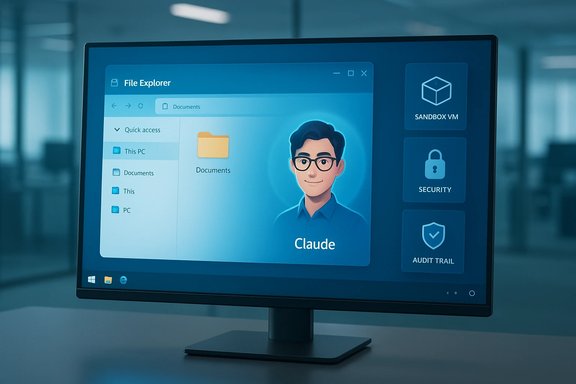
- Cowork is an agentic feature built into the Claude desktop app that lets users grant Claude access to a specific folder on their machine and then assign tasks in plain English. The assistant plans the job, executes steps inside a sandboxed environment, and produces persistent files as output. The design deliberately restricts access to a selected folder to limit lateral exposure.
- The workflow is simple by design: select a folder, describe the task, watch Claude decompose the job into steps (visible in a sidebar), and either approve or let it run. The interface mirrors Claude Code’s agentic UX but removes the need for CLI setup, making it accessible to nontechnical users. Early demos show tasks such as organizing downloads, extracting data from receipts, synthesizing reports from a folder of notes, and automating repetitive file transformations.
Technical constraints and safety measures
Anthropic has layered multiple defensive controls into Cowork’s initial release:- Scoped folder access: Claude can only read and modify files in the folder the user explicitly selects. It cannot roam the filesystem unless additional permissions are granted.
- Sandboxed execution: Tasks run in an isolated VM-like environment on the desktop to reduce system-level risk, while still allowing Claude to produce files that persist approach is intended to strike a balance between powerful automation and containment.
- Action transparency and confirmation: Cowork shows a step-by-step plan and requires confirmation for high-risk actions (deletions, external publishing, or actions on sensitive domains). Anthropic explicitly warns users about vague prompts that could lead to destructive outcomes.
- Beta gating and subscription limits: Cowork launched as a research preview and is initially available only to Anthropic’s higher-tier Max subscribers. Windows support was not included at initial launch; Anthropic has said Windows is planned but not yet scheduled. These gating choices let the company scale access while observing usage patterns and adversarial tests.
Practical limits (what Cowork cannot do — yet)
- System-wide file access, poutside the selected folder, and integrations that require elevated OS permissions are intentionally restricted in early releases.
- Browser and cloud connectors vary by platform and require explicit per-domain permissions or enterprise controls.
- The feature relies on the robustness of natural-language planning; brittle UI behaviors or ambiguous prompts can still yield errors or unwanted file changes.
Why this matters for Windows users and IT teams
Productivity upside
- For knowledge workers, Cowork reduces tedious copy/paste and multi-step extraction: imagine transforming a folder of scanned receipts into a single expense report with line items and CSV exports in minutes rather than hours.
- For smaller teams and solor to automation drops: no scripting or tooling experience is required to orchestrate multi-file workflows.
- For developers, the democratization of Claude Code-style automation places more of the end-to-end workflow — from code generation to file operations and test scaffolding — directly into the hands of product managers, designers, and analysts.
Real security and governance concerns
- Data exposure risk: Even with folder scoping, a lot of sensitive data sits in ordinary folders (Downloads, Desktop). Users may inadvertently grant access to personally identifiable information, credentials exported to files, or corporate assets. Anthropic’s sandbox reduces risk but does not elim])
- Prompt injection via files: Files themselves can be adversarial. Documents with crafted content could attempt to steer the agent into actions that leak information or perform unsafe operations. Anthropic has hardened system prompts and classifier defenses, but early red-team results reportedly found non-trivial injection success rates that needed mitigation.
- Operational error: Agents are not infallible. Vague instructions can lead to destructive actions (accidental deletions or miscategorization), and rollback guarantees depend on user backups and the local sandbox behavior. Anthropic recommends backups and cautious initial testing.
- Enterprise governance gap: Unlike server-side enterprise automation where IT controls identity, audit trails, and data residency centrally, desktop agents blur ownership lines. IT teams a new endpoint that requires policy controls, user training, and possibly MDM/endpoint configuration to limit how and when the feature can be enabled across managed devices.
How Anthropic appears to have built Cowork — and why speed matters
Anthropic’s product strategy has favored rapid iteration and embedding agentic capabilities across surfaces (browser panel, Claude Code, desktop app). Multiple accounts indicate a compressed development cycle for Cowork, reportedly leveraging Claude Code to write much of the product’s code in a short sprint. Whether the “self-coding” narrative is marketing or accurate, the technical reality is that agentic pipelines now substantially reduce the time from prototype to product — a capability that raises competitive stakes and regulatory eyebrows alike. This velocity gives Anthropic two practical advantages:- It lets Anthropic commercialize promising use cases quickly and gather real-world safety feedback.
- It compresses the time competitors have to respond with similar agentic experiences.
The wider market context: cost, competition, and capital
Why OpenAI’s cash-runway discussion matters to users of agentic AI
A widely discussed financial analysis argues that OpenAI — despite vast revenues and deep partner ties — faces a severe cash-burn profile that could exhaust reserves within roughly 12–18 months absent new funding or altered monetization. The column and subsequent coverage cited estimates of multi-billion-dollar annual burn rates and raised questions about how frontier AI players will balance compute commitments, margin pressures, and consumer expectations for low-cost or free access. These dynamics matter because they influence:- Which firms can subsidize free access while scaling infrastructure;
- Whether large platform partners (cloud providers, hyperscalers) will tighten distribution or require different pricing/usage arrangements;
- The velocity of enterprise integrations and security investments that vendors can sustain.
What the public reporting actually says (verified points)
- Multiple analyses and news outlets reported that an expert commentator projected OpenAI could run out of cash in about 18 months if current spending continues. That projection has been widely referenced in the roundups. These stories cite company burn projections and external estimates of multi-billion-dollar annual infrastructure and training costs.
- Reported figures mentioned in coverage include an $8 billion spending projection for one recent year and much larger cumulative infrastructure figures across future years. These numbers vary between outlets and are drawn from a mix of internal leaks, third-party analysis, and extrapolations. They should be treated as directional rather than precise audited numbers. Caveat: the exact dollar amounts, timelines, and assumptions behind burn-rate calculations are not uniformly disclosed and depend heavily on confidential contract terms, negotiated vendor discounts, and capital commitments.
Practical implications for enterprise buyers and IT teams
- Firms evaluating agentic features (from Anthropic, OpenAI, Microsoft, or others) should assume product availability and pricing can change quickly. If a vendor’s deployment depends on continued subsidization, terms may shift to metered consumption, enterprise-only access, or partnership-led integrations. IT procurement should plan pilots with contingency for pricing changes.
- Strategic partnerships matter. Microsoft, NVIDIA, and other cloud partnerter the economics of model hosting and distribution. Anthropic’s multi-cloud posture and integration paths (e.g., Foundry/Copilot surfaces) offer enterprises more routing options, while OpenAI’s commercial ties — and questions around its capital strategy — influence where certain services land and at what cost.
Security-first checklist for deploying Cowork in managed Windows environments
- Policy lock-down: Use MDM tools (Intune, Jamf for mac clients, etc. to restrict Cowork installation or to enforce ppes.
- User training: Require a staged onboarding protocol that covers folder selection best practices, backup routines, and how to interpret the agent’s plan before approval.
- Backups and snapshots: Enforce versioned backups on folders that agents can access; prefer networked document stores with version history over local Desktop/Downloads access by default.
- Audit and telemetry: Configure endpoint telemetry to log agent sessions, file changes, and API calls. Ensure logs are centrally stored for forensics.
- Least privilege: Restrict Cowork to non-sensitive folders during pilot phases; expand only after satisfactory safety testing.
- Incident playbook: Have a rollback and containment plan if automated actions cause data loss or inadvertent exfiltration.
Strengths, weaknesses, and the judgment call for IT leaders
Strengths
- Lowered barrier to automation: Cowork brings agentic workflows to people who would never write shell scripts or orchestrate agents in the terminal. That democratization can significantly reduce time-to-outcome for routine tasks.
- Tighter developer-to-user continuity: Because Cowork reuses the same agentic primitives as Claude Code, teams can prototype in Code and safely hand similar flows to broader staff as Cowork templates. That continuity speeds adoption while preserving engineering rigor.
- Transparent planning and human-in-the-loop controls: Visible plans and confirmation steps provide friction where it matters — a pragmatic compromise between full autonomy and manual operation.
Weaknesses and risks
- Residual vulnerability to prompt attacks and ambiguous instructions: Even hardened system prompts and classifiers are not perfect; attackers and accidental misuse remain real risks. Anthropic’s own testing flagged non-trivial injection success rates prior to mitigation.
- Platform and policy fragmentation: Early releases are platform-limited (macOS first), gated by subscription tiers, and may change as vendors refine pricing. For global enterprises that standardize on Windows, this creates deployment friction and heterogeneous user experiences.
- Economic uncertainty at industry scale: The sustainability of widely available, low-cost agentic services is tied to vendor economics. If major players face capital constraints, access models could rapidly evolve toward enterprise-only or higher-priced consumption tiers. This makes long-term vendor lock-in decisions materially riskier.
Recommendations: a staged, safety-first adoption plan
- Pilot on non-sensitive data: Start with well-scoped pilots using public or sanitized datasets (marketing collateral, public reports, generic receipts).
- Evaluate agent explanations: Require that Cowork’s plan step-by-step output be part of the acceptance criteria for any automated run.
- Integrate backups and CI-style checks: Treat file outputs from Cowork like code commits — perform validation steps automatically where possible and store artifacts in versioned repositories.
- Measure ROI and failure modes: Track time saved, error rates, and incident occurrences. Use these metrics to decide whether to widen access or redesign workflows.
- Contractual and pricing guardrails: For enterprise-grade or production workflows, negotiate clear SLAs, audit rights, and exit terms to protect against sudden pricing or availability shifts tied to vendor capital pressures.
Conclusion
Cowork marks a notable democratization of agentic AI: it brings the power of Claude Code-style automation to nontechnical users in a consumable desktop form. That shift promises real productivity gains — faster document synthesis, automated expense handling, and streamlined file transformations — but it also brings renewed urgency to security, governance, and procurement practices. Organizations must balance the immediate upside with disciplined controls: sandboxing, backups, policy enforcement, and staged pilots.At the same time, the industry’s financial dynamics — including public discussion about major providers’ cash burn and runway — add another axis of risk. Enterprises evaluating agentic services should plan for product and pricing volatility, negotiate firm contractual protections, and build playbooks that let them pivot providers if economic pressures force vendor strategy changes.
Cowork is emblematic of a broader inflection point: agents are leaving the lab and arriving on the desktop. For IT teams and Windows-focused organizations, the correct reaction is pragmatic and proactive: pilot with care, enforce least privilege, instrument every run, and treat this wave of automation as a new category of endpoint service that deserves the same operational rigor as any other production system.
Source: Bandwidth Blog https://bandwidthblog.co.za/2026/01...cture-after-examining-the-company-s-finances]
