

Anthropic’s quiet, discipline-first playbook — focusing on enterprise contracts, midsize production models, and predictable operational economics — could hand it a decisive advantage over OpenAI in the contest that now matters most: sustainable profitability and durable enterprise adoption.
The generative‑AI era that exploded with ChatGPT has bifurcated into two coherent but very different corporate strategies. On one side sits OpenAI: aggressive, scale‑first, and vertically integrated with big bets on an enormous compute footprint and consumer-facing products. On the other sits Anthropic: safety‑oriented, enterprise‑first, and engineered around predictable unit economics and narrower product focus.
Recent financial documents reported by major outlets show the size of that divergence. Internal investor materials obtained by the Wall Street Journal indicate Anthropic expects to reach break‑even in 2028 and to dramatically shrink its burn rate as revenue grows. By contrast, OpenAI projects very large operating losses through the same period — a figure widely cited as roughly $74 billion in operating losses for 2028 in the WSJ coverage. These projections underpin the thesis that winning the AI race may no longer be about the biggest model but about the cleanest financials.
The WSJ and other coverage underscore OpenAI’s willingness to accept long periods of negative operating income while it attempts to secure a near‑insurmountable lead in compute capacity, infrastructure, and model research. The company’s approach favors scale and capability over short‑term profitability, betting that dominance in capability will eventually translate into monopoly pricing and integrated revenue streams.
OpenAI’s capability‑first strategy keeps it at the technological frontier and deeply embedded in consumer and enterprise products; that position is invaluable and may eventually translate into dominant market power. But it comes with a long, capital‑intensive runway that depends on investor patience and the ability to translate scale into profitable enterprise contracts before the cash runs out or capital costs spike. Anthropic’s strategy could reshape investor valuation frameworks for AI companies — moving emphasis from sheer user counts and model size to margin per request, predictable enterprise revenue, and the ability to govern and audit models for regulated customers. If Anthropic realizes its internal projections, it will provide a powerful counterexample to the assumption that bigger is always better.
For enterprise tech leaders and WindowsForum readers, the takeaway is practical: evaluate models not just on raw capability scores, but on predictable costs, contractual protections, and fit for your workload. The vendor that wins where it matters most may well be the one that demonstrates both technical competence and sustainable unit economics — and the market is already beginning to reward that combination. Flag: Several headline figures referenced here (projected burn rates, precise revenue run‑rates, and internal break‑even timing) derive from internal company projections and media reports based on leaked or investor‑shared documents. They should be treated as company‑level forecasts until validated by audited public filings or explicit company confirmations.
Source: digit.in Anthropic will beat OpenAI where it matters most: Here’s how
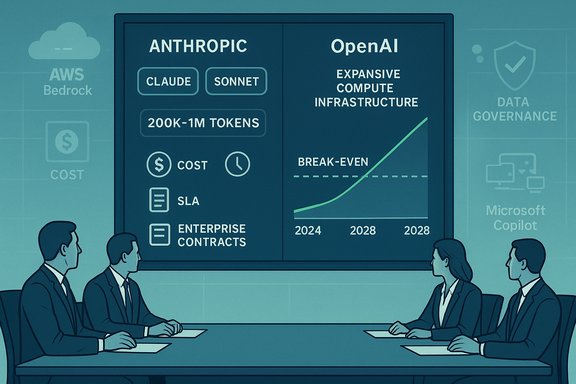 Background: two contrasting roadmaps for the AI era
The generative‑AI era that exploded with ChatGPT has bifurcated into two coherent but very different corporate strategies. On one side sits OpenAI: aggressive, scale‑first, and vertically integrated with big bets on an enormous compute footprint and consumer-facing products. On the other sits Anthropic: safety‑oriented, enterprise‑first, and engineered around predictable unit economics and narrower product focus.Recent financial documents reported by major outlets show the size of that divergence. Internal investor materials obtained by the Wall Street Journal indicate Anthropic expects to reach break‑even in 2028 and to dramatically shrink its burn rate as revenue grows. By contrast, OpenAI projects very large operating losses through the same period — a figure widely cited as roughly $74 billion in operating losses for 2028 in the WSJ coverage. These projections underpin the thesis that winning the AI race may no longer be about the biggest model but about the cleanest financials.
What the numbers say (and what to treat cautiously)
- Anthropic’s investor‑level projections shown to the WSJ list break‑even in 2028 and an expectation that cash burn will fall from a high share of revenue in 2025 to a single‑digit percentage by 2027.
- OpenAI’s internal outlook, as reported in the same WSJ coverage, forecasts ~$74 billion in operating losses in 2028, driven by massive investments in compute, data centers, and model training. Parallel reporting suggests OpenAI’s 2025 revenue is in the low‑double‑digit billions range (commonly reported as ~$13 billion for 2025), while its 2025 cash burn and R&D/operational spending remain very high.
Overview: Anthropic’s discipline-first strategy
Anthropic’s business model emphasizes enterprise contracts, safety and interpretability guarantees, and midsize models optimized for throughput and cost predictability. That combination produces three practical advantages:- Lower per‑unit compute and predictable inference costs for routine, high‑volume enterprise tasks.
- Contractual enterprise features (non‑training guarantees, stronger SLAs) that attract regulated customers.
- Cleaner revenue mix with fewer unpaid consumer users, which simplifies unit economics and shortens the path to profitability.
Product posture: workhorse models, not spectacle
Anthropic’s Claude family is deliberately tiered: mid‑sized Sonnet models for throughput, and higher‑capability Opus models for reasoning and coding tasks. The Sonnet variants prioritize predictable latency, throughput economics, and very large context windows for document‑centric workflows. Opus variants focus on deeper reasoning and code generation where higher capability commands a premium. This product segmentation is aimed at routing the right workload to the right model — a clear efficiency play. Anthropic also emphasizes enterprise controls — contractual non‑training promises, tenant grounding, and fine‑grained SLAs — differentiators that many customers now list as mandatory for regulated deployments. Those features translate to pricing and contract clarity that enterprise CFOs can model, which in turn reduces friction to large deals and predictable recurring revenue.OpenAI’s compute‑dominance gamble
OpenAI’s strategy is to build the most capable, widely‑adopted models and to saturate consumer and enterprise touchpoints: integrated into Microsoft Copilot, powering myriad apps, and driving a large API ecosystem. That ubiquity brings advantages — platform effects, developer mindshare, and an outsized position in product integrations — but it also carries extraordinary capital and operational cost.The WSJ and other coverage underscore OpenAI’s willingness to accept long periods of negative operating income while it attempts to secure a near‑insurmountable lead in compute capacity, infrastructure, and model research. The company’s approach favors scale and capability over short‑term profitability, betting that dominance in capability will eventually translate into monopoly pricing and integrated revenue streams.
The cost of capability
- Training advanced large models and operating inference at global scale requires hundreds of thousands of GPUs, bespoke data centers, and multi‑year contracts with chip and cloud vendors.
- OpenAI’s capital plans include extensive infrastructure commitments and stock‑based compensation to retain top talent — both of which substantially increase near‑term cash burn.
Technical verification: models, context windows and enterprise features
A useful way to judge the two strategies is to verify the technical claims that underpin them.Context windows and model availability
Anthropic’s official documentation and cloud marketplace information make clear that standard Claude models support very large context windows (commonly 200,000 tokens), and that Sonnet variants have beta options for 1,000,000‑token contexts for eligible customers. These extended context windows are aimed at long‑document synthesis, codebases, and large multi‑document enterprise workflows. Anthropic documents also describe tiered pricing for extended contexts and dedicated rate limits — practical levers for enterprise cost control.Microsoft distribution and model choice
Microsoft’s decision to surface Anthropic’s Claude Sonnet 4 and Opus 4.1 as selectable engines inside Microsoft 365 Copilot’s Researcher and inside Copilot Studio is a concrete distribution win that materially increases Anthropic’s enterprise reach. Microsoft explicitly notes that Anthropic‑hosted endpoints often run outside Microsoft‑managed environments (for example, on AWS/Bedrock), which introduces cross‑cloud data‑flow considerations that tenants must account for. Corporate admins must opt‑in to enable Anthropic models in Copilot. These are verifiable product facts documented in vendor blogs and industry reporting.Economics: unit cost, pricing, and profit pathways
The core of the “Anthropic beats OpenAI on profitability” thesis is economic: lower marginal cost for common enterprise workloads + high‑value contracts = faster path to break‑even.- Anthropic’s midsize Sonnet models are intentionally positioned for high‑throughput tasks (documents, spreadsheets, slides) where cost per inference matters. Using Sonnet for routine tasks allows Anthropic and partners to reserve Opus for high‑value reasoning and code work that commands premium pricing.
- OpenAI’s play often defaults to running very capable models broadly — which increases cost per call at scale, especially when many end users generate high volumes of short, routine inferences. That model can still be monetized profitably if pricing and enterprise capture scale fast enough, but the runway is longer.
Strengths: where Anthropic’s approach gains real leverage
- Cleaner unit economics: Right‑sizing model capacity to workload reduces cost-per-task and yields better gross margins on enterprise deals.
- Enterprise hooks: Contractual guarantees (non‑training, data residency options, SLAs) matter for banks, governments, and regulated industries.
- Faster path to predictable cash flow: Fewer consumer freebies and a developer/enterprise focus yields a revenue mix that is easier to forecast and monetize.
- Strategic distribution: Integration as a selectable backend in major products (e.g., Microsoft Copilot) brings scale without the customer acquisition cost of consumer virality.
Risks and caveats: why profitability isn’t a slam dunk
Anthropic’s plan reduces some risks but introduces others. The key hazards to watch are:- Execution risk at scale: Tripling international headcount and expanding enterprise engineering teams is operationally difficult. Local compliance, legal, and product localization work must be executed without degrading product quality.
- Regulatory and legal exposure: Copyright litigation and data‑use disputes continue to shadow the industry. Contractual non‑training guarantees help, but do not eliminate legal risk tied to historical training data or third‑party claims.
- Cloud dependency and vendor risk: Anthropic’s host and deployment choices (notably AWS and Bedrock for many deployments) create cross‑cloud dependencies that complicate integrations with partners using different clouds; Microsoft’s use of Anthropic endpoints hosted outside Microsoft‑managed infrastructure highlights this tradeoff. Cross‑cloud inference can increase latency and egress cost and raises data‑sovereignty questions.
- Margin pressure from hyperscalers: Hyperscale cloud vendors and platform owners can bundle models into broader product suites, potentially compressing margins for independent model vendors. Competing against vertically integrated cloud providers that can pair compute and model licensing at favorable economics is an ongoing challenge.
What this means for IT leaders, developers, and WindowsForum readers
The industry’s move from “biggest model wins” to “smart economics wins” changes procurement and architecture decisions for enterprises and developers.Practical checklist for enterprises evaluating Claude vs GPT‑family backends
- Confirm data handling and non‑training commitments in writing. Check how prompts, logs, and outputs are retained and whether they may be used to train models absent an explicit contract.
- Pilot non‑sensitive workloads first (marketing decks, internal research) before routing regulated data to third‑party hosted endpoints.
- Design a model‑orchestration layer: plan for task routing so you can use midsize models for throughput tasks and reserve high‑capability models for critical reasoning steps.
- Update DLP and tenant admin policies to reflect cross‑cloud inference and opt‑in controls when models are hosted outside your primary cloud.
- Test latency and egress costs in cross‑cloud flows — these can materially change TCO for agent and Copilot scenarios.
Developer guidance
- For code generation and CI/CD integration, test models on real repository patterns — Anthropic’s Claude lineage and OpenAI’s fine‑tuned models can behave differently on subtle code tasks; empirical validation beats benchmark claims.
- Exploit large context windows where they matter (contract review, long technical documentation, whole‑repo analysis). Sonnet and Sonnet‑beta 1M windows are designed for that purpose, but expect premium pricing for extended contexts.
Strategic verdict: capability vs. commercial durability
Anthropic’s approach proves a critical point for the AI industry: you can design for enterprise maturity and still ship capable models. That balance — capable enough where it matters, disciplined enough to make money — is the heart of the profitability thesis.OpenAI’s capability‑first strategy keeps it at the technological frontier and deeply embedded in consumer and enterprise products; that position is invaluable and may eventually translate into dominant market power. But it comes with a long, capital‑intensive runway that depends on investor patience and the ability to translate scale into profitable enterprise contracts before the cash runs out or capital costs spike. Anthropic’s strategy could reshape investor valuation frameworks for AI companies — moving emphasis from sheer user counts and model size to margin per request, predictable enterprise revenue, and the ability to govern and audit models for regulated customers. If Anthropic realizes its internal projections, it will provide a powerful counterexample to the assumption that bigger is always better.
Conclusion: the real competition is financial engineering plus product fit
The current phase of AI competition is as much financial engineering as it is model architecture. Anthropic’s disciplined posture — midsize production models for high‑volume tasks, contractual enterprise features, large context windows for document workflows, and targeted cloud partnerships — gives it a credible path to earlier profitability. OpenAI’s deep capabilities and distribution remain formidable but come with a long, capital‑intensive tail.For enterprise tech leaders and WindowsForum readers, the takeaway is practical: evaluate models not just on raw capability scores, but on predictable costs, contractual protections, and fit for your workload. The vendor that wins where it matters most may well be the one that demonstrates both technical competence and sustainable unit economics — and the market is already beginning to reward that combination. Flag: Several headline figures referenced here (projected burn rates, precise revenue run‑rates, and internal break‑even timing) derive from internal company projections and media reports based on leaked or investor‑shared documents. They should be treated as company‑level forecasts until validated by audited public filings or explicit company confirmations.
Source: digit.in Anthropic will beat OpenAI where it matters most: Here’s how
