

AOL Instant Messenger was the social glue of an era when being online still felt novel, fragile, and a little magical. For millennials who came of age on dial-up, buddy lists, away messages, and the unmistakable “door opening” sound are not just nostalgic artifacts; they are reminders of how the internet learned to feel conversational. The five apps in the original AOL roundup mark a period when instant messaging moved from a niche technical feature to a cultural habit, and they also trace the rapid rise and fall of the companies that tried to own that habit. AOL Instant Messenger, MSN Messenger, Yahoo Messenger, MySpaceIM, and ICQ each left a distinct imprint on how people connected online, even as all five eventually gave way to mobile-first messaging and modern social platforms.
Before iMessage, WhatsApp, Signal, Discord, and Teams became everyday verbs, instant messaging lived on desktop screens tied to specific networks and usernames. The experience was less about a single universal inbox and more about belonging to a particular ecosystem, whether that meant AOL, Microsoft, Yahoo, or a social network that wanted to be its own universe. That fragmentation seems dated now, but it helped define an entire phase of internet culture, when each service competed not only on features but on identity.
The rise of these services also reflected the limitations of the hardware and connectivity of the time. Households often shared one computer, one phone line, and one screen, so being online at all was an event. Messaging was therefore not just a convenience; it was a workaround for the awkwardness of landlines, class schedules, and long-distance charges. The social norms that emerged around status icons, custom greetings, and presence indicators were early attempts to make digital life feel human.
AOL, Microsoft, Yahoo, and later MySpace all treated messaging as a strategic control point. Whoever owned the chat client could keep users inside a broader web of services, from email and search to portals and advertising. That is why IM wars mattered so much: the winner did not just win messaging, it won attention, retention, and a place in the daily routine.
The original AOL article is framed as nostalgia, but the more interesting story is strategic. These apps were not disposable toys. They were the prototype for always-on social software, and each one taught a different lesson about scale, lock-in, interoperability, and product decay. In that sense, the shutdown dates matter less than the design patterns they normalized, many of which are still visible in today’s messaging products.
The platform also helped codify early internet slang and etiquette. Abbreviations such as A/S/L became part of the wider online vocabulary, while away messages became a form of low-key broadcasting that foreshadowed modern status updates and social feeds. That is why AIM still lingers in memory: it was not just a messenger, it was a behavioral template.
For millennials, AIM was often the first place where a username became an alter ego. The screen name you picked mattered, and the away message you left behind could signal mood, availability, or social capital. In practice, AIM made digital presence feel customizable in a way that modern platforms often hide behind algorithmic feeds. That was a much more participatory internet.
The service ultimately could not keep pace with newer competitors and the shift to cross-platform communication. Once Skype, WhatsApp, and mobile-first messaging became the norm, a desktop-centric, screen-name-driven product started to look like a relic. Its shutdown in December 2017 was less a surprise than a symbolic closing of the dial-up era.
Microsoft also pushed richer features over time, including webcam calls, media integration, and deeper tie-ins with Windows services. Those additions made the platform feel more ambitious than a pure text client. In hindsight, MSN Messenger represented a transitional moment between the simple buddy-list era and the broader multimedia communications model that Skype and later Teams would inherit.
The company’s attempt to converge Messenger with Skype was strategically logical, even if emotionally painful for users. Microsoft wanted a single communications layer instead of multiple overlapping tools, and shutting down Messenger in 2013 was part of that consolidation. The move was especially revealing because it showed how quickly a once-dominant consumer product could become redundant inside a larger platform strategy.
It also left behind a strangely resilient afterlife. Community projects and protocol emulators have kept the spirit of MSN Messenger alive for enthusiasts who miss the old interface and the social rhythm it created. That persistence says a lot about the product’s emotional footprint: even after official support ends, some software still occupies a place in memory that newer apps never quite replace.
That combination of utility and whimsy helped the service maintain relevance during its peak years. It was not merely a utilitarian chat tool; it felt like part of the web’s social surface, where status, color, and expression mattered as much as the actual message. Yahoo’s willingness to add voice features and mobile support also showed that the company understood the platform had to keep evolving.
Still, Yahoo Messenger’s strengths could not overcome Yahoo’s wider corporate drift. The company was repeatedly trying to be a portal, media company, mail provider, and communication hub all at once, which made focus difficult. By the time mobile messaging had become central, Yahoo Messenger was already fighting not only rivals but also organizational inertia. That is often how legacy products die—slowly, and for strategic reasons more than technical ones.
Its long life also makes its shutdown especially telling. Unlike some failed products that vanished early, Yahoo Messenger lasted long enough to watch the market transform around it. That longevity gives it a special place in internet history: not a pioneer in the absolute sense, but a persistent competitor that helped prove instant messaging could be a mainstream consumer habit.
That said, MySpaceIM also exposed the fragility of platform leadership. The rise of Facebook made MySpace look cluttered and dated almost overnight, and the shift was as much about product elegance as network effects. MySpaceIM did not fail because real-time chat was a bad idea; it failed because the social network that hosted it lost the culture war.
The service’s move to in-browser only messaging in 2009 is revealing. It shows how a product can lose momentum not only through abandonment, but through narrowing scope and declining ambition. Once the broader platform stops growing, the chat layer becomes an accessory rather than a destination.
This is one of the clearest examples of a product being right in concept but wrong in timing and execution. MySpaceIM anticipated a future in which social identity and messaging would be tightly fused, yet the company lacked the momentum to make that future stick. The lesson is still relevant for platforms trying to turn chat into a strategic moat.
The service also appealed to gamers and technically inclined users who wanted a lightweight way to stay connected outside active sessions. In that respect, ICQ anticipated the always-on social layer that later became normal in gaming communities and chat apps. It was less polished than some of its successors, but it arrived early enough to define expectations.
AOL’s acquisition of Mirabilis in 1998 gave ICQ a huge corporate backer, but not always the attention it deserved. AOL invested heavily in AIM and treated ICQ as a sibling rather than a flagship, which likely limited its strategic potential in North America. That imbalance is one reason ICQ is remembered more as a pioneer than a perpetual leader.
ICQ’s long arc also reflects how acquisitions can preserve history without preserving momentum. Under different ownership, the service survived for years, but the market had already moved on. Its longevity was impressive, yet its eventual retirement underscored a broader truth: being first is not enough if the platform model around you changes too quickly.
Another lesson is that feature richness only matters if the user base remains active. Yahoo Messenger and MSN Messenger were both featureful, but the market shifted underneath them toward mobile-first, always-synced communication. Once messaging stopped being tied to the PC, desktop-centric clients had to justify their existence in a much harsher competitive environment.
A third lesson is that design details can become cultural artifacts. Away messages, Buzz buttons, IMVironments, and UINs may seem quaint, but each created an emotional or social hook that users remembered. The best software often leaves behind habits that outlast the software itself. That is exactly what happened here.
That split matters because it explains why some products outlived their consumer appeal by refocusing on business use, while others disappeared entirely. Messaging was always dual-use software, but not every company successfully made the leap from consumer novelty to enterprise utility. The strongest survivors learned to be both familiar and indispensable.
They also offer a useful business lesson: platforms win when they make communication feel effortless, personal, and habitual. Each of the classic IM services found a different path to that outcome, and each one shows how much product success depends on timing as well as execution. The nostalgia is real, but so is the strategic insight.
There is also a broader concern about interoperability. The old IM wars created silos that made it harder for users to communicate across services, a problem that modern messaging ecosystems still wrestle with in different forms. That fragmentation made sense competitively, but it was bad for users.
Another risk is assuming feature creativity guarantees durability. Yahoo Messenger had fun extras, AIM had iconic social mechanics, and ICQ had early-mover advantage, but none of that prevented decline. Messaging platforms live or die on network effects, device transitions, and ecosystem strategy as much as on product quality.
As messaging continues to evolve into a layer of operating systems, social networks, and enterprise software, the old desktop clients serve as a reminder that communication tools are never just tools. They are social environments, and the winners are usually the ones that make people feel seen, connected, and hard to dislodge. The next generation of messaging platforms will likely keep changing form, but the old lessons will remain surprisingly durable.
Source: AOL.com 5 Instant Messaging Apps Only Millennials Will Remember
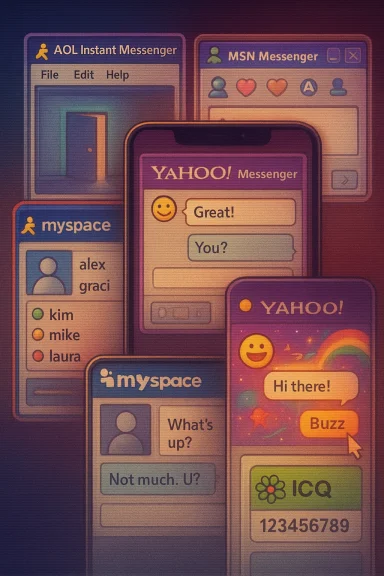 Background
Before iMessage, WhatsApp, Signal, Discord, and Teams became everyday verbs, instant messaging lived on desktop screens tied to specific networks and usernames. The experience was less about a single universal inbox and more about belonging to a particular ecosystem, whether that meant AOL, Microsoft, Yahoo, or a social network that wanted to be its own universe. That fragmentation seems dated now, but it helped define an entire phase of internet culture, when each service competed not only on features but on identity.The rise of these services also reflected the limitations of the hardware and connectivity of the time. Households often shared one computer, one phone line, and one screen, so being online at all was an event. Messaging was therefore not just a convenience; it was a workaround for the awkwardness of landlines, class schedules, and long-distance charges. The social norms that emerged around status icons, custom greetings, and presence indicators were early attempts to make digital life feel human.
AOL, Microsoft, Yahoo, and later MySpace all treated messaging as a strategic control point. Whoever owned the chat client could keep users inside a broader web of services, from email and search to portals and advertising. That is why IM wars mattered so much: the winner did not just win messaging, it won attention, retention, and a place in the daily routine.
The original AOL article is framed as nostalgia, but the more interesting story is strategic. These apps were not disposable toys. They were the prototype for always-on social software, and each one taught a different lesson about scale, lock-in, interoperability, and product decay. In that sense, the shutdown dates matter less than the design patterns they normalized, many of which are still visible in today’s messaging products.
AOL Instant Messenger: the template for online social life
AOL Instant Messenger did more than popularize chat; it taught a generation how to perform identity online. Launched in 1997 and shut down in 2017, AIM brought buddy lists, screen names, away messages, and buddy icons into the mainstream, making presence itself a social signal. Its success was partly technical, but its real achievement was cultural: it turned “I’m at my computer” into a shared social state rather than a lonely one.Why AIM felt different
AIM arrived at a time when the web still felt unorganized and a little mysterious. It solved a very specific problem—quick person-to-person communication—but it did so with personality. The system’s low-friction sign-in, persistent buddy lists, and custom status text made users feel like they were curating a social space rather than merely sending messages.The platform also helped codify early internet slang and etiquette. Abbreviations such as A/S/L became part of the wider online vocabulary, while away messages became a form of low-key broadcasting that foreshadowed modern status updates and social feeds. That is why AIM still lingers in memory: it was not just a messenger, it was a behavioral template.
For millennials, AIM was often the first place where a username became an alter ego. The screen name you picked mattered, and the away message you left behind could signal mood, availability, or social capital. In practice, AIM made digital presence feel customizable in a way that modern platforms often hide behind algorithmic feeds. That was a much more participatory internet.
The business paradox
AIM’s irony was that AOL’s broader business model was not built for the kind of openness messaging eventually required. AOL was still closely tied to subscription-era thinking, and AIM’s appeal partly came from being free and widely accessible. That tension between the old AOL model and the future of messaging helped explain why AIM was so influential and yet so vulnerable.The service ultimately could not keep pace with newer competitors and the shift to cross-platform communication. Once Skype, WhatsApp, and mobile-first messaging became the norm, a desktop-centric, screen-name-driven product started to look like a relic. Its shutdown in December 2017 was less a surprise than a symbolic closing of the dial-up era.
- AIM normalized presence-based communication.
- AIM made status messages socially meaningful.
- AIM turned screen names into personal brands.
- AIM’s simplicity became its biggest strength and, later, its biggest weakness.
- AIM remains the clearest shorthand for old-school internet messaging.
MSN Messenger: Microsoft’s disciplined rival
MSN Messenger, later Windows Live Messenger, was Microsoft’s answer to AOL’s dominance, and it brought a more integrated, Windows-native feel to the competition. Launched in 1999, it connected neatly with Hotmail and Outlook, which made sign-in and contact management feel natural for people already living inside Microsoft’s ecosystem. By 2003, it had reached massive scale, and by 2013 Microsoft had decided to retire it in favor of Skype.The Microsoft advantage
The biggest strength of MSN Messenger was not just that it worked; it was that it fit the rest of Microsoft’s stack. Users could log in with a Hotmail account, keep contacts synchronized, and move more easily between email and chat. That integration mattered because it reduced friction, and in messaging, friction is often the difference between adoption and abandonment.Microsoft also pushed richer features over time, including webcam calls, media integration, and deeper tie-ins with Windows services. Those additions made the platform feel more ambitious than a pure text client. In hindsight, MSN Messenger represented a transitional moment between the simple buddy-list era and the broader multimedia communications model that Skype and later Teams would inherit.
The company’s attempt to converge Messenger with Skype was strategically logical, even if emotionally painful for users. Microsoft wanted a single communications layer instead of multiple overlapping tools, and shutting down Messenger in 2013 was part of that consolidation. The move was especially revealing because it showed how quickly a once-dominant consumer product could become redundant inside a larger platform strategy.
The end of an era, not the end of the idea
What made MSN Messenger memorable was the way it blurred the line between work and play. It was used by teens, students, families, and office workers alike, often on the same machines, and that broad audience made it culturally durable. When Microsoft finally pulled the plug, it was not just retiring software; it was retiring a mode of internet sociability.It also left behind a strangely resilient afterlife. Community projects and protocol emulators have kept the spirit of MSN Messenger alive for enthusiasts who miss the old interface and the social rhythm it created. That persistence says a lot about the product’s emotional footprint: even after official support ends, some software still occupies a place in memory that newer apps never quite replace.
- Hotmail integration gave MSN a practical edge.
- Webcam and media features pushed it beyond basic chat.
- Windows branding made it feel native to PC users.
- Skype migration reflected platform consolidation.
- The shutdown underscored how quickly user habits can outgrow a successful desktop app.
Yahoo Messenger: feature-rich, but always in the shadow of bigger shifts
Yahoo Messenger had the unusual advantage of belonging to one of the internet’s biggest portal brands, and it used that position to experiment aggressively with features. Beginning as Yahoo Pager in 1998 and transitioning to Yahoo Messenger in 1999, the service added emoticons, video calling, file sharing, IMVironments, and the famous Buzz button, all while trying to remain relevant in a crowded IM market. It survived for two decades, but it was ultimately shut down in July 2018.A product built for personality
Yahoo Messenger stood out because it embraced customization in a way that mirrored the broader Yahoo portal experience. IMVironments let users stylize chat windows, giving conversations a more decorative and playful tone than many rivals offered. The Buzz button, meanwhile, captured a very human problem: how to get someone’s attention without sounding rude.That combination of utility and whimsy helped the service maintain relevance during its peak years. It was not merely a utilitarian chat tool; it felt like part of the web’s social surface, where status, color, and expression mattered as much as the actual message. Yahoo’s willingness to add voice features and mobile support also showed that the company understood the platform had to keep evolving.
Still, Yahoo Messenger’s strengths could not overcome Yahoo’s wider corporate drift. The company was repeatedly trying to be a portal, media company, mail provider, and communication hub all at once, which made focus difficult. By the time mobile messaging had become central, Yahoo Messenger was already fighting not only rivals but also organizational inertia. That is often how legacy products die—slowly, and for strategic reasons more than technical ones.
Why it mattered
Yahoo Messenger showed that IM could be more expressive than plain text. It leaned into personality, attention-getting, and visual design at a time when the web was still defining its own social grammar. In that sense, it was an important bridge between old-school chat and later social messaging apps that would build reaction systems, stickers, and status features into the core experience.Its long life also makes its shutdown especially telling. Unlike some failed products that vanished early, Yahoo Messenger lasted long enough to watch the market transform around it. That longevity gives it a special place in internet history: not a pioneer in the absolute sense, but a persistent competitor that helped prove instant messaging could be a mainstream consumer habit.
- Yahoo Messenger’s IMVironments made chats feel individualized.
- The Buzz button became a cultural shortcut for “reply now.”
- Voice features expanded the platform beyond text.
- Its long survival reflected Yahoo’s scale, not necessarily its strategic clarity.
- The shutdown in 2018 reflected a market that had moved decisively to mobile.
MySpaceIM: the social network tries to own the inbox
MySpaceIM is especially interesting because it arrived from a social network rather than a dedicated messaging company. Officially launched in 2007 after a soft launch in 2006, it represented an early attempt by a social platform to make real-time chat part of the same experience as profiles, comments, and music discovery. In retrospect, it looks like an early version of the messaging-integrated social products that dominate today.Social networking and messaging converge
MySpace was already a cultural giant when it experimented with messaging. Its user base was huge, and its identity was strongly tied to personalization, music, and social discovery, so adding IM felt like a natural extension. The platform’s partnership with Skype in 2007 further illustrated that messaging and voice were already beginning to merge into a broader communications stack.That said, MySpaceIM also exposed the fragility of platform leadership. The rise of Facebook made MySpace look cluttered and dated almost overnight, and the shift was as much about product elegance as network effects. MySpaceIM did not fail because real-time chat was a bad idea; it failed because the social network that hosted it lost the culture war.
The service’s move to in-browser only messaging in 2009 is revealing. It shows how a product can lose momentum not only through abandonment, but through narrowing scope and declining ambition. Once the broader platform stops growing, the chat layer becomes an accessory rather than a destination.
The precursor to modern social DMs
In hindsight, MySpaceIM looks like a prototype for the integrated messaging that social platforms now treat as essential. Today, no major social network can afford to ignore direct messaging, group chats, or media sharing, because those features help retain users and deepen engagement. MySpace reached that conclusion early, but not early enough to save its core business.This is one of the clearest examples of a product being right in concept but wrong in timing and execution. MySpaceIM anticipated a future in which social identity and messaging would be tightly fused, yet the company lacked the momentum to make that future stick. The lesson is still relevant for platforms trying to turn chat into a strategic moat.
- MySpaceIM was an early social-network-owned chat client.
- Its Skype integration showed that voice and IM were converging.
- Facebook’s rise undercut MySpace’s momentum.
- Browser-only messaging signaled strategic contraction.
- It anticipated the DM-centric design of modern social apps.
ICQ: the original mass-market instant messenger
ICQ deserves special status because it was not merely popular; it was foundational. Launched in 1996 by Mirabilis and later acquired by AOL in 1998, ICQ is widely regarded as the first instant messaging service to achieve mass adoption across the internet. Its “I Seek You” branding, UIN identity system, and long lifespan made it a formative part of early online communication culture.The significance of the UIN
ICQ’s numbered identity system gave users a unique handle that became, in practice, a status marker. Lower numbers could imply early adoption or insider credibility, which is exactly the kind of social hierarchy early internet services often generated by accident. That detail may sound trivial now, but it reveals how much social meaning users could extract from small technical design choices.The service also appealed to gamers and technically inclined users who wanted a lightweight way to stay connected outside active sessions. In that respect, ICQ anticipated the always-on social layer that later became normal in gaming communities and chat apps. It was less polished than some of its successors, but it arrived early enough to define expectations.
AOL’s acquisition of Mirabilis in 1998 gave ICQ a huge corporate backer, but not always the attention it deserved. AOL invested heavily in AIM and treated ICQ as a sibling rather than a flagship, which likely limited its strategic potential in North America. That imbalance is one reason ICQ is remembered more as a pioneer than a perpetual leader.
Why ICQ’s shutdown felt symbolic
When ICQ was finally retired in June 2024, it closed a chapter that had lasted nearly three decades. The shutdown did not simply end one product; it marked the final fading of the pre-mobile, protocol-heavy, user-numbered messaging era. For many people, ICQ represented the earliest proof that the internet could be used for direct social presence rather than just browsing and email.ICQ’s long arc also reflects how acquisitions can preserve history without preserving momentum. Under different ownership, the service survived for years, but the market had already moved on. Its longevity was impressive, yet its eventual retirement underscored a broader truth: being first is not enough if the platform model around you changes too quickly.
- ICQ was the first mass-adopted internet IM service.
- The UIN system made identity feel numeric and status-driven.
- It was especially popular with early internet power users and gamers.
- AOL’s ownership did not translate into lasting mainstream dominance.
- Its 2024 shutdown closed the book on an entire generation of chat history.
Why these apps mattered beyond nostalgia
These five services were more than relics. They established the core ideas that still shape digital messaging today: presence, read-like immediacy, identity, contact lists, notifications, and the expectation that communication should be near-instant. Modern apps may be faster, more polished, and cross-platform by default, but they owe a large debt to the conventions these older products created.The product lessons still visible today
One lesson is that messaging works best when it is integrated into a larger ecosystem. AOL had the portal, Microsoft had email and Windows, Yahoo had the web portal, and MySpace had social profiles. The companies that treated IM as a core layer, not a side feature, were usually the ones that made the strongest cultural impact.Another lesson is that feature richness only matters if the user base remains active. Yahoo Messenger and MSN Messenger were both featureful, but the market shifted underneath them toward mobile-first, always-synced communication. Once messaging stopped being tied to the PC, desktop-centric clients had to justify their existence in a much harsher competitive environment.
A third lesson is that design details can become cultural artifacts. Away messages, Buzz buttons, IMVironments, and UINs may seem quaint, but each created an emotional or social hook that users remembered. The best software often leaves behind habits that outlast the software itself. That is exactly what happened here.
Enterprise and consumer divergence
For consumers, these apps were about friendship, flirting, boredom, and status. For companies, they hinted at something larger: real-time collaboration, enterprise presence, and eventually unified communications. Microsoft’s later move from Messenger to Skype, and then toward more enterprise-oriented collaboration tools, reflects that shift from casual chat to structured communication.That split matters because it explains why some products outlived their consumer appeal by refocusing on business use, while others disappeared entirely. Messaging was always dual-use software, but not every company successfully made the leap from consumer novelty to enterprise utility. The strongest survivors learned to be both familiar and indispensable.
- Presence awareness became a universal messaging expectation.
- Status text evolved into away messages, bios, and story features.
- Contact synchronization became a baseline feature.
- Voice and video became standard once data networks improved.
- Cross-device continuity eventually replaced desktop lock-in.
Strengths and Opportunities
The biggest strength of revisiting these apps is that they reveal how quickly the internet matured. What once felt novel now looks foundational, and that makes the history useful rather than merely sentimental. These products also help explain why today’s messaging services are designed the way they are, from contact lists to delivery indicators to custom status and reaction systems.They also offer a useful business lesson: platforms win when they make communication feel effortless, personal, and habitual. Each of the classic IM services found a different path to that outcome, and each one shows how much product success depends on timing as well as execution. The nostalgia is real, but so is the strategic insight.
- Historical clarity: the apps explain the evolution of internet communication.
- Product design lessons: status, identity, and presence still matter.
- Platform strategy insight: messaging is often a retention engine.
- Cultural memory: these apps shaped how a generation thinks about online life.
- Competitive analysis: their failures show how fast network effects can shift.
- Consumer relevance: modern apps still borrow from their interfaces and behaviors.
- Enterprise relevance: unified communications evolved from the same roots.
Risks and Concerns
The main risk in romanticizing these services is that nostalgia can obscure why they disappeared. Many of these apps were tied to desktops, proprietary networks, or corporate strategies that could not survive the move to mobile and cloud-based communication. The sentimental story is real, but the business story is harsher: user habits change, and platforms that fail to follow get left behind.There is also a broader concern about interoperability. The old IM wars created silos that made it harder for users to communicate across services, a problem that modern messaging ecosystems still wrestle with in different forms. That fragmentation made sense competitively, but it was bad for users.
Another risk is assuming feature creativity guarantees durability. Yahoo Messenger had fun extras, AIM had iconic social mechanics, and ICQ had early-mover advantage, but none of that prevented decline. Messaging platforms live or die on network effects, device transitions, and ecosystem strategy as much as on product quality.
- Desktop dependence made these apps vulnerable to mobile disruption.
- Closed ecosystems limited cross-service communication.
- Corporate churn often mattered more than user affection.
- Feature creep did not always translate into retention.
- Brand transitions sometimes diluted the original product identity.
- Market timing punished even technically successful services.
- Nostalgia bias can make old software seem more durable than it was.
Looking Ahead
The real legacy of these apps is not that they were better than what came after. It is that they defined the grammar of digital conversation so effectively that later platforms still build on their assumptions. Every time a messaging app shows your status, syncs your contacts, sends a read receipt, or supports voice and video alongside text, it is carrying forward a piece of this history.As messaging continues to evolve into a layer of operating systems, social networks, and enterprise software, the old desktop clients serve as a reminder that communication tools are never just tools. They are social environments, and the winners are usually the ones that make people feel seen, connected, and hard to dislodge. The next generation of messaging platforms will likely keep changing form, but the old lessons will remain surprisingly durable.
- Watch for more platform consolidation in messaging and collaboration.
- Expect further cross-device integration across phones, PCs, and browsers.
- Pay attention to privacy and identity controls as chat becomes more embedded.
- Look for AI features to become standard inside messaging surfaces.
- Keep an eye on interoperability pressures as users resist fragmentation.
Source: AOL.com 5 Instant Messaging Apps Only Millennials Will Remember
