

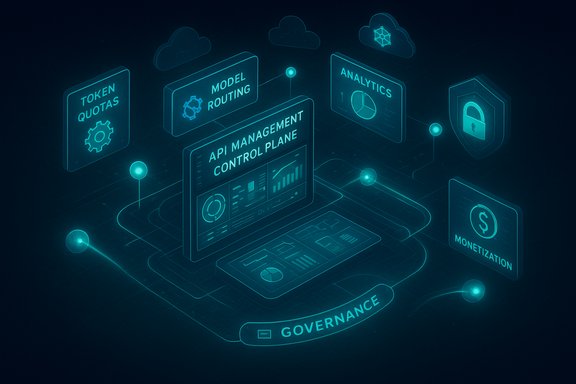
The API management landscape in 2026 is now inseparable from enterprise strategy: platforms that once focused on request routing and rate limiting are evolving into governance, security, and monetization control planes for AI workloads, agentic services, and globally distributed microservices. This feature synthesizes a recent industry roundup with independent verification and analysis to help Windows and infrastructure teams pick the right platform for scale, security, cost control, and AI-first workloads.
APIs are the operating fabric of modern software: they connect mobile apps, SaaS services, on-prem systems, event streams, and now large language models. API management platforms have migrated from simple ingress proxies to full lifecycle systems that cover design, developer experience, runtime policy enforcement, observability, monetization, and increasingly, AI-aware controls for model access and cost containment.
Three structural trends define the market in 2026:
This analysis synthesizes a recent Inventiva catalog of top platforms, cross-checked against vendor release notes and independent reporting to highlight confirmed product changes, EOL timelines, performance benchmarks, and operational risks. Readers adopting or migrating API platforms must validate vendor claims with representative pilots (especially for AI workload cost and latency), require demonstrable telemetry integration, and bake in redundancy and chargeback controls that prevent API-driven runaway costs. The technology decisions made today will shape developer velocity, security posture, and the economics of AI for years to come—select a platform with an operational model the organization can sustain, then instrument, govern, and continuously test the deployment against real-world traffic and adversarial scenarios.
Source: inventiva.co.in Top 10 API Management Platforms In 2026 - Inventiva
 Background / Overview
APIs are the operating fabric of modern software: they connect mobile apps, SaaS services, on-prem systems, event streams, and now large language models. API management platforms have migrated from simple ingress proxies to full lifecycle systems that cover design, developer experience, runtime policy enforcement, observability, monetization, and increasingly, AI-aware controls for model access and cost containment.Three structural trends define the market in 2026:
- The rise of AI workloads (LLM inference, agents) that require token-aware throttling, model routing, and cost monitoring at the gateway.
- The push for hybrid and multi-cloud architectures, driving demand for control-plane / data-plane separation, self-hosted gateways, and Kubernetes-native operations.
- Increasing security and compliance requirements—especially data residency, DLP, and auditable runtime controls—pushed by regulated industries.
How this analysis was validated
Key vendor claims and release-level details were cross-checked against vendor documentation and independent reporting. Examples:- Apigee’s October 2025 “API insights” release and the Apigee Operator ApigeeBackendService GA in September 2025 were verified from Google Cloud product release notes.
- Kong’s announcement that Kong Gateway Enterprise 3.8 entered EOL in September 2025 was confirmed on Kong’s product release blog.
- The major AWS outage in October 2025 that impacted API Gateway-dependent services was reported across multiple outlets; this underlines vendor-dependent resilience considerations.
- Postman’s scale metrics (40+ million developers, 500,000 organizations) and 2025 State of the API findings are supported by the vendor’s press releases.
- Apache APISIX’s high-performance single‑core QPS claims are documented in APISIX community materials and independent performance write-ups; treat such numbers as lab benchmarks rather than guaranteed production outcomes.
1) Google Apigee — enterprise API governance, now AI-aware
Platform summary
Apigee remains a market leader for enterprises that need a full-featured API control plane supporting policy enforcement, analytics, monetization, and hybrid deployment. Recent releases added API insights (a unified traffic/performance view across gateways) and Kubernetes Operator enhancements that integrate with GKE inference routing—useful for managing AI endpoints.Notable strengths
- Full lifecycle management: proxy-based policy enforcement, developer portal, and monetization tools.
- Hybrid control plane: run runtime in Kubernetes or on-prem while keeping central governance in Google Cloud.
- AI workload support: features for token-aware rate limiting and multi-model routing are being added to address LLM cost and routing concerns.
Risks and caveats
- Cost and skill investment: Apigee’s enterprise positioning typically requires significant licensing and integration costs, and many customers engage partners for deployment.
- Cloud affinity: best value is realized with Google Cloud integration; multi-cloud use cases work but may require additional engineering.
- Operational complexity for AI: AI-specific controls exist but must be configured and tested carefully to manage token spend and RAG (retrieval-augmented generation) flows.
Ideal fit
Large regulated enterprises and organizations already invested in Google Cloud that need robust governance, monetization, and AI integration at scale.2) Kong Gateway — extensible, Kubernetes-aligned, open-core
Platform summary
Kong’s open-source gateway plus Kong Enterprise offers a flexible, plugin-driven model for high-throughput gateways. Kong also maintains native Kubernetes integration via the Kong Ingress Controller and Konnect management plane. The vendor announced EOL for Kong Gateway Enterprise 3.8 with a sunset period—customers should plan upgrades.Notable strengths
- Plugin ecosystem: dozens of official plugins and a mature third‑party ecosystem for auth, security, logging, and transformation.
- Kubernetes and mesh integration: acts as both an ingress controller and a gateway for service mesh patterns.
- Open-core model: ability to start with the OSS gateway and add enterprise features as needs grow.
Risks and caveats
- Operational overhead for large, distributed deployments if the organization lacks platform engineering capabilities.
- Version lifecycle: EOL policies mean planned upgrade cycles are essential to avoid unsupported infrastructure.
Ideal fit
Cloud-native teams on Kubernetes needing a flexible, high-performance gateway with the option to avoid vendor lock-in.3) AWS API Gateway — managed, deeply integrated with AWS
Platform summary
AWS API Gateway is the default managed gateway within AWS. It supports REST, HTTP, and WebSocket APIs and integrates tightly with Lambda, Cognito, IAM, and CloudWatch for a serverless-friendly API stack.Notable strengths
- Seamless AWS integration: native glue to Lambda, DynamoDB, Cognito, and CloudWatch accelerates development on AWS.
- Multiple API types: trade-offs between the feature-rich REST APIs and the lower-cost, higher-performance HTTP APIs allow cost/feature optimization.
Risks and caveats
- Vendor lock-in: deep AWS integration complicates migration or multi-cloud strategies.
- Historic outages: the October 20, 2025 AWS regional outage illustrated how a single-cloud dependency can cause broad service disruption; contingency planning is required.
- Cost sensitivity: request-based pricing and egress charges can grow quickly with heavy AI inference traffic unless careful caching and quotas are used.
Ideal fit
Organizations already committed to AWS who want a fully managed gateway and serverless integration.4) Microsoft Azure API Management — Azure-first enterprise governance
Platform summary
Azure APIM offers hybrid deployment models (managed, self-hosted gateway), a rich policy framework, and integration with Azure AD, Power Platform, and Azure Monitor. XML-based policy definitions enable powerful transformations and security controls.Notable strengths
- Enterprise governance: strong identity and compliance integrations for Microsoft-centric shops.
- Hybrid flexibility: self-hosted gateways address data residency and low-latency needs.
- Developer portal and analytics: customizable developer experience and monitoring.
Risks and caveats
- XML policy complexity: a steeper learning curve compared with some alternatives.
- Platform lock-in: greatest value for organizations standardized on Microsoft tooling and Azure.
Ideal fit
Enterprises built on Microsoft stacks that need centralized governance and Azure-native integrations.5) MuleSoft Anypoint Platform — integration-first API strategy
Platform summary
MuleSoft blends API management with enterprise integration, championing an API-led connectivity approach that separates system, process, and experience APIs. As part of Salesforce, MuleSoft adds tight Salesforce integration and increasing AI features for orchestration.Notable strengths
- Unified API + integration: build integration flows and expose them as managed APIs.
- API-led architecture: promotes reusability and maintainability across large integration estates.
Risks and caveats
- High TCO: licensing and required specialist skills can be substantial.
- Implementation effort: significant planning for governance, developer processes, and training.
Ideal fit
Large enterprises with complex legacy systems and advanced integration needs that require a consolidated integration + API platform.6) WSO2 API Manager — open-source, vendor-agnostic control plane
Platform summary
WSO2 offers a fully open-source API manager with a federated control plane, GraphQL and async API support, and a Kubernetes-native gateway. The open-source model provides transparency and flexibility for tailored enterprise deployments.Notable strengths
- Open-source freedom: no vendor lock-in, full transparency, and extensibility.
- Protocol breadth: REST, SOAP, GraphQL, WebSockets, and Async APIs in one platform.
- Flexible deployment: cloud, on-prem, hybrid options.
Risks and caveats
- Support and ops: open-source deployments require internal expertise or paid support engagements.
- Documentation and ecosystem: may be less turnkey compared with larger commercial vendors.
Ideal fit
Organizations that prioritize openness, customization, and control, especially in regulated sectors that demand auditable on-prem deployments.7) Tyk — developer-friendly, cloud-native, and pragmatic
Platform summary
Tyk offers an open-source gateway paired with optional commercial management and developer portals. Tyk emphasizes developer experience, GraphQL-first features, and Kubernetes-native operations.Notable strengths
- GraphQL support: field-level throttling, complexity analysis, and schema stitching.
- Hybrid deployment: lightweight gateway with centralized cloud or self-hosted control plane.
- Accessibility: intuitive dashboards and GitOps-friendly workflows.
Risks and caveats
- Maturity of enterprise features: while enterprise-ready, some organizations still prefer incumbents for massive-scale governance features.
Ideal fit
Mid-market and technology firms seeking a balance of features, ease-of-use, and cost control.8) IBM API Connect — enterprise-grade governance with IBM integration
Platform summary
IBM API Connect is an enterprise-focused platform offering API lifecycle management, developer portals, and strong security/compliance capabilities. It integrates tightly with IBM’s middleware and DataPower appliances.Notable strengths
- Security and compliance: thorough logging, audit trails, and deployment flexibility (SaaS, single-tenant, on-prem).
- IBM ecosystem: leverages DataPower and other IBM integration components for high-throughput scenarios.
Risks and caveats
- Cost and operational complexity: licensing tiers and professional services can be high; suitable primarily for large enterprises with IBM investments.
Ideal fit
Large enterprises with existing IBM infrastructure or strict compliance and high-throughput requirements.9) Postman — developer-first API lifecycle & collaboration
Platform summary
Postman’s evolution from an API testing tool to a full API platform emphasizes design, testing, documentation, mocking, monitoring, and team collaboration. Postman reports usage by 40+ million developers and 500,000 organizations, making it the de facto developer environment for many API teams.Notable strengths
- Developer productivity: design-to-test workflows, mocks for parallel development, and in-platform CI/CD integrations.
- Collaboration and governance: workspaces, versioning, and style guides that reduce duplication and accelerate onboarding.
Risks and caveats
- Not a full runtime gateway: Postman complements runtime API management—use Postman for design, testing, and life-cycle governance and pair with a gateway for runtime policy enforcement and monetization.
- Enterprise runtime gap: lacks advanced runtime security controls, DLP integrations, and monetization features found in specialized API managers.
Ideal fit
Developer-centric organizations that want to standardize API design, testing, and documentation while pairing Postman with a runtime gateway for production enforcement.10) Apache APISIX / API7 — high-performance, cloud-native API gateway
Platform summary
Apache APISIX is a cloud-native gateway project (originally by API7) that emphasizes performance, dynamic configuration, and plugin extensibility. Community documentation and independent tests cite high single-core QPS in lab benchmarks; APISIX claims single-core QPS in the tens of thousands under ideal conditions—benchmarks vary by hardware and workload. Treat such numbers as directional; real production performance depends on workload, plugins, and environment.Notable strengths
- Performance: extremely efficient architecture based on OpenResty/NGINX and LuaJIT; ideal for high-throughput scenarios.
- Dynamic configuration: no restarts required for rule/policy changes.
- Kubernetes and service mesh friendliness: APISIX Ingress Controller and Gateway API alignment.
Risks and caveats
- Ecosystem maturity: APISIX’s ecosystem is growing rapidly but is younger than some incumbents; third‑party integrations may be fewer.
- Operational expertise: extracting peak performance often requires careful tuning and observability.
Ideal fit
Cloud-native engineering teams on Kubernetes that require exceptional throughput and want an open-source, high-performance gateway.Comparative analysis: strengths, trade-offs, and AI-readiness
- Enterprise governance and compliance: Apigee, MuleSoft, IBM, and Azure APIM lead with built-in monetization, audit trails, and vendor-backed compliance assurances. These are the safe choices for highly regulated industries.
- Open-source flexibility and performance: Kong, WSO2, Tyk, and APISIX provide strong open-source options. Kong and APISIX stand out for performance and extensibility; WSO2 for comprehensive protocol support.
- Developer-first lifecycle: Postman excels for design, testing, mocks, and documentation; pair it with a gateway for production controls.
- AI-first features: Platforms are racing to add AI-aware capabilities: token-aware throttling, model routing, cost-based routing, and agent identity/quotas. Apigee and APISIX have documented steps toward AI workload support; many vendors offer policy templates to limit LLM exposure.
Practical selection checklist (operational requirements)
- Inventory and classify APIs by sensitivity, owner, and consumer type (internal, partner, public).
- Determine deployment footprint: fully managed, self-hosted gateway(s), or hybrid control plane.
- Validate AI integration controls: per-key token quotas, model routing, caching of responses, and DLP/filtering.
- Test resilience: run chaos tests that simulate regional provider outages (avoid single-cloud single-region dependency).
- Confirm observability and telemetry: structured logs, distributed tracing, and alerting that feed SIEM/Cost-monitoring.
- Define monetization and chargeback model early if API-as-product is a goal.
- Require proof-of-value pilots with representative traffic and worst-case LLM usage to measure cost and latency.
Security and cost-risk considerations
- API-as-a-cost center: LLM inference and agentic workflows can create runaway costs unless gateways enforce quotas and cost-aware policies.
- Prompt injection and model abuse: runtime controls at the API boundary (input validation, response sanitization, tool invocation policies) mitigate many model-specific vectors.
- Supply-chain and monoculture risk: centralizing policy at a single gateway simplifies governance but concentrates risk; maintain layered defenses and test for policy misconfiguration.
- Outage planning: the October 2025 AWS outage is a practical reminder: design for cross-region redundancy, multi-cloud failover, or at least graceful degradation of non-critical services.
Price and procurement guidance
- Expect TCO to include licensing, infrastructure, implementation services, and staff training—not just software costs.
- For open-source-first options (Kong OSS, APISIX, WSO2, Tyk gateway) budget for operational staff or managed support subscriptions.
- For managed platforms (Apigee, AWS API Gateway, Azure APIM), include contingency costs for egress, high-volume request pricing, and AI inference charges.
- Negotiate SLAs around feature delivery, security patches, and upgrade windows—especially where EOL timelines exist (e.g., Kong 3.8).
Final recommendations
- Choose Apigee or Azure APIM if enterprise governance, monetization, and compliance are the primary criteria and the organization is aligned with Google or Microsoft ecosystems.
- Choose Kong or APISIX when performance, extensibility, and Kubernetes-native operations matter, and when teams can manage a steeper platform engineering profile.
- Use AWS API Gateway for fast serverless builds inside AWS, but add cross-region and provider failover planning to mitigate systemic outages.
- Use Postman to standardize API design, testing, and collaboration; pair it with a runtime gateway for enforcement and cost control.
- Treat MuleSoft as the integration-led option for organizations with deep legacy and enterprise integration needs.
Closing assessment
API management in 2026 is no longer a narrow infrastructure decision—it is a strategic control plane for security, cost governance, developer productivity, and AI operations. Every platform has trade-offs: vendor-managed platforms reduce operational burden but increase cloud dependency; open-source gateways offer flexibility and performance but require more platform engineering. The right choice aligns with technical architecture, procurement appetite, and the organization’s tolerance for vendor lock-in.This analysis synthesizes a recent Inventiva catalog of top platforms, cross-checked against vendor release notes and independent reporting to highlight confirmed product changes, EOL timelines, performance benchmarks, and operational risks. Readers adopting or migrating API platforms must validate vendor claims with representative pilots (especially for AI workload cost and latency), require demonstrable telemetry integration, and bake in redundancy and chargeback controls that prevent API-driven runaway costs. The technology decisions made today will shape developer velocity, security posture, and the economics of AI for years to come—select a platform with an operational model the organization can sustain, then instrument, govern, and continuously test the deployment against real-world traffic and adversarial scenarios.
Source: inventiva.co.in Top 10 API Management Platforms In 2026 - Inventiva
