

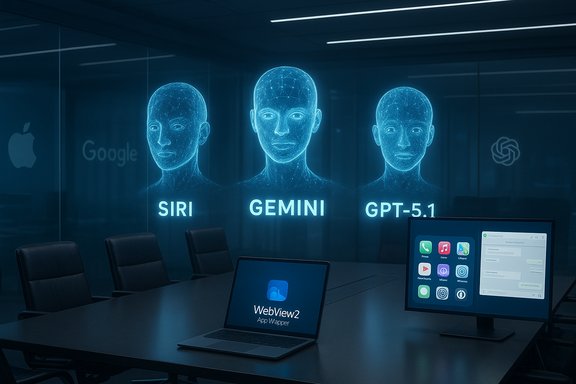
Apple, AI, and the desktop: a single week of news that feels like the frame of the next five years — a mix of boardroom maneuvers, product second-guessing, big‑tech alliances, and a stubborn trend toward “web-first” desktop apps that will matter to Windows users, developers, and IT shops alike. Over the last several days the tech press landed a set of linked stories with immediate practical effects: the Financial Times reported Apple has quietly intensified succession planning for Tim Cook; Bloomberg and others say Apple is close to buying a custom Google Gemini model to power a next‑gen Siri; OpenAI shipped GPT‑5.1 and a new set of personalities for ChatGPT; WhatsApp on Windows reverted from a native WinUI app to a WebView2 wrapper; Tesla is testing Apple CarPlay internally; and Apple’s iPhone Air product line is being rethought after underwhelming demand. Each item alone matters; together they sketch how corporate strategy, platform choices, and user experience priorities are shifting — and how Windows users and IT pros should respond.
Apple’s boardroom and product cycles, OpenAI’s product cadence, Meta’s desktop strategy, and Tesla’s infotainment choices are not isolated news bites. They’re signals about how large platform companies are balancing three pressures:
This piece summarizes the key facts, verifies high‑impact technical claims where possible, cross‑references independent reporting, and provides a practical analysis for WindowsForum readers: what the news means for users, admins, developers, and the broader Windows ecosystem.
If Ternus becomes CEO, expect:
Apple’s internal succession planning and its reported deal to white‑label Google’s Gemini for Siri show that even the most vertically integrated companies will pragmatically partner when product expectations and timelines demand it. OpenAI’s GPT‑5.1 release confirms the rapid evolution of assistant capabilities — and the rise of personalization as a mainstream feature. Meta’s WhatsApp regression to a WebView2 wrapper is an important reminder that cross‑platform engineering shortcuts have tangible desktop costs. Tesla’s CarPlay tests are a timely example of product teams reversing prior stances under customer pressure.
For WindowsForum readers: plan for more hybrid, cross‑platform behavior from major apps; audit integrations and notification behaviors; and prepare governance for enterprise AI personality and tone settings. The next 12 months will be shaped as much by these engineering and commercial choices as by hardware launches — and for users and admins who pay attention now, there’s an opportunity to avoid the worst of the friction as platforms iterate.
Source: Daring Fireball Daring Fireball, by John Gruber
 Background / Overview
Apple’s boardroom and product cycles, OpenAI’s product cadence, Meta’s desktop strategy, and Tesla’s infotainment choices are not isolated news bites. They’re signals about how large platform companies are balancing three pressures:- ship faster and stay competitive in AI-driven features,
- control costs and engineering scope by reusing code across platforms, and
- manage brand/identity and privacy tradeoffs while doing so.
This piece summarizes the key facts, verifies high‑impact technical claims where possible, cross‑references independent reporting, and provides a practical analysis for WindowsForum readers: what the news means for users, admins, developers, and the broader Windows ecosystem.
Apple’s succession planning: what changed and why it matters
The basic claim, verified
The Financial Times reported that Apple’s board and senior executives have “intensified preparations” for Tim Cook to step down as soon as next year, with John Ternus — Apple’s senior vice‑president of hardware engineering — widely seen as the likeliest internal successor. The FT coverage was echoed and summarized by Reuters, and later carried widely in business outlets. Both reports present the same fundamental picture: Apple’s board is quietly preparing a transition, sources say the formal announcement is unlikely to arrive before the company’s critical late‑January earnings report, and the company’s performance is not the stated driver of the timing. Those are the load‑bearing facts you should treat as credible: multiple independent outlets reported the same anonymous‑source narrative within hours of the FT piece.Why John Ternus is the expected pick — and why that matters
John Ternus runs hardware engineering and is credited internally with Apple’s recent hardware and silicon integration successes. Promoting a product‑oriented executive — someone steeped in engineering and design — would be a conscious signal from Apple’s board about continuity: keep product quality and integration as the core priority. Apple’s operational playbook benefits from a leader who understands the Pipelines (supply, manufacturing, silicon, system design).If Ternus becomes CEO, expect:
- continued emphasis on device quality, integration, and careful product cadence;
- a likely move for Tim Cook into a public, advisory, or executive‑chair role (a common path at Apple when long‑serving CEOs step down);
- limited immediate change to Apple’s business model or partner posture (the board appears to prefer continuity over disruption).
Caveats and verification
This is anonymous‑source reporting about internal planning. The FT’s description is plausibly accurate (and Reuters repeated it), but the timing — “as soon as next year” — is inherently contingent and subject to change. Takeaway: the claim that the transition is being prepared is verifiable across outlets; any precise date or format of an announcement remains unconfirmed until Apple speaks.Apple + Google Gemini for Siri: a pragmatic detour into licensing
What was reported and how reliable it appears
Bloomberg’s Mark Gurman reported that Apple is planning to pay roughly $1 billion per year to Google for a bespoke 1.2‑trillion‑parameter Gemini model to power Siri’s “summarizer” and “planner” functions. Multiple outlets reprinted or summarized Gurman’s reporting, and Reuters and other publications independently noted the same core claim that Apple evaluated multiple vendors and is exploring a deep technical partnership with Google to run a Gemini variant inside Apple’s Private Cloud Compute (PCC). Bloomberg’s narrative of a “bake‑off” — reportedly including Anthropic and OpenAI alongside Google — and the judgment that financial and integration terms favored Google are consistent across the reporting. Reuters and industry outlets corroborated the core idea that Apple is in advanced discussions rather than having a final, public agreement.Technical specifics verified
Several technical claims are worth verifying because they matter for privacy, latency, and engineering:- the figure “~1.2 trillion parameters” (Gemini variant size): this is reported by Bloomberg and repeated by other outlets; parameter counts are vendor disclosures and public hints. Treat 1.2T as the widely reported estimate for the custom Gemini instance Apple is considering, but note that model “parameter count” alone is not a precise measure of capability.
- the ~$1 billion per year payment: Bloomberg’s estimate is the most‑cited figure. Independent outlets (MacRumors, Reuters recaps) echoed that number; while we cannot see the contract, multiple reporters referencing the same figure raises confidence that the estimate is grounded in sources. Still, until contract terms are public, the exact amount should be treated as a reported figure, not a confirmed invoice.
- running third‑party models inside Apple’s Private Cloud Compute (PCC): Apple’s PCC architecture is public documentation (Apple has described sealed Apple silicon nodes, attestation, and stateless execution). That architecture plausibly supports hosting vendor models in a controlled Apple environment, and reporting says Apple would host the inference on PCC — not Google’s cloud — to preserve data isolation. The feasibility of deploying a massive model on PCC is technically plausible but non‑trivial (it will require co‑engineering), and independent technical commentary flags the need for model compression, runtime adaptation, and strict logging agreements.
Strategic analysis: why Apple might do this
Apple has strong incentives to ship a materially better Siri quickly:- Customers expect AI‑level improvements now; building a competitive internal model could take years.
- Apple’s brand promise includes privacy; hosting a third‑party model on PCC is a way to get the quality of cloud LLMs while maintaining control over data handling and UX.
- The financial cost (reported near $1B/year) is small relative to Apple’s cash flow and could be offset against losing time‑to‑market.
Risks and regulatory flags
- antitrust optics: a deep Apple‑Google pact around core assistant capabilities will invite regulator interest given the companies’ prior search and app‑store scrutiny;
- perception risks: Apple markets privacy and independence; using a Google model — even if hosted on Apple servers — is an optics problem and will need careful messaging;
- engineering risk: running a 1.2T‑parameter model at low latency on PCC without leaking telemetry is an engineering and operational challenge.
OpenAI ships GPT‑5.1: personalities, Instant vs. Thinking, and what changed
What OpenAI announced
OpenAI publicly launched GPT‑5.1 — an incremental but meaningful upgrade to the GPT‑5 family — with two operational modes: GPT‑5.1 Instant (the fast, conversational default) and GPT‑5.1 Thinking (an adaptive reasoning variant for hard tasks). OpenAI also introduced expanded Personality presets in ChatGPT’s settings so users can choose tones such as Default, Friendly, Professional, Candid, Quirky, Cynical, Nerdy, and Efficient, and it rolled out developer API updates for GPT‑5.1. These are OpenAI’s own product pages and release notes.Verification and cross‑checks
OpenAI’s blog and system card addenda describe the model and the rollout dates (mid‑November 2025 for GPT‑5.1). Major tech outlets — Axios, Tom’s Guide, Beebom, and Releasebot — summarized the release with consistent detail on the two modes and personality settings. That gives strong cross‑validation: OpenAI’s announcements and independent coverage align on functionality and timing.What this means for users and enterprises
- personalization: the Personality presets make ChatGPT more approachable for a broad user base, but they also amplify the “tone” of AI answers — useful for end‑users but something corporate policies should control in Enterprise settings;
- quality: OpenAI frames GPT‑5.1 as simultaneously warmer and smarter — for many users that will mean more emotionally resonant replies (the “I’ve got you” tone) unless admins lock in a different preset like Efficient;
- governance: enterprises and IT teams should audit the Enterprise/Edu rollout settings (OpenAI notes GPT‑5.1 defaults are disabled by default in some Enterprise plans) and decide whether to enable the new personality options for organizational workspaces.
Practical note for Windows users
Windows users who use ChatGPT or Copilot should expect the new personalities and modes to propagate into consumer apps and the Windows ecosystem rapidly (OpenAI’s API release was announced for developers). IT managers should test whether the new “warmer” default is acceptable for customer‑facing or compliance‑sensitive tasks, and consider locking the personality to “Efficient” or “Professional” where a neutral, factual tone is required.WhatsApp for Windows: native to WebView2 — a regression for desktop integration
The change and supporting reporting
Meta replaced its native WinUI/UWP WhatsApp client on Windows 11 with a WebView2‑based wrapper that effectively loads web.whatsapp.com inside an Edge WebView. Windows‑facing outlets reported the change, and The Verge summarized the same shift: WhatsApp on Windows is now a Chromium‑based web wrapper that sacrifices native Windows integrations for a single codebase across platforms. Windows Latest and The Verge reported performance regressions (higher RAM usage, sluggishness, worse notification behavior) in early tests.Why this matters for Windows users
- native integration lost: native apps can hook into Windows notifications, Do Not Disturb, focus assist, toast prioritization, and other OS features more effectively than a WebView wrapper. Early reports indicate the wrapper struggles with Windows’ Do Not Disturb and notification reliability.
- resource usage: WebView2 and Chromium processes typically consume more memory and may spawn multiple helper processes, which is visible to users who watch Task Manager.
- developer tradeoff: Meta gets a simpler engineering and release pipeline by shipping a unified web codebase; Windows users, though, lose the niceties that made the native app attractive (smoother animations, lower CPU/RAM, and better UX conformance).
Cross‑checks
The Verge’s reporting and Windows Latest’s hands‑on testing provide independent confirmation of the change and the performance implications; Beebom and other outlets also reproduced the observations. That cross‑validation is consistent: Meta made a deliberate choice to return to a web wrapper.Practical guidance for Windows admins and users
- Expect the new WhatsApp client to appear in the Microsoft Store updates or to require a sign‑out/relogin (the rollout may log you out to complete the transition).
- If you run WhatsApp for critical notifications (customer support, security alerts), test notification behavior and consider fallback channels until the wrapper stabilizes.
- Enterprise deployments that used a native client for lower resource impact should plan for higher memory footprint and test perimeter‑security implications of a WebView2‑based client.
iPhone Air, production cuts, and the perils of “thin” product design
Reported facts
The Information reported (paywalled) that Apple scaled back production of the original iPhone Air and postponed a second‑generation Air that had been slated for fall 2026; some engineers hope to redesign and ship a two‑camera iPhone Air in spring 2027 alongside the regular iPhone line. The story and subsequent summaries raised questions about the Air’s product fit and whether adding a second lens (ultra‑wide vs telephoto) is the right fix. MacRumors, MJTsai, and Daring Fireball summarized and reacted to the reporting. The WSJ ran a separate piece arguing Air’s sales disappointed in some markets and framed the device as a “marketing win and a sales flop” by some measures; Daring Fireball pushed back on a particular WSJ anecdote about poor wedding photos, rightly noting the WSJ did not show comparative images or explain the shooting conditions.Technical verification and nuance
- cameras: Daring Fireball’s analysis is useful technical context: historically, when Apple’s two‑camera premium phones existed, the second lens tended to be telephoto rather than ultra‑wide. That pattern suggests Apple might add a telephoto to the Air if it wants to give it a more compelling primary photography capability. But this is product‑strategy inference, not an announced spec. Treat it as reasoned speculation.
- production cuts: multiple supply‑chain indicators and retailer anecdote data are consistent with a scaled‑back production run, but Apple does not publish per‑model unit numbers by SKU publicly. Production‑cut reports are credible but are necessarily second‑hand unless Apple confirms them.
Why this matters for WindowsForum readers
This is primarily an Apple product story, but it matters for the broader market: Apple’s shift in product design choices — thinness traded against camera versatility and battery capacity — signals how Apple is experimenting with new hardware tradeoffs. For Windows‑centric vendors and app developers who target iOS users, it’s another reminder that Apple will continue to push novel form factors and product segmentation that affect app compatibility, accessory design, and cross‑platform feature expectations.Tesla testing CarPlay: an unexpected UX concession
The report and verification
Bloomberg reported Tesla is internally testing Apple CarPlay support — a major reversal from Tesla’s historical stance — and that the company’s internal tests show a windowed CarPlay experience rather than full replacement of Tesla’s UI. Car and Driver and other outlets summarized Bloomberg’s reporting, and the story circulated widely across the EV and auto press.What this means
- for buyers: CarPlay is a dealmaker for many car buyers; if Tesla ships it, some prospective buyers who previously considered CarPlay a “must‑have” will be less hesitant to buy a Tesla.
- for Tesla: the company clearly wants to keep control of the primary UI and vehicle functions; a windowed CarPlay minimizes the integration surface while delivering the user expectation most buyers asked for.
- for Windows users and the industry: Tesla’s move is a reminder that platform integrations (CarPlay, Android Auto) remain significant differentiators in hardware choices and that vendors will respond to customer demand even if it means changing long‑standing product principles.
macOS / iOS 26.1: a small but telling UI fix
The concrete change
Apple released 26.1 point updates that include several usability tweaks — notably a change to alarms so that the Stop action now requires a deliberate slide gesture (“Slide to stop”), and Apple added a Settings toggle (Accessibility → Touch → Prefer Single‑Touch Actions) to revert to the old single‑tap behavior. MacStories and 9to5Mac documented the change and how to disable it if you prefer the previous UI. That’s a straightforward, verifiable change in the release notes and public beta documentation.Why it matters
This small UX reversal shows Apple listening to feedback and rolling out low‑risk behavioral changes to reduce accidental interactions. The broader lesson: platform vendors continue to iterate UI affordances in response to real user behavior, and the details of those affordances matter for accessibility and for how apps are expected to behave on each platform.Synthesis: what all this means for Windows users, developers, and IT
Big strategic takeaways
- pragmatism beats purity: large companies are making economically pragmatic choices — licensing models, reusing web code, and integrating requested platform features — even when those choices clash with prior philosophical stances (e.g., Tesla on CarPlay; Meta on native desktop clients; Apple on in‑house AI).
- the privacy paradox: companies promise privacy guarantees while outsourcing heavy compute to third parties. Apple’s reported plan to run a custom Gemini on its PCC is one pragmatic dodge: get the model quality while trying to keep the privacy narrative intact — but expect regulators and privacy advocates to scrutinize the details.
- UX vs. engineering velocity: reusing web code (WebView2/Electron) accelerates cross‑platform development but sacrifices native integration. Windows users who care about polished, low‑resource apps should be prepared for more web wrappers in major cross‑platform products.
Practical guidance (short checklist)
- For IT admins and support leads:
- Test WhatsApp (Windows) notification behavior and memory use before mandating it for support/alerting workflows.
- Audit ChatGPT/GPT‑5.1 personality defaults in enterprise workspaces and set a policy (e.g., lock to “Efficient” or disable personality changes for employee accounts used on customer cases).
- Prepare communications for users who rely on native app features (e.g., notification reliability) and consider alternative channels for critical alerts.
- For Windows developers:
- prioritize native integrations where performance and OS feature parity matter (notifications, DnD, system theme); if you must ship a WebView2 wrapper, document its limitations and test resource usage on low‑spec hardware.
- For power users and enthusiasts:
- watch Apple’s moves (succession + Gemini deal) for signals about future platform priorities (Apple Intelligence and Siri): cross‑platform workflows that depend on Apple’s assistant may change materially in 2026.
Risks, open questions, and unverifiable claims
- succession timing: the FT‑reported timeline for Tim Cook stepping down “as soon as next year” is plausible and repeated by Reuters, but the exact timing and internal arrangements remain unconfirmed until Apple issues a formal statement. Treat any specific switch date as speculative until announced.
- Gemini contract terms: the ~$1 billion/year figure and the 1.2T parameter spec are widely reported by Bloomberg and others, but neither the model architecture nor contract details are public documents; therefore, treat those as well‑sourced industry reporting rather than disclosed contract facts.
- WhatsApp’s long‑term roadmap: Meta’s move to WebView2 is confirmed in hands‑on reporting, but future product reversals or re‑native efforts could still happen. The risk is that a poor Windows desktop experience will accelerate alternative desktop client adoption or push users to the web by choice.
Conclusion
This week’s headlines are less a scattershot of anecdotes and more the first visible outlines of a larger industry shift: the major platform players are choosing speed and interoperability in the near term while juggling brand, privacy, and UX promises. For Windows users and professionals, that means more care is required in app selection, alerting policies, and integration testing — and more pressure on vendors to prove that “web‑first” convenience won’t undercut platform fidelity.Apple’s internal succession planning and its reported deal to white‑label Google’s Gemini for Siri show that even the most vertically integrated companies will pragmatically partner when product expectations and timelines demand it. OpenAI’s GPT‑5.1 release confirms the rapid evolution of assistant capabilities — and the rise of personalization as a mainstream feature. Meta’s WhatsApp regression to a WebView2 wrapper is an important reminder that cross‑platform engineering shortcuts have tangible desktop costs. Tesla’s CarPlay tests are a timely example of product teams reversing prior stances under customer pressure.
For WindowsForum readers: plan for more hybrid, cross‑platform behavior from major apps; audit integrations and notification behaviors; and prepare governance for enterprise AI personality and tone settings. The next 12 months will be shaped as much by these engineering and commercial choices as by hardware launches — and for users and admins who pay attention now, there’s an opportunity to avoid the worst of the friction as platforms iterate.
Source: Daring Fireball Daring Fireball, by John Gruber
