

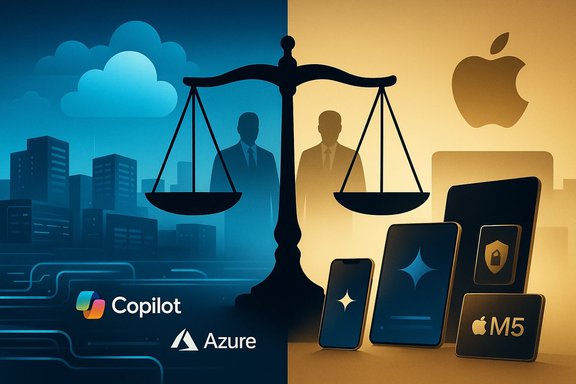
Microsoft and Apple are no longer merely competitors in hardware and OS design; they are staking out two fundamentally different bets on how artificial intelligence will be delivered, monetized, and governed across consumer and enterprise markets—one centered on cloud-led, seat‑based monetization and platform control, the other on premium device integration, on‑device inference, and privacy‑forward user experiences. The conflict is less about who builds the best model and more about which ecosystem can convert AI into recurring revenue, defend margins under rising infrastructure costs, and keep regulators at bay.
The recent debate about “who wins AI” reframes the field as a contest between ecosystems rather than discrete technologies. Analysts and investors argue that the next phase of AI will reward companies that convert AI features into recurring revenue—through seat licensing, platform consumption, device subscriptions, or verticalized services—rather than only firms that supply raw compute. This investment‑oriented thesis places Microsoft and Apple in different buckets: Microsoft as the enterprise monetizer (Copilot + Azure inference) and Apple as the premium, device‑centric monetizer (on‑device AI plus new services). This framing is reflected in contemporary coverage and analyst notes that highlight platform monetization as the key vector for 2026 and beyond. nalysis surfaces three linked realities: (1) Microsoft is actively turning AI into predictable, seat‑based and consumption revenue via Copilot and Azure; (2) Apple is pushing harder on on‑device silicon (M5 era) to deliver low‑latency, privacy‑oriented AI features; and (3) both approaches carry distinct operational, regulatory, and investment risks that will shape the next five years of product and enterprise decisions.
Microsoft’s reshaped agreement with OpenAI—part of a broader recapitalization and governance reconfiguration—extends Microsoft’s commercial affinity to OpenAI models while introducing governance guardrails around AGI declarations. The deal extends certain IP rights and clarifies long‑term commercial alignment, creating material product advantages for Microsoft (Copilot, Azure integration) while also drawing regulatory interest due to concentration of frontier IP and channel commitments. Independent coverage and Microsoft’s own communications describe the updated terms and the governance changes that accompany them.
Regulatory risk is non‑trivial. Concentration of frontier model access and extended IP rights (as in the Microsoft‑OpenAI arrangement) invite antitrust and national security scrutiny, while pervasive on‑device AI raises privacy and consumer protection questions in jurisdictions with strong data‑protection rules. Companies will increasingly need to publish transparency artifacts and contractual clauses that satisfy regulators and large corporate buyers.
Short term, the enterprise and cloud markets tilt toward Microsoft’s playbook—measurable seat conversions, rapidly growing Azure inference consumption, and a reinforced partnership with frontier model creators provide a clear monetization path. Longer term, Apple’s device and silicon advantage can create durable, differentiated consumer experiences and viable subscription services—especially where privacy, latency, and offline capability matter. Its pragmatic choice to combine on‑device strengths with selective cloud model partnerships (for example, Gemini) accelerates capability delivery without abandoning the vertically integrated model. For IT leaders, developers, and investors, the prudent course is to treat both models as strategic levers rather than mutually exclusive bets: design for hybrid deployment, demand contractual controls over model governance, and measure AI consumption as a core line item. The next chapter of AI will reward those who convert capability into repeatable customer value while managing the operational and regulatory complexities that come with scale.
Source: Investing.com Microsoft Vs. Apple — AI and Hardware Ecosystems | Investing.com
 Background / Overview
The recent debate about “who wins AI” reframes the field as a contest between ecosystems rather than discrete technologies. Analysts and investors argue that the next phase of AI will reward companies that convert AI features into recurring revenue—through seat licensing, platform consumption, device subscriptions, or verticalized services—rather than only firms that supply raw compute. This investment‑oriented thesis places Microsoft and Apple in different buckets: Microsoft as the enterprise monetizer (Copilot + Azure inference) and Apple as the premium, device‑centric monetizer (on‑device AI plus new services). This framing is reflected in contemporary coverage and analyst notes that highlight platform monetization as the key vector for 2026 and beyond. nalysis surfaces three linked realities: (1) Microsoft is actively turning AI into predictable, seat‑based and consumption revenue via Copilot and Azure; (2) Apple is pushing harder on on‑device silicon (M5 era) to deliver low‑latency, privacy‑oriented AI features; and (3) both approaches carry distinct operational, regulatory, and investment risks that will shape the next five years of product and enterprise decisions.Microsoft: wheel
Microsoft’s AI narrative centers on an integrated stack that converts identity, productivity seats, and cloud consumption into predictable revenue. The core pieces of this flywheel are:- Identity and distribution (Entra/Azure AD): enterprise control plane and billing anchor.
- Productivity integration (Microsoft 365 Copilot): per‑seat AI features that can be upsold to existing customers.
- Cloud supply (Azure inference and platform services): metered inference that generates variable revenue as workloads scale.
- Frontier model access (OpenAI partnership): product differentiation and early access to leading-model capabilities.
Why the flywheel matters
The combination of pervasive enterprise software (Office, Teams, Dynamics) and a hyperscale cloud creates a powerful cross‑sell mechanism: Copilot seat adoption increases inference consumption, which in turn pulls more Azure capacity and justifies additional datacenter investment. This is not merely marketing; Copilot is priced and packaged in commercial offerings, turning feature releases into seat‑based revenue streams that can bured.CapEx, inference economics, and execution risk
Building the physical infrastructure to deliver inference at global scale is capital intensive. Microsoft’s cloud capex has increased materially as it scales datacenters optimized for inference workloads. That investment creates two visible tensions:- If utilization and monetization meet expectations, capex yields durable returns through high‑margin software and platform revenue.
- If utilization falls short—because customers keep models on‑prem, shift to competitors, or adopt cheaper model providers—then margins will be pressured and the investment case weakens.
Microsoft’s reshaped agreement with OpenAI—part of a broader recapitalization and governance reconfiguration—extends Microsoft’s commercial affinity to OpenAI models while introducing governance guardrails around AGI declarations. The deal extends certain IP rights and clarifies long‑term commercial alignment, creating material product advantages for Microsoft (Copilot, Azure integration) while also drawing regulatory interest due to concentration of frontier IP and channel commitments. Independent coverage and Microsoft’s own communications describe the updated terms and the governance changes that accompany them.
Apple: on‑device AI, integration, and privacy as product strategy
Apple’s play is almost the mirror image of Microsoft’s: rather than leaning on centralized inference and seat‑based monetization, Apple doubles down on silicon and device control. The key components are:- Apple Silicon (M5 family): hardware that specifically boosts on‑device neural throughput to enable local inference, lower latency, and offline capabilities.
- Apple Intelligence: integrated system services that aim to bring personalized, privacy‑respecting AI to iPhone, iPad, and Vision Pro.
- Device‑plus‑services monetization: incremental services and features that can be tied to devices, potentially creating recurring revenue streams without full reliance on cloud inference.
The Google (Gemini) tie‑up and pragmatic pragmatism
Despite the on‑device emphasis, Apple has signaled pragmatism in its model sourcing. Recent announcements show Apple will rely on Google’s Gemini as a foundation for next‑generation Apple Intelligence features, including a revamped Siri. This is notable: Apple retains control of the front‑end UX, privacy protections, and device integrations, while leveraging an external model where it makes sense to accelerate capability delivery. Multiple outlets confirm the multi‑year collaboration that positions Gemini to underpin Apple’s near‑term service upgrades.Strengths and guardrails
Apple’s strengths are clear:- Vertical integration: owning silicon, OS, app store distribution, and a premium installed base.
- Privacy as product: a competitive differentiator that resonates with high‑value customers and certain enterprise buyers.
- Power‑efficient on‑device inference: lower cloud costs per feature and better latency/UX in many scenarios.
Hardware ecosystems: divergence and convergence
The two strategies point to a wider dichotomy in the ecosystem:- Cloud‑first, scale‑economies model (Microsoft):
- Pros: easier product updates, scalable monetization through consumption, stronger enterprise contract stickiness.
- Cons: heavy capex, dependency on hyperscaler economics and GPU suppliers, and intensified regulatory scrutiny.
- Device‑first, integration‑led model (Apple):
- Pros: superior UX, differentiated privacy story, control over silicon and form factor innovation, potential for device‑anchored subscriptions.
- Cons: higher per‑user R&D cost, limitations on some server‑scale AI features, and reliance on partnerships for rapid feature parity.ometimes converge—Apple may use cloud inference for very large models, while Microsoft will invest in edge and hybrid deployments to meet latency and compliance needs—but the default orientations shape product roadmaps and customer talks today.
Practical implications for IT leaders, developers, and Windows users
Microsoft’s and Apple’s paths translate into concrete decisions for IT teams and end users.- For enterprise IT and procurement:
- Treat Copilot adoption as a governance and budget exercise. Expect per‑seat subscription fees (Copilot for Microsoft 365 is publicly listed at roughly $30/user/month for many commercial plans) and metered agent usage that requires FinOps controls.
- Model hybrid scenarios: sensitive workloads may remain on‑prem or within private cloud compute, while non‑sensitive automation uses Azure inference.
- Insist on auditability, data‑residency guarantees, and telemetry limits when negotiating AI services.
- For developers:
- Build for both cloud and device: on‑device inference (Apple M5 or equivalent) enables new UX patterns, but many high‑capacity models still need cloud hosting and fine‑tuning capabilities.
- Plan for multiple runtimes and inference backends; abstractions that let an app switch between local and cloud models will maximize reach.
- For Windows users and enterprise endpoints:
- Expect deeper Copilot features across Office apps and Windows, but also evolving pricing models tied to metered AI usage.
- Evaluate endpoints on both performance and data governance; devices with strong local inference may reduce cloud costs and latency for certain workflows.
Investment and regulatory view: monetization vectors and risks
From an investor perspective, the AI winners for the next phase are likely those who can do two things simultaneously:- Convert raw AI capability into repeatable, defensible revenue (seats, subscriptions, vertical SaaS).
- Control distribution so pricing power and margins follow usage growth.
Regulatory risk is non‑trivial. Concentration of frontier model access and extended IP rights (as in the Microsoft‑OpenAI arrangement) invite antitrust and national security scrutiny, while pervasive on‑device AI raises privacy and consumer protection questions in jurisdictions with strong data‑protection rules. Companies will increasingly need to publish transparency artifacts and contractual clauses that satisfy regulators and large corporate buyers.
Tactical scenarios: five outcomes to watch
- Microsoft converts Copilot adoption into a multi‑year, sticky revenue stream and Azure inference utilization grows in line with disclosed run rates—this validates the cloud‑monetization thesis and drives long‑term margin recovery as capacity utilization improves.
- Apple successfully stitches Gemini‑bas with M5 on‑device experiences to create a superior, privacy‑safe assistant—this outcome could reshape consumer expectations and create new device‑attached services revenue.
- A third‑party model or alternative compute approach (cheaper, more efficient model architectures, or regional competitors) materially lowers the cost of inference—this compresses hyperscaler margins and revalues capex assumptions across the boampose constraints on cross‑company IP and bundling (particularly around frontier model access and enterprise contracts), forcing new product packaging and potentially limiting exclusive monetization windows.
- Hybrid outcomes prevail: enterprises adopt multi‑cloud and multi‑model strategies, using Microsoft for core productivity services while selectively choosing on‑device or third‑party models for specialized tasks—this leads to an arms race in developer tooling and governance features rather than a single clear winner.
Strengths, weaknesses, and unverifiable claims (a cautionary note)
Both corporate strategies have real strengths: Microsoft’s ability to monetize at scale through seats and Azure consumption is proven and measurable; Apple’s hardware‑driven approach yieldriences and a powerful privacy narrative. But several widely circulated claims are still speculative or lack public verification:- Some reports circulating in industry forums and certain archived discussions attribute very large multi‑hundred‑billion dollar AI commitments to Apple (figures like $500 billion) or odd one‑off investments that cannot be reconciled with Apple’s public filings. These numbers should be regarded as unverified unless disclosed in SEC filings or official company announcements.
- Contractual specifics between Apple and third‑party providers (including precise pricing in the Google‑Gemini arrangement) are often reported as leaked figures. While multiple outlets reference approximate numbers—some reports estimate an annualized fee in the low‑to‑mid‑hundreds of millions to $1 billion—those figures have not been uniformly confirmed in audited filings. Treat them as directional, not definitive.
Practical checklist for CIOs and IT procurecurrent Microsoft 365 usage and identify test seats for Copilot pilots; map outcomes to projected metered inference costs.
- Require AI procurement contracts to include model provenance, non‑training clauses, audit rights, and telemetry limits.
- Benchmark device performance for local inference (M5 and modern alternatives) if low‑latency or offline AI is core to workflows.
- Establish FinOps for AI: track agent usage, model prompts, and inference volume as first‑class budget items.
- Plan for multi‑model strategies: design applications to switch inference backends between on‑device, Azure, or third‑party APIs based on cost, latency, and privacy constraints.
Conclusion: a two‑track AI future, with room for multiple winners
The Microsoft vs. Apple dynamic is not a zero‑sum game where one brand must utterly defeat the other. Instead, it reveals two viable monetization architectures for AI: cloud‑centric platform economics that scale via seat licensing and metered inference, and device‑centric integration that extracts value through premium hardware, privacy, and close OS‑level coupling.Short term, the enterprise and cloud markets tilt toward Microsoft’s playbook—measurable seat conversions, rapidly growing Azure inference consumption, and a reinforced partnership with frontier model creators provide a clear monetization path. Longer term, Apple’s device and silicon advantage can create durable, differentiated consumer experiences and viable subscription services—especially where privacy, latency, and offline capability matter. Its pragmatic choice to combine on‑device strengths with selective cloud model partnerships (for example, Gemini) accelerates capability delivery without abandoning the vertically integrated model. For IT leaders, developers, and investors, the prudent course is to treat both models as strategic levers rather than mutually exclusive bets: design for hybrid deployment, demand contractual controls over model governance, and measure AI consumption as a core line item. The next chapter of AI will reward those who convert capability into repeatable customer value while managing the operational and regulatory complexities that come with scale.
Source: Investing.com Microsoft Vs. Apple — AI and Hardware Ecosystems | Investing.com
