

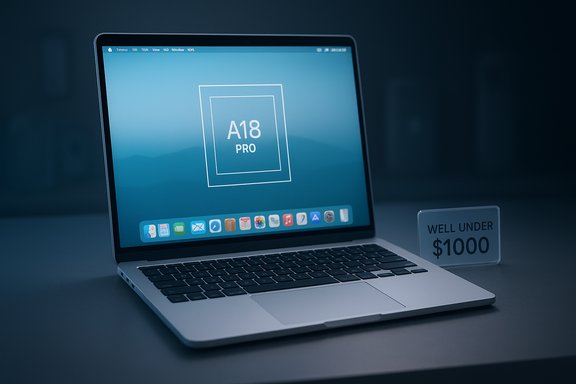
Apple’s rumored “cheap” MacBook — a smaller, aluminum‑chassis notebook powered by an A‑series chip and reportedly priced “well under $1,000” and shipping in the first half of 2026 — is shaping up to be more than just a rumor: it’s a plausible strategic gambit that could reshape the lower‑cost laptop battleground and force Windows OEMs and Microsoft to rethink how they defend the $500–$900 segment. Multiple journalist and supply‑chain reports now point to active testing and early production of a device codenamed J700, and independent outlets have repeated the same core claims: an iPhone‑class A‑series SoC (A18 Pro has been named), a slightly smaller-than‑13.6‑inch LCD, and a target price that sits below the current MacBook Air starting point.
Apple’s move into a low‑cost MacBook is not new as a rumor, but this iteration is unusually specific: Bloomberg’s reporting — backed by follow‑ups from Reuters, The Verge, MacRumors and other outlets — places the machine in early production with an intended 2026 release window and a price bracket that would directly challenge midrange Windows notebooks and Chromebooks. The device is frequently described as a Mac built with “less‑advanced components” to hit those price targets, meaning trade‑offs on display tech, I/O and likely memory configurations, while preserving Apple’s strengths in efficiency and integration. This is important because the low‑cost Windows laptop market has, for years, been dominated by price‑led hardware that often sacrifices build quality, display fidelity and battery efficiency. Analysts, community observers and internal market threads recently documented how a hard deadline — the end of support for Windows 10 — already nudged a subset of Windows users toward Macs in late 2025, creating a context in which a credible, attractively priced MacBook could accelerate platform switching.
Apple’s rumored budget MacBook is a strategic provocation that tests an open market question: can Apple preserve its premium engineering standards while expanding volume into price points historically dominated by Chromebooks and low‑cost Windows PCs? The early signals suggest Apple is willing to make calculated component trade‑offs — lower‑end LCD, constrained external I/O and modest RAM — while selling the more important benefits: battery life, long‑term OS updates and an integrated ecosystem. For the Windows world, that means the low‑end playing field will get more competitive, but it does not spell immediate doom. Instead, it’s a clear market signal: if Windows OEMs and Microsoft want to retain buyers at the $500–$900 tier, they must stop treating those SKUs as an afterthought and instead deliver durable value where it counts — battery, display, and day‑to‑day polish. Multiple independent reports reinforce the core rumors and the market context, but the final verdict awaits Apple’s official specifications and pricing disclosure; until then, treat specific price claims and exact hardware limits as plausible but unconfirmed.
Source: Windows Central It's more bad news for Microsoft and Windows 11 — Apple's cheap MacBook actually sounds good
 Background / Overview
Apple’s move into a low‑cost MacBook is not new as a rumor, but this iteration is unusually specific: Bloomberg’s reporting — backed by follow‑ups from Reuters, The Verge, MacRumors and other outlets — places the machine in early production with an intended 2026 release window and a price bracket that would directly challenge midrange Windows notebooks and Chromebooks. The device is frequently described as a Mac built with “less‑advanced components” to hit those price targets, meaning trade‑offs on display tech, I/O and likely memory configurations, while preserving Apple’s strengths in efficiency and integration. This is important because the low‑cost Windows laptop market has, for years, been dominated by price‑led hardware that often sacrifices build quality, display fidelity and battery efficiency. Analysts, community observers and internal market threads recently documented how a hard deadline — the end of support for Windows 10 — already nudged a subset of Windows users toward Macs in late 2025, creating a context in which a credible, attractively priced MacBook could accelerate platform switching.What the reports actually say: hardware, price and timing
The consistent claims
- The codename is reported as J700 and Apple is said to be in testing and early production.
- The CPU is likely an A‑series iPhone chip — Bloomberg and supply‑chain analysts point to the A18 Pro as the early frontrunner. Apple has historically tested iPhone silicon in Mac prototypes (developer kits used A‑series parts in the transition years), which makes the idea technically feasible.
- Display will be slightly smaller than the MacBook Air’s 13.6‑inch panel (reports mention ~13‑inch or around 12.9‑inch), and the screen technology will likely be a cost‑focused LCD rather than Apple’s higher‑end OLED/Liquid Retina options.
- Apple’s internal price target is described as “well under $1,000”, with pundits and some leaks suggesting a psychological $599–$699 band is possible — though that specific $599 headline has circulated and should be treated cautiously until Apple confirms pricing.
What’s plausible and what’s speculative
- Plausible: Apple can ship a stable, long‑battery‑life notebook using an A‑series SoC because Apple designs both the silicon and macOS. Early testing reportedly shows the chosen iPhone SoC can match or exceed the older M1 MacBook Air in everyday tasks. Independent reviews of A‑series silicon in non‑Mac contexts have shown strong single‑thread/burst efficiency, which supports the claim that an A‑series Mac could be highly efficient for web, office and media use.
- Speculative / unverified: exact RAM and storage configurations, final display brightness and color performance, port speeds (notably the presence or absence of Thunderbolt/USB4), and the precise retail price. Supply‑chain leaks point to conservative RAM and a lack of Thunderbolt support as likely trade‑offs, but those remain unconfirmed until Apple publishes specs. Treat claims about an exact $599 price or precise RAM caps as rumor‑level until Apple posts official SKU information.
Why this matters to Microsoft, OEMs and the midrange Windows market
The experiential gap in the $500–$900 band
For most buyers in the $500–$900 range, the choice is driven by perceived value: build quality, battery life, display quality and low‑friction software updates. Many midrange Windows laptops prioritize cost and thus compromise on display, chassis and battery tune‑ups. The result is a large cohort of “functional but forgettable” Windows devices that win on price but lose on long‑term satisfaction. The entry of a well‑made MacBook below $1,000 would raise buyers’ expectations for the same price band and could tilt first‑time switch decisions toward macOS, especially among students, iPhone owners and mainstream knowledge workers.Momentum from the Windows 10 end‑of‑support cycle
Market tracking and community analysis show a refresh wave tied to Windows 10’s end of mainstream support. That deadline forced many users to buy new hardware or enroll in interim ESU programs — and analysts documented a measurable uptick in Mac shipments during the Q3 2025 refresh cycle. The combination of a forced hardware refresh and an attractive, lower‑cost Mac option could amplify Mac’s gains in the near term and change procurement calculus for individual and small‑business buyers.The brand and perception problem for Windows 11
Windows 11’s public perception is mixed in mainstream conversations: complaints about forced AI features, sporadic ads/promotions inside the OS, and a narrative that Windows has become bloated or fragmentary persist in public discourse. That perception is not a technical verdict so much as a mass‑market sentiment that affects purchase decisions. A $700 MacBook that “just works” with long battery life and Apple ecosystem advantages can be an easy default choice for buyers who view Windows as noisy or increasingly complicated.The technical trade‑offs and where Windows still retains advantages
What Apple is likely to sacrifice to hit the price target
- Display quality: reports point to a lower‑end LCD instead of Apple’s premium panels, which lowers production cost but also reduces peak brightness, HDR capability and color depth compared with higher‑tier MacBooks.
- I/O and external display support: early reporting suggests an A‑series MacBook may not include Thunderbolt/USB4 speeds, meaning fewer external displays and slower dock throughput unless Apple finds a software workaround. That’s a meaningful limitation for professionals who rely on multi‑monitor setups.
- Memory and multitasking headroom: to keep costs down Apple may cap RAM at levels that are fine for casual users but constraining for heavy multitaskers and creative professionals. That will define the device’s sweet spot — students and light office users rather than pro content creators.
Where Windows still wins
- Choice and hardware diversity: Windows OEMs offer a broad mix of form factors, ports, repairability and upgrade paths. For buyers who need user‑replaceable components, a wider selection of ports, or purpose‑built gaming and workstation features, Windows retains clear advantages.
- Compatibility for Windows‑only apps: many line‑of‑business and specialist applications remain Windows‑exclusive or work best on Windows, creating a structural reason for many buyers and enterprises to stick with Windows devices. Virtualization can help, but it’s not a drop‑in replacement for native support in every case.
Consumer and enterprise implications: buying guidance and TCO dynamics
For consumers and students
If the rumored MacBook hits an attractive price with Apple’s usual finish and battery life, it will be compelling for:- iPhone users who value cross‑device continuity and minimal management friction.
- Students seeking a durable, long‑battery laptop that can run mainstream productivity apps locally.
For IT and procurement
Enterprises should not treat a low‑cost Mac as a universal solution. The decision matrix must include:- Inventory of critical Windows‑only LOB apps and drivers.
- Pilot testing with representative users to measure support cost and productivity impacts.
- Careful TCO modeling that includes trade‑in value, residuals, MDM/EDR licensing for macOS, virtualization costs and user retraining.
What Microsoft and Windows OEMs should do — a practical roadmap
If Apple does ship a sub‑$1,000 MacBook that outperforms comparable Windows devices in battery life, build feel and perceived reliability, Microsoft and OEMs have a few defensible responses:- Reinforce the value proposition of Windows hardware in the midrange by emphasizing better displays, longer battery optimizations, and meaningful warranty/support packages that tilt perceived TCO in Windows’ favor. Consumers often trade upfront price for total ownership experience.
- Move pragmatic PowerToys features and small‑wins UX improvements into Windows Settings to boost immediate perceived quality of life — features like better default window tiling, power diagnostics, and per‑app energy controls produce outsized daily benefits. These are low‑cost engineering moves with high user visibility.
- Avoid gating essential features behind premium “Copilot+” hardware tiers in a way that alienates mainstream users. If advanced AI features are marketed as premium, ensure the baseline Windows experience remains clean and high‑value for mass buyers.
Risks, verification points and what to watch next
Key facts to verify once Apple announces
- Final price and SKU breakdown: “Well under $1,000” is useful as a headline but the SKU matrix (base RAM/storage and optional upgrades) will determine the device’s real competitiveness. Treat $599 as aspirational until Apple lists SKUs.
- A‑series model and performance: whether the initial shipping chip is A18 Pro or something else will affect headroom for tasks and on‑device AI features. Independent benchmarks on retail units will be essential to translate supply‑chain leaks into buyer guidance.
- Port speeds and external display support: lack of Thunderbolt/USB4 would be a structural limitation for many buyers; confirm native external display limits and whether Apple uses software tricks for additional outputs.
Unverifiable or high‑risk claims right now
- Exact price point (e.g., $599) remains unverified and should be treated as a rumor until formal pricing is posted.
- Statements about “M1 parity” or broad performance equivalence should be treated as preliminary; A‑series chips are efficient in burst workloads, but multi‑threaded sustained loads and unified memory ceiling differences matter for heavier users.
Strategic takeaways for readers and the Windows community
- This rumored MacBook is a credible threat to the midrange Windows segment because Apple will leverage silicon efficiency, long software support, and brand perception to offer an experience that may feel superior to many low‑cost Windows models at the same price. Multiple outlets corroborate Apple’s testing and pricing targets, so treat the device as a credible arrival rather than mere gossip.
- The device will not displace Windows in every corner: gaming, heavy GPU work, pro virtualization and many enterprise LOB scenarios keep Windows firmly relevant. The Windows ecosystem’s diverse hardware and upgradeability remain structural advantages.
- For Microsoft and OEMs, the immediate action is not panic but product discipline: ship better low‑cost hardware with stronger displays and battery tuning, fold small but meaningful UX fixes into Windows, and make the baseline experience feel intentional and premium — even on cheaper devices. The community has repeatedly asked for these “small wins” and they will matter more if Apple tightens competition at the low end.
Apple’s rumored budget MacBook is a strategic provocation that tests an open market question: can Apple preserve its premium engineering standards while expanding volume into price points historically dominated by Chromebooks and low‑cost Windows PCs? The early signals suggest Apple is willing to make calculated component trade‑offs — lower‑end LCD, constrained external I/O and modest RAM — while selling the more important benefits: battery life, long‑term OS updates and an integrated ecosystem. For the Windows world, that means the low‑end playing field will get more competitive, but it does not spell immediate doom. Instead, it’s a clear market signal: if Windows OEMs and Microsoft want to retain buyers at the $500–$900 tier, they must stop treating those SKUs as an afterthought and instead deliver durable value where it counts — battery, display, and day‑to‑day polish. Multiple independent reports reinforce the core rumors and the market context, but the final verdict awaits Apple’s official specifications and pricing disclosure; until then, treat specific price claims and exact hardware limits as plausible but unconfirmed.
Source: Windows Central It's more bad news for Microsoft and Windows 11 — Apple's cheap MacBook actually sounds good
