

Apple’s first foldable iPhone may be approaching its most important milestone yet, but the latest supply-chain reporting points to a familiar caveat: a September unveiling and a smooth retail launch are not necessarily the same thing. The device widely described in reports as the iPhone Ultra or iPhone Fold is still expected to appear alongside Apple’s next premium iPhone generation, yet its actual availability could be constrained, delayed, or staggered if final manufacturing work does not progress as planned.
The central development is Foxconn’s reported role in taking the foldable iPhone through the New Product Introduction process and into mass production. That is a meaningful sign of maturity for a device that has been rumored for years. But it is not a guarantee that Apple has cleared every quality, yield, durability, and capacity hurdle required to ship a complex new product in meaningful volume.
For Windows and broader consumer technology enthusiasts, the story is bigger than another premium handset. Apple’s entry into foldables could reshape expectations for ultra-thin mobile hardware, cross-device productivity, app layouts, component supply chains, and the competitive pressure facing Samsung, Google, Microsoft partners, and Chinese Android manufacturers. The catch is that Apple’s first foldable appears likely to arrive with the same trade-offs that have defined the category from the beginning: extraordinary engineering ambition, an extremely high price, and potential limits on availability.
Reports indicate that Foxconn has been selected to lead Apple’s foldable iPhone through NPI, a manufacturing phase that turns an approved product design into a repeatable, scalable production process. This is where a hardware concept becomes something that can be assembled in the millions without unacceptable defect rates or unpredictable quality issues.
That distinction matters. A prototype can look finished, feel polished, and even function reliably in limited testing. Mass production introduces a far tougher test: whether every supplier can deliver identical parts at scale, whether automated assembly equipment can operate consistently, and whether finished units meet Apple’s standards without creating excessive waste.
Foxconn is an unsurprising choice for that job. The company has been central to iPhone manufacturing for years and has experience managing high-volume production schedules, component logistics, automated assembly, final testing, and late-stage engineering changes. A foldable iPhone, however, is not simply another variation of the existing iPhone formula.
It combines several difficult hardware elements into one device:
Apple has a long history of revealing products before every model is ready to ship at full scale. In many cases, a launch event establishes the product category, confirms the design, showcases the software experience, and opens the door for preorders. Retail availability can follow shortly afterward, but it can also vary by region, capacity, color, storage configuration, or carrier channel.
For a first-generation foldable iPhone, Apple may have several options if production remains tight:
Still, the latest reports make clear that the core question is no longer simply whether Apple is interested in foldables. The question is whether its first foldable can reach the market at the volume and polish expected from an iPhone launch.
The hinge is the obvious mechanical concern, but it is far from the only one.
Minor variation in hinge assembly can create visible differences in display alignment, resistance, noise, or folding feel. At premium pricing, Apple cannot afford a launch in which two supposedly identical devices feel noticeably different in the hand.
Foldable displays have improved dramatically, but they remain more complex and more vulnerable than the rigid glass panels found in ordinary smartphones. Apple’s likely emphasis on a nearly crease-free design would raise the engineering bar further.
Every fraction of a millimeter matters in a foldable design. Camera modules, battery cells, wireless charging coils, speakers, thermal materials, and structural reinforcements all compete for internal space. A thinner device can look impressive in a keynote, yet it can also make repairs harder, reduce room for battery capacity, and complicate heat management under heavy workloads.
A low yield can quickly become a launch problem. Even if suppliers produce enough displays, hinges, and frames, Apple cannot sell units that fail durability tests, have visual display flaws, do not close correctly, or fall outside strict tolerance requirements.
This is why reports of final production adjustments should be interpreted carefully. They may signal routine refinement, which is common before a major hardware launch. But they can also reveal that one or more parts of the process are not yet producing enough acceptable units for the intended shipment volume.
During NPI, manufacturing teams work closely with product engineers to validate that a device can be built reliably at scale. The work usually involves refining assembly tools, establishing inspection criteria, qualifying suppliers, testing production lines, identifying bottlenecks, and improving the consistency of each step.
For a foldable iPhone, the NPI process would likely focus intensely on:
That said, even Foxconn cannot manufacture its way around an unresolved product-design limitation. If a hinge component wears too quickly, an internal display layer fails stress testing, or a critical part arrives in insufficient volume, the final timetable can still move.
However, the name should not be treated as final.
Apple could choose a number of naming approaches:
That positioning could help distinguish it from conventional large-screen smartphones, but it also creates high expectations. A foldable iPhone needs to justify not only its price but also its durability, camera performance, battery life, app experience, and long-term usefulness.
Rumored display sizes have generally clustered around a roughly 5.5-inch external screen and a 7.7- to 7.8-inch internal display. If accurate, that would make the product a direct competitor to large Android foldables such as Samsung’s Galaxy Z Fold range and Google’s Pixel Fold family.
A book-style form factor makes strategic sense for Apple.
A well-executed foldable iPhone could make mobile Office workflows more appealing, especially for reading documents, reviewing presentations, responding to email, and participating in Teams meetings. But it would still face the limitations of mobile operating systems, touch-first editing, and accessory dependence.
The device could narrow the gap between phone and tablet. It is unlikely to erase the role of a Windows PC for sustained desktop-class work.
That pricing is understandable from a hardware perspective. Foldable OLED panels, advanced hinges, complex assembly processes, reinforced chassis materials, and lower manufacturing yields all add cost. Apple will also likely position the device as a halo product rather than an immediate mass-market replacement for the standard iPhone.
But the price introduces several risks.
The company has had years to study the weaknesses of existing products: visible creases, hinge vulnerability, dust resistance, awkward aspect ratios, camera compromises, heavy bodies, and software that does not always take full advantage of the larger display.
A delayed entry can provide valuable advantages:
That is an ambitious promise. It is also why the final production hurdle matters so much.
Instead, the evidence points to a product in a sensitive late-stage phase. Foxconn’s reported NPI responsibility is encouraging because it indicates that Apple is working toward manufacturing readiness. At the same time, talk of ongoing production challenges reinforces that the company may still be optimizing the device at a point when the margin for error is narrow.
The reported September reveal remains plausible. A commercial launch on the same timetable is less certain.
That uncertainty is especially relevant because Apple’s first foldable will not be judged as an isolated experiment. It will be measured against the maturity of the iPhone brand, the engineering progress made by Android foldables, and the expectations attached to a potential Ultra-tier price.
If Apple delivers a thin, durable, nearly crease-free book-style foldable with compelling software and dependable availability, it could reset the premium smartphone conversation. If the company has to limit supply, push back shipping, or compromise on key hardware expectations, the device may still be important—but its first chapter will be defined as much by scarcity and caution as by innovation.
For now, the iPhone Ultra appears close enough to production to be taken seriously, yet not close enough for buyers to assume they will be able to purchase one the moment Apple puts it on stage.
The central development is Foxconn’s reported role in taking the foldable iPhone through the New Product Introduction process and into mass production. That is a meaningful sign of maturity for a device that has been rumored for years. But it is not a guarantee that Apple has cleared every quality, yield, durability, and capacity hurdle required to ship a complex new product in meaningful volume.
For Windows and broader consumer technology enthusiasts, the story is bigger than another premium handset. Apple’s entry into foldables could reshape expectations for ultra-thin mobile hardware, cross-device productivity, app layouts, component supply chains, and the competitive pressure facing Samsung, Google, Microsoft partners, and Chinese Android manufacturers. The catch is that Apple’s first foldable appears likely to arrive with the same trade-offs that have defined the category from the beginning: extraordinary engineering ambition, an extremely high price, and potential limits on availability.
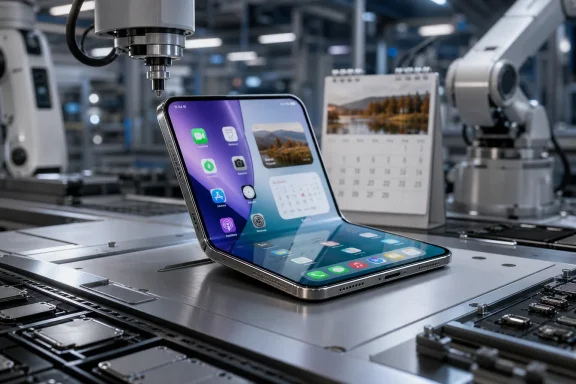 Apple’s Foldable iPhone Is Reportedly Near the Finish Line
Reports indicate that Foxconn has been selected to lead Apple’s foldable iPhone through NPI, a manufacturing phase that turns an approved product design into a repeatable, scalable production process. This is where a hardware concept becomes something that can be assembled in the millions without unacceptable defect rates or unpredictable quality issues.That distinction matters. A prototype can look finished, feel polished, and even function reliably in limited testing. Mass production introduces a far tougher test: whether every supplier can deliver identical parts at scale, whether automated assembly equipment can operate consistently, and whether finished units meet Apple’s standards without creating excessive waste.
Foxconn is an unsurprising choice for that job. The company has been central to iPhone manufacturing for years and has experience managing high-volume production schedules, component logistics, automated assembly, final testing, and late-stage engineering changes. A foldable iPhone, however, is not simply another variation of the existing iPhone formula.
It combines several difficult hardware elements into one device:
- A large flexible OLED display that must withstand repeated folding.
- A precision hinge with tight mechanical tolerances.
- Extremely thin internal packaging for batteries, circuit boards, cameras, cooling, and antennas.
- A chassis that has to remain rigid without adding excessive weight.
- Software behaviors that must move gracefully between closed and unfolded states.
- A quality-control process that can detect issues invisible in conventional slab phones.
The Important Difference Between an Announcement and a Launch
The most important nuance in the latest iPhone Ultra reporting is the difference between being announced and being available to buy.Apple has a long history of revealing products before every model is ready to ship at full scale. In many cases, a launch event establishes the product category, confirms the design, showcases the software experience, and opens the door for preorders. Retail availability can follow shortly afterward, but it can also vary by region, capacity, color, storage configuration, or carrier channel.
For a first-generation foldable iPhone, Apple may have several options if production remains tight:
- Announce and release on schedule
The best-case outcome would see the foldable iPhone revealed in September, preorders opened soon afterward, and initial deliveries beginning within the standard iPhone launch window. - Announce in September but ship later
Apple could unveil the device alongside the iPhone 18 Pro family while setting a later on-sale date. This would preserve the marketing impact of the launch event while giving suppliers additional time to build inventory. - Launch in limited markets first
A constrained rollout could prioritize the United States, China, Japan, selected European markets, and other regions where premium iPhone demand is strongest. - Release in very limited quantities
Apple could technically meet a launch target while allowing demand to exceed supply dramatically. That outcome would likely produce long delivery estimates and limited in-store availability. - Delay the retail release entirely
If durability or yield problems remain significant, Apple may conclude that protecting the product’s reputation is more important than meeting an internal calendar target.
Still, the latest reports make clear that the core question is no longer simply whether Apple is interested in foldables. The question is whether its first foldable can reach the market at the volume and polish expected from an iPhone launch.
Why Foldable Manufacturing Is So Difficult
Traditional smartphones are already tightly engineered products. Foldables take the challenge further because their screens, frames, batteries, cables, sensors, and internal boards must accommodate physical movement every day.The hinge is the obvious mechanical concern, but it is far from the only one.
Hinge durability and consistency
A foldable hinge must open smoothly, hold the device securely at different angles, resist dust and debris, and maintain its behavior after years of repeated use. It also has to fit within a body that is expected to be exceptionally thin.Minor variation in hinge assembly can create visible differences in display alignment, resistance, noise, or folding feel. At premium pricing, Apple cannot afford a launch in which two supposedly identical devices feel noticeably different in the hand.
Flexible display reliability
The internal screen is likely to be the defining feature of the device. That means Apple needs to minimize the visible crease, preserve display brightness and color accuracy, prevent delamination, and protect the panel against pressure damage.Foldable displays have improved dramatically, but they remain more complex and more vulnerable than the rigid glass panels found in ordinary smartphones. Apple’s likely emphasis on a nearly crease-free design would raise the engineering bar further.
Ultra-thin internal design
Reports have repeatedly suggested that Apple is targeting an extremely thin profile when the device is unfolded. That would be a major achievement if realized, but slimness creates compromises.Every fraction of a millimeter matters in a foldable design. Camera modules, battery cells, wireless charging coils, speakers, thermal materials, and structural reinforcements all compete for internal space. A thinner device can look impressive in a keynote, yet it can also make repairs harder, reduce room for battery capacity, and complicate heat management under heavy workloads.
Manufacturing yield
One of the least glamorous but most important factors is yield: the percentage of manufactured units or components that pass quality checks and can be sold.A low yield can quickly become a launch problem. Even if suppliers produce enough displays, hinges, and frames, Apple cannot sell units that fail durability tests, have visual display flaws, do not close correctly, or fall outside strict tolerance requirements.
This is why reports of final production adjustments should be interpreted carefully. They may signal routine refinement, which is common before a major hardware launch. But they can also reveal that one or more parts of the process are not yet producing enough acceptable units for the intended shipment volume.
What Foxconn’s NPI Role Actually Means
The phrase New Product Introduction can sound like ordinary corporate terminology, but in consumer electronics it describes a high-risk and highly structured transition.During NPI, manufacturing teams work closely with product engineers to validate that a device can be built reliably at scale. The work usually involves refining assembly tools, establishing inspection criteria, qualifying suppliers, testing production lines, identifying bottlenecks, and improving the consistency of each step.
For a foldable iPhone, the NPI process would likely focus intensely on:
- Hinge assembly and durability testing.
- Flexible display integration.
- Adhesive application and structural bonding.
- Foldable cable routing.
- Battery placement and safety validation.
- Camera alignment within an unusually thin chassis.
- Wireless and cellular antenna performance.
- Cosmetic inspection for gaps, unevenness, scratches, and display irregularities.
- Automated opening, closing, and functional testing.
That said, even Foxconn cannot manufacture its way around an unresolved product-design limitation. If a hinge component wears too quickly, an internal display layer fails stress testing, or a critical part arrives in insufficient volume, the final timetable can still move.
The “iPhone Ultra” Name Remains Uncertain
The iPhone Ultra label has become popular in rumors because it conveniently describes the expected positioning of Apple’s first foldable: larger, more expensive, and more ambitious than the existing Pro Max tier. It also aligns with Apple’s use of “Ultra” branding on products such as Apple Watch Ultra.However, the name should not be treated as final.
Apple could choose a number of naming approaches:
- iPhone Ultra
- iPhone Fold
- iPhone Fold Ultra
- iPhone Pro Fold
- A completely new brand identity that avoids direct comparison with Android foldables
That positioning could help distinguish it from conventional large-screen smartphones, but it also creates high expectations. A foldable iPhone needs to justify not only its price but also its durability, camera performance, battery life, app experience, and long-term usefulness.
Expected Design: A Book-Style Device, Not a Flip Phone
Current reporting broadly points toward a book-style foldable design rather than a compact clamshell phone. In other words, the device would function like a normal smartphone when closed and open into a wider internal display closer in character to a small tablet.Rumored display sizes have generally clustered around a roughly 5.5-inch external screen and a 7.7- to 7.8-inch internal display. If accurate, that would make the product a direct competitor to large Android foldables such as Samsung’s Galaxy Z Fold range and Google’s Pixel Fold family.
A book-style form factor makes strategic sense for Apple.
A larger canvas for iOS and iPad-style apps
The unfolded display could make better use of apps designed for iPad-like layouts, including:- Multitasking interfaces.
- Floating media controls.
- Expanded document views.
- Email and calendar panes.
- Photo editing tools.
- Gaming controls.
- Split-screen communication and reference workflows.
A possible productivity challenge for Windows devices
For Windows users, Apple’s foldable may be less a replacement for a laptop than a pressure point for mobile productivity. Microsoft has spent years trying to make Windows, Android, and iOS work better together through Phone Link, OneDrive, Microsoft 365, Outlook, Edge, Teams, and cross-platform cloud services.A well-executed foldable iPhone could make mobile Office workflows more appealing, especially for reading documents, reviewing presentations, responding to email, and participating in Teams meetings. But it would still face the limitations of mobile operating systems, touch-first editing, and accessory dependence.
The device could narrow the gap between phone and tablet. It is unlikely to erase the role of a Windows PC for sustained desktop-class work.
Premium Pricing Will Be Part of the Risk
The foldable iPhone is expected to sit well above the price of Apple’s current top-tier iPhones. Reports have suggested a starting price above $2,000, which would place it firmly in luxury technology territory.That pricing is understandable from a hardware perspective. Foldable OLED panels, advanced hinges, complex assembly processes, reinforced chassis materials, and lower manufacturing yields all add cost. Apple will also likely position the device as a halo product rather than an immediate mass-market replacement for the standard iPhone.
But the price introduces several risks.
The first-generation tax
Consumers may hesitate to spend more than $2,000 on a first-generation foldable device, especially if questions remain about durability, repairability, battery longevity, or visible display creasing. Apple’s brand can support premium pricing, but it does not eliminate buyer skepticism.The upgrade calculation
A buyer considering an iPhone Ultra may compare it not only with an iPhone Pro Max, but also with a high-end iPhone plus an iPad, or with a Windows ultrabook paired with a regular iPhone. The foldable has to make a compelling case that it can consolidate those roles.Repair costs
Foldable screens and hinges are inherently more expensive to repair than conventional phone displays. Even with AppleCare coverage, accidental damage terms, replacement processes, and out-of-warranty pricing will matter greatly to early adopters.Supply constraints could amplify the premium
If launch inventory is limited, the device may become difficult to obtain even for customers willing to pay full price. That can increase the product’s exclusivity, but it can also frustrate Apple’s most enthusiastic customers and restrict the developer base needed to optimize apps for the larger display.Apple’s Cautious Approach Could Be a Strength
Apple has arrived late to several categories, but it often waits until the underlying technology has matured enough to support a more polished mass-market experience. That approach is particularly relevant to foldables.The company has had years to study the weaknesses of existing products: visible creases, hinge vulnerability, dust resistance, awkward aspect ratios, camera compromises, heavy bodies, and software that does not always take full advantage of the larger display.
A delayed entry can provide valuable advantages:
- Apple can source more mature flexible OLED technology.
- Hinge designs have had time to evolve.
- Developer tools can better support adaptable layouts.
- Consumer expectations are already established by Android foldables.
- Apple can learn from competitors’ repair, warranty, and durability challenges.
- The company can launch into a category with clearer premium demand.
That is an ambitious promise. It is also why the final production hurdle matters so much.
The Risks Apple Cannot Ignore
The potential for a September reveal should not obscure the practical risks surrounding the device.A late hardware issue can change everything
A complex component problem discovered late in validation can be disruptive even if it affects only a small percentage of units. Apple may choose to redesign a part, tighten tolerance requirements, change a supplier process, or slow production until quality improves.Software must match the hardware
A larger folding screen demands more than a stretched interface. Apple needs fluid transitions, reliable app continuity, sensible multitasking, and first-party apps that show why the format is useful. If the software experience feels unfinished, the hardware’s engineering achievement will not be enough.Durability will be judged harshly
Foldables are scrutinized differently from ordinary phones. A minor scratch, crease change, screen failure, or hinge noise can become a major reputational issue when buyers have paid a premium for a flagship device.Demand forecasts can be difficult
Apple must balance the cost of producing an expensive new device against the risk of underestimating demand. Low initial supply may protect the company from excess inventory, but it can also cause the launch to feel constrained rather than triumphant.What the Latest Reports Really Suggest
The most reasonable reading of the current reporting is neither that Apple’s foldable iPhone is guaranteed to ship without disruption nor that a delay is inevitable.Instead, the evidence points to a product in a sensitive late-stage phase. Foxconn’s reported NPI responsibility is encouraging because it indicates that Apple is working toward manufacturing readiness. At the same time, talk of ongoing production challenges reinforces that the company may still be optimizing the device at a point when the margin for error is narrow.
The reported September reveal remains plausible. A commercial launch on the same timetable is less certain.
That uncertainty is especially relevant because Apple’s first foldable will not be judged as an isolated experiment. It will be measured against the maturity of the iPhone brand, the engineering progress made by Android foldables, and the expectations attached to a potential Ultra-tier price.
If Apple delivers a thin, durable, nearly crease-free book-style foldable with compelling software and dependable availability, it could reset the premium smartphone conversation. If the company has to limit supply, push back shipping, or compromise on key hardware expectations, the device may still be important—but its first chapter will be defined as much by scarcity and caution as by innovation.
For now, the iPhone Ultra appears close enough to production to be taken seriously, yet not close enough for buyers to assume they will be able to purchase one the moment Apple puts it on stage.
References
- Primary source: Times Now
Published: 2026-07-24T08:36:37+00:00
Loading…
www.timesnownews.com - Official source: apple.com
iPhone News - Newsroom - Apple
Get official iPhone news from the Apple Newsroom archive. Access iPhone press releases, updates, photos, videos and more.www.apple.com - Related coverage: 9to5mac.com
Loading…
9to5mac.com - Related coverage: digitalcameraworld.com
Apple is reportedly making 10 million folding iPhones – but that's just one of five new phones in a massive iPhone 18 lineup, even as other firms retreat | Digital Camera World
Leaker reveals Apple's massive component hoard for the upcoming iPhone 18 series, including a surprising five modelswww.digitalcameraworld.com - Related coverage: t3.com
Apple expects even bigger desire for the iPhone Ultra – orders additional foldable stock before launch | T3
The launch of the iPhone Ultra is expected to stir more than just a little excitementwww.t3.com