

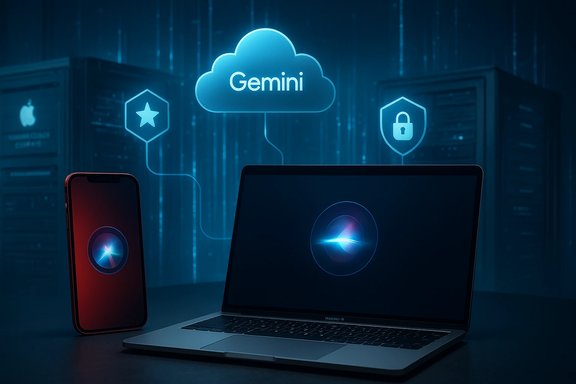
Apple’s quiet pivot to marry its privacy-first architecture with Google’s raw model power marks one of the most consequential product and business moves in the mobile AI era: a reported multi‑year collaboration that will place Google’s Gemini family at the core of Apple Intelligence and the next‑generation Siri, while running inference inside Apple’s Private Cloud Compute to preserve the company’s privacy guarantees.
Apple launched its Apple Intelligence initiative to reimagine Siri and system‑level assistant features across iPhone, iPad and Mac. The approach was always hybrid: on‑device first, cloud when needed — with a specific architectural component called Private Cloud Compute (PCC) that Apple designed to host heavy inference while claiming strict privacy and attestation guarantees. PCC uses Apple silicon in sealed server nodes, attestation checks, and stateless runtime controls so that sensitive user data is not retained or accessible to staff. Apple has published technical documentation and tooling to let independent researchers examine parts of PCC. Despite the architectural groundwork, Apple’s internal model work lagged behind competitors in raw capability for tasks that require very large, multimodal models — long‑context summarization, planner-style multi‑step task execution, and robust multimodal grounding. After running what industry reporting describes as a “bake‑off” among in‑house models and third‑party vendors — including Anthropic, OpenAI, and Google — Apple appears to have chosen a pragmatic route: deploying a bespoke variant of Google’s Gemini family inside Apple’s PCC to accelerate Siri’s capability upgrade while continuing to develop its own models. Multiple outlets have reported a roughly $1 billion‑per‑year commercial arrangement and a custom model with a reported 1.2 trillion parameter scale; these numbers are widely reported industry estimates and have not been contractually confirmed by Apple or Google.
Key drivers for the Apple–Google arrangement include:
That promise, however, comes with caveats. The most important are engineering (latency and scaling), governance (telemetry versus privacy), and perception/regulatory risk (market concentration). Reported price and model‑size figures have become shorthand for the deal’s scale, but they remain industry estimates that require caution. Apple’s PCC gives the company a technical way to host third‑party models while claiming privacy assurances — yet the real test will be how Apple operationalizes model updates, incident response, user opt‑ins, and provenance at scale.
For WindowsForum readers and the broader tech community, this move rewrites competitive dynamics: platform owners are now negotiating alliances that mix on‑device assurances with third‑party model specialization. Competition will accelerate, and the winners will be the platforms that not only deliver capability but also demonstrate sustainable, verifiable governance. The coming months of product previews, WWDC notes, regulatory filings and developer documentation will determine whether this deal is a masterstroke of pragmatic engineering or a high‑risk bandage on a much deeper model‑development gap.
Source: Qoo10.co.id https://www.qoo10.co.id/en/gadget/6...s-intelligence-with-advanced-ai-integration/]
 Background / Overview
Apple launched its Apple Intelligence initiative to reimagine Siri and system‑level assistant features across iPhone, iPad and Mac. The approach was always hybrid: on‑device first, cloud when needed — with a specific architectural component called Private Cloud Compute (PCC) that Apple designed to host heavy inference while claiming strict privacy and attestation guarantees. PCC uses Apple silicon in sealed server nodes, attestation checks, and stateless runtime controls so that sensitive user data is not retained or accessible to staff. Apple has published technical documentation and tooling to let independent researchers examine parts of PCC. Despite the architectural groundwork, Apple’s internal model work lagged behind competitors in raw capability for tasks that require very large, multimodal models — long‑context summarization, planner-style multi‑step task execution, and robust multimodal grounding. After running what industry reporting describes as a “bake‑off” among in‑house models and third‑party vendors — including Anthropic, OpenAI, and Google — Apple appears to have chosen a pragmatic route: deploying a bespoke variant of Google’s Gemini family inside Apple’s PCC to accelerate Siri’s capability upgrade while continuing to develop its own models. Multiple outlets have reported a roughly $1 billion‑per‑year commercial arrangement and a custom model with a reported 1.2 trillion parameter scale; these numbers are widely reported industry estimates and have not been contractually confirmed by Apple or Google. What Apple and Google announced — the high level
- Apple and Google describe the relationship as a multi‑year technical collaboration where the next generation of Apple Foundation Models will be based on Google’s Gemini models and related cloud technology.
- Apple will keep the visible Siri experience, UX metaphors, privacy UX and device integrations in‑house; the third‑party model will be an engineered backend component.
- Reported product scope: Gemini variants will power Siri’s summarizer and planner components — the parts that synthesize long documents, extract context, and coordinate multi‑step tasks across apps — while other Siri features may still use Apple’s own models.
- Hosting model: Crucially, the Gemini variant is reported to run inside Apple’s PCC nodes — meaning inference occurs on Apple‑controlled infrastructure, not Google’s public cloud. Apple’s PCC promises attested runtime, ephemeral data handling, and tooling for independent verification.
Technical architecture: how Gemini + PCC would work in practice
Apple’s stated technical posture for Apple Intelligence is explicit:- Use on‑device models whenever possible for fast, private tasks.
- When a user request requires larger model capacity or long context, route it to Private Cloud Compute.
- PCC runs on Apple silicon with cryptographic attestation, stateless execution, and deletion of session data after inference. Apple has published a Virtual Research Environment and select PCC components to facilitate independent review.
- Google would deliver a custom Gemini runtime or model variant specifically adapted to Apple’s PCC environment. That includes packaging the model to run inside Apple’s trusted execution environment, conforming to PCC’s attestation and anti‑telemetry constraints.
- At inference time, the iPhone (or Mac/iPad) would encrypt the prompt and any permitted context to PCC nodes, PCC would verify node identity, run the Gemini variant to produce the response, and then delete session data — in theory keeping raw prompt data inaccessible to outside parties.
- To meet Siri's responsiveness expectations, Apple will need tight latency engineering: model quantization, sparse activation techniques (Mixture‑of‑Experts), sharding strategies, and optimized runtime stacks to keep round‑trip times acceptable for voice interactions. Industry reporting notes that the Gemini architecture uses MoE routing which can allow very large total parameter counts while only activating a subset per query — a design that helps balance capability and cost.
The numbers: what is reported and what is verified
Several of the most notable claims in press coverage are quantitative and consequential. Independent cross‑checks show:- Reported payment: ~US$1 billion per year from Apple to Google for access to a bespoke Gemini instance. This figure originated with Bloomberg and has been widely echoed in industry coverage; it remains an industry‑sourced estimate rather than a corporate disclosure.
- Reported model size: ~1.2 trillion parameters for the custom Gemini variant Apple would license. Again, this is a reported engineering description; companies have not publicly released exact parameter counts for the bespoke instance. The MoE design common in recent large models also means effective per‑request compute can be far smaller than a raw parameter count suggests.
- Timeline signals: Industry reporting places initial Siri previews and staged rollouts in 2026, with specific references to iOS 26.4 and broader availability across later 2026 updates. Apple’s public timeline granularity remains coarse; treat exact release dates as provisional until Apple’s release notes confirm them.
Why Apple chose this route (strategic calculus)
Apple faces a simple but painful product reality: Siri’s perceived capability gap with competitors risks platform momentum and user perception. Building a first‑class, multimodal, long‑context assistant purely in‑house at Apple scale would demand significant time, talent, and capital.Key drivers for the Apple–Google arrangement include:
- Speed to market: Integrating a pre‑existing, production‑grade foundation model family like Gemini accelerates feature delivery versus multi‑year internal model development.
- Feature lift where it matters: Apple reportedly scoped Gemini to power the summarizer and planner components — the functions likely to deliver the biggest visible upgrade to Siri’s multi‑step reasoning and document/image summarization.
- Tradeoff management: By insisting the model run inside PCC, Apple attempts to sustain the company’s privacy narrative, even while outsourcing model expertise.
Privacy, telemetry, and model improvement — the governance puzzle
Apple’s PCC offers novel technical mechanisms to restrict data exposure: attestation, ephemeral processing, and published VRE tooling for independent verification. However, real‑world product quality for generative models typically depends on continuous feedback and curated telemetry. Reconciling zero‑retention privacy promises with model improvement is the core governance challenge:- Telemetry tradeoffs: High‑quality model fixes usually require downstream signals (user corrections, anonymized logs). Apple can try opt‑in telemetry, differential privacy, synthetic data generation, or closed‑loop retraining on opt‑in samples — but each choice has tradeoffs for speed and quality of fixes.
- Hallucinations and safety: Trillion‑parameter models can still hallucinate. Apple will need robust retrieval‑augmented generation (RAG), citation systems, domain‑specific filters, and policy enforcement for sensitive categories (health, finance, legal) to avoid delivering confident but incorrect actions. The planner component particularly magnifies these risks because it may trigger cross‑app tasks or suggestions.
- Third‑party access controls: Even if Gemini runs inside PCC, contractual and operational guardrails must prevent model owner access to ephemeral data, ensure no backchannel telemetry, and define obligations around security incidents. These elements will draw scrutiny from regulators and privacy advocates.
Regulatory and antitrust considerations
The Apple–Google tie‑up is inevitably political and regulatory because:- It deepens an already fraught commercial relationship between two dominant platform players, rekindling antitrust attention over default arrangement dynamics.
- Critics warn that concentrating major model families behind a small set of tight vendor relationships risks consolidating power over AI infrastructure and the semantic layer of user experiences. High‑profile voices have already framed the deal as a potential concentration risk.
- Regulators will ask whether the arrangement privileges one vendor, whether contractual terms restrict competition, and whether user choice or competition in the assistant market is materially constrained.
Product and user impact: what will change in Siri and Apple Intelligence
Short‑term (first wave):- Better summarization of long documents, emails, PDFs and web pages.
- More reliable multi‑step task planning (calendar booking, multi‑app workflows) via a planner component backed by Gemini capability.
- Improved multimodal understanding — combining text, images and voice for richer answers in Visual Intelligence contexts.
- Deeper Spotlight/Safari integration for AI‑augmented web search summaries.
- Expanded developer hooks for Apple Intelligence features dependent on Gemini‑backed reasoning.
- Incremental improvements as Apple refines RAG pipelines, provenance and safety filters.
Risks, tradeoffs and open questions
- Latency vs. capability: Trillion‑scale models are powerful but costly and potentially slower. Apple must engineer a balance so Siri feels snappy in voice use cases.
- Model governance: Hallucinations, bias, and safety will manifest differently in planner and summarizer roles — mitigating these will require substantial engineering and evaluation tooling.
- Perception risk: Apple’s brand is built on independence and privacy. Even running Gemini inside PCC may be perceived by some users as “relying on Google,” especially if communications aren’t crystal‑clear.
- Commercial exposure: The reported $1 billion annual price tag (if accurate) is material. It raises questions about long‑term economics and whether Apple will fully transition to in‑house models once they reach parity.
- Developer APIs and entitlements: Apple is likely to expand Apple Intelligence developer hooks. Watch for changes to entitlements, privacy‑preserving APIs and quotas tied to PCC usage.
- Enterprise security posture: Companies that manage corporate devices will want clarity on how PCC requests interact with managed profiles and corporate data. The privacy boundaries around enterprise data and PCC must be explicitly defined.
- Cross‑platform implications: A more capable Siri reshapes user expectations for assistants everywhere — Windows and Android ecosystems may see pressure to iterate on Copilot and Assistant integrations.
- Regulatory filings and disclosures: Antitrust and privacy regulators may require disclosures or impose conditions. These filings will reveal more about commercial terms and operational constraints.
- User opt‑ins for telemetry: Expect Apple to test opt‑in telemetry or in‑product feedback mechanisms as it iterates model quality while upholding privacy promises.
Practical takeaways and recommended stance
- Treat the reported $1 billion/year and 1.2 trillion parameter figures as credible but unverified industry reporting: Bloomberg and multiple outlets have repeated these numbers, yet neither corporation has published binding confirmations. Apple and Google’s joint statements confirm collaboration, not commercial specifics.
- Apple’s Private Cloud Compute is a unique engineering effort that materially changes the privacy calculus for cloud‑backed generative AI; its public documentation and VRE tools make the claims verifiable in ways many cloud vendors do not currently match. However, operationalizing a custom third‑party model inside PCC remains an engineering and governance challenge.
- For enterprise and privacy‑minded users, the practical test will be product behavior: whether Apple supplies clear user controls, transparent provenance, and rigorous safety fences around planner and summarizer outputs. Absent that, adoption in regulated or sensitive contexts will lag.
Conclusion
The reported Apple–Google collaboration to put Gemini at the backbone of Apple Foundation Models and to use that capability inside Apple’s Private Cloud Compute is a pragmatic, high‑stakes answer to a hard product problem: how to deliver world‑class assistant features without abandoning a privacy posture that’s core to Apple’s value proposition. If executed well, the partnership could give Siri the reasoning, summarization and multimodal fluency it has long lacked — and do so in a way that preserves Apple’s control over user data paths.That promise, however, comes with caveats. The most important are engineering (latency and scaling), governance (telemetry versus privacy), and perception/regulatory risk (market concentration). Reported price and model‑size figures have become shorthand for the deal’s scale, but they remain industry estimates that require caution. Apple’s PCC gives the company a technical way to host third‑party models while claiming privacy assurances — yet the real test will be how Apple operationalizes model updates, incident response, user opt‑ins, and provenance at scale.
For WindowsForum readers and the broader tech community, this move rewrites competitive dynamics: platform owners are now negotiating alliances that mix on‑device assurances with third‑party model specialization. Competition will accelerate, and the winners will be the platforms that not only deliver capability but also demonstrate sustainable, verifiable governance. The coming months of product previews, WWDC notes, regulatory filings and developer documentation will determine whether this deal is a masterstroke of pragmatic engineering or a high‑risk bandage on a much deeper model‑development gap.
Source: Qoo10.co.id https://www.qoo10.co.id/en/gadget/6...s-intelligence-with-advanced-ai-integration/]
