

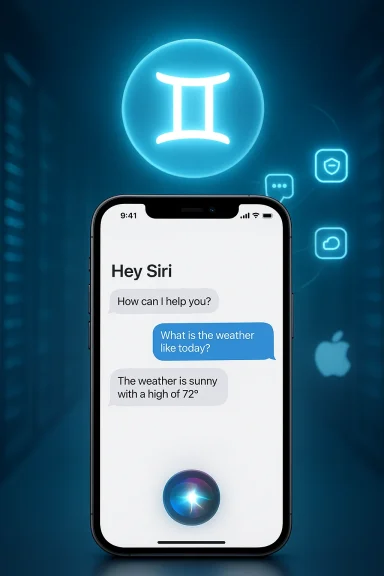
Apple appears to be on the brink of the most consequential reboot of Siri in a decade: a cloud‑backed, Gemini‑powered assistant that promises true conversational context, on‑screen awareness and deep links into personal data — and the timing, the technical architecture, and the commercial terms attached make this one of the most important product-and-strategy stories in consumer AI this year. Reported demonstrations are expected imminently, the underlying models reportedly come from Google’s Gemini family (rebranded internally as Apple Foundation Models for the iOS ecosystem), and industry estimates peg the commercial price tag in the high hundreds of millions annually — but many of the headline numbers remain unconfirmed and should be treated as reported, not official.
Siri launched as a novel, voice‑driven interface in 2011 and for years defined a key Apple experience: instant, OS‑level access to device features using natural language. But the assistant stopped evolving at the same rate as generative AI and large language models (LLMs). While Apple announced a broader Apple Intelligence strategy and on‑device models, the company repeatedly delayed the more transformative, conversational Siri features that users and investors expected. That gap opened a strategic vulnerability: rivals integrated cloud‑scale LLMs and began shipping assistants that could maintain long conversations, handle multimodal inputs, and orchestrate multi‑step tasks across apps.
Investors and markets have noticed. In early January 2026 Alphabet briefly overtook Apple in market capitalization — a symbolic market moment widely tied to investor confidence in Google’s AI execution. That backdrop helps explain why Apple’s reported decision to lean on Google Gemini is such a big deal. For Apple it’s a pragmatic acceleration move; for Google it’s validation and recurring revenue.
Technically, the architecture likely involves:
For Google, having Gemini power Siri — even behind Apple branding and Apple’s PCC — is a huge commercial win: recurring contract revenue, deeper ecosystem reach, and a validation that Gemini competes at scale. The market reaction in early January — Alphabet’s valuation leap tied in part to this partnership narrative — is exactly the kind of investor signal both companies expect.
Note, however, that the most widely reported dollar figures and parameter counts are industry leaks; Apple and Google have not published contract values or detailed engineering specs. Independent analysts have produced a range of estimates and should be considered informative rather than definitive.
Apple’s Siri reboot is both a technical engineering project and a strategic, reputational gamble. The company is promising a future where Siri is conversational, context‑aware and genuinely useful — the kind of assistant that changes workflows and daily routines. The migration to Gemini (or a tailored Gemini variant running in Apple’s Private Cloud Compute) is a pragmatic shortcut to capability, but the technical, privacy and product integration hurdles are real and unforgiving.
The earliest and most important test is almost immediate: the upcoming demonstrations. If Apple can show real, reliable scenarios — not just curated magic — the product will earn both user attention and a second look from critics. If the demo underdelivers, Apple will have to guard its brand while continuing to iterate in public, and investors will keep judging the company on its ability to execute in the age of AI.
Key reporting and industry analysis referenced in this piece were drawn from public reporting and internal industry summaries describing the Apple‑Google collaboration, expected demo timing, and commonly reported technical and commercial details; where figures (parameter counts, dollar amounts) are reported by industry sources they are explicitly flagged as unconfirmed and should be treated as estimates until Apple or Google publish official specifications or contract terms.
Source: Gizmodo New, Smarter Siri Is Reportedly Weeks from Arriving. It Had Better Be Amazing
 Background / Overview
Siri launched as a novel, voice‑driven interface in 2011 and for years defined a key Apple experience: instant, OS‑level access to device features using natural language. But the assistant stopped evolving at the same rate as generative AI and large language models (LLMs). While Apple announced a broader Apple Intelligence strategy and on‑device models, the company repeatedly delayed the more transformative, conversational Siri features that users and investors expected. That gap opened a strategic vulnerability: rivals integrated cloud‑scale LLMs and began shipping assistants that could maintain long conversations, handle multimodal inputs, and orchestrate multi‑step tasks across apps.Investors and markets have noticed. In early January 2026 Alphabet briefly overtook Apple in market capitalization — a symbolic market moment widely tied to investor confidence in Google’s AI execution. That backdrop helps explain why Apple’s reported decision to lean on Google Gemini is such a big deal. For Apple it’s a pragmatic acceleration move; for Google it’s validation and recurring revenue.
What the reporting actually says — and what’s still unverified
- Demonstration timing: Bloomberg’s Mark Gurman, cited and summarized by other tech outlets, says Apple plans demonstrations of the new Siri’s functionality in the second half of February at a small Apple event or showcase. That schedule places a public preview weeks — not months — away.
- Partnership confirmation: Apple and Google jointly acknowledged a multi‑year collaboration to base the next generation of “Apple Foundation Models” on Google’s Gemini models and cloud technology. Apple said Apple Intelligence will continue to rely on on‑device processing and its Private Cloud Compute architecture for privacy, even as it leverages Google’s model family for heavy lifting. Multiple outlets republished the joint statement Apple provided to CNBC.
- Model scale and price: Widely cited industry reporting attributes a custom Gemini variant to Apple’s needs, with reported parameter counts in the neighborhood of 1.2 trillion and a recurring commercial figure near $1 billion per year. These numbers were widely repeated in the press but have not been publicly disclosed or confirmed by Apple or Google; treat them as sourced reporting, not contractual fact. Independent industry analysis also highlights that raw parameter count is only one measure of model capability; architecture (Mixture‑of‑Experts, sparse activation), retrieval and fine‑tuning matter more in real workloads.
- Internal naming: Reports say Apple internally refers to the Google‑built model as Apple Foundation Models version 10 (AFM v10) to preserve its Apple‑first product messaging. That naming detail has been reported by multiple outlets quoting Bloomberg and industry insiders. Again: it’s a reported internal convention, not an Apple press release line.
Why this architecture — Apple devices + Private Cloud Compute + Gemini — matters
Apple’s stated AI posture since Apple Intelligence launched has been “device‑first, cloud‑when‑necessary.” The company prefers on‑device models for privacy and responsiveness, but for long context, multimodal reasoning and complex planning, device compute often isn’t enough. Private Cloud Compute (PCC) is Apple’s attempt to square that circle: run heavier inference on Apple‑controlled servers, under attestation and privacy guarantees, while keeping the visible UX and data governance in Apple’s control. If Google supplies a tuned Gemini variant that can be deployed inside PCC nodes, Apple can accelerate capability without abandoning the privacy story that underpins its brand.Technically, the architecture likely involves:
- On‑device models and caches for immediate, privacy‑sensitive tasks and low‑latency fallbacks.
- Routing to PCC when a query requires long‑context summarization, multimodal reasoning, chaining tasks across apps, or heavy world‑knowledge lookups.
- A tailored, containerized Gemini runtime adapted to Apple’s attested environment (attestation ensures the runtime is running on Apple hardware with the expected secure stack).
- Strong engineering for latency (quantization, MoE sparse activation, sharding, batching) to avoid slow, voice‑assistant feeling responses.
What the new Siri promises to deliver — realistic expectations
Reporting and leaks point to a set of product behaviors Apple has long promised but not reliably shipped:- Sustained, multi‑turn conversations that preserve context across a session and across apps.
- On‑screen awareness: Siri can inspect the active screen, understand content (webpages, emails, calendars), and act on it when the user permits.
- Access to personal, on‑device data with permissioned injection so Siri can provide personalized, actionable responses (e.g., “Do I have time for this event?” by analyzing Calendar, Mail and location).
- Better factual answers, reasoning and planning: multi‑step task execution like “find flights, add itinerary to Calendar and share details with my spouse.”
- A more natural, less rigid “personality” and fewer abrupt non‑answers.
The technical and product risks Apple must overcome
Apple’s ambition is achievable, but execution is hard. Key failure modes to watch:- Latency that kills the experience. If a voice query routes to PCC and takes multiple seconds to return, users will abandon Siri for typed search or a competitor. Overcoming this requires advanced model engineering (quantization, expert routing), localized caching strategies, and possibly graded responses (quick, conservative fallback answers while the full response is prepared).
- Hallucinations and unsafe actions. Large models generate plausible but incorrect outputs and can suggest actions that should not be taken (sending emails with incorrect recipients, recommending risky medical advice). Apple must build robust retrieval‑augmented generation, citation, and conservative guardrails — especially where actions touch other apps (Mail, Messages, Wallet).
- Privacy optics and auditability. Apple has pledged to keep Apple Intelligence on devices and in its PCC environment, but hosting a third‑party model raises questions about telemetry, training‑feedback loops, and vendor access. The cryptographic and runtime guarantees PCC offers are a meaningful technical control, but independent audits, transparency about opt‑in telemetry, and clear policies about what data is retained will be required to sustain trust.
- Product coherence and marketing. Apple historically emphasizes a unified, polished product message; quietly using a Google model but branding it as “Apple Foundation Models v10” is a pragmatic choice but one that could backfire if revealed as outsourcing the core experience. The reputational risk is asymmetric: if Siri underdelivers, Apple pays the public price even if Google supplied the model.
- Cost and supplier lock‑in. Reported multi‑hundred‑million annual fees or a billion‑dollar range are significant. Long‑term dependence on a single external model vendor could constrain Apple’s strategic choices and draw regulatory scrutiny given the existing Apple‑Google search relationship. These are business risks beyond pure engineering.
The business case: why Apple would pay — and why Google would accept
From Apple’s perspective, the deal (reported cost aside) is about competitive positioning and time‑to‑market. Apple needs a credible assistant upgrade now; building in‑house to the same capability level could take years. The hybrid approach lets Apple keep the UX, identity, and privacy framing while outsourcing the model research and scale.For Google, having Gemini power Siri — even behind Apple branding and Apple’s PCC — is a huge commercial win: recurring contract revenue, deeper ecosystem reach, and a validation that Gemini competes at scale. The market reaction in early January — Alphabet’s valuation leap tied in part to this partnership narrative — is exactly the kind of investor signal both companies expect.
Note, however, that the most widely reported dollar figures and parameter counts are industry leaks; Apple and Google have not published contract values or detailed engineering specs. Independent analysts have produced a range of estimates and should be considered informative rather than definitive.
Privacy and regulatory hot spots — what to watch
Apple’s pitch has always been privacy. Running a third‑party model inside PCC is technically plausible as a privacy‑preserving architecture, but technical guarantees must be translated into operational and legal ones:- Independent audits: Will Apple allow third‑party audits of PCC operations and of the containerized model runtime to verify no telemetry leaks?
- Telemetry opt‑ins: Will Apple require explicit user consent for any prompts or personal data used to fine‑tune models or collect usage telemetry?
- Government subpoenas and data requests: How will Apple defend a claim that “this model never sent data to Google” if external legal processes demand access?
- Antitrust signal: Deepening the Apple‑Google partnership risks renewed regulatory scrutiny given the historical antitrust concerns around default search agreements. The combination of search, models, and OS‑level integration is a complicated regulatory vector.
How to judge Apple’s next Siri: short checklist for the demo and the first public release
When Apple demos and then ships a preview or release, these are the practical outcomes that will determine success:- Responsiveness: Voice interactions should feel near‑instant; any cloud routing should not introduce perceivable lag.
- Context fidelity: Siri must correctly use on‑screen and personal context when explicitly permitted, without leaking unrelated personal data.
- Accuracy and conservatism: Factual answers should be verifiable or framed with caveats; risky recommendations must be gated.
- Action reliability: If Siri acts across apps (calendar invites, messages, purchases), it must reliably do so safely and reversibly.
- Developer tooling and controls: Third parties and enterprise users need clear APIs and governance controls to adopt Siri-powered features safely.
Timeline and next milestones
- Late February (reported): public demonstrations at an Apple event or small showcase, per Bloomberg’s Mark Gurman. This is the first public checkpoint.
- Spring 2026: reporting points to iOS 26.4 as the likely preview window for the first wave of Apple Intelligence features powered by the new foundation models.
- June 2026 (WWDC): a fuller presentation of conversational, chatbot‑style Siri features and broader Apple Intelligence integration is likely if Apple follows the staged rollout pattern described in reporting.
Final analysis — what success and failure look like for Apple
A successful rollout would give Apple a differentiated assistant that:- Feels personal and context‑aware without sacrificing privacy;
- Competes credibly with large chat assistants on reasoning and planning tasks;
- Reinvigorates Apple’s services roadmap by enabling new, subscriptionable features (e.g., Health+ with AI coaching, advanced writing tools, smarter search).
Apple’s Siri reboot is both a technical engineering project and a strategic, reputational gamble. The company is promising a future where Siri is conversational, context‑aware and genuinely useful — the kind of assistant that changes workflows and daily routines. The migration to Gemini (or a tailored Gemini variant running in Apple’s Private Cloud Compute) is a pragmatic shortcut to capability, but the technical, privacy and product integration hurdles are real and unforgiving.
The earliest and most important test is almost immediate: the upcoming demonstrations. If Apple can show real, reliable scenarios — not just curated magic — the product will earn both user attention and a second look from critics. If the demo underdelivers, Apple will have to guard its brand while continuing to iterate in public, and investors will keep judging the company on its ability to execute in the age of AI.
Key reporting and industry analysis referenced in this piece were drawn from public reporting and internal industry summaries describing the Apple‑Google collaboration, expected demo timing, and commonly reported technical and commercial details; where figures (parameter counts, dollar amounts) are reported by industry sources they are explicitly flagged as unconfirmed and should be treated as estimates until Apple or Google publish official specifications or contract terms.
Source: Gizmodo New, Smarter Siri Is Reportedly Weeks from Arriving. It Had Better Be Amazing
