• Thread Author
Microsoft is rolling Copilot Vision into Windows — a permissioned, session‑based capability that lets the Copilot app “see” one or two app windows or a shared desktop region and provide contextual, step‑by‑step help, highlights that point to UI elements, and multimodal responses (voice or typed) while preserving user control over what is shared.

A person wearing Copilot Vision AR headset works at a blue-lit computer workstation.Background​

Microsoft has steadily evolved Copilot from a text‑only assistant into a multimodal platform that uses voice, vision, and limited agentic actions to assist users across Windows. Copilot Vision is the visual arm of that strategy: instead of inferring context solely from text input or file metadata, Copilot Vision can analyze pixels on a screen (OCR, UI recognition, image analysis), extract actionable information, and respond with targeted guidance. The feature is being shipped through the Copilot app (a native Windows app distributed via the Microsoft Store) and is being rolled out progressively to Windows Insiders before wider availability. This piece explains what Copilot Vision does, how it works on typical Windows PCs and Copilot+ hardware, what to expect during rollout, and the meaningful privacy, security, and operational tradeoffs IT teams and power users should consider.

What Copilot Vision actually is​

  • Copilot Vision is a session‑bound, opt‑in capability inside the Copilot app that can analyze shared windows, app content, and desktop regions and then answer questions, give explanations, or provide guided instructions. Sessions begin when the user clicks the glasses icon in the Copilot composer and explicitly selects which window(s) or desktop region to share.
  • The assistant supports multimodal interaction:
  • Voice‑first: Vision originally launched as a voice‑centric experience that could narrate guidance out loud and highlight where to click.
  • Text‑in / text‑out: Microsoft has added typed Vision sessions, so users can type questions about the content they share and receive text replies in the Copilot chat pane; switching between text and voice is possible within a session. This text‑in/text‑out mode began rolling out to Windows Insiders via a Microsoft Store update to the Copilot app.
  • Key interactive features now available or in preview include:
  • Two‑app sharing (share content from two windows to give Copilot cross‑context awareness).
  • Highlights — visual indicators showing where to click inside the shared window to accomplish a requested action.
  • In‑flow text editing during Vision sessions (select a text box in a shared window and ask Copilot to rewrite, simplify, or localize the text while previewing the suggested change before applying it).
These capabilities shift the assistant from passive answer retrieval to an active guide that can interpret application UIs, annotate them, and help you complete tasks without guesswork.

How Copilot Vision works (the practical flow)​

  • Open the Copilot app (the native app downloaded from the Microsoft Store).
  • Click the glasses icon in the Copilot composer to start a Vision session.
  • Choose the app window(s) or the Desktop Share option you want Copilot to analyze. A visible glow indicates the active shared region.
  • Ask Copilot a question by voice or by typing (in text‑in sessions). Copilot will analyze on‑screen content, extract text with OCR where needed, infer UI semantics, and respond with instructions, annotations (Highlights), or generated text.
  • Stop sharing at any time with the Stop/X control — Vision is session‑bound and cannot see outside what you choose to share.
Behind the scenes, Vision combines on‑device UI detection and OCR with cloud or local model inference depending on device capabilities (more on that below). The experience is deliberately permissioned and visible to the user to reduce inadvertent exposure of private content.

Device support: Windows versions, Copilot app, and Copilot+ PCs​

Windows editions and rollout​

Microsoft documents that Copilot Vision (as part of the Copilot app feature set) is available for supported installations of Windows 10 and Windows 11 in regions where Copilot is offered, with staged regional rollouts beginning in the United States and expanding to additional non‑European countries. The Windows Insider program has been the first channel to receive typed Vision, Highlights, and other enhancements during preview.

Copilot+ PCs and on‑device acceleration​

Microsoft distinguishes between two runtime profiles:
  • Most Windows PCs will be able to use Copilot Vision after opt‑in, but many inference operations will run in Microsoft’s cloud if the device lacks dedicated AI acceleration.
  • Copilot+ PCs are a hardware tier specifically designed to run richer on‑device AI experiences. To earn the Copilot+ label, Microsoft requires an NPU (neural processing unit) that can perform at least 40 TOPS (trillions of operations per second), along with minimum memory and storage (commonly 16 GB RAM and 256 GB SSD) and Windows 11. These NPUs allow lower‑latency, more private local inference for select Copilot features.
Independent outlets and hardware coverage confirm Microsoft’s 40+ TOPS guidance and the practical distinction between cloud‑backed Copilot on ordinary Windows machines and accelerated, lower‑latency experiences on Copilot+ devices. Expect the most advanced local features to perform best on Copilot+ hardware.

What Copilot Vision can do — real user scenarios​

  • On‑screen troubleshooting: Stuck in nested settings or an unfamiliar app? Share the window and ask Copilot to “show me how” — Vision can highlight the UI element you need to click and narrate or type the steps. This is especially valuable for less technical users or when following long, platform‑specific guides.
  • Live document editing: Share an email draft or a text field and ask Copilot to rewrite it for tone, length, or clarity; Vision can preview suggested edits before insertion, letting you accept or refine the result. This works across browser fields, text editors, and many apps where content is visible on the screen.
  • Cross‑app context: Share two windows (for example, a spreadsheet and an email) so Copilot can compare data across them and answer questions that require correlating content from both sources.
  • Creative assistance: Share an image or photo editing app and ask Copilot for suggestions (e.g., “improve lighting” or “crop composition”) and receive step‑by‑step guidance or suggested settings.
  • Accessibility and quiet workflows: Text‑in Vision helps users in meetings or public spaces who can’t use voice; voice‑first Vision benefits users who need hands‑free guidance. The ability to switch between modalities widens accessibility.

Privacy, control, and enterprise governance​

Copilot Vision is explicitly opt‑in and session‑based: it does not run invisibly in the background or continuously monitor your display. The Copilot composer displays a glow around shared windows and a clear Stop/X control for ending the session. Microsoft documents that Vision displays a privacy notice on first use and that the on‑device wake‑word spotter or short in‑memory audio buffers used by voice features are transient and not stored on disk. Important privacy details to note:
  • Vision cannot act without explicit sharing; users must select windows and press Start. This reduces the risk of accidental exposure.
  • Microsoft’s published guidance indicates that some processing may be routed to cloud services on non‑Copilot+ devices; organizations with data residency concerns should plan accordingly.
  • Vision is not available to commercial accounts signed in with Entra ID in some configurations (Microsoft calls out specific account types and commercial exclusions in support documentation). Admins can also control which endpoints receive the Copilot app and whether features are enabled.
These are strong design choicees, but they come with operational tradeoffs: sessioning and visible UI reduce accidental exposure, yet cloud processing for non‑accelerated devices introduces downstream governance considerations (where inference happens, what is logged, and retention policies). IT teams must review Microsoft’s admin controls and Copilot licensing to align Vision use with corporate compliance. Industry analysis and early community reports reinforce that while Microsoft emphasizes opt‑in and visible controls, enterprise pilots are warranted to confirm compliance posture.

Security and risk analysis​

Copilot Vision’s novelty raises several security vectors that organizations and individual users should weigh.
  • Data exposure during cloud inference: On devices without a qualifying NPU, some visual content is sent to cloud models for analysis. That introduces common cloud‑processing risks: data transit, third‑party model handling, and retention policies. Administrators should verify contract terms and data processing agreements when enabling Vision enterprise‑wide.
  • Sensitive content and DRM: Microsoft’s support notes that Vision will not analyze DRM‑protected or explicitly harmful content. However, accidental sharing of sensitive materials (credentials, confidential documents) remains a human risk. Training users on the Stop control and visual confirmation glow is essential to minimize mistakes.
  • Phishing and social engineering vectors: A malicious actor could coerce a user into sharing a window containing secrets. Controls, auditing, and user education matter: disable Vision where risk is unacceptable, require explicit admin consent, and monitor Copilot logs if allowed by policy.
  • Model hallucination and incorrect guidance: Visual analysis uses OCR and inference models; these are not perfect. Copilot may misidentify UI elements or suggest the wrong sequence of clicks. For critical workflows (e.g., financial transactions, high‑privilege administrative tasks), treat Copilot’s guidance as an assistant, not an authoritative operator, and require human verification. Community testing in Insider previews has shown generally useful behavior but also gaps that should temper blind trust.

Rollout, versions, and what to expect​

  • Microsoft is distributing Copilot app updates through the Microsoft Store. Specific package and Windows build requirements have been called out for particular features; for example, certain text‑editing Vision features were associated with Copilot app versions in the 1.25103.107+ and 1.25121.60.0 ranges and with particular Insider Windows builds during preview. Rollouts are staged — not every Insider or region receives updates at once.
  • Expect iterative enhancements. Vision began as a voice‑centric experiment, added highlights and two‑app sharing, and later received text‑in/text‑out; Microsoft is continuing to add features in Copilot Labs and the Insiders channel before broader release. Regularly update the Copilot app and monitor Microsoft’s Copilot blog and Windows Insider channels to track which capabilities are available in your region and channel.

How to prepare: practical recommendations​

For home and power users​

  • Try Vision in a safe environment first (Insider preview if available), and learn the UI: the glasses icon, Stop control, and the glow around shared windows. These visual cues are the safety net that prevents accidental sharing.
  • If you frequently work with sensitive documents, enable Vision only when needed and close unrelated windows before starting a session.
  • Keep the Copilot app updated via the Microsoft Store and review the app’s About page to confirm package versions if testing new features.

For IT and security teams​

  • Inventory where Copilot will be used (consumer, managed M365 endpoints, guest devices) and map the regulatory exposure.
  • Establish pilot groups to test Vision workflows and log/assess what is sent to cloud services, including retention and redaction behavior.
  • Review Microsoft administrative controls for deploying or suppressing Copilot app installations on managed endpoints.
  • Update acceptable‑use and security training materials to include Vision usage guidance and the “Stop/X” habit for users.

For OEMs and purchasers​

  • If low latency and stricter privacy are priorities, buy Copilot+‑branded machines or confirm NPU capability (40+ TOPS) and other minimums. These devices will perform more inference locally and reduce cloud round trips for some features. Verify the vendor claims and check on compatibility with your critical apps.

Strengths and limits: critical assessment​

Notable strengths​

  • Contextual help where it matters: Being able to point to a UI element and get a precise instruction is a real productivity multiplier for average users who don’t want to parse technical documentation.
  • Multimodal flexibility: Text‑in/text‑out plus voice means Vision fits many workflows and accessibility needs, widening adoption scenarios.
  • Hardware scaling: Copilot+ provides a clear path to better privacy and latency for enterprises willing to standardize on AI‑ready hardware.

Practical limits and risks​

  • Dependence on cloud for many users: On non‑Copilot+ machines, Vision’s cloud reliance raises data governance questions that enterprises must address.
  • Error rates and hallucination risk: OCR and model inference are fallible; erroneous guidance in critical contexts can be harmful without human oversight. Early feedback from Insiders signals usefulness but also occasional missteps.
  • Regional and account exclusions: Expect regional rollouts, EEA gating, and variable availability for commercial Entra‑ID accounts in early phases. If you’re in a regulated region or using enterprise identity, confirm availability before planning widespread adoption.
When judged against Microsoft’s stated aims, Copilot Vision is a significant step toward making Windows more interactive and less opaque — but it is not a finished product. It’s a helpful assistant, not an autonomous operator, and the UX and governance need to be handled deliberately.

Troubleshooting and tips​

  • If Copilot Vision doesn’t appear: confirm the Copilot app is updated via Microsoft Store and that you are on the Insider channel if you expect preview features. Check the Copilot app About page for package version numbers.
  • If Vision returns incorrect text or misses UI elements:
  • Re‑share a single window rather than Desktop Share to reduce visual clutter.
  • Ensure text is readable (avoid tiny fonts or overlapping windows) and reshare.
  • Use typed follow‑ups to clarify ambiguous instructions — the typed interface gives you a persistent transcript.
  • For admins: use pilot logs, feedback hub reports, and staged enablement to catch consistent errors that might indicate app or OS build incompatibilities. Microsoft has used staged Insiders rollouts precisely to surface these problems before wide distribution.

Final verdict: why this matters to Windows users​

Copilot Vision moves the Windows experience toward a more conversational, context‑aware desktop where the assistant can literally look over your shoulder and point out the next step. That capability promises real productivity gains for help desks, knowledge workers, and people who frequently switch between apps.
But the business and security implications are nontrivial: cloud processing paths, region gating, and enterprise account exclusions mean organizations must pilot and plan. Hardware choices matter too — Copilot+ devices can deliver superior local inference and privacy, but they are not required for basic Vision functionality. Copilot Vision is not a gimmick. It is a pragmatic next step in embedding AI into the OS rather than treating it as an external tool. For individual users, it will feel like getting a knowledgeable co‑pilot for routine tasks; for IT, it will require deliberate governance and pilot testing before enterprise‑wide adoption.

Quick checklist: what to do next​

  • Update the Copilot app through the Microsoft Store and check the About page for the latest package version if testing new features.
  • Try Vision in a constrained environment (non‑sensitive windows only) to get familiar with the glasses icon, the glow, and Stop controls.
  • IT teams: run a pilot that documents what gets sent to the cloud, retention, and potential policy violations; verify admin controls for Copilot deployments.
  • If privacy or latency is critical, evaluate Copilot+ hardware options and confirm NPU TOPS claims with OEMs.

Copilot Vision represents a clear pivot in how Microsoft envisions human‑computer interaction on Windows: from keyboard/mouse abstractions to a multimodal collaboration model where the OS and an AI assistant work side‑by‑side with visible, user‑controlled boundaries. The technology will be especially powerful when paired with Copilot+ hardware, but useful even on ordinary machines — provided users and IT teams account for the privacy, governance, and reliability tradeoffs that accompany cloud‑assisted visual AI.
Source: thewincentral.com Copilot Vision Is Coming to Windows

 

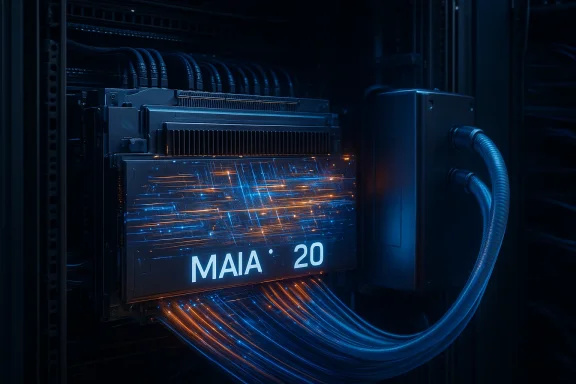
Microsoft has quietly turned a corner in the hyperscaler silicon race with Maia 200, a second‑generation, inference‑focused AI accelerator built on TSMC’s 3nm process that Microsoft says will throttle down the cost of token generation and provide a viable alternative to the dominant GPU narrative. (blogs.microsoft.com)

Futuristic blue-lit processor block marked MAIA 200 with copper cooling tubes on a circuit board.Background​

The last three years have seen hyperscalers race to own more of their AI stack — from chips to racks to orchestration software. Amazon’s Trainium lineage and Google’s TPU series were early signs that the cloud giants prefer vertically integrated hardware strategies when it can materially lower the cost of training and inference. Nvidia’s GPU dominance, however, has remained the industry default because of raw versatility, software maturity, and ecosystem momentum. Microsoft’s Maia 200 is the company’s most visible attempt yet to tilt that balance for inference workloads.
Why does that matter? Modern large language models and real‑time assistants are dominated by inference costs: the expenses and throttles that appear when models must create millions or billions of tokens for real users. Any architecture that meaningfully reduces the dollars-per-token — while keeping latency low — becomes a strategic lever for cloud pricing, product margins, and competitive positioning. Microsoft is framing Maia 200 as precisely that lever. (blogs.microsoft.com)

Overview: what Microsoft announced​

Microsoft introduced Maia 200 on January 26, 2026, through an official blog post by Scott Guthrie. The company describes Maia 200 as an inference‑first accelerator designed to boost token throughput and lower inference cost. Key vendor claims include fabrication on TSMC’s 3nm node, native support for FP4 and FP8 tensor cores, 216 GB of on‑package HBM3e hitting 7 TB/s, 272 MB of on‑chip SRAM, a 750 W SoC envelope, and a transistor budget of “over 140 billion.” Microsoft further claims over 10 petaFLOPS at FP4 and over 5 petaFLOPS at FP8 for a single Maia 200 die. (blogs.microsoft.com)
Microsoft positions Maia 200 as the fastest first‑party hyperscaler silicon by certain dense‑math metrics — specifically FP4 and FP8 throughput — and claims a 30% improvement in performance per dollar compared with its current fleet hardware. The company also announced early SDK access for academics, developers, and open‑source contributors, and said the chips are already deployed in Azure’s US Central (Iowa) data center with an imminent rollout to US West 3 (Phoenix). (blogs.microsoft.com)

Technical deep dive: architecture and specs​

Fabrication and transistor budget​

Maia 200 is built on TSMC’s 3nm process (Microsoft calls it N3P/N3) and reportedly contains over 140 billion transistors. That transistor count places Maia 200 among the largest single-die designs disclosed by cloud providers and is consistent with recent hyperscaler designs that lean into chiplet and large‑die strategies for inference density. Note that transistor counts are vendor‑reported metrics and tend to be quoted in marketing materials rather than independently measured across the industry. (blogs.microsoft.com)

Compute: FP4 and FP8 emphasis​

Unlike general‑purpose GPUs that optimize a wide range of precisions, Maia 200 is purpose‑engineered around narrow‑precision compute: FP4 (4‑bit floating point) and FP8 (8‑bit floating point). Microsoft advertises peak throughput in excess of 10 PFLOPS for FP4 and 5+ PFLOPS for FP8 per chip, figures aimed squarely at inference workloads where model weights and activations can be heavily quantized without large accuracy losses. These peak FLOPS support Microsoft’s claim that Maia 200 can “effortlessly run today’s largest models” while providing headroom for future growth. (blogs.microsoft.com)
It’s important to understand what peak FLOPS mean in practice: raw FP4/FP8 peak numbers describe idealized math throughput under specific conditions. Real‑world token throughput depends on memory bandwidth, the data‑movement fabric, model sparsity, quantization overheads, and system‑level orchestration. We’ll unpack those constraints next. (blogs.microsoft.com)

Memory subsystem: on‑package HBM3e and on‑die SRAM​

A major differentiator for Maia 200 is its memory architecture. Microsoft specifies 216 GB of HBM3e packaged alongside the die with 7 TB/s of sustained bandwidth, plus 272 MB of on‑chip SRAM used as a high‑speed scratchpad and collective buffering. For inference workloads — especially autoregressive generation where the model frequently streams weights and key‑value caches — large, high‑bandwidth memory reduces the need to chop a model across many devices and lowers request latency. (blogs.microsoft.com)
The on‑die SRAM is notable because it allows the chip to stage frequently used data and intermediate tensors close to the compute fabric, minimizing round‑trips to HBM. Microsoft’s architecture includes a specialized DMA engine and a network‑on‑chip (NoC) optimized for narrow‑precision datatypes to reduce data‑movement overheads and increase sustained utilization. (blogs.microsoft.com)

Packaging, power, and interconnect​

Microsoft lists a 750 W SoC TDP for Maia 200 and describes a two‑tier scale‑up network built on standard Ethernet with a custom Maia AI transport layer that exposes 2.8 TB/s of bidirectional dedicated scale‑up bandwidth for collective operations across clusters of up to 6,144 accelerators. Within a tray, four Maia accelerators are fully connected with direct links to keep high‑bandwidth traffic local and minimize off‑chip hops. Microsoft emphasizes a closed‑loop liquid cooling Heat Exchanger Unit (HXU) for thermal management and faster rack deployment. (blogs.microsoft.com)
This Ethernet‑first approach is a deliberate deviation from InfiniBand‑centric fabrics historically used in high‑performance AI clusters. Microsoft argues the custom transport layer and tight NIC integration deliver predictable performance and cost advantages without proprietary fabrics. The practical payoff will depend on how well Azure’s switch and NIC software stacks can match the latency and congestion control characteristics historically delivered by InfiniBand in large all‑reduce and collective patterns. (blogs.microsoft.com)

How Maia 200 stacks up against rivals​

Comparing chips from different vendors is always nuanced — vendors choose their own precision setups, memory stacks, and test conditions. Still, Microsoft explicitly compares Maia 200 to Amazon’s Trainium3 and Google’s TPU v7 (code‑name Ironwood), and independent reporting has drawn the same parallels. Below are the key comparative points.
  • Microsoft claims 3× FP4 performance vs Amazon Trainium3 and FP8 performance above Google’s TPU v7. (blogs.microsoft.com)
  • Google’s TPU v7 (Ironwood) advertises ~4,614 TFLOPS FP8 with 192 GB HBM3e and ~7.3–7.4 TB/s of HBM bandwidth. Google’s design emphasizes high pod scalability and shared memory across thousands of chips per pod.
  • AWS’s Trainium3 chips are reported at ~2.52 PFLOPS FP8 with 144 GB HBM3e and ~4.9 TB/s of bandwidth per chip; AWS scales with UltraServers packing dozens to over a hundred chips.
  • Nvidia’s newest Blackwell GPUs (B‑class/H‑class) are designed for both training and inference and typically advertise different tradeoffs — higher raw BF16/BF32 capability, different TDPs, and a mature software ecosystem. Public comparisons must account for power envelopes (Nvidia’s largest devices operate at significantly higher TDPs) and the fact that GPUs still dominate mixed workloads and training pipelines.
Two important caveats:
  • Peak FP4/FP8 TFLOPS are useful for comparing quantized throughput, but they don’t capture end‑to‑end token latency, dataset movement, or model conversion overheads.
  • Cloud providers design chips to optimize their internal economics; Maia 200’s advantage on paper won’t automatically translate into identical benefits for arbitrary third‑party workloads without software and runtime maturity.
These nuances mean performance claims should be interpreted as architecture tradeoffs, not universal dominance statements. (blogs.microsoft.com)

Software, tooling and developer experience​

Microsoft is offering a Maia SDK preview with PyTorch integration, a Triton compiler, an optimized kernel library, and a low‑level programming language (NPL). The SDK also includes a Maia simulator and cost calculator to help developers model token cost and performance early in the development lifecycle. Microsoft invited developers, academics, AI labs and open‑source contributors to apply for preview access. (blogs.microsoft.com)
This software stack is crucial. Hyperscaler silicon only unlocks customer value when model conversion, kernel support and runtime scheduling tools are mature. Microsoft’s mention of Triton and PyTorch support is important because it signals an attempt to meet developers where they are — but the real test will be how effortless and lossless model quantization is on Maia 200, and whether the SDK supports common model families and optimizer patterns without significant reengineering. Independent benchmarks and community feedback during the SDK preview will be the real barometer. (blogs.microsoft.com)

Strategic implications for Microsoft and the market​

  • Microsoft is signaling a tangible move to widen its hardware independence from a single‑vendor GPU market, while still partnering with GPU suppliers where appropriate. Owning an inference-optimized accelerator improves Azure’s pricing flexibility for products like Microsoft 365 Copilot and services run on Microsoft Foundry. (blogs.microsoft.com)
  • Maia 200’s Ethernet‑centric fabric and the claim of reducing time‑to‑deployment by more than half aim to lower operational friction when rolling out new racks. For Microsoft, faster deployment reduces capital scheduling friction when chasing capacity for large model hosting. (blogs.microsoft.com)
  • By emphasizing token throughput and per‑dollar performance, Microsoft looks to win on the economics that matter to customers running inference at scale: more tokens per dollar and lower latency for interactive services. This could pressure AWS and Google to sharpen pricing or accelerate their own next‑gen silicon rollouts.
  • Maas of inference chips across hyperscalers may encourage model creators to target narrower, quantized inference formats (FP8/FP4), increasing the incentive for model tooling that preserves accuracy under aggressive quantization.

Risks, unknowns, and practical caveats​

  • Vendor‑stated performance vs field performance: Microsoft’s numeric claims (transistor counts, FP4/FP8 PFLOPS, 7 TB/s HBM bandwidth, 30% performance per dollar) are credible and aligned with public reporting, but they are ultimately vendor measurements. Independent benchmarks will be required to confirm sustained token throughput and performance per dollar across realistic workloads. Treat marketing claims as directional until verified by third‑party tests. (blogs.microsoft.com)
  • Training capabilities: Maia 200 is explicitly an inference accelerator. Microsoft’s announcement does not position Maia 200 as a training workhorse — a space still dominated by high‑memory, high BF16/BF32 GPU platforms and specialized training ASICs. Enterprises that need to iterate on models at scale will still lean on training‑optimized hardware or hybrid approaches. (blogs.microsoft.com)
  • Ecosystem and software maturity: The SDK preview and Triton/PyTorch support are encouraging, but the developer experience for converting, quantizing and validating model fidelity on FP4/FP8 will determine how quickly Maia 200 becomes a practical alternative for teams. Historically, hardware without a robust tooling stack struggles to reach mainstream adoption. (blogs.microsoft.com)
  • Supply chain and geopolitical risk: Maia 200’s reliance on TSMC’s 3nm node ties production to a highly contested supply chain stratagem. Recent industry commentary has highlighted the systemic concentration risks in advanced semiconductor foundries. Microsoft will need to maintain supply redundancy and manage geopolitical risk as it scales Maia deployments. Reports also flag a longer‑term plan to consider US fabrication (Microsoft has signalled intent for future generations), but those plans are preliminary.
  • Comparative fairness: Cross‑vendor comparisons (e.g., Maia 200 vs Trainium3 vs TPU v7 vs Nvidia Blackwell) must account for differences in target workloads, precision strategies, and rack‑level vs chip‑level scaling. A chip that wins on FP4 throughput may not be the best choice when memory capacity or BF16 compute matters more. Readers should view the head‑to‑head numbers as architectural signals, not universal rankings.

What this means for enterprises and developers​

  • For Azure customers: Maia 200 presents a potential pathway toward lower inference costs for large models hosted on Azure, especially for latency‑sensitive services such as chat assistants, code generation, and real‑time multimodal workloads. Enterprises should watch initial SDK trials and early benchmarks to assess migration effort and price/performance tradeoffs relative to existing GPU instances. (blogs.microsoft.com)
  • For model builders and open‑source projects: Microsoft’s SDK preview invites community participation, which could accelerate toolchain maturity. Model maintainers should evaluate the cost‑benefit of targeting FP8/FP4 quantization pipelines and validate that model quality remains acceptable for their use cases. This step could unlock considerable savings for high‑throughput inference scenarios. (blogs.microsoft.com)
  • For on‑prem and hybrid customers: Maia 200 is deployed initially as a proprietary Azure accelerator; Microsoft hasn’t announced a product for direct on‑prem sale. Organizations seeking hardware diversity for on‑prem inference will still evaluate third‑party accelerators and GPU alternatives until Microsoft’s launch roadmap or partners surface broader procurement options. (blogs.microsoft.com)

Five practical actions for WindowsForum readers​

  • If you run inference at scale on Azure, request Maia SDK preview access and build a small conversion pipeline to gauge model fidelity under FP8/FP4. Microsoft has opened preview applications for researchers and developers. (blogs.microsoft.com)
  • Benchmark real workloads (not synthetic FLOPS) and measure token latency, throughput, and per‑token cost across typical request patterns. Peak FLOPS do not equal production token throughput. (blogs.microsoft.com)
  • Validate quantization impact: evaluate accuracy loss vs cost savings for your models when moving from BF16/FP16 to FP8/FP4 representations. Maintain a rollback path until you’re confident in regression behavior. (blogs.microsoft.com)
  • Monitor ecosystem tools (Triton integrations, PyTorch ops, and the Maia cost calculator). Tool maturity is the gating factor for developer productivity and model portability. (blogs.microsoft.com)
  • Keep an eye on cross‑vendor comparisons and third‑party benchmarks. AWS Trainium3, Google’s TPU v7, and Nvidia’s new Blackwell boards are evolving rapidly; the competitive landscape will change as each vendor brings additional hardware and software updates to market.

Final analysis: strengths, limits, and the near future​

Maia 200 is a concrete, well‑engineered step by Microsoft into inference specialization. Its strengths are clear: a memory‑heavy package with a generous HBM3e budget, a significant on‑die SRAM cache, a network architecture tuned for inference scale‑up, and aggressive FP4/FP8 math throughput that makes sense for token generation economics. The Ethernet‑first scale‑up and the 30% performance‑per‑dollar claim reflect Microsoft’s obsession with cost efficiency at cloud scale, and the early deployments in Iowa and Phoenix show the company moved quickly from silicon tapeout to rack deployment. (blogs.microsoft.com)
At the same time, Maia 200’s real‑world impact depends on software maturity, independent validation of sustained token throughput, and how broadly Microsoft is willing to expose the silicon to third parties. The chip is purpose‑built for inference; organizations that require heavy on‑prem training or mixed workloads will still default to GPU ecosystems or training‑oriented ASICs. Supply chain concentration at TSMC and the fact that vendor‑stated peaks hide implementation tradeoffs are additional practical risks. (blogs.microsoft.com)
For WindowsForum readers — particularly developers and IT leaders responsible for AI cost and performance — Maia 200 is a signal: hyperscalers are serious about owning inference economics. If Microsoft’s SDK delivers on its promise, and independent benchmarks confirm meaningful per‑token savings, Maia 200 could push competitors to accelerate their own low‑precision inference strategies and lead to a richer set of options for cost‑sensitive production deployments. The next weeks and months will reveal whether the marketing claims translate into measurable, repeatable benefits in production environments. (blogs.microsoft.com)
In short: Maia 200 is less a revolution than a carefully executed architectural bet — one that prioritizes the economics of inference, not raw training supremacy. If you operate large, inference‑heavy services, this is one development to watch closely.

Source: Mobile World Live Microsoft debuts new chip to take on Nvidia
 

France’s drive for digital sovereignty just moved from policy to procurement: the government has ordered a national roll‑out of Visio, its home‑grown videoconferencing platform, and signalled an end to routine use of Microsoft Teams, Zoom, Cisco Webex and GoTo Meeting across state services by 2027. The move — announced during a visit by Minister Delegate David Amiel to a CNRS laboratory — will expand a year‑long pilot into a broad deployment that already counts some 40,000 regular users and is expected to reach 200,000 public servants in the immediate rollout phase.

Professionals monitor a blue-lit map of France with connected network nodes.Background: why France is standardising on a sovereign meeting platform​

For more than a decade public administrations have adopted a patchwork of commercial collaboration tools. That diversity simplifies individual teams’ lives in the short term, but it creates a long list of operational and security headaches at scale: inconsistent data residency, fragmented access controls, costly licence renewals across different vendors, and complex interoperability for cross‑departmental workflows.
France frames the Visio decision as the logical next step in an ongoing strategy to rebuild public digital infrastructure under state control. The initiative sits within La Suite Numérique — the DINUM‑managed suite of open‑source, sovereign collaboration tools (including Tchap, Docs, Grist and Visio) accessible to civil servants via the ProConnect identity system. The state has been piloting these components for months and emphasises mutualisation, auditability and hosting on qualified French cloud infrastructure.
Political and strategic context also matters. European policymakers have been increasingly vocal about reducing reliance on non‑European digital providers for critical infrastructure, citing geopolitical risk and the legal reach of foreign laws. France explicitly connects Visio to broader sovereignty goals: the platform is intended to prevent the “exposure” of sensitive scientific exchanges and state communications to non‑European actors.

What Visio is today — features, hosting and first adopters​

Core functionality and user numbers​

Visio started as an experimental service and has been in regular use for roughly a year. According to government communications, it already supports about 40,000 regular users and is undergoing phased deployment to 200,000 agents, with the objective of making it the unique videoconferencing tool for state services by 2027. Major early adopters include the CNRS (which plans to migrate its 34,000 staff and roughly 120,000 associated researchers off Zoom), the Ministry of the Armed Forces, Assurance Maladie and the Directorate General of Public Finances (DGFiP).
Functionally, Visio aims to offer the collaboration staples public servants expect: scheduled and ad‑hoc video meetings, screen sharing, basic participant management and modern web‑based UX. One French technical outlet reported capacity for meetings of up to 150 participants, signalling feature parity with mainstream meeting services for many administrative use cases.

Sovereign hosting and security posture​

From an infrastructure perspective, Visio is hosted on OUTSCALE (a Dassault Systèmes brand) which holds the ANSSI SecNumCloud qualification. The government highlights that choice to assert legal and operational control over data residency and technical oversight. ANSSI’s SecNumCloud label and Outscale’s public statements make clear that the platform is intended to meet France’s high‑assurance cloud requirements for public sector services.
Crucially, the project has been developed by DINUM (the Interministerial Directorate for Digital Affairs) with support from ANSSI (the French cybersecurity agency). The state’s announcement stresses audits, bug bounty work and security hardening as part of the platform’s trajectory toward broader use.

AI features: transcription and future subtitles​

Visio already includes meeting transcription capabilities which, the government says, are powered by French AI technologies — notably the speaker‑separation models from Pyannote. The roadmap also points to real‑time subtitling arriving later in 2026 using tools developed by French research groups (for example, the Kyutai lab mentioned in official briefings). These choices underline an ambition to couple sovereignty with advanced collaboration features built on national AI projects.

The claimed benefits: security, interoperability and cost savings​

France’s announcement sets out three headline benefits:
  • Security and confidentiality: Hosting on SecNumCloud infrastructure and state control over code and operations reduce the risk that sensitive communications are subject to foreign legal claims or third‑party vendor incidents.
  • Interoperability and standardisation: Replacing a “mosaic” of tools with a single, state‑managed platform should simplify cross‑ministry work and lower technical friction for joint processes. DINUM frames this as a governance and resilience gain.
  • Cost savings: The government estimates savings of approximately €1 million per year per 100,000 users who migrate away from commercial licences. That figure is being used to justify the economics of moving to an in‑house, open‑sourced, centrally supported service.
These claims are credible in principle: centralising procurement and consolidating licences can reduce duplication and negotiating overhead. Hosting on qualified domestic clouds removes a whole class of cross‑border legal uncertainty. However, the net benefit will depend heavily on execution — especially on how the platform handles scale, feature parity, accessibility and third‑party collaboration.

Critical analysis: strengths, operational challenges and unseen risks​

Strengths — plausible and immediate​

  • Policy alignment and legal clarity. By hosting on SecNumCloud infrastructure and managing the stack internally, France reduces its exposure to extraterritorial claims and can enforce uniform security policies across departments. The move aligns with the national “Cloud at the Center” doctrine and EU sovereignty debates.
  • Control and auditability. An open, state‑controlled platform makes it easier to perform source audits, integrate mandatory logging policies, run coordinated incident response and require a single security baseline across services. DINUM’s model (open source components, bug bounties, audits) supports this approach.
  • Industrial policy opportunity. Prioritising French cloud and AI suppliers (Outscale, Pyannote, local research labs) creates domestic innovation demand and may help develop a European supply chain for collaboration tooling and AI in government contexts.

Operational and technical challenges — what will determine success​

  • Feature parity and user experience. Many teams will expect parity with mature commercial incumbents in areas such as large‑meeting moderation, recorded meeting management, calendar integrations, federated meetings with external parties, and polished reliability across networks and devices. Delivering consistent UX at scale is non‑trivial; short‑term friction can erode user adoption and reintroduce shadow IT. Reports indicate Visio supports standard meeting sizes and core features, but broader capabilities will need steady, well‑resourced development to match enterprise expectations.
  • Interoperability with external partners. Government departments regularly communicate with external contractors, international agencies, private organisations and researchers. A sovereign platform that is closed to outsiders by default — or that requires ProConnect credentials — raises practical questions about cross‑sector meetings and collaboration. While La Suite can invite external actors for mission‑specific work, the friction of external authentication and trust establishment could hamper collaboration unless flexible, secure federation mechanisms are provided.
  • Scale and resilience under load. Running real‑time audio/video at nation‑scale involves large network, compute and edge resource demands. Outscale’s SecNumCloud certification is an important baseline, but the operational realities of managing peaks, cross‑region latency, and 24/7 global interop will test the platform long before it achieves full maturity. Historical public cloud outages and commercial vendors’ multi‑region investments show why this is a practical, not just political, challenge.
  • Security trade‑offs with AI features. On one hand, local AI stacks reduce exposure to third‑party telemetry; on the other, integrating speech transcription and real‑time subtitling introduces new data processing flows, model update cycles, and potential privacy risks. Ensuring models process only state‑authorized data, enforce retention rules, and are free from covert data exfiltration vectors requires strong engineering and governance controls. The government claims a path for safe AI transcription via Pyannote and Kyutai technologies, but ongoing assessment will be necessary.

Political and legal considerations​

  • Perception of protectionism. While framed as security and efficiency, a move away from U.S. vendors may be characterised by some as protectionist and could complicate procurement relationships or reciprocal contracts with non‑EU partners. The French government emphasises that La Suite is mission‑focused and not intended to be a commercial competitor; nevertheless, diplomatic and trade considerations are a live factor.
  • Limited scope for private sector and international reuse. La Suite is intentionally designed for public agents and is accessed via ProConnect; the product is not a general‑purpose public offering. That limits the immediate market impact but narrows the platform’s threat model and regulatory exposure—an explicit trade‑off that policymakers appear to accept.

Practical implications for IT leaders and suppliers​

For government IT teams and civil servants​

  • Expect a phased migration timetable: critical offices and research bodies (CNRS, DGFiP, Assurance Maladie) are first movers with scheduled cutovers in early 2026–2027. Migration planning must include user training, calendar and identity integrations, and a remediation playbook for cross‑platform meetings.
  • Maintain dual‑stack readiness: until Visio fully matches all collaboration scenarios, teams will need sanctioned escape routes for secure external calls. IT leaders should define clear exception processes and technical corridors (for example, temporary guest rooms, secure bridges to partner platforms) to avoid ad‑hoc tool sprawl.

For suppliers and vendors (Microsoft, Zoom, Cisco and partners)​

  • Expect renewed pressure to demonstrate European governance models, local hosting options, contractual data sovereignty and integration with SecNumCloud or equivalent certifications. Commercial vendors may accelerate EU‑hosted sovereign offers or revised contractual clauses to retain public sector business.
  • Opportunity exists for EU cloud providers and AI startups to become second‑tier suppliers to government programs. Partnerships that embed national certifications, clear audit trails and local support will be more competitive for future tenders.

What to watch next — key milestones and metrics​

  • Adoption rate and user satisfaction. The government’s success metric will be not just numbers of accounts but sustained meeting hours, user retention and cross‑departmental adoption. Expect surveys and internal dashboards to appear during rollout.
  • Interoperability controls. Will DINUM publish clear federation standards or APIs to connect Visio to external scheduling systems, identity providers and enterprise UC systems? The quality of these integrations will shape real‑world usefulness.
  • Operational transparency. Regular publication of security audits, incident reports, capacity metrics and third‑party pen‑test results will be crucial to maintain confidence in the platform’s promises. DINUM has signalled a commitment to audits and bug bounties; ongoing public reporting will be a test of that commitment.
  • Feature roadmap delivery. Transcription and subtitling are on the roadmap; tracking whether these AI features meet accuracy, latency and privacy expectations in real deployments will be instructive. Watch for published accuracy figures, retention policies, and model governance disclosures.

Caveats and unverifiable claims​

Some figures and projections published in initial press reporting — such as precise cost‑savings estimates and long‑term run‑rate effects — are plausible but depend on internal accounting assumptions (licence costs, migration costs, staffing), which have not been published in full detail. The headline €1 million per 100,000 users per year saving appears in official briefings, but it should be considered an estimated figure subject to verification once full TCO analyses (including support, network and development costs) are published. Readers should treat such high‑level fiscal claims as indicative rather than definitive until audited budgetary figures are available.
Likewise, while the government identifies Pyannote and Kyutai as technology partners for transcription and subtitling, the operational details — such as where model weights are stored, whether models are retrained on aggregated meeting content, and how long transcriptions are retained — will determine privacy and security exposure. Those technical governance details have not all been publicly enumerated at the time of the announcement, so they warrant close scrutiny as Visio is rolled out.

Bottom line — sovereignty as strategy, not a silver bullet​

France’s Visio rollout is a defining moment for European digital sovereignty in practice: it demonstrates a willingness to turn policy rhetoric into operational infrastructure decisions. The programme’s strengths lie in its coherence with existing sovereignty policies (SecNumCloud hosting, DINUM stewardship, ProConnect access), its use of local cloud and AI ecosystems, and its early adoption by heavyweight public institutions such as CNRS.
That said, sovereignty is a long game. The platform’s ultimate value will be judged on pragmatic metrics: whether it can reliably support peak loads, integrate with external partners without imposing crippling friction, deliver the advanced features users expect, and do so at a lower overall cost than continued vendor licences. Execution risk is real, and the French state will need to sustain investment, transparent governance and strong operations to make Visio more than a symbolic victory in the sovereignty debate.
For IT managers and procurement leads outside France, the announcement is a signal: sovereignty considerations will increasingly influence public‑sector and regulated procurement. For vendors, the lesson is clear — cloud and collaboration providers who fail to offer robust local governance options and certified hosting will find themselves edged out of strategic government business. For citizens and researchers, Visio’s promise of greater control over public data is welcome — but only if that promise is matched by secure, reliable, and interoperable service delivery.

Fast facts (summary)​

  • Visio is the French state’s videoconferencing tool developed by DINUM and generalised for the administration by 2027.
  • The platform is in active rollout: ~40,000 current users, extended deployment to 200,000 agents announced.
  • Early migrations include the CNRS (34,000 staff + 120,000 affiliated researchers), DGFiP, Assurance Maladie and the Ministry of the Armed Forces.
  • Hosting: OUTSCALE, SecNumCloud‑qualified cloud; development and security support from DINUM and ANSSI.
  • AI features: speaker separation and transcription via Pyannote; real‑time subtitling slated from French AI research efforts (e.g., Kyutai).
The rollout of Visio will be one of the clearest early tests of whether a national digital‑sovereignty stack can meet the functionality and resilience requirements of modern public administration — and whether political intentions can be converted into durable, secure digital infrastructure without sacrificing the agility that collaboration tools have come to provide.

Source: SMBtech https://smbtech.au/news/french-gove...n-favour-of-sovereign-visio-meeting-platform/
 

Microsoft’s Maia 200 is not a tweak to existing cloud hardware — it’s a full‑scale push to redesign how one of the world’s biggest hyperscalers runs large models, and it accelerates a tectonic shift away from the single‑vendor GPU era toward vertically integrated AI stacks built by the cloud platforms themselves.

Blue-lit data center featuring MAIA 200 servers, glowing cables, and a MAIA SDK panel.Background​

The last five years have been defined by one obvious truth: GPUs — led by NVIDIA — powered the rapid growth of modern generative AI. But the economics of running inference at cloud scale, rising GPU prices, supply bottlenecks and the friction of closed ecosystems (notably CUDA) have prompted hyperscalers to invest in custom silicon and system designs. Google pioneered that path with TPUs; AWS has been aggressive with its Trainium family and massive Project Rainier deployments; Meta and others have been quietly iterating with their own designs. Microsoft’s announcement of the Maia 200 on January 26, 2026, moves it from a developer of cloud services into a first‑party silicon contender in a way that matters for Azure customers, enterprise IT, and the AI infrastructure market as a whole.
Microsoft framed Maia 200 as an inference accelerator — a chip and system optimized for token generation and real‑time model serving — and made a series of bold claims about raw silicon performance, system efficiency, and rapid rollout into production data centers. These claims and the surrounding industry responses reshape the vendor competition map and raise important technical and strategic questions for enterprises planning AI investments.

What the Maia 200 is (and what it isn’t)​

The hardware summary​

  • Process node and packaging: Maia 200 is built on TSMC’s 3‑nanometer process.
  • Memory: The accelerator pairs with 216 GB of HBM3E (implemented as six 12‑layer stacks in the module).
  • On‑chip resources: Microsoft reports ~272 MB of on‑die SRAM and specialized DMA/data‑movement engines to keep tensors fed.
  • Compute primitives: Native FP8 and FP4 tensor cores (Maia 200 advertises very high FP4 throughput).
  • Thermal envelope: The packaged SoC sits in a high‑power TDP envelope (Microsoft references system‑level designs in the 750 W range for Maia‑class devices).
  • System-level fabric: Microsoft describes a two‑tier Ethernet‑based scale‑up network and a custom Maia AI transport protocol that emphasizes predictable collectives across thousands of accelerators rather than proprietary InfiniBand.
  • Deployment: Initial racks are already in Microsoft’s US Central (Iowa) region, with additional deployments in Arizona and planned broader rollout across Azure.
These are not incremental GPU revisions — Microsoft co‑designed silicon, memory subsystem and rack fabric with the end‑to‑end datacenter in mind. The architectural emphasis is clear: lower‑precision math (FP8/FP4) plus big on‑chip and near‑chip memory to reduce data movement (the classic bottleneck for inference) and a standardized, Ethernet‑centric scale‑up fabric to lower TCO.

Software and developer tooling​

Microsoft is shipping a Maia SDK preview that includes:
  • PyTorch integration,
  • a Triton compiler,
  • a Maia kernel library and low‑level NPL language,
  • a Maia simulator and cost calculator.
That combination targets both model portability (high‑level frameworks) and the low‑level performance work needed to squeeze maximum tokens per dollar from the platform.

Verifiable claims and how they line up with the market​

Microsoft made several explicit, verifiable claims. It also framed those claims as comparisons to other hyperscaler silicon.
Key Microsoft claims (from the Maia launch):
  • “Three times the FP4 performance of AWS’s latest AI chip” (Trainium3).
  • “FP8 computational efficiency surpasses Google’s TPU v7” (Ironwood).
  • “30% better performance per dollar than the latest generation hardware” in Microsoft’s fleet.
  • Rapid deployment: time from first packaged part to rack deployment cut to less than half that of comparable AI infrastructure programs.
Independent public disclosures from AWS and Google make several of these comparisons meaningful to parse:
  • AWS Trainium3 (Trn3) is AWS’s 3‑nm training/accelerator family: it emphasizes density, high HBM capacity (Trainium3 chips are described with HBM3E capacities materially lower than Maia’s 216 GB per‑chip figure) and multiple‑times improvements over previous Trainium generations in throughput and energy. AWS positions Trainium3 for training and large‑scale workloads with claims of substantial performance‑ and power‑efficiency gains versus prior Trainium chips.
  • Google’s TPU v7 (Ironwood) is presented as an inference‑focused part with large per‑chip HBM3E pools (commonly reported around 192 GB HBM3E per chip) and multi‑petaFLOPS FP8 capability, built for very large, low‑latency serving clusters for Gemini models.
Both vendor claims are true in their contexts; the crucial caveat is that these vendors are comparing different metrics on different workloads. Microsoft’s Maia numbers emphasize FP4 token throughput for inference — workloads and precisions where architectures can behave very differently. AWS and Google numbers emphasize other precision points, per‑chip FP8 math, memory bandwidth and end‑to‑end system metrics for long‑context models. That means raw “times‑faster” statements must be read through the lens of precision, operator mix, system balance and the specific model used for the benchmark.

Detailed architecture notes and what they mean in practice​

Memory and the “memory wall”​

Maia 200’s use of 216 GB of HBM3E per accelerator is significant. Memory capacity and bandwidth are now as consequential as raw compute for inference because:
  • Large models increasingly require shared model context or per‑accelerator KV caches to serve very long prompts without cross‑chip transfers.
  • High on‑chip/near‑chip SRAM reduces trips to HBM and thus reduces latency and energy.
Microsoft’s reported NoC + DMA + large SRAM approach is designed to shift the performance envelope away from FLOPS counting to token per second counting, where feeding and keeping compute busy dominates.
Industry reporting indicates SK Hynix is the supplier for the HBM3E stacks used in Maia 200 modules. Microsoft’s public launch materials did not call out suppliers by name; however, multiple independent trade reports identify SK Hynix as the memory source and note the six‑stack configuration summing to ~216 GB. That kind of supply‑chain detail matters: HBM3E capacity is constrained globally, and memory suppliers control a chokepoint that affects who can ship at scale.

System network and TCO tradeoffs​

Microsoft intentionally chose an Ethernet‑centric scale‑up fabric with a custom transport layer for Maia clusters. This has clear cost advantages:
  • Ethernet switches and cabling economies versus proprietary fabrics or InfiniBand.
  • Predictability at scale and simplified integration with existing datacenter networks.
But Ethernet does not magically match InfiniBand for all‑to‑all, low‑latency collectives in training workloads. Microsoft is optimizing Maia for dense inference clusters — that is, token generation and online serving — where the economics and failure modes differ from massive multi‑rack training jobs.

Low‑precision compute: FP8 and FP4​

Maia’s emphasis on FP4 performance signals that Microsoft expects aggressive quantization to remain central to inference economics. FP4 can deliver large gains in compute density, but not all models or pipelines tolerate FP4 out of the box. Model adaptation, quantization‑aware training and careful retraining/LLM distillation will determine real world gains. Microsoft’s SDK includes the tools to port and tune models, but work is required to realize the claimed multiples over competitors on arbitrary workloads.

How Maia 200 compares to other hyperscaler silicon (concise competitive snapshot)​

  • Microsoft Maia 200
  • Node: TSMC 3 nm
  • Memory: 216 GB HBM3E (6 × 12‑layer stacks)
  • Precision emphasis: FP4 / FP8 (high FP4 throughput)
  • System: Ethernet‑based scale‑up fabric
  • Positioning: Inference, synthetic data generation, Copilot/Foundry acceleration
  • AWS Trainium3
  • Node: AWS‑designed chip (3 nm)
  • Memory: ~144 GB HBM3E (per public specs)
  • Positioning: Training and serving (Trainium family targets training efficiency)
  • Notable program: Project Rainier (huge Trainium2/Trainium fleet for Anthropic/Rainier scaling)
  • Google TPU v7 (Ironwood)
  • Memory: ~192 GB HBM3E reported
  • Precision: high FP8 throughput
  • Positioning: Inference at web scale for Gemini models; Google markets pods and large scale deployment
These are apples‑to‑apples only in part — vendor claims target different precisions, software stacks, and fleet tradeoffs. The real world is a mixed packing of chips across clouds and enterprises.

Supply‑chain and industrial implications​

  • HBM capacity is strategic. Reports that SK Hynix has become the sole supplier of HBM3E stacks for Microsoft’s Maia units underscore how memory vendors can act as gatekeepers. HBM manufacturing capacity and yields will shape which vendors can realistically ship millions of accelerators in 2026–2027.
  • Packaging and thermal systems matter. High‑density accelerators require liquid cooling and new rack designs. Microsoft notes closed‑loop liquid heat exchangers in its Maia racks; customers should anticipate new cabling, cooling and power footprints in next‑gen Azure instances.
  • Ecosystem commitments are flexible. Even as hyperscalers design first‑party silicon, they will still buy third‑party chips: OpenAI’s Broadcom deal, Anthropic’s multi‑cloud Trainium usage, and massive GPU purchases by all major labs make the market multi‑sourced for now.

Why NVIDIA isn’t obsolete — and how it’s responding​

Microsoft’s Maia 200 tightens the multi‑vendor dynamic, but it doesn’t end NVIDIA’s relevance. The company has been aggressively expanding beyond GPUs into models, systems, CPUs and strategic investments to defend its ecosystem:
  • Strategic investments and partnerships. NVIDIA’s $2 billion investment in CoreWeave (announced January 26, 2026) deepens its cloud software and data‑center reach and helps ensure reference deployments for its upcoming CPU and Rubin platform offerings.
  • Technology and acquisitions. NVIDIA secured a licensing/talent transaction with Groq late in 2025 that brought Groq’s inference IP and engineers into its orbit — a move that strengthens NVIDIA’s inference story without leaving the field open to a new rival.
  • Model and robotics play. NVIDIA has been open‑sourcing physical‑AI models (Alpamayo family, Cosmos models) and building the Omniverse simulation stack to make its platform most attractive for robotics, simulation and autonomous systems — domains where inference determinism and end‑to‑end integration pay off.
  • CPU line and full‑stack positioning. The company is introducing CPUs and co‑packaged systems (Vera, Rubin, Thor/HYPERION in automotive) to offer integrated platforms across training, inference and edge deployments.
What NVIDIA is doing is systematic: take away incentives to move entirely off the platform by making the stack more comprehensive (chips, software, orchestration, simulation and models). That’s an ecosystem play — and it explains why hyperscalers are moving to partial vertical integration rather than absolute isolation from GPU vendors.

Risks, caveats and open questions​

  • Benchmark semantics and workspace differences. Claimed multiples (e.g., “3× FP4 vs Trainium3”) are heavily benchmark‑dependent. Vendors can and do choose favorable workloads and precision settings. Expect independent tests and third‑party benchmarks to be decisive for enterprise procurement decisions.
  • Software portability and developer friction. Microsoft’s SDK promises PyTorch integration and Triton tooling, but the market still relies on a large body of CUDA‑optimized kernels and frameworks. Porting, optimizing, and validating models across Maia, Trainium and TPUs will impose real engineering costs — especially for large, fine‑tuned LLM stacks.
  • HBM supply and pricing pressure. If SK Hynix is indeed a significant supplier for Maia 200 HBM3E stacks, HBM availability and pricing will determine how many units Microsoft can build and how quickly third parties can obtain similar configurations.
  • Model quality and quantization tolerance. Aggressive FP4 use only works if models maintain acceptable output quality after quantization. The cost savings per token are compelling, but they must be weighed against potential quality regressions in reasoning, factuality or safety — especially for LLMs that power critical features like Copilot.
  • Infrastructure lock‑in. Vertical integration reduces dependence on third parties but increases operational lock‑in for the hypercaler. For customers, the calculus becomes more complex: better price/perf on Azure Maia instances might come with less flexibility to move workloads across clouds that prefer alternative accelerators.
  • Regulatory and antitrust exposure. As hyperscalers pair first‑party silicon with cloud services and model hosting, regulators will scrutinize market power, preferential treatment of first‑party services, and cross‑subsidization risks.

What this means for enterprise IT, ISVs and developers​

  • Cloud buyers: Expect a broader set of accelerator options from major clouds. Enterprises planning multi‑cloud AI strategies should include accelerator portability and quantization testing in procurement cycles.
  • DevOps and ML engineers: Add quantization pipelines, vendor‑specific kernels and end‑to‑end validation tests to CI/CD to handle precision changes and backend differences. Early SDK trials on Maia and Trainium3 will be essential to estimate migration overhead.
  • ISVs and model vendors: Longer‑term pricing improvements for inference could change product economics. SaaS vendors that charge per token or per inference may see margin pressure or new opportunities depending on which clouds they partner with.
  • Startups and edge players: The open‑sourcing of robotics and vehicle reasoning models (e.g., NVIDIA’s Alpamayo/Cosmos family) lowers barriers to entry for physical AI, while Maia and Trainium families push cloud economics in inference‑heavy verticals.

Longer‑term outlook: fragmentation, consolidation, or coexistence?​

The market is moving toward a multi‑axis outcome rather than a single winner:
  • In the short term, we will see heterogeneous deployments where GPUs, TPUs, Trainium‑class, Maia‑class and specialized inference LPUs all coexist depending on workload profile.
  • Over the medium term (12–36 months), expect consolidation driven by supply constraints (HBM, reticle limits), regulatory reactions and a flurry of ecosystem deals that either expand platforms or wrinkle competition (NVIDIA’s Groq licensing/talent moves and CoreWeave investment are examples).
  • In the long term, the equilibrium could be either a few vertically integrated stacks (NVIDIA ecosystem, cloud‑native silicon stacks from hyperscalers) or a more open, standards‑driven environment — depending on developer tooling, open frameworks, and whether independent silicon startups can scale without being absorbed.
For now, Microsoft’s Maia 200 is a meaningful escalation: it is a convincing demonstration that a hyperscaler can move from the “software + commodity GPU” model to a silicon + system + software model built for inference economics. Whether that translates into multi‑cloud disruption depends on software portability, HBM supply, independent benchmarks, and the pace at which other hyperscalers scale their own silicon programs.

Final takeaways​

  • Maia 200 is significant because Microsoft built a production‑ready inference accelerator and deployed it into Azure regions rapidly—this is not a lab demo.
  • The technical play is sensible: prioritize memory capacity and data movement for inference, embrace FP4/FP8 where model quality permits, and design racks and networks for predictable collective operations at cloud scale.
  • Ecosystem competition intensifies: AWS, Google, Meta and OpenAI have symmetrical programs; NVIDIA is fighting back by expanding vertically (models, CPU/SoC lineups, strategic investments and licensing).
  • Customers win in the near term with more choice and improved token economics, but will face complexity in portability, validation, and vendor selection.
  • Watch three indicators over the next 12 months: independent benchmark publications, HBM3E supply and pricing dynamics, and real‑world availability of Maia‑backed Azure SKUs for external customers.
Microsoft’s Maia 200 is a clear statement: the era of single‑vendor dominance for every layer of AI is ending. What follows will be a period of rapid architectural experimentation, consolidation deals, and — most importantly for enterprises — a steeper but more rewarding optimization curve for inference economics. The practical question for IT leaders is simple: when will you validate your models on the new silicon, and how will you architect portability so that superior price‑performance from one vendor doesn’t become a single point of operational risk?

Source: 조선일보 Microsoft Unveils Maia 200 AI Chip, Accelerating Big Tech Shift from NVIDIA
 

Microsoft has quietly moved one step closer to owning the full AI stack with Maia 200, a purpose-built inference accelerator the company says will speed up Azure’s AI workloads, lower token costs for AI services, and begin to reshape how enterprises run large language models in the cloud.

Azure cloud-based MAIA 200 inference accelerator with FP8/FP4 tensor cores and large on-chip SRAM cache.Background​

For the past several years hyperscalers have been quietly building custom silicon to cut costs and add strategic differentiation. Microsoft’s Maia lineage — following earlier in-house efforts — is the latest example of that trend. The company’s public announcement frames Maia 200 as an inference-first accelerator designed to be embedded into Azure’s heterogeneous infrastructure and tuned to the low‑precision math dominating modern large language model (LLM) inference pipelines.
The timing is important. Cloud providers face both economic and strategic pressure to reduce per‑token costs for generative AI services and to reduce dependence on third‑party GPU suppliers. Microsoft’s Maia 200 arrives into a market where throughput, energy efficiency, networking scale, and cost-per-inference matter as much as peak FLOPS claims. Microsoft positions Maia 200 not as a general CPU/GPU replacement but as an optimized building block for token-generation, latency‑sensitive inference, and massive, distributed serving clusters.

What Maia 200 is (and what it is not)​

Maia 200 is a custom AI accelerator built by Microsoft for Azure. At its core the design emphasizes:
  • Native support for low‑precision tensor math (FP8 and FP4)
  • High‑bandwidth memory at the package level (HBM3e)
  • A large on‑chip SRAM pool to reduce off‑chip data movement
  • A scale‑up networking topology that uses standard Ethernet with a custom transport
  • Integration with Azure’s control plane, telemetry, and rack-level security
This is an inference accelerator first: Microsoft describes Maia 200 as tuned for token throughput and predictable latency, rather than raw general-purpose training throughput. The chip is shipped as part of a tray/rack system with a specific thermal and power envelope, and Microsoft says it will be deployed inside Azure data centers rather than sold as a standalone component for on-premises purchase.
Important nuance: Many of the headline numbers circulating in early coverage are Microsoft’s own published specifications and performance comparisons. Independent, third‑party benchmark data is not yet publicly available at scale, so performance claims should be read as vendor statements until proven in neutral benchmarks.

Key hardware specifications and architecture​

Microsoft’s description and subsequent reporting from multiple technology outlets outline the following core specifications and system design choices:
  • Fabrication process: TSMC 3 nm node.
  • Precision and compute: native FP8 and FP4 tensor cores optimized for inference.
  • Peak low‑precision performance: reported in the double‑digit petaFLOPS range for 4‑bit (FP4) and mid‑petaFLOPS for 8‑bit (FP8) workloads.
  • On‑package memory: a sizeable HBM3e pool reported in the low‑hundreds of gigabytes (commonly quoted as around 216 GB) with multi‑TB/s memory bandwidth.
  • On‑die SRAM: a large SRAM footprint (commonly cited around 272 MB) to work as a high‑speed cache for model parameters and activations.
  • Transistor count: reported figures vary by outlet (from roughly 100 billion to over 140 billion transistors) but all accounts agree this is a very large, complex silicon design.
  • Power envelope: the Maia 200 system is specified with a thermal/power profile in the high hundreds of watts — a design point consistent with high‑density inference accelerators.
  • Networking: a two‑tier scale‑up network built on standard Ethernet, with about 2.8 TB/s of bidirectional dedicated scale‑up bandwidth exposed per accelerator and support for collective operations across very large clusters (Microsoft cites cluster sizes up to several thousand accelerators).
  • Integration: native Azure control plane hooks, telemetry, diagnostics, and rack/chip security.
These design choices make clear what Microsoft prioritized: maximize inference throughput per dollar and per watt, reduce the cost and latency of moving model data around, and simplify scale-up using commodity networking rather than proprietary fabric.

Performance claims and comparisons​

Microsoft’s messaging centers on three principal claims:
  • Maia 200 delivers substantial gains in low‑precision inference throughput (FP4 and FP8) compared with the latest offerings from other hyperscalers.
  • Maia 200 is more energy‑ and cost‑efficient for inference workloads — Microsoft cites roughly a 30% improvement in performance‑per‑dollar over the prior generation hardware in its fleet.
  • Maia 200 is already integrated into Azure services such as Microsoft 365 Copilot, Microsoft Foundry, and internal Superintelligence model pipelines.
Other outlets have compared Microsoft’s numbers against Amazon’s Trainium family and Google’s TPU lineup. The company has publicly asserted relative advantages — for example, multiples of FP4 throughput versus specific Trainium generations, and FP8 parity or superiority versus recent TPU generations — but those are manufacturer comparisons. Independent comparative benchmarks are not yet available at scale, and direct apples‑to‑apples comparisons are tricky because different accelerators optimize for different precisions, memory hierarchies, interconnects, and rack‑level server designs.
Readers should note that performance in real production workloads depends on model architecture, quantization strategy, batching, network topology, and how well the inference stack (frameworks, compilers, kernel libraries) maps a model onto the hardware. Microsoft’s early SDK, Triton compiler support, and PyTorch integrations are designed to address these practical engineering concerns, but real‑world throughput gains will vary by workload.

Deployment, availability, and Azure integration​

Microsoft says Maia 200 has already started deployment in select Azure U.S. regions and will be rolled out more broadly across its global data‑center footprint over time. Early targets included U.S. Central and other U.S. regions, with staged rollouts to follow.
The accelerator is presented as a native Azure resource, integrated with:
  • Microsoft’s telemetry and diagnostics stack for fine‑grained observability
  • Chip‑ and rack‑level security mechanisms and management
  • Azure’s orchestration and heterogeneous scheduling systems so Maia 200 can serve multiple models and workloads
  • Microsoft services such as Microsoft 365 Copilot, Foundry, and the Superintelligence team’s internal apps
For developers Microsoft is previewing a Maia SDK that includes:
  • PyTorch integration for model authors
  • Triton compiler support and an optimized kernel library
  • Access to a lower‑level programming language for fine‑grained control
  • A simulator and cost calculator to help teams estimate the run‑time behavior and economics of their models on Maia hardware
At launch, availability is clearly Azure‑centric: Microsoft intends to use Maia 200 to power its own cloud services and to provide developers and enterprise customers with Maia‑backed capacity through Azure rather than as a retail chip.

Why Microsoft built Maia 200: technical priorities and tradeoffs​

The Maia 200 design is centered on three technical bottlenecks that challenge modern inference deployments:
  • Data movement: moving model parameters and activations between memory tiers and across nodes frequently dominates power and latency. Maia 200’s large HBM pool plus on‑chip SRAM aims to reduce that traffic and maintain high arithmetic unit utilization.
  • Low‑precision compute: modern LLM inference is increasingly tolerant of FP8/FP4 quantization, and Maia 200’s native support for these formats targets the sweet spot for token generation: smaller data widths, higher arithmetic density, and lower energy per operation.
  • Scalable collective operations: inference at hyperscale requires predictable collective performance across many accelerators; Microsoft’s two‑tier scale‑up network and custom transport aim to provide deterministic collectives while preserving the economies of standard Ethernet.
These tradeoffs make Maia 200 extremely well suited for dense, low‑precision inference clusters. The flip side: the architecture is less focused on large‑scale training workloads that require very high double‑precision or single‑precision throughput and different memory and interconnect patterns. Microsoft’s public messaging frames Maia 200 as complementary to existing heterogeneous infrastructure (including GPUs and other accelerators) rather than a one‑size‑fits‑all replacement.

Business and strategic implications​

Maia 200 signals several shifts in the cloud and AI landscape:
  • Cloud vertical integration: Microsoft is doubling down on owning more of the stack — from datacenter to silicon to control plane — to control costs and product differentiation for AI services.
  • Cost control on token economics: for enterprises buying or consuming large volumes of generative AI, even modest improvements in performance‑per‑dollar translate into large absolute savings. Microsoft is positioning Maia 200 to reduce Azure’s marginal cost of inference and to pass some efficiency gains to customers or retain them as margin.
  • Competitive dynamics: Maia 200 intensifies hyperscaler competition with Amazon, Google, and other cloud vendors who have also invested heavily in custom accelerators. Enterprises will see more varied hardware choices in cloud catalogs.
  • Ecosystem effects: Microsoft’s SDK and tools are meant to encourage early porting of models to Maia. If the developer ecosystem embraces Maia tools, Microsoft gains a path to influence how models are quantized and compiled for inference — reinforcing lock‑in dynamics for workloads tightly optimized for Azure’s hardware.

Risks, unknowns, and caveats​

No new hardware launch is without risk. Here are the principal concerns and open questions enterprises should weigh:
  • Vendor claims vs independent benchmarks: Many headline claims (transistor counts, petaflops at FP4/FP8, “3× performance” comparisons) originate in Microsoft’s announcement. Neutral, third‑party benchmarks that apply consistent workloads across competing hardware are essential to validate these claims.
  • Variability in reported specifications: Early reporting shows discrepancies across outlets for transistor counts, exact HBM capacity figures, and the precise performance multipliers claimed versus rival accelerators. Those differences highlight the need for independent verification.
  • Supply chain and production constraints: Maia 200’s reliance on advanced foundry capacity (TSMC 3 nm) introduces a supply‑chain dependence shared across the industry. Prior reporting on Microsoft’s Maia development indicated schedule shifts and design revisions; manufacturing cadence and availability could remain constrained.
  • Platform portability and model compatibility: Models optimized to leverage Maia-specific features, quantization formats, or the Maia low‑level programming language may be harder to port to other hardware without re‑engineering. Organizations with heterogeneous deployments should plan for portability testing and fallback strategies.
  • Power and thermal density: Maia 200’s performance comes with a substantial power envelope per accelerator; dense racks using Maia will demand serious attention to power distribution and cooling.
  • Vendor lock‑in risk: Deep integration between Azure services and Maia hardware improves performance and manageability but increases the risk that workloads will become dependent on Azure‑specific tooling or economics.
  • Security and governance: Custom silicon can introduce new attack surfaces (firmware, low‑level management stacks). Microsoft emphasizes chip‑ and rack‑level security, but customers should ask for auditability and independent security reviews before running sensitive workloads.
Where public details are thin or inconsistent, those points are marked as provisional by necessity. Enterprises should treat early claims as pointers for piloting and validation, not as procurement certainties.

Practical guidance for enterprise IT and platform teams​

If you run or manage cloud AI workloads and are considering Maia 200–backed capacity in Azure, take a structured approach:
  • Define the workload profile
  • Is the workload inference‑heavy (token streaming, chatbots, Copilot‑like assistants) or training‑heavy (fine‑tuning, large‑scale pretraining)?
  • What precision formats (FP8/FP4/INT8) are available for your models, and can they be safely quantized without unacceptable quality loss?
  • Pilot on Maia‑equivalent stacks
  • Request access to the Maia SDK preview or simulator to test model mapping, quantization, and performance expectations.
  • Use representative datasets and prompts to measure latency, throughput, and quality (e.g., ROUGE/BLEU/QA accuracy or human evaluation for generative outputs).
  • Cost modeling and lifecycle analysis
  • Account for per‑token cost reductions, but also total cost of ownership elements: migration engineering, potential lock‑in, hybrid cloud egress, and monitoring/telemetry costs.
  • Model power and rack-density implications for any hybrid/on‑prem strategies that replicate Azure’s Maia performance.
  • Portability and fallback planning
  • Ensure critical workloads have migration paths to alternative hardware (GPUs, TPUs, other accelerators) to avoid single‑vendor exposure.
  • Use containerized inference serving and high‑level frameworks to keep migration friction manageable.
  • Security and compliance review
  • Ask Microsoft for detailed security documentation on chip/firmware protections, attestation mechanisms, and any third‑party audits.
  • Validate compliance posture for regulated workloads and confirm whether Maia‑hosted services inherit Azure’s compliance certifications.
  • Negotiate for transparency
  • If your workloads are large enough to matter, insist on SLA detail, performance testing, transparency on price adjustments, and exit terms.

Broader industry impact​

Microsoft’s Maia 200 is another sign that hyperscalers will increasingly design domain‑specific hardware as part of their long‑term AI strategy. The consequences are both technical and economic:
  • Greater hardware heterogeneity: Expect more specialized accelerators targeted at inference, training, and specific model classes. That will complicate cross‑cloud portability but enable finely tuned performance at scale.
  • Pressure on GPU vendors: Large cloud providers designing in‑house silicon and specialized systems reduce total addressable market growth for external GPU suppliers on the inference side.
  • Compiler & tooling arms race: Software stacks (compilers, kernel libraries, quantization toolchains) will be an increasingly decisive battleground; superior tooling can determine how much of a theoretical hardware gain becomes real in production.
  • Standardization attempts: As heterogeneity grows, industry pressure will mount for cross‑platform standards for model representation and quantized formats. Interoperability projects and open tool support will matter a great deal for cross‑vendor portability.
  • Research implications: Large AI research groups will likely benchmark across accelerators to ensure model architectures are not being over‑optimized for a single vendor’s silicon, preserving scientific generalizability.

Bottom line: who wins and who should care​

Maia 200 is strategically significant even before independent benchmarks: it demonstrates Microsoft’s intent to vertically integrate and optimize the economics of inference at hyperscale. For Azure customers and enterprises running inference‑heavy workloads, Maia 200 promises lower token costs and potentially better latency for cloud‑native generative AI services.
However, the claims carry the usual caveats attached to vendor launches. The most important guardrails for IT leaders are to demand neutral benchmarking, plan for portability, and treat early access as a pilot step rather than a full migration trigger.
If Microsoft’s performance‑per‑dollar and integration claims prove true under independent tests, Maia 200 will accelerate competition between cloud providers, pushing down the cost of inference and expanding options for businesses deploying AI at scale. If the data falls short, Maia 200 will still represent a step in the iterative arms race for tighter hardware‑software co‑design across the cloud industry.
For now, Maia 200 is best read as a concrete expression of Microsoft’s strategy: own more of the stack, tune the cloud for token economics, and build a developer ecosystem around hardware that gives Azure a measurable advantage for inference workloads. The next months of independent benchmarks, third‑party adoption, and real workload case studies will tell whether Maia 200 becomes a defining platform for inference — or another promising early milestone on the path to that outcome.

Source: dev.ua Microsoft announced its own artificial intelligence accelerator Maia 200
 

Microsoft’s Maia 200 marks a decisive step in the company’s push to own the full AI stack — a custom inference accelerator designed to deliver faster token-generation, higher utilization, and lower operating cost for large-scale AI deployed across Azure and Microsoft services such as Microsoft 365 Copilot. The chip, now rolling into select U.S. data centers, is engineered for modern low-precision AI workloads (FP4/FP8), pairs silicon-level changes with system and network optimizations, and arrives alongside a preview SDK to let developers begin porting and optimizing models.

Blue-lit server rack labeled Azure, highlighting 3nm 140B+ transistors and FP4/FP8 compute blocks.Background​

Microsoft has been steadily building internal silicon capabilities for years as part of a broader strategy to control cost, performance, and product differentiation for AI services. The Maia family — following earlier in-house efforts — is specifically positioned around inference, the production-phase computations that power chatbots, copilots, search, and other real-time AI features. Maia 200 is the latest public milestone of that program, designed to increase throughput for token generation while improving performance per dollar and per watt at cloud scale.
The announcement follows an industry trend: hyperscalers are investing in proprietary accelerators to reduce dependence on a single supplier and to optimize for their own workloads. Microsoft’s messaging emphasizes end-to-end engineering — from TSMC-fabricated silicon to rack-level networking and an SDK — reflecting the company’s desire to tightly integrate hardware and cloud software.

What Maia 200 Is (and Is Not)​

Purpose-built for inference​

Maia 200 is explicitly targeted at inference workloads rather than general-purpose training. That focus shapes design trade-offs: high throughput on low-precision tensor math, large on-package memory bandwidth for streaming tokens, and systems-level reliability and collective operations for dense inference clusters. Microsoft positions Maia 200 as an inference accelerator optimized for production model serving at scale — the part of the cloud stack that most directly affects the cost and responsiveness of user-facing AI.

Not a consumer SoC or a desktop GPU​

This is datacenter-grade silicon intended to run inside racks and trays, integrated with Azure’s control plane and management systems. It’s not being sold as a discrete product to end customers; rather, Microsoft will deploy Maia 200 inside Azure and use it to power Microsoft services and cloud offerings. That means enterprises will see the benefits mainly through Azure services rather than by installing Maia 200 in their own on-premises servers.

Under the Hood: Key Technical Details​

Microsoft released a substantial technical brief alongside the announcement that highlights the architecture choices behind Maia 200. Below are the most consequential specifications Microsoft publicized and how independent coverage corroborates them.
  • Fabrication and transistor count: Maia 200 is built on TSMC’s 3-nanometer process. Microsoft describes the part as containing over 140 billion transistors. Independent reports vary in the exact figure reported, but confirm a multi-hundred-billion-transistor class SoC built on 3nm.
  • Precision and compute: Microsoft claims Maia 200 delivers over 10 petaFLOPS at 4-bit precision (FP4) and over 5 petaFLOPS at 8-bit precision (FP8). Those numbers are aimed at modern quantized inference paradigms where lower-precision math significantly increases throughput for token-generation workloads.
  • Memory subsystem: The accelerator pairs on-die SRAM (Microsoft quotes 272 MB), and a large HBM3e memory pool (216 GB with very high bandwidth) to keep large models and context windows well-fed. Microsoft emphasizes a redesigned DMA engine and a NoC fabric for efficient, narrow-precision data movement.
  • Power envelope: Maia 200 is presented as a high-throughput part within a server-level thermal envelope; Microsoft states a 750 W SoC TDP as the design target in their technical brief.
  • Scale-up networking: A major systems innovation is the use of a two-tier scale-up network built on standard Ethernet plus a custom Maia transport layer. Microsoft cites 2.8 TB/s of bidirectional scale-up bandwidth per accelerator and the ability to run predictable collective operations across clusters up to 6,144 accelerators. This approach favors standardized datacenter networking while aiming to retain deterministic, low-hop communication for collective ops.
These figures matter because modern inference performance is as much about moving and aligning data as it is about raw tensor arithmetic. Microsoft’s architecture shows attention to the memory and network plumbing needed to sustain large-context, low-latency generation.

Performance Claims and Competitive Context​

Microsoft makes aggressive comparative claims: Maia 200 is marketed as having roughly three times the FP4 performance of Amazon’s Trainium Gen 3 and FP8 performance that exceeds Google’s TPUv7. The company also claims Maia 200 is the most efficient inference system they’ve deployed, citing a roughly 30% improvement in performance-per-dollar relative to prior hardware in their fleet.
Independent reporting broadly confirms Microsoft’s positioning, though third-party journalists and analysts note that comparisons across vendors and even across different precision formats (FP4 vs FP8 vs BF16) are inherently nuanced. Headlines citing “3x faster” are shorthand for specific FP4 workloads and must be read as apples-to-apples claims Microsoft used in their materials. Analysts point out that real-world gains depend on model architecture, batch sizes, and the software stack used to map computation to the hardware.

Why precision-split metrics matter​

FP4 and FP8 are increasingly the currency of inference economics: lower-precision formats allow more arithmetic per watt and per dollar, but they require careful model engineering to preserve accuracy. Microsoft’s emphasis on FP4 and FP8 performance directly targets mass-market token-generation scenarios where cost-per-token is the key metric. Still, performance claims measured in petaFLOPS are a partial guide; end-to-end latency, memory capacity for large context windows, and system-level utilization determine the real customer experience.

Systems Integration: From Chip to Rack to Azure​

Maia 200 isn’t just a chip; it’s positioned as an entire accelerator system that includes:
  • A custom transport protocol layered over Ethernet for collective operations and low-latency scale-up.
  • Tray-level designs where accelerators are directly connected with non-switched links to minimize intra-tray hops.
  • Tight integration with Azure’s management, telemetry, diagnostics, and security tooling.
Microsoft says time from first packaged part to rack deployment was considerably faster than comparable programs, citing lessons learned from prior internal silicon projects and a tightly integrated chip-to-cloud engineering approach. The company also highlights Maia 200 as part of a heterogeneous Azure fabric — meaning Maia will work alongside other accelerators depending on workload needs.

Where it’s deployed now​

Microsoft reports initial deployment in the U.S. Central Azure region near Des Moines, Iowa, with the U.S. West 3 region near Phoenix, Arizona listed as the next target and additional regions planned thereafter. The first users include Microsoft’s own internal model teams (the Superintelligence team) and Microsoft services such as Foundry and Microsoft 365 Copilot.

Developer Story: SDK, PyTorch, Triton, and Portability​

To build an ecosystem, Microsoft is previewing a Maia SDK aimed at researchers, ISVs, and developers. The SDK includes:
  • PyTorch integration to make model porting easier for the large open-source and enterprise communities already standardized on PyTorch.
  • A Triton compiler and an optimized kernel library for inference kernels.
  • A low-level language (NPL) and a Maia simulator plus cost-calculator to let developers estimate running costs early in the development lifecycle.
These tools are intended to reduce friction when porting workloads between heterogeneous accelerators in Azure — an important pragmatic detail given that many customers value portability and tooling continuity. Early access to the SDK is being offered to selected partners and researchers to accelerate optimization.

What This Means for Microsoft Services (Copilot, Foundry, OpenAI models)​

Maia 200’s primary, immediate impact will be internal: powering higher-throughput inference for Microsoft services. Expect lower latency and broader availability of features like always-on Copilot experiences, expanded context windows, or additional safety checks at scale because Maia 200 aims to make those operations cheaper and faster to run. Microsoft specifically called out its use for synthetic data generation, reinforcement learning pipelines, and production-serving for models, which together accelerate iterative model improvement cycles.
For Azure customers, benefits will be realized indirectly through:
  • Lower token costs when Microsoft passes through improved price/perf.
  • New instance types and managed services optimized for inference on Maia hardware.
  • Potentially faster time-to-production for models optimized with the Maia SDK.

Strengths: Where Maia 200 Looks Strong​

  • Purpose-built inference optimization: Maia 200’s focus on low-precision tensor formats, large HBM3e pools, and on-die SRAM addresses the highest-value bottlenecks for token-generation workloads.
  • Systems-level design: By tackling interconnects and scale-up networks as part of the design, Microsoft reduces the risk that fast chips will be starved by slow fabrics. This is often where purpose-built systems beat raw compute comparisons.
  • Faster time-to-deployment claims: Microsoft reports faster silicon-to-rack timelines, which suggests improved internal processes and better integration across engineering teams. Faster rollouts mean Microsoft can iterate on features and deliver cost improvements sooner.
  • Developer tooling and ecosystem: Early SDKs with PyTorch and Triton support lower the barrier for ISVs and research groups to port workloads and test cost savings.

Risks, Unknowns, and Areas to Watch​

  • Claims need real-world validation: Microsoft’s headline numbers are compelling but depend heavily on which models and workloads were tested. Independent third-party benchmarks that mirror customer workloads are required to trust the “3x FP4” or “30% perf-per-dollar” claims across the board. Journalists and analysts noted comparison nuance and called for reproducible, third-party testing.
  • Availability and vendor lock-in: Maia 200 is initially a Microsoft-deployed accelerator; customers won’t be buying Maia-equipped servers for private datacenters. Enterprises will need to evaluate whether they accept the trade-offs of running on Microsoft’s hardware via Azure versus retaining portability across GPU-based instances. The SDK and PyTorch support help, but some migration and re-tuning will be required.
  • Supply chain and manufacturing risk: Maia 200 relies on TSMC’s advanced 3nm node. As the industry has experienced before, foundry capacity and yield variability at cutting-edge nodes can affect shipment cadence and unit economics. Microsoft’s internal roll‑out cadence and any public guarantees around capacity are not fully detailed.
  • Security and observability: While Microsoft mentioned chip- and rack-level security, specialized accelerators add new complexity for attestation, patching microcode, and diagnosing hardware faults at scale. Enterprises will expect enterprise-grade telemetry and SLAs; how quickly Azure services expose that transparency remains to be seen.
  • Inconsistent external reporting on some specs: Different outlets report slightly different transistor counts and wording around performance. Where numbers diverge across articles, treat the precise figure as provisional until independent technical tear-downs or whitepapers are available.

Strategic Implications: The Hyperscaler Chip Race Intensifies​

Maia 200 demonstrates Microsoft’s intent to control more of the stack where differentiation matters for AI economics. Hyperscalers investing in in-house silicon — from training to inference — reduce margin pressure and can optimize for their own application mix. For Microsoft, owning inference silicon means:
  • Lower per-token costs for its own product suite.
  • Greater leverage to iterate on safety, privacy, and compliance features baked into the hardware/software stack.
  • A competitive narrative against rivals offering alternative silicon (NVIDIA, Google TPUs, AWS Trainium/Graviton offerings).
This will force enterprise cloud buyers to think in terms of services and outcomes (cost per token, latency, availability) rather than raw chip names. Hyperscalers that succeed in delivering measurable cost or latency advantages will likely win both developer mindshare and enterprise workloads.

Practical Guidance for IT Teams and Developers​

  • Evaluate workloads for precision tolerance. If your models maintain accuracy on FP8 or FP4 quantization, the Maia generation of hardware could deliver substantial cost and throughput gains. Begin with profiling and quantization-aware retraining to assess feasibility.
  • Start early with the SDK preview if you run production inference on Azure. Microsoft’s preview tooling (PyTorch + Triton + Maia simulator) is specifically meant to reduce iteration time and find regressions in porting.
  • Model portability: keep architecture-agnostic abstractions where possible. Even with SDK support, expect engineering work on kernels, memory layout, and collective ops when migrating between accelerator types.
  • Consider hybrid strategies. Use Maia-optimized Azure instances for inference-heavy production workloads while retaining GPUs or other accelerators for training or edge scenarios where Maia is not yet available.
  • Watch for independent benchmarks. Before wholesale migration, require representative, third-party or reproducible internal tests that mirror your production traffic patterns. Vendor claims can be optimistic for specific workloads.

Roadmap: Maia as a Multi-Generational Program​

Microsoft is explicit that Maia 200 is the first in a planned series of accelerators. The company describes Maia as a multi-generational program that will continue to push performance per dollar and per watt. That roadmap matters: ongoing silicon cadence implies Microsoft expects to reinvest heavily in custom hardware to meet the constantly rising demands of large models and user expectations for always-on AI. For customers, that promises continual improvements in economics — but also a landscape of evolving tooling and deployment patterns.

Verification Notes and Cautionary Flags​

  • Several numerical claims (transistor counts, flops, exact perf-per-dollar figures) are drawn directly from Microsoft’s technical brief and company statements. Independent outlets corroborate many of these claims, but some outlets report slightly different numbers (for example, transistor counts and SoC specifics). Treat precise headline numbers as subject to minor reporting variance until whitepapers, independent benchmarks, or third‑party hardware analyses are published.
  • The “3x” and “30%” figures are meaningful when evaluated against matched workloads. They are not a universal multiplier across every model or batch size. Independent bench tests will be required to validate those improvements for specific customer workloads.

Conclusion​

Maia 200 is more than a chip announcement — it’s a systems play that blends silicon, memory architecture, and network fabric with developer tools and cloud integration. Microsoft’s emphasis on FP4/FP8 throughput, large HBM3e pools, and a predictable scale-up network addresses the practical bottlenecks of modern inference: feeding large models quickly and economically while maintaining reliability at scale. For Azure customers, Maia 200 promises meaningful improvements in cost and latency for token-heavy services, provided model architectures can leverage lower-precision compute and revised memory/transmission patterns.
However, the usual caveats apply: public claims require independent validation, availability is initially limited to Azure regions and Microsoft services, and real-world gains depend on workload characteristics. For IT leaders and AI engineers, the sensible path is pragmatic curiosity: profile your models for low-precision readiness, experiment with the Maia SDK preview where available, and demand representative benchmarks before committing production workloads. If Microsoft’s numbers hold up under independent scrutiny, Maia 200 could be a tipping point in how hyperscalers think about and price inference — and a meaningful efficiency win for organizations running large-scale, latency-sensitive AI on Azure.

Source: Microsoft Source Microsoft Introduces Maia 200, Its Next‑Gen AI Accelerator
 

Microsoft’s Maia 200 is the clearest signal yet that hyperscalers are moving from buying AI compute by the rack to designing it from the silicon up — a purpose‑built inference accelerator that Microsoft says will deliver faster responses, lower per‑token costs, and improved energy efficiency across Azure services including Microsoft 365 Copilot.

Blue-lit data center server module labeled MAIA 20 with glowing cables.Background​

The cloud AI landscape has changed: raw training FLOPS, while still headline‑grabbing, are no longer the only metric that matters. Today, inference — the repeated, production‑time execution of models to generate tokens and respond to users — is where the recurring cost of running AI really accumulates. Microsoft’s Maia program started as an internal experiment and has now reached its second public milestone with Maia 200, an inference‑first chip and systems package purpose‑engineered to reduce the cost and latency of serving large models at hyperscale.
Hyperscalers have been quietly pursuing first‑party silicon for the strategic advantages it offers: control over supply, the ability to tailor hardware to specific workloads, and the potential to change unit economics across billions of inference queries. Microsoft is explicit: Maia 200 is a systems play — silicon plus memory, interconnect, cooling and software — intended to sit inside Azure’s heterogeneous compute fleet rather than be sold as a standalone chip.

Maia 200 at a Glance​

Headline specifications and vendor claims​

Microsoft’s published technical brief and subsequent reporting present a consistent list of headline claims for Maia 200:
  • Fabrication: TSMC 3 nm (N3) process.
  • Transistor budget: vendor‑stated figures in the low‑hundreds of billions (Microsoft references “over 140 billion” in some materials).
  • Native low‑precision tensor formats: hardware support for FP8 and FP4.
  • Peak low‑precision throughput (vendor figures): >10 petaFLOPS at FP4 and >5 petaFLOPS at FP8.
  • Memory: roughly 216 GB HBM3e on‑package with aggregate bandwidth cited in the multi‑TB/s range (Microsoft cites ~7 TB/s).
  • On‑die SRAM: vendor quoted ~272 MB to serve as a fast scratch/cache.
  • Power envelope: ~750 W SoC TDP (design/operational package).
  • Scale‑up networking: Ethernet‑based two‑tier scale‑up fabric with a proprietary Maia transport layer and per‑chip bidirectional scale‑up bandwidth figures in the terabytes/sec range (vendor cites ~2.8 TB/s bidirectional).
  • Deployment: initial rollout already begun in select Azure U.S. data centers (Microsoft has named US Central and US West regions in public statements).
These are Microsoft’s public numbers and the central architectural tradeoffs driving the design: favor memory capacity and proximity plus aggressive low‑precision compute to maximize tokens‑per‑dollar and tokens‑per‑watt in deployed inference.

Why Microsoft Built Maia 200: The Strategic Case​

Microsoft frames Maia 200 around three straightforward priorities:
  • Reduce the recurring cost of inference (tokens per dollar), the real profit and margin driver for consumer and enterprise AI features.
  • Secure predictable capacity and diversify dependency away from third‑party GPUs in an era of supply pressure and high rental costs for training‑focused accelerators.
  • Differentiate Azure by providing an integrated, optimized stack — silicon, racks, telemetry, orchestration and SDKs — that can be tuned to Microsoft’s own models and those of large enterprise customers.
Those motivations are typical of the hyperscaler push into first‑party silicon: when inference is the recurring bill, a sustained 20–30% improvement in perf/$ — the number Microsoft cites for Maia 200 versus prior fleet hardware — materially changes product economics. Microsoft’s claim of ~30% better performance‑per‑dollar is a headline economic metric in their narrative.

Inside the Architecture: A Technical Deep Dive​

Memory‑centric design​

Maia 200’s most distinct design emphasis is memory hierarchy. Microsoft argues that inference is often memory‑bound: model weights, context windows and KV caches must be supplied to tensor units quickly to avoid stalls. To attack that bottleneck, Maia 200 combines:
  • Large HBM3e capacity on package (reported ~216 GB) to reduce the need for remote weight fetches.
  • A sizeable on‑die SRAM pool (~272 MB reported) used as a low‑latency scratch for hot weights, activations and collective buffering to cut trips to HBM and network.
  • A specialized DMA/NoC and memory subsystem tuned for narrow‑precision datatypes to keep tensor pipelines fed.
This two‑tier approach — large HBM plus substantial on‑die SRAM — is explicitly engineered to reduce the number of devices required to serve a model and to shorten latency tails in generation workloads.

Aggressive low‑precision compute​

Maia 200’s tensor units are optimized for FP8 and FP4 arithmetic, which allows more arithmetic density per watt and per byte moved. Microsoft reports double‑digit petaFLOPS at 4‑bit and mid‑petaFLOPS at 8‑bit for a single chip, figures pitched at inference workloads where quantization strategies maintain model quality.
This design trade‑off sacrifices some flexibility for training (which often benefits from FP16, BF16 or higher) in exchange for much higher inference throughput at low precision. The consequence is that Maia 200 is inference‑first by architecture, not a drop‑in replacement for general‑purpose training GPUs.

Scale‑up networking and system integration​

A single accelerator is only as useful as the system it sits in. Microsoft pairs Maia 200 with:
  • A two‑tier rack and cluster scale‑up topology that uses standard Ethernet augmented with a Maia transport to provide deterministic collective operations at scale.
  • Tray‑level direct links connecting four Maia accelerators and an architecture designed to scale to thousands of accelerators with predictable collectives.
  • A liquid cooling heat‑exchanger side‑car and a rack design tailored to Maia’s thermal envelope to achieve production reliability inside Azure.
By designing the NIC, transport and rack together, Microsoft is betting it can deliver predictable tail‑latency behavior for inference while keeping operating costs manageable in a cloud setting.

Software and Developer Access​

Microsoft launched a preview Maia SDK aimed at enabling early optimization and porting. The SDK includes:
  • PyTorch integration for direct model authoring and inference pipelines.
  • A Triton compiler integration and an optimized kernel library to map models efficiently to Maia’s specialized units.
  • A lower‑level programming interface (referred to in public materials as NPL or a Maia low‑level language), simulators and a cost‑calculator to estimate runtime behavior and economics.
Microsoft is positioning the SDK to reduce friction for teams already invested in PyTorch and Triton toolchains, but early access and a preview release mean production readiness will depend on the maturity of compiler and quantization tooling.

Performance Claims and the Evidence Gap​

Microsoft’s published numbers — throughput, memory bandwidth, SRAM size, and a ~30% perf/$ improvement — form a compelling narrative. They also require healthy skepticism:
  • The most important figures are vendor‑provided and compared to competitor chips using selective metrics. Independent, apples‑to‑apples benchmarks at scale are not yet available publicly.
  • Comparative claims (e.g., multiples versus Amazon Trainium Gen‑3 or parity/superiority versus Google TPU v7 on certain precisions) should be read as vendor statements until neutral third‑party testing validates them.
Microsoft itself expects these caveats: real‑world throughput depends on model architecture, quantization fidelity, batching, network topology and how well frameworks and kernels map the model onto the hardware. The company’s SDK aims to mitigate these practical issues, but performance will vary by workload.

Deployment, Availability and Azure Integration​

Microsoft says Maia 200 racks are already in select U.S. Azure regions with staged rollouts planned to other regions as capacity grows. The initial adopters are internal teams (Superintelligence, Foundry), Microsoft 365 Copilot, and hosted OpenAI models on Azure, with developer access through the SDK preview expected to follow. Because Microsoft will expose Maia 200 primarily as an Azure resource, enterprises will experience Maia’s benefits through Azure services rather than installing chips on‑premises.
Operationally, Maia is integrated with Azure’s control plane, telemetry, and orchestration systems so that the accelerators can be scheduled, monitored and managed like other cloud resources — a necessary capability for large, multi‑tenant clouds.

Risks, Limitations and Open Questions​

No major architecture is without tradeoffs. Key risks and caveats for Maia 200 include:
  • Vendor‑reported metrics versus independent validation: Many crucial numbers are Microsoft claims and need neutral benchmarking on real workloads before enterprises reorganize their infrastructure around Maia.
  • Inference specialization: Maia 200’s focus on FP4/FP8 and memory locality diminishes its utility for high‑precision training workloads, meaning organizations will still need a heterogeneous fleet for training and some inference scenarios.
  • Quantization and model quality: Relying on aggressive low‑precision formats increases the burden on quantization tooling and model evaluation to maintain output quality, especially for complex reasoning or safety‑sensitive tasks.
  • Thermal and power costs: A ~750 W TDP design requires sophisticated cooling and impacts datacenter PUE and operational planning; gains in perf/$ must be examined net of power, cooling and rack density tradeoffs.
  • Availability and vendor lock‑in: Because Maia 200 will be offered primarily as Azure capacity, customers who want on‑prem Maia hardware cannot currently buy it as a discrete component; this reinforces the cloud‑first, Azure‑centric model.
Enterprises should treat Microsoft’s efficiency and comparative claims as hypotheses to be validated by pilot programs, workload‑level testing and careful TCO modeling.

What This Means for Developers and IT Leaders​

For model authors, platform engineers and cloud architects, Maia 200 introduces both opportunity and work:
  • Opportunity: Potentially lower inference costs, improved latency for interactive AI features, and a path to ship higher‑value, token‑heavy products at reduced marginal cost. This is especially relevant for services like Microsoft 365 Copilot that serve millions of interactive requests.
  • Work: Effort is required to port and tune models for FP8/FP4 execution, validate quantization strategies, and measure tail latency and quality regression across representative workloads. Microsoft’s SDK preview, Triton support and PyTorch integration aim to reduce friction, but teams will need to validate results empirically.
Recommended practical steps for teams evaluating Maia‑backed capacity:
  • Run representative inference workloads on Azure Maia preview or equivalent simulators to measure latency, throughput, and quality under realistic batching and stateful contexts.
  • Test aggressive quantization paths (FP8, FP4) and compare model outputs against baseline FP16/BF16 deployments to quantify any quality drift.
  • Model whole‑system TCO including power, cooling, networking and orchestration overhead, not just chip‑level perf/$.
  • Consider hybrid scheduling that places latency‑sensitive production serving on Maia capacity while retaining training and high‑precision tasks on proven GPU fleets.

Market and Competitive Implications​

Maia 200 completes Microsoft’s strategic arc from experimentation (Maia 100) to a productionized, inference‑optimized accelerator. The launch places pressure on other hyperscalers — notably AWS and Google Cloud — to continue developing differentiated silicon or to accelerate partnerships and pricing to stay competitive on inference economics. Microsoft’s public comparisons to Amazon Trainium and Google TPU lineups emphasize the competitive posture underlying Maia’s release; however, those comparisons are selective and should be validated by independent benchmarks.
If Microsoft’s perf/$ and tokens‑per‑watt advantages hold in real workloads, Azure could gain a sustainable edge in pricing and throughput for production generative AI features, particularly those integrated tightly with Microsoft applications and services. The wider industry effect may be a faster migration toward heterogeneous cloud fabrics in which first‑party accelerators and third‑party GPUs coexist and are scheduled based on workload characteristics.

Final Analysis: Where Maia 200 Matters — and Where Prudence Is Required​

Maia 200 is consequential for three reasons:
  • It crystallizes the trend that inference economics drive hyperscaler silicon decisions today.
  • It demonstrates Microsoft’s commitment to building an end‑to‑end AI stack — silicon, software, and systems — to control cost and capacity for its flagship AI services.
  • It provides a realistic path for Azure customers to access optimized inference capacity without buying specialized hardware directly, which may accelerate product roadmaps that are token‑heavy.
At the same time, a high degree of caution is appropriate. Key claims remain vendor‑stated and must be validated across a diversity of real‑world workloads. Quantization tooling, compiler maturity and full system TCO will ultimately determine whether Maia 200’s theoretical gains translate into operational advantage for customers. Enterprises and developers should view the Maia SDK preview as an invitation to test and verify, not as a production endorsement without empirical proof.

Microsoft’s Maia 200 is more than a new chip announcement; it is a strategic move to reshape the economics and operational contours of cloud AI inference. For WindowsForum readers — whether builders, architects or decision makers — the immediate imperative is practical: engage with the preview, run workload‑level tests, and measure real token cost, latency and quality outcomes before committing at scale. If Microsoft’s claims hold up in neutral benchmarks, Maia 200 could lower the effective cost of generative AI at scale and tilt competitive dynamics in Azure’s favor; if not, the industry will still have learned valuable lessons about where the next cycle of specialized AI silicon should invest its engineering effort.
Conclusion: Maia 200 is a landmark release in hyperscaler silicon strategy — promising, purposeful and engineered around the realities of deployed generative AI — but its ultimate impact will be decided by independent validation, tooling maturity and the economics of running token‑heavy services in production.

Source: Microsoft Source Microsoft Introduces Maia 200, Its Next‑Gen AI Accelerator
 

Back
Top