

Apple’s long-running Hide My Email flaw has finally been patched, but the incident leaves an uncomfortable aftertaste for iCloud+ subscribers who paid for a privacy feature that could, under specific conditions, reveal the very email address it was meant to conceal.
The issue affected Apple’s alias-based email forwarding system, which creates unique random addresses for website registrations, newsletters, online purchases, and correspondence. Instead of handing over a primary inbox address, users could provide a Hide My Email alias and let Apple forward legitimate mail to their actual account. That protection is valuable only if the connection between the alias and the destination inbox stays secret.
For more than a year, that connection was not reliably protected. A carefully crafted or automatically rejected message could cause the recipient’s real forwarding address to appear in mail-server logs, undermining the central privacy promise of the service. Apple says it deployed a patch on July 3 and that the underlying issue is fully resolved. However, the unusual delay, conflicting testing reports, and possibility of historical mail logs mean the fix is not the end of the story for every affected user.
Hide My Email is part of an iCloud+ subscription and is designed to reduce the amount of personal information users hand over online. Rather than using a primary Gmail, Outlook, iCloud, or work address everywhere, a user can generate an Apple-managed random email address for a specific service.
Messages sent to that random address are forwarded to an email address associated with the user’s Apple Account. The service can be used through iPhone, iPad, Mac, Safari, Mail, and iCloud.com, depending on the workflow and device.
The practical advantages are straightforward:
That makes the newly fixed flaw significant. The defect did not merely create a nuisance or allow additional spam. It reportedly broke the identity-separation property that made the service worth using in the first place.
This is important because email is not a single, private channel between two people. It is a distributed delivery system involving sending servers, receiving servers, spam filters, security gateways, relays, and logging systems. Every stage may create records used for troubleshooting, abuse prevention, compliance, and delivery diagnostics.
That distinction matters. A system can safely relay ordinary, accepted email while still leaking sensitive routing information when it generates or handles an error response. Security engineering is often defined by these paths: failures, retries, bounces, automated notices, and exceptional states that receive less scrutiny than the normal successful workflow.
For a privacy-conscious user, an exposed primary email address can be enough to create a wider identity trail. Email addresses are commonly used as durable identifiers across:
For users who selected Hide My Email to distance personal accounts from a business, a hobby community, a public-facing profile, or an unwanted contact, the risk could be more personal than a typical spam problem.
The public disclosure in early July brought fresh scrutiny to the pace and quality of Apple’s response. Apple later stated that it had deployed a patch on July 3, 2026, and that the issue had been fully resolved.
That date is notable because initial public reporting around the flaw appeared shortly before or around the same period. The timeline creates the impression that a serious privacy defect in a paid service remained unresolved for roughly a year before a working fix was available.
Still, a privacy feature must be judged by the outcome, not merely by the investigation effort behind it. If a flaw can still expose a protected identity after a claimed fix, then the real-world privacy guarantee has not been restored.
The episode highlights an enduring security problem for major platform providers: a product can be technically sophisticated, broadly useful, and well integrated into an operating system while still failing under a narrowly defined but security-critical condition.
The conflicting results leave several possible explanations:
For an iCloud+ feature sold on privacy benefits, users deserve confidence that the repair was not only implemented but also validated across the service’s real-world mail paths.
Because this is an infrastructure and relay-service issue, the remediation appears to be primarily on Apple’s side. Users should not assume that a particular iPhone, iPad, Windows PC, Mac, or Mail app update alone was the sole protection. Service-side fixes can take effect without a visible operating-system update.
However, the fix cannot retroactively erase logs that may already have been created by external email systems.
The researchers involved have cautioned that Hide My Email addresses created before July 7, 2026 should be treated as potentially exposed. That does not mean every preexisting alias was definitely unmasked. There is no public evidence that all aliases were harvested, that every user was affected, or that the flaw was exploited at scale.
But it does mean affected users cannot confidently audit the full history of exposure from their own inboxes. An email rejected upstream may never have appeared in a mailbox, and the relevant records could exist only on a sender’s or intermediary’s systems.
This is the uncomfortable reality of privacy failures in distributed systems: the original defect can be fixed, while the data trail created during the vulnerable period may remain beyond the vendor’s control.
The reported flaw could reveal the user’s real email address associated with a Hide My Email alias. It did not, by itself, reportedly expose:
Windows users frequently manage mixed ecosystems. A person may generate a Hide My Email alias on an iPhone but receive the forwarded mail in Outlook.com, Gmail, Microsoft 365, or a corporate Exchange mailbox accessed through Windows 11. The privacy boundary matters regardless of which operating system runs the email client.
The Apple Hide My Email incident demonstrates that privacy guarantees are only as strong as the least-protected exceptional path.
Those are genuine strengths. The service remains useful after the patch, especially for routine account sign-ups and reducing unwanted marketing exposure.
Yet the incident also shows why privacy products should be assessed with the same seriousness as security products. A password manager that exposes vault contents through an error message would not be excused because ordinary logins worked properly. Likewise, an email relay that reveals the hidden destination during a bounce condition fails a key part of its privacy design.
A lawsuit is an allegation, not a legal finding. The claims will have to be tested in court, and Apple will have an opportunity to respond. Still, the dispute points to a broader consumer-protection question: what standard should apply when a subscription service is sold specifically on privacy benefits?
That affects expectations in several ways:
But they do not erase the reputational risk. Privacy claims create a high bar. When a company offers a service specifically designed to prevent a category of exposure, the company must show that it can identify, contain, validate, and communicate serious failures quickly.
There is no need for panic or a mass reset of every online account. The sensible approach is to prioritize aliases connected to sensitive activity or people.
Users should avoid treating one Hide My Email alias as a universal replacement for a primary address. Reusing a single alias across multiple services weakens the ability to isolate data sharing and increases the value of that alias to marketers or attackers.
Before deactivating an older Hide My Email address, update the email address at the affected website or service. Confirm that the new alias receives messages correctly, then deactivate the older one if appropriate.
The product still solves a common privacy problem: most online services demand an email address long before users can determine whether the service deserves trust. A random forwarding alias provides a practical layer of separation between a primary inbox and the wider web.
That ease of use produces practical benefits:
The appropriate conclusion is not “never use it again.” It is more precise: use it with an understanding that aliases reduce exposure but do not create an invulnerable identity shield.
A robust privacy relay must preserve its guarantee under normal delivery, rejected mail, spam decisions, malformed messages, and every other corner case that an internet-scale email system encounters. Error handling is not an afterthought. It is part of the security boundary.
Apple’s July patch appears to have closed the immediate vulnerability, and that is an essential outcome. But the yearlong gap between report and durable remediation, combined with uncertainty around prior exposure, has created a trust problem that a short statement of resolution cannot entirely erase.
For iCloud+ subscribers, the best path is measured rather than alarmist: continue using Hide My Email for new sign-ups, replace older aliases where the privacy stakes are high, secure the destination mailbox, and treat any pre-July 2026 alias as potentially less private than originally promised. The service is useful again, but this episode has shown that even well-designed privacy tools must earn trust continuously—especially when their entire purpose is to keep an identity hidden.
The issue affected Apple’s alias-based email forwarding system, which creates unique random addresses for website registrations, newsletters, online purchases, and correspondence. Instead of handing over a primary inbox address, users could provide a Hide My Email alias and let Apple forward legitimate mail to their actual account. That protection is valuable only if the connection between the alias and the destination inbox stays secret.
For more than a year, that connection was not reliably protected. A carefully crafted or automatically rejected message could cause the recipient’s real forwarding address to appear in mail-server logs, undermining the central privacy promise of the service. Apple says it deployed a patch on July 3 and that the underlying issue is fully resolved. However, the unusual delay, conflicting testing reports, and possibility of historical mail logs mean the fix is not the end of the story for every affected user.
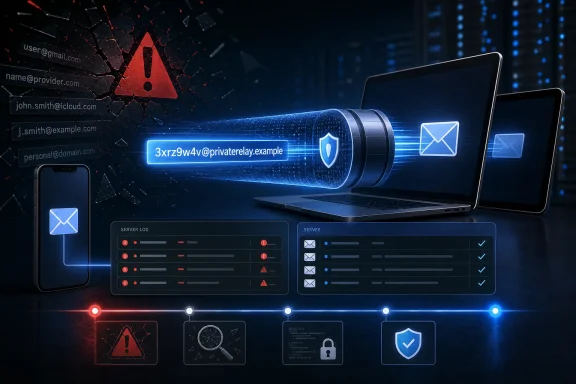 Background: What Hide My Email Is Supposed to Do
Hide My Email is part of an iCloud+ subscription and is designed to reduce the amount of personal information users hand over online. Rather than using a primary Gmail, Outlook, iCloud, or work address everywhere, a user can generate an Apple-managed random email address for a specific service.Messages sent to that random address are forwarded to an email address associated with the user’s Apple Account. The service can be used through iPhone, iPad, Mac, Safari, Mail, and iCloud.com, depending on the workflow and device.
The practical advantages are straightforward:
- A retailer, app, newsletter, or forum does not receive the user’s main email address.
- Users can identify which service may have leaked or misused an address.
- An unwanted alias can be deactivated without disrupting the primary inbox.
- Replies can continue through the alias, preserving the separation between a user’s real address and the outside party.
- The number of data brokers, marketers, and breached databases holding a primary email address can be reduced.
That makes the newly fixed flaw significant. The defect did not merely create a nuisance or allow additional spam. It reportedly broke the identity-separation property that made the service worth using in the first place.
The Vulnerability: How an Alias Could Reveal the Real Inbox
The technical details were initially withheld while the issue remained exploitable, which was the responsible choice. The broad outline is now clearer: an email sent to a Hide My Email alias could trigger a rejection or bounce path in which the user’s actual forwarding address became visible in mail transfer logs.This is important because email is not a single, private channel between two people. It is a distributed delivery system involving sending servers, receiving servers, spam filters, security gateways, relays, and logging systems. Every stage may create records used for troubleshooting, abuse prevention, compliance, and delivery diagnostics.
A privacy feature failed during an edge case
Apple’s intended model was simple:- A sender addresses an email to a Hide My Email alias.
- Apple receives the message.
- Apple forwards it to the user’s selected real inbox.
- The sender sees only the alias, not the forwarding destination.
That distinction matters. A system can safely relay ordinary, accepted email while still leaking sensitive routing information when it generates or handles an error response. Security engineering is often defined by these paths: failures, retries, bounces, automated notices, and exceptional states that receive less scrutiny than the normal successful workflow.
Why mail logs are a meaningful privacy risk
The concern is not simply that a sender might receive a visible bounce message containing the destination address. Mail infrastructure can log details at multiple points, including addresses, routing data, delivery outcomes, timestamps, and rejection reasons.For a privacy-conscious user, an exposed primary email address can be enough to create a wider identity trail. Email addresses are commonly used as durable identifiers across:
- Account databases
- Breach datasets
- People-search sites
- Marketing platforms
- Social networks
- Professional profiles
- Data-broker records
- Password-reset targeting campaigns
- Phishing and impersonation attempts
For users who selected Hide My Email to distance personal accounts from a business, a hobby community, a public-facing profile, or an unwanted contact, the risk could be more personal than a typical spam problem.
A Yearlong Reporting Timeline Raises Hard Questions
The issue was reportedly disclosed to Apple in June 2025 by security researcher Tyler Murphy, co-founder of EasyOptOuts. Apple acknowledged the report and investigated it, but the vulnerability remained reproducible through subsequent stages of communication.The public disclosure in early July brought fresh scrutiny to the pace and quality of Apple’s response. Apple later stated that it had deployed a patch on July 3, 2026, and that the issue had been fully resolved.
That date is notable because initial public reporting around the flaw appeared shortly before or around the same period. The timeline creates the impression that a serious privacy defect in a paid service remained unresolved for roughly a year before a working fix was available.
Earlier remediation efforts appear to have been insufficient
Reporting on the case indicates that Apple had previously suggested the issue was addressed, including an earlier claimed fix that did not fully eliminate the behavior in later testing. That does not necessarily mean Apple ignored the report; complex mail-routing systems can involve difficult interactions between spam filters, relay logic, error messages, and third-party infrastructure.Still, a privacy feature must be judged by the outcome, not merely by the investigation effort behind it. If a flaw can still expose a protected identity after a claimed fix, then the real-world privacy guarantee has not been restored.
The episode highlights an enduring security problem for major platform providers: a product can be technically sophisticated, broadly useful, and well integrated into an operating system while still failing under a narrowly defined but security-critical condition.
The July 3 patch was not immediately free from doubt
A further complication came from independent reporting that the problematic behavior could still be reproduced on July 17, two weeks after Apple said the patch had been deployed. Later testing reportedly found that the issue could no longer be reproduced, and the researchers who initially reported the flaw have acknowledged that the underlying bug has been fixed.The conflicting results leave several possible explanations:
- The patch may have rolled out gradually across Apple’s infrastructure.
- Different aliases, routes, mail hosts, or filtering conditions may have behaved differently during transition.
- A related condition may have remained accessible even after the main flaw was remediated.
- Testing may have encountered propagation delays or infrastructure changes outside a user’s direct view.
For an iCloud+ feature sold on privacy benefits, users deserve confidence that the repair was not only implemented but also validated across the service’s real-world mail paths.
What the Fix Does — and Does Not — Change
The most reassuring part of the story is that the flaw is now understood to be fixed going forward. Apple has said the issue has been fully resolved, and subsequent reporting indicates that the attack path no longer works.Because this is an infrastructure and relay-service issue, the remediation appears to be primarily on Apple’s side. Users should not assume that a particular iPhone, iPad, Windows PC, Mac, or Mail app update alone was the sole protection. Service-side fixes can take effect without a visible operating-system update.
However, the fix cannot retroactively erase logs that may already have been created by external email systems.
Historical exposure is the unresolved risk
The central post-patch concern is not that Hide My Email aliases continue to leak now. It is that any alias used before the effective fix date may have been exposed in historical mail transfer logs if the relevant conditions occurred.The researchers involved have cautioned that Hide My Email addresses created before July 7, 2026 should be treated as potentially exposed. That does not mean every preexisting alias was definitely unmasked. There is no public evidence that all aliases were harvested, that every user was affected, or that the flaw was exploited at scale.
But it does mean affected users cannot confidently audit the full history of exposure from their own inboxes. An email rejected upstream may never have appeared in a mailbox, and the relevant records could exist only on a sender’s or intermediary’s systems.
This is the uncomfortable reality of privacy failures in distributed systems: the original defect can be fixed, while the data trail created during the vulnerable period may remain beyond the vendor’s control.
Exposure is not account takeover
The distinction between email address exposure and email-account compromise should remain clear.The reported flaw could reveal the user’s real email address associated with a Hide My Email alias. It did not, by itself, reportedly expose:
- Apple Account passwords
- Mailbox contents
- Saved passwords
- Two-factor authentication codes
- Payment card information
- Device backups
- Account session tokens
Why This Matters Beyond Apple’s Ecosystem
This is not only an Apple story. It is also a case study in how email forwarding, privacy relays, and identity-protection tools should be evaluated across platforms.Windows users frequently manage mixed ecosystems. A person may generate a Hide My Email alias on an iPhone but receive the forwarded mail in Outlook.com, Gmail, Microsoft 365, or a corporate Exchange mailbox accessed through Windows 11. The privacy boundary matters regardless of which operating system runs the email client.
Alias privacy depends on the entire delivery chain
Any email masking service has to account for more than the visible alias. The system must protect identity information through:- SMTP envelope handling
- Message headers
- Forwarding behavior
- Bounce processing
- Spam and malware filtering
- Delivery status notifications
- Automated replies
- Quarantine mechanisms
- Server logs
- Third-party relay interactions
The Apple Hide My Email incident demonstrates that privacy guarantees are only as strong as the least-protected exceptional path.
Privacy products must be treated as security-sensitive services
Apple markets privacy as a major part of its platform identity, and Hide My Email fits naturally into that strategy. It is easy to use, built into familiar interfaces, and avoids the friction of managing a separate alias provider.Those are genuine strengths. The service remains useful after the patch, especially for routine account sign-ups and reducing unwanted marketing exposure.
Yet the incident also shows why privacy products should be assessed with the same seriousness as security products. A password manager that exposes vault contents through an error message would not be excused because ordinary logins worked properly. Likewise, an email relay that reveals the hidden destination during a bounce condition fails a key part of its privacy design.
The Legal and Trust Consequences for Apple
Apple now faces a proposed class-action lawsuit alleging that it continued marketing Hide My Email as a privacy feature while allegedly knowing that its core promise could be defeated.A lawsuit is an allegation, not a legal finding. The claims will have to be tested in court, and Apple will have an opportunity to respond. Still, the dispute points to a broader consumer-protection question: what standard should apply when a subscription service is sold specifically on privacy benefits?
Paid privacy changes the expectations
Hide My Email is available through iCloud+, not as an entirely separate line item. Even so, it exists inside a paid subscription bundle whose value proposition includes privacy and online protection features.That affects expectations in several ways:
- Users may have selected iCloud+ partly because of Hide My Email.
- Businesses and consumers may have trusted aliases for sensitive registrations.
- The feature’s purpose is not peripheral; concealing the main address is its defining function.
- A long delay in repairing an identity-exposure flaw is harder to dismiss as a minor defect.
But they do not erase the reputational risk. Privacy claims create a high bar. When a company offers a service specifically designed to prevent a category of exposure, the company must show that it can identify, contain, validate, and communicate serious failures quickly.
What Hide My Email Users Should Do Now
The patch improves protection for future use, but users who relied heavily on Hide My Email before early July should take a practical inventory of their aliases.There is no need for panic or a mass reset of every online account. The sensible approach is to prioritize aliases connected to sensitive activity or people.
Review aliases tied to higher-risk accounts
Consider replacing or deactivating older aliases used with:- Financial services and payment platforms
- Healthcare providers and insurance portals
- Government services
- Employment and recruiting sites
- Legal services
- Dating platforms
- Activism, advocacy, or whistleblowing-related accounts
- Online communities where personal identity separation matters
- Accounts vulnerable to targeted harassment
- Services that may hold valuable personal records
Create new aliases instead of reusing old ones
A core benefit of an alias system is compartmentalization. Using a unique alias for each company or service makes it easier to identify the source of unwanted mail and deactivate only the affected address.Users should avoid treating one Hide My Email alias as a universal replacement for a primary address. Reusing a single alias across multiple services weakens the ability to isolate data sharing and increases the value of that alias to marketers or attackers.
Secure the real inbox behind the alias
Since Hide My Email ultimately forwards mail to a real mailbox, that destination account deserves strong protections:- Use a unique, long password stored in a trusted password manager.
- Enable multi-factor authentication, preferably with an authenticator app, passkey, or security key where available.
- Review recovery email addresses and phone numbers.
- Check recent sign-in activity for unfamiliar sessions.
- Be alert for phishing messages that use personal details or reference services where an older alias was used.
- Verify password-reset requests by visiting the service directly rather than following links in email.
Do not deactivate an alias before updating dependent accounts
Deactivation stops forwarding. That is useful for shutting down a spammed address, but it can also lock a user out of account recovery flows or prevent receipt of important notifications.Before deactivating an older Hide My Email address, update the email address at the affected website or service. Confirm that the new alias receives messages correctly, then deactivate the older one if appropriate.
The Strengths That Remain
Despite the seriousness of this incident, it would be a mistake to conclude that Hide My Email is inherently without value.The product still solves a common privacy problem: most online services demand an email address long before users can determine whether the service deserves trust. A random forwarding alias provides a practical layer of separation between a primary inbox and the wider web.
Convenience is a real security benefit
Many people understand the value of aliases but do not use them because the setup feels cumbersome. Apple’s advantage is integration. When the option appears directly in a sign-up field or browser workflow, users are more likely to employ it.That ease of use produces practical benefits:
- Less need to disclose a main address casually
- Easier removal of unwanted mail routes
- Better separation between online accounts
- Lower exposure to list-sharing and marketing reuse
- Fewer reasons to use unsafe throwaway email services
The patch should restore ordinary forward-looking use
With the reported vulnerability fixed, Hide My Email can again serve its intended role for new account registrations and ongoing correspondence. Apple’s platform integration, per-alias management, and forwarding controls remain strengths.The appropriate conclusion is not “never use it again.” It is more precise: use it with an understanding that aliases reduce exposure but do not create an invulnerable identity shield.
The Larger Lesson: Privacy Promises Require Verifiable Resilience
The Hide My Email flaw is a reminder that privacy cannot be evaluated only by polished interfaces or reassuring product language. The real test is what happens when the system fails.A robust privacy relay must preserve its guarantee under normal delivery, rejected mail, spam decisions, malformed messages, and every other corner case that an internet-scale email system encounters. Error handling is not an afterthought. It is part of the security boundary.
Apple’s July patch appears to have closed the immediate vulnerability, and that is an essential outcome. But the yearlong gap between report and durable remediation, combined with uncertainty around prior exposure, has created a trust problem that a short statement of resolution cannot entirely erase.
For iCloud+ subscribers, the best path is measured rather than alarmist: continue using Hide My Email for new sign-ups, replace older aliases where the privacy stakes are high, secure the destination mailbox, and treat any pre-July 2026 alias as potentially less private than originally promised. The service is useful again, but this episode has shown that even well-designed privacy tools must earn trust continuously—especially when their entire purpose is to keep an identity hidden.
References
- Primary source: TechRepublic
Published: 2026-07-23T20:11:01+00:00
Loading…
www.techrepublic.com - Related coverage: techradar.com
Loading…
www.techradar.com - Related coverage: macrumors.com
Loading…
www.macrumors.com - Related coverage: appleinsider.com
Loading…
appleinsider.com - Related coverage: techcrunch.com
Apple's Hide My Email feature has a bug that's been exposing real email addresses, researcher claims | TechCrunch
Research appears to reveal a bug that could render the feature effectively useless.techcrunch.com - Related coverage: tecmundo.com.br
Loading…
www.tecmundo.com.br