

Apple used a short, tightly focused March 3 hardware roll — a simultaneous refresh across MacBook Air, MacBook Pro, and Apple’s external-display lineup — to push the M5 generation deeper into the Mac ecosystem and to double down on the company’s on-device AI story. Preorders open Wednesday, March 4, with products arriving in stores and with customers on Wednesday, March 11. What looked at first like another incremental update is actually a coordinated repositioning: higher base storage, upgraded wireless, new silicon architecture names, and a refreshed monitor family that replaces the long-running Pro Display XDR with a more mainstream “Studio Display XDR” strategy. This article walks through the announcements, verifies the technical claims that matter, and examines what the M5 cycle means for Mac users — and for Windows and pro users watching Apple’s strategy unfold.
Apple’s March event did not lean on a single keynote moment. Instead it delivered a tightly grouped set of product updates that together refocus the Mac product stack around new M5-series silicon and a simpler, two-tier display lineup. The moves are strategic: Apple is trying to smooth value perception by increasing base storage, leaning into on-device AI with architectural changes in the chip line, and giving professional customers clearer display upgrade paths.
At a glance, the headlines are straightforward:
Practical implications:
What to watch:
Longer-term, the Fusion Architecture and embedded Neural Accelerators show Apple’s roadmap toward more heterogeneous compute on the Mac platform. That may reshape certain workloads that benefit from on-device AI (real-time video enhancement, assistant features, local inference for privacy-sensitive tasks). However, wide adoption depends on developers and pro software vendors shipping optimized code paths for the M5 family.
From a market perspective, Apple is signaling that consumer and pro product lines will both carry AI expectations going forward. That ups the stakes for Microsoft, Intel, NVIDIA, and OEMs to articulate their own AI hardware and software strategies for Windows devices in the near future.
Two unavoidable caveats remain. First, Apple’s performance and AI claims are manufacturer statements until independent benchmarks arrive. Treat percentage gains and “fastest” language with healthy skepticism until real-world tests are published. Second, Apple’s decisions continue the platform’s drift toward less field serviceability and deeper vertical integration, which is beneficial to some buyers and restrictive to others.
If you need a new Mac this quarter, the practical calendar matters: preorders open March 4, availability March 11. Evaluate the new baseline configurations carefully, match them to your applications, and — if your workflows depend on third-party acceleration frameworks — confirm that those vendors have updated builds to take advantage of the M5 family’s architectural changes. The M5 launch is not just another chip cycle; it’s Apple clearly positioning the Mac for an era where on-device AI matters.
Source: onmsft.com Apple March Event Live: M5 Pro, M5 Mac, MacBook Air, MacBook Pro, and new Studio Displays - OnMSFT
 Background / Overview
Apple’s March event did not lean on a single keynote moment. Instead it delivered a tightly grouped set of product updates that together refocus the Mac product stack around new M5-series silicon and a simpler, two-tier display lineup. The moves are strategic: Apple is trying to smooth value perception by increasing base storage, leaning into on-device AI with architectural changes in the chip line, and giving professional customers clearer display upgrade paths.At a glance, the headlines are straightforward:
- The MacBook Air moves to the M5 system-on-chip (SoC) and raises the base storage to 512GB; starting price is $1,099.
- The MacBook Pro family receives M5 Pro and M5 Max options, with the 14‑inch model now starting with 1TB of internal storage and a $2,199 price point for the baseline Pro configuration.
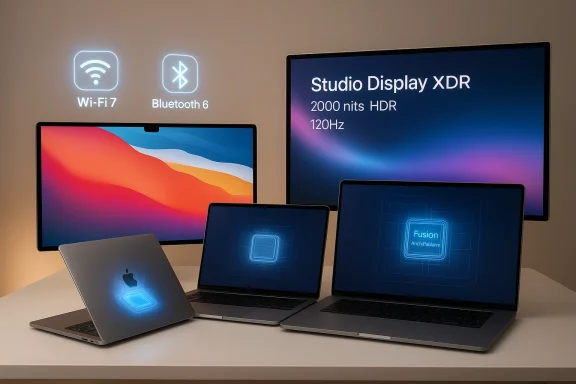
- Apple introduces two updated Studio displays: a standard Studio Display and a pro-tier Studio Display XDR that replaces the old Pro Display XDR naming and brings mini‑LED backlighting, extreme HDR brightness, and adaptive refresh up to 120Hz.
- Key new platform features include Wi‑Fi 7, Bluetooth 6, Thunderbolt 5 on displays, and multiple references to Neural Accelerators and higher unified memory bandwidth in the M5 Pro/Max chips.
What Apple announced: the products in detail
MacBook Air (M5): the consumer thin-and-light goes AI-ready
Apple moved the MacBook Air onto the M5 SoC while making two user-visible configuration changes that are easy to miss but will matter to many buyers.- M5 chip with integrated Neural Acceleration: Apple positions M5 as a faster CPU plus a next-generation GPU with Neural Accelerators embedded into GPU cores for AI-related workloads. This aligns with the industry trend toward hardware-accelerated inference and on-device models.
- Base storage raised to 512GB and pricing starts at $1,099 for the smaller configuration. Apple’s decision to double base SSD capacity addresses a common complaint about “you’ll pay extra for storage” and helps keep base units usable for longer before customers feel compelled to upgrade.
- Connectivity and I/O: The Air gains support for Wi‑Fi 7 and Bluetooth 6, improving wireless throughput and future-proofing wireless accessory compatibility for the next few years.
- Performance claims: Apple claims faster CPU performance, faster SSD throughput, and expanded maximum storage options depending on the model. These are consistent with Apple’s silicon cadence and generational claims — but benchmarks will be necessary to validate real-world gains in multicore, GPU, and AI workloads.
MacBook Pro (M5 Pro & M5 Max): the new pro stack
Apple refreshed the 14‑inch and 16‑inch MacBook Pro models with two new chip families and a packaging/architecture story that the company emphasized during the announcement.- M5 Pro and M5 Max: Apple frames the Pro chip for demanding pro workflows and the Max chip for the heaviest compute and creative tasks. The company introduced the term Fusion Architecture — essentially a bonded, multi-die, advanced-package approach that pairs a high-performance CPU die with a next-gen GPU die and accelerators to raise overall compute and memory bandwidth.
- Memory and GPU scaling: Apple is pushing higher unified-memory ceilings and wider memory bandwidth on Max-tier machines; that trend supports large datasets, heavy video timelines, and in‑memory AI models.
- Base storage change: the 14‑inch MacBook Pro now starts at 1TB rather than 512GB. This is a notable baseline bump for pro buyers who commonly fill smaller drives with large media libraries or VM images.
- Pricing: the new 14‑inch MacBook Pro baseline is $2,199. (Customizations, higher memory, and Max configurations push prices higher.)
- New wireless chip: MacBook Pro models include a new custom wireless chip for Wi‑Fi 7 and Bluetooth 6.
- Port and display support: triple Thunderbolt 5 ports and improved display chaining are part of the pro I/O story.
Studio Display and Studio Display XDR: two displays, clearer choices
Apple replaced the Pro Display XDR product line with two new Studio displays to cover mainstream and pro needs:- Studio Display: the mainstream 27‑inch 5K Retina option, refreshed with a 12MP Center Stage camera, improved microphones and speakers, and crucially Thunderbolt 5 connectivity for more downstream bandwidth and accessory chaining.
- Studio Display XDR: the pro model is a 27‑inch 5K Retina XDR with mini‑LED backlighting, 2,000 nits peak HDR brightness, and 120Hz adaptive refresh. Apple said the XDR variant includes thousands of dimming zones for better HDR contrast and supports adaptive sync to improve motion smoothness for video and gaming content.
- Audio and camera: both monitors include a 12MP camera with Center Stage, studio-quality microphones, and a six‑speaker array with spatial audio.
- Pricing and availability: pricing starts at $1,599 for the standard Studio Display and $3,299 for the Studio Display XDR. Preorders open March 4, availability March 11. Apple also introduced education pricing variants.
The M5 chips: what’s really new under the hood
Apple’s messaging around the M5 generation centers on three concepts: a new packaging/architecture called Fusion Architecture, next-gen GPU designs with neural acceleration per GPU core, and increased unified memory bandwidth for higher AI compute.Fusion Architecture and multi-die packaging
Apple’s Fusion Architecture is a packaging-level move: Apple bonds multiple dies in a single package to enable a mix of CPU and GPU dies optimized for their tasks. The advantage of this approach is twofold:- It allows Apple to scale GPU resources independently of CPU, which is useful when creative workloads are GPU heavy.
- It permits higher memory bus widths and different interconnect topologies that increase effective memory bandwidth for GPU and AI subsystems.
Neural Accelerators inside GPU cores
Apple explicitly calls out Neural Accelerators integrated into GPU cores — essentially dedicated ML acceleration units on the graphics die. This is meaningful because it signals Apple is optimizing not only for traditional graphics compute but also for tensor-like, matrix-multiply-heavy operations typical of machine learning inference.Practical implications:
- On-device AI features (image and video analysis, model inference, real-time assistant features) can run faster and more power-efficiently when silicon includes dedicated tensor hardware.
- Developers will need API support and optimized libraries to extract peak throughput; Apple’s platform advantage is control over both hardware and macOS-level frameworks, which should minimize fragmentation.
Memory and bandwidth
Apple emphasized higher unified memory ceilings for Max machines and increased memory bandwidth figures, which are central to heavy pro use-cases: video timelines, complex 3D scenes, scientific models, and on-device large-language-model inference.What to watch:
- Whether application vendors (Adobe, Autodesk, Unity, game engines, specialized compute tools) update to use larger unified memory and bandwidth effectively.
- Whether the Max-tier memory ceilings (which Apple expanded) materially reduce out-of-memory bottlenecks for real projects.
Pricing, storage and configuration strategy
One of the quieter but most consequential moves is Apple’s baseline configuration updates.- MacBook Air: base storage moved to 512GB, starting at $1,099. That’s an explicit attempt to shore up perceived value at the price point.
- MacBook Pro: 14‑inch starts at 1TB of SSD, $2,199 base. Pro buyers frequently need larger local storage; making 1TB baseline reduces immediate upgrade pressure and aligns price vs value.
- Displays: Studio Display $1,599, Studio Display XDR $3,299 base, with nano-texture glass and stand options increasing the cost.
Connectivity, I/O and ecosystem updates
Apple’s product pages and messaging highlight a few platform-level improvements worth calling out:- Wi‑Fi 7 and Bluetooth 6 appear across the new MacBooks as part of a new wireless chip. Wi‑Fi 7 brings higher theoretical throughput, reduced latency, and better multi-user handling — useful for high-bandwidth collaboration and cloud-based workflows.
- Thunderbolt 5 lands on the new Studio displays, offering more downstream bandwidth for daisy-chaining accessories and external storage. It also enables higher power delivery on the upstream port for fast charging.
- Camera and audio improvements on both the laptops and displays (12MP Center Stage cameras, studio mics, six-speaker arrays) shift the baseline expectation for remote work and content capture.
Strengths: where Apple doubled down successfully
- Clear product segmentation: Apple made the line-up easier to understand — Air for thin-and-light with on-device AI, Pro for scaled compute and memory, Studio Display and Studio Display XDR for mainstream and pro displays. That clarity saves buyer research time and positions Apple to upsell logically.
- Higher baseline storage: moving to 512GB for Air and 1TB for the Pro models addresses a persistent consumer gripe and increases the immediate out-of-the-box utility for heavier users.
- On-device AI emphasis: embedding Neural Accelerators in GPU cores and increasing unified memory bandwidth means Apple designed the hardware with local ML inference in mind, an important move given privacy and latency advantages for on-device AI.
- Modernized displays: Thunderbolt 5, 12MP camera, improved audio, and the XDR mini-LED panel with 2,000 nits bring displays up to date for HDR production workflows and remote collaboration standards.
- Energy and repair messaging: Apple continues to highlight recycled materials and repairability, which matters to enterprise buyers and institutions.
Risks, open questions, and limitations
- Performance claims vs independent testing: Apple’s statements about percentage performance gains and “fastest single-thread” claims should be treated as manufacturer-provided until third-party benchmarks verify them. Real workloads often vary from lab-style benchmarks.
- Software optimization and app ecosystem: The M5 chips’ advantages for AI and GPU compute will depend heavily on whether key professional apps adopt optimized kernels that use the Neural Accelerators and take advantage of Fusion Architecture memory bandwidth. Without broad app-level support, theoretical silicon advantages may underdeliver.
- Price sensitivity: Although base storage increased, list prices in many configurations reflect higher starting points compared to prior generations. For price-conscious customers or enterprise procurement teams, effective cost of ownership remains a discussion point.
- Ecosystem lock-in and cross-platform parity: Apple’s tight hardware-software integration is a strength, but it also continues to increase platform lock-in. Teams that need cross-platform parity — Windows + macOS workflows, or cross‑device GPU rendering — must weigh that tradeoff.
- Repair and modular upgrades: Apple’s messaging around repairability and recycled materials is welcome, but internal SSDs and unified memory arrangements make post-purchase upgrades impossible for many buyers. The upfront choice becomes more important.
- AI model size and on-device limits: While Neural Accelerators improve inference potential, there are practical limits to model size and performance compared to server-side GPU clusters. Apple’s approach favors low-latency, private inference and smaller on-device models; teams that require massive models will still rely on cloud GPUs.
How this compares to the Windows laptop and pro display market
Apple’s updates continue to push the narrative of tightly integrated hardware and software for optimized performance and power efficiency. Microsoft and OEM partners have accelerated on-device AI too, but with different tradeoffs: Windows vendors lean more on discrete GPUs, modular upgrade paths, and cross-vendor ecosystems.- For creators who rely on widely supported GPU toolchains (CUDA-heavy video editors, many machine-learning frameworks), the Windows + NVIDIA route still has advantages in raw third-party tooling and ecosystem familiarity.
- Apple’s unified memory architecture reduces data movement and can simplify workflows for apps optimized for it — when those apps exist.
- On the display side, Apple’s Studio Display XDR pricing and feature set target creatives who need calibrated HDR and color fidelity; Windows and third-party monitor vendors continue to offer high-end pro displays with a wider range of I/O and profiling options at similar or lower price points, so buyers should compare calibration, color-gamut claims, and local-dimming implementations closely.
Buying advice and upgrade guidance
- If you need a dependable, portable daily driver and want long battery life plus native on-device AI features, the MacBook Air (M5) with 512GB base storage is the sensible default.
- If you’re a creative professional who works with large video timelines, 3D scenes, or on-device ML models, consider M5 Pro or M5 Max MacBook Pros and prioritize higher unified memory and the Max GPU option if your workloads are GPU-bound.
- If you rely on third-party apps that have historically favored CUDA or Windows-native toolchains, evaluate whether those apps have macOS-native accelerated builds for M‑series silicon before committing.
- For pro displays, compare the Studio Display XDR to specialty HDR monitors from color-focused manufacturers; Apple’s monitor is integrated and polished, but specific production pipelines may still prefer third-party pro displays with hardware calibration workflows.
- Remember the purchase is a long-term commitment: Apple’s unified components (soldered RAM, monolithic SSDs) mean you can’t upgrade later. Buy the memory and storage you expect to need over the next 4–6 years.
Short-term and long-term implications
Short term, the March refresh is a buying trigger: with preorders on March 4 and availability March 11, many buyers who were on the fence will purchase now rather than wait. Apple’s base-storage increases reduce immediate upgrade pressure and make the new baseline models attractive to a broad audience.Longer-term, the Fusion Architecture and embedded Neural Accelerators show Apple’s roadmap toward more heterogeneous compute on the Mac platform. That may reshape certain workloads that benefit from on-device AI (real-time video enhancement, assistant features, local inference for privacy-sensitive tasks). However, wide adoption depends on developers and pro software vendors shipping optimized code paths for the M5 family.
From a market perspective, Apple is signaling that consumer and pro product lines will both carry AI expectations going forward. That ups the stakes for Microsoft, Intel, NVIDIA, and OEMs to articulate their own AI hardware and software strategies for Windows devices in the near future.
Final assessment
Apple’s March 3 hardware dump was short on theatrical flourish and long on practical product alignment. The company tightened the Mac product stack — increasing baseline storage, refreshing displays, and framing the M5 generation around a Fusion Architecture and neural-accelerator-equipped GPUs. For buyers, the headline moves (512GB base on Air, 1TB on 14‑inch Pro) are tangible improvements that increase immediate utility. For developers and power users, the hardware changes are promising but depend on software optimizations and independent verification.Two unavoidable caveats remain. First, Apple’s performance and AI claims are manufacturer statements until independent benchmarks arrive. Treat percentage gains and “fastest” language with healthy skepticism until real-world tests are published. Second, Apple’s decisions continue the platform’s drift toward less field serviceability and deeper vertical integration, which is beneficial to some buyers and restrictive to others.
If you need a new Mac this quarter, the practical calendar matters: preorders open March 4, availability March 11. Evaluate the new baseline configurations carefully, match them to your applications, and — if your workflows depend on third-party acceleration frameworks — confirm that those vendors have updated builds to take advantage of the M5 family’s architectural changes. The M5 launch is not just another chip cycle; it’s Apple clearly positioning the Mac for an era where on-device AI matters.
Source: onmsft.com Apple March Event Live: M5 Pro, M5 Mac, MacBook Air, MacBook Pro, and new Studio Displays - OnMSFT
