Apple’s new MacBook Neo is a deliberate pivot: a compact, colorful 13‑inch laptop that brings Apple’s iPhone‑class silicon, a full macOS experience, and an unprecedented $599 entry price to a segment long dominated by Windows OEMs and Chromebooks.
Apple unveiled the MacBook Neo on March 4, 2026, positioning it as the company’s “most affordable laptop ever” and the first Mac to ship with an A‑series processor designed originally for iPhone. The official announcement details a 13‑inch Liquid Retina display, the Apple A18 Pro system‑on‑chip, up to 16 hours of battery life, and a starting U.S. price of $599 ($499 for eligible education customers).
This launch follows weeks of leaks, accidental posts, and intense press speculation about Apple entering the low‑cost laptop market — a move analysts and outlets framed as part of a broader strategy to extend Apple’s ecosystem into price bands where Windows and Chrome OS historically competed. Coverage from major outlets and tech sites confirmed and expanded on Apple’s claims shortly after the announcement.
Independent reporting and initial hands‑on coverage echo Apple’s headline message — that the Neo delivers surprisingly capable everyday performance for browsing, productivity, and light creative tasks — but they also flag limitations including the base 8 GB RAM and the narrower upgrade path.
Key caution points:
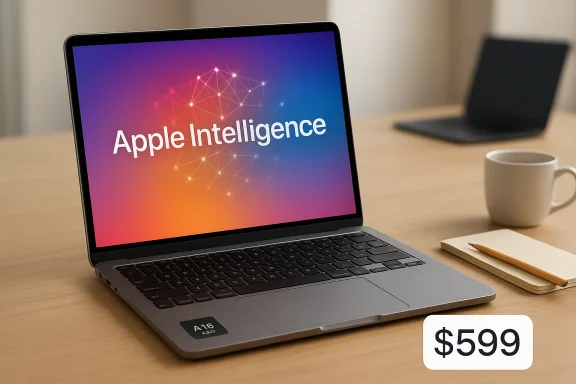
Apple’s broader argument: on‑device AI tasks (summaries, photo “Clean Up” tools, localized writing aids) run faster and more privately on the Neo because of the Neural Engine. That’s compelling for privacy‑minded customers, but it depends on macOS developers shipping optimized on‑device features. The Neo ships with Apple Intelligence in beta and macOS Tahoe as the platform for these experiences.
The pricing strategy is explicitly geared toward broadening Apple’s installed base — appealing to students, first‑time Mac buyers, and cost‑sensitive consumers who have historically stayed with Windows or Chrome OS. Early reporting frames this as a strategic attempt to capture marketshare in education and low‑cost consumer segments.
Community chatter underscores two recurring themes: surprise at Apple’s aggressive pricing, and concern about the base 8 GB memory and lack of upgradeability. Early posts and forums have already begun comparing Neo to similarly priced Windows and Chromebook models, with many users acknowledging that the Neo’s performance for everyday tasks will likely outpace equivalently spec’d x86 rivals, but that power users will still prefer higher‑spec Macs or Windows machines.
But Apple’s engineering and market positioning involve tradeoffs. The base 8 GB configuration, soldered memory, and minimal I/O constrain the Neo’s upside for demanding users. The decision to use an A‑series chip brings efficiency and tight integration benefits, particularly for on‑device AI and day‑to‑day performance, but also raises questions about long‑term performance headroom compared with M‑series Macs in pro workflows. Readers should evaluate the Neo against their actual workflows: for many students and mainstream users, it will be an ideal, modern laptop; for power professionals, it’s a pragmatic, budget‑friendly gateway to the Mac ecosystem rather than a replacement for higher‑spec Macs.
The Neo’s arrival marks a strategic shift: Apple is playing both sides of the market now — premium performance at the top and calculated accessibility at the bottom. Whether that gambit reorders laptop market share will depend on how well Apple’s efficiency claims hold up in third‑party testing and how competitors respond.
Source: Apple Say hello to MacBook Neo
 Background
Apple unveiled the MacBook Neo on March 4, 2026, positioning it as the company’s “most affordable laptop ever” and the first Mac to ship with an A‑series processor designed originally for iPhone. The official announcement details a 13‑inch Liquid Retina display, the Apple A18 Pro system‑on‑chip, up to 16 hours of battery life, and a starting U.S. price of $599 ($499 for eligible education customers).This launch follows weeks of leaks, accidental posts, and intense press speculation about Apple entering the low‑cost laptop market — a move analysts and outlets framed as part of a broader strategy to extend Apple’s ecosystem into price bands where Windows and Chrome OS historically competed. Coverage from major outlets and tech sites confirmed and expanded on Apple’s claims shortly after the announcement.
What Apple announced — the essentials
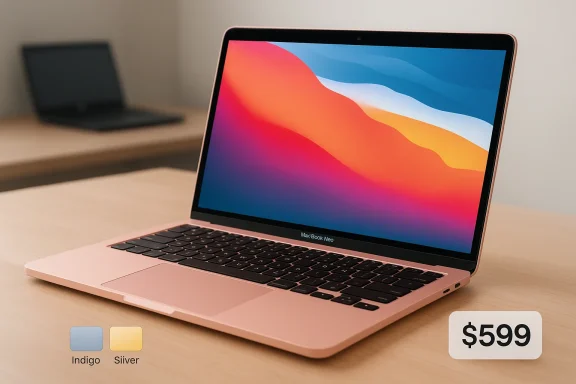
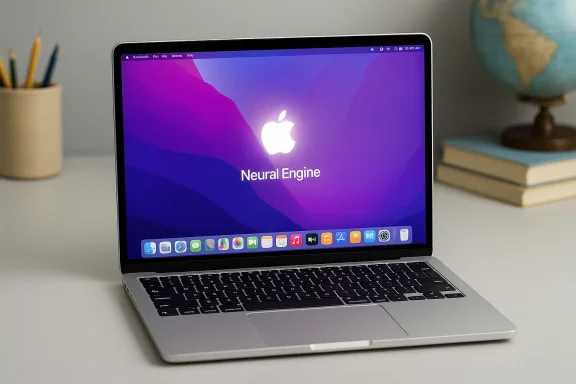
- Design and colors: Durable aluminum enclosure in four finishes — blush, indigo, silver, and citrus — with keyboard keycaps and wallpapers matched to the chassis. The laptop reportedly weighs about 2.7 pounds, putting it firmly in the ultraportable class.
- Display: 13‑inch Liquid Retina IPS panel with a native resolution of 2408 × 1506, 500 nits peak brightness, support for 1 billion colors, and an anti‑reflective coating.
- Chip and memory: Apple A18 Pro with a 6‑core CPU, 5‑core GPU, and a 16‑core Neural Engine; base configuration ships with 8 GB of unified memory and at least a 256 GB SSD.
- Audio, video, I/O: 1080p FaceTime HD camera, dual mics with beamforming, dual side‑firing speakers with Spatial Audio and Dolby Atmos, two USB‑C ports (left port: USB 3 with external display support; right port: USB 2), and a 3.5 mm headphone jack. Wi‑Fi 6E and Bluetooth 6 are included.
- Battery and thermals: Apple claims up to 16 hours of battery life using standard web‑browsing and streaming tests; the Neo is a fanless design, relying on passive cooling.
- Software: Ships with macOS Tahoe, deeper Apple Intelligence features, Continuity with iPhone, and built‑in apps like Safari, Messages, and Photos.
Design and build: affordable, but unmistakably Apple
Aluminum unibody and color strategy
Apple deliberately leans on familiar Mac design cues—an aluminum enclosure, soft rounded corners, and the tactile quality of a Magic Keyboard—while dialing color to consumer tastes. The Neo’s color palette and coordinated keycaps/wallpapers are notable because Apple rarely invests in such a coordinated finish strategy below its premium tiers. This supports Apple’s objective: make a low‑cost Mac feel like an aspirational, personal device rather than a stripped‑down commodity.Portability vs. practical tradeoffs
At 2.7 pounds, the Neo hits a sweet spot for students and commuters. But the choice to include only two USB‑C ports (with asymmetric capabilities) and a single headphone jack reflects compromises likely made to control cost and maintain a slim, fanless silhouette. For many buyers in this segment, adapters or docks will be required for legacy peripherals and external displays. Apple’s spec sheet explicitly notes that only the left USB‑C port supports external displays.The display: a standout in the segment
The Neo’s 2408 × 1506 Liquid Retina panel with 500 nits and 1 billion colors claims to outclass most rivals in the $500–$800 bracket on raw brightness and color depth. Apple’s emphasis here is strategic: display quality is frequently the single most visible difference between inexpensive Windows laptops and higher‑end Macs. In side‑by‑side comparisons, a brighter, higher‑resolution panel delivers clearer text, deeper color for photos, and better HDR potential for media. Independent reporting affirms Apple’s claim that the panel exceeds typical laptops at similar price points.A18 Pro in a Mac: what changes, and what it means
An iPhone chip in a laptop
The defining technical story is that the MacBook Neo uses the A18 Pro — a chip architecture derived from Apple’s iPhone silicon line rather than the M‑series chips Apple introduced in Macs. Apple frames this as a feature: the A18 Pro brings high efficiency, on‑device Apple Intelligence, and strong single‑threaded performance in a power‑sipping, fanless package.Performance claims and testing context
Apple’s materials state the Neo is “up to 50% faster for everyday tasks” versus the bestselling PC with Intel Core Ultra 5, and “up to 3x faster” for certain on‑device AI workloads. Those claims are benchmark‑specific: Speedometer 3.1 for web browsing, and a set of Adobe Photoshop tests for creative workflows. Apple also notes tests were run on pre‑production Neo units and selected Intel systems, specifying configurations and the exact benchmark builds used. That transparency is useful but also customary: vendor benchmarks are optimistic by design. Readers should treat “up to” claims as best‑case comparisons and expect real‑world results to vary by workload.Independent reporting and initial hands‑on coverage echo Apple’s headline message — that the Neo delivers surprisingly capable everyday performance for browsing, productivity, and light creative tasks — but they also flag limitations including the base 8 GB RAM and the narrower upgrade path.
Benchmarks, real‑world performance, and the "apples‑to‑apples" problem
What Apple tested
- Speedometer 3.1 for web responsiveness, comparing pre‑production MacBook Neo with prereleases of Safari to Intel Core Ultra 5 systems running Chrome/Edge.
- Adobe Photoshop 2026 filters and AI features to demonstrate on‑device image processing advantages of the Neural Engine.
- Affinity benchmark runs and battery life tests using specific web and video workloads. Apple documents these test conditions in the press materials.
How to read those numbers
Vendor benchmarks are useful but inherently selective. Apple chose real‑world workloads where the Neo’s strengths (tight hardware/software integration, efficient neural engine for AI tasks, and a fast browser in Safari) would shine. Third‑party reviewers will need to re‑run tests across a broader range of apps, and in configurations that include heavier multitasking or compiled native workloads where M‑series chips or discrete GPUs dominate.Key caution points:
- The Neo’s base 8 GB unified memory is limited for heavy multitasking or many pro creative workflows. While Apple Silicon often outperforms x86 designs at equal memory levels, memory capacity still matters for large datasets, VMs, and advanced content creation.
- Apple’s comparisons use the “bestselling PC with Intel Core Ultra 5” as the comparator. That is a moving target and depends on vendor configurations, thermals, and Windows/Chrome differences. The press materials disclose the test partner systems and operating systems used.
Battery life and thermals: fanless efficiency with limits
Apple’s claim of up to 16 hours of battery life is plausible given the low‑power characteristics of the A‑series chips and the Neo’s 36.5 Wh battery specification listed in the technical sheet. However, battery life is highly workload dependent. Apple’s stated figures come from controlled browsing and streaming tests. Heavy CPU/GPU workloads, prolonged on‑device AI jobs, or background tasks (like large file transfers or virtualization) will reduce real‑world runtime. The Neo’s fanless design is a plus for silence and reliability, but sustained heavy workloads may trigger thermal throttling sooner than in actively cooled machines.Software, Apple Intelligence, and ecosystem advantages
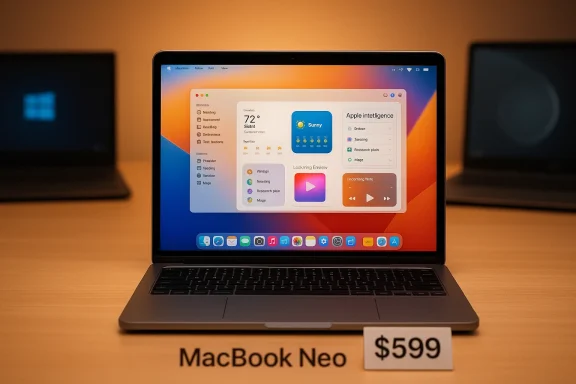
macOS Tahoe and Apple Intelligence are core differentiators. Apple bundles Continuity features that make the Mac/iPhone pairing seamless for users already invested in the ecosystem—Handoff, Universal Clipboard, and iPhone Mirroring are highlighted in Apple’s materials. The Neo is pitched not as an isolated device but as an entry gate to Apple’s services and cross‑device workflows.Apple’s broader argument: on‑device AI tasks (summaries, photo “Clean Up” tools, localized writing aids) run faster and more privately on the Neo because of the Neural Engine. That’s compelling for privacy‑minded customers, but it depends on macOS developers shipping optimized on‑device features. The Neo ships with Apple Intelligence in beta and macOS Tahoe as the platform for these experiences.
Environmental claims: a sustainability play
Apple markets the MacBook Neo as the company’s lowest‑carbon MacBook to date, with 60% recycled content, 90% recycled aluminum, 100% recycled cobalt in the battery, and manufacturing powered in part (45%) by renewable electricity in the supply chain. The Neo’s enclosure uses a forming process that reduces aluminum use by 50% compared to traditional machining methods, and packaging is 100% fiber‑based. These details are consistent with Apple’s sustainability messaging and appear in the product literature. Independent verification of supplier practices will follow through third‑party audits, but Apple’s recycled‑content claims are explicit.Pricing, availability, and the education angle
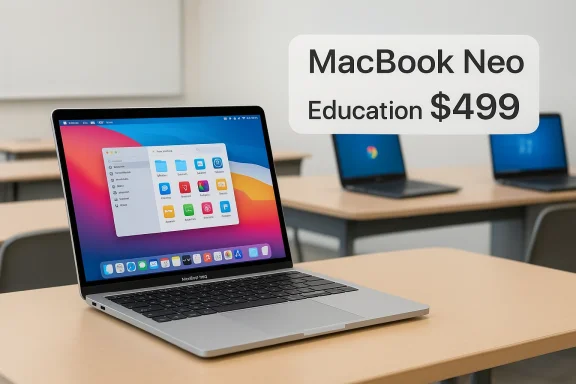
Apple’s headline price of $599 (U.S.) and $499 for education customers is significant: it undercuts many premium Chromebooks and some Windows laptops while bringing macOS and Apple hardware quality to an aggressively low price band. Pre‑orders opened March 4, with shipping and retail availability starting March 11. Multiple outlets and Apple’s own specs page corroborate the pricing and timing.The pricing strategy is explicitly geared toward broadening Apple’s installed base — appealing to students, first‑time Mac buyers, and cost‑sensitive consumers who have historically stayed with Windows or Chrome OS. Early reporting frames this as a strategic attempt to capture marketshare in education and low‑cost consumer segments.
Competitive implications: pressure on Windows OEMs and Chromebooks
Apple’s move places immediate pressure on PC OEMs that target the sub‑$800 market. A $599 MacBook with Apple’s brand cachet, display quality, and tight ecosystem integration is poised to disrupt the device purchasing decisions of students and mainstream consumers. Coverage from major outlets notes this as a potentially disruptive product for the broader laptop market. However, Microsoft and OEM partners still control flexibility (ports, upgradeability, wider variety of processors), and Windows machines often offer more RAM or storage for the same price. Buyers who need expandability or specific Windows software will still find value in PC alternatives.The compromises — where Apple cut corners
No product is without tradeoffs. The most important compromises buyers should know:- 8 GB unified memory in base models. For many casual users this is acceptable; for heavy multitaskers, coding with multiple containers, or large photo/video projects, 8 GB is limiting. Apple’s unified memory is efficient, but capacity constraints remain a practical limiter.
- No internal upgrade path. Like other modern Macs, RAM and storage are soldered — configuration decisions at purchase are final.
- Limited I/O and display support. With only two USB‑C ports and one external‑display capable port, users who plug in docks, SD cards, and multiple peripherals will need adapters.
- A‑series vs M‑series differences. The A18 Pro is optimized for efficiency and AI microtasks but is architecturally different from M‑series chips. For sustained pro workloads and heavy native macOS code optimized for M‑series, there will be scenarios where M‑equipped Macs remain superior.
Early reactions: press, community, and the rumor trail
Tech press outlets reacted quickly and broadly: mainstream news organizations framed the Neo as Apple’s low‑cost gambit to capture budget buyers, while specialty Mac sites dug into the architecture shift to A‑series silicon and the compromise calculus. Industry commentary pointed to Apple’s clever blend of hardware quality and pricing, and to the product’s symbolic significance as the first mass‑market Mac not built around an M‑series SoC.Community chatter underscores two recurring themes: surprise at Apple’s aggressive pricing, and concern about the base 8 GB memory and lack of upgradeability. Early posts and forums have already begun comparing Neo to similarly priced Windows and Chromebook models, with many users acknowledging that the Neo’s performance for everyday tasks will likely outpace equivalently spec’d x86 rivals, but that power users will still prefer higher‑spec Macs or Windows machines.
Recommendations: who should (and should not) buy a MacBook Neo
The MacBook Neo is a strong contender for:- Students who value portability, battery life, and the Apple ecosystem at a low entry price.
- First‑time Mac buyers who prioritize a high‑quality display and integrated macOS experience over raw expandability.
- Users focused on web, document work, streaming, and light photo editing who prefer a silent, fanless laptop.
- Power users who run heavy multitasking, virtualization, or large media projects that benefit from 16+ GB of memory and active cooling.
- Professionals who depend on a broad assortment of ports, user‑serviceable components, or high‑wattage external GPUs.
- Buyers who need full parity with Windows‑only enterprise apps that may not be optimized for Apple Silicon.
What to test once you get hands‑on — a checklist for reviewers and buyers
- Real‑world battery life across mixed workloads (browsing, video, video editing, AI photo edits).
- Memory pressure behavior: open many browser tabs, run Slack/Teams, and edit large images to judge swap performance.
- Thermal throttling under sustained loads — render a long video or run a synthetic loop and monitor clocks and temperatures.
- External display reliability on the single display‑capable USB‑C port with a variety of adapters.
- Apple Intelligence features in macOS Ta language support, and local vs cloud processing behavior.
- Compatibility and performance of key third‑party apps (MS Office, Adobe Creative Cloud, native vs Rosetta builds).
Final analysis: a calculated gamble that shifts the lower end
The MacBook Neo is a calculated, strategic product: Apple has packaged signature design, display quality, and macOS continuity into a fanless, extremely affordable laptop. That alone is newsworthy — Apple has historically defended premium pricing, and the $599 entry point is a clear signal that Apple intends to broaden the Mac’s appeal. The move should force Windows OEMs and Chromebook makers to respond on features, value, or pricing.But Apple’s engineering and market positioning involve tradeoffs. The base 8 GB configuration, soldered memory, and minimal I/O constrain the Neo’s upside for demanding users. The decision to use an A‑series chip brings efficiency and tight integration benefits, particularly for on‑device AI and day‑to‑day performance, but also raises questions about long‑term performance headroom compared with M‑series Macs in pro workflows. Readers should evaluate the Neo against their actual workflows: for many students and mainstream users, it will be an ideal, modern laptop; for power professionals, it’s a pragmatic, budget‑friendly gateway to the Mac ecosystem rather than a replacement for higher‑spec Macs.
Closing thoughts
Apple’s MacBook Neo rewrites the conversation about what a $599 laptop can be. It’s a pragmatic blend of design, display fidelity, and Apple’s software‑hardware integration—backed by sustainability messaging and a bold education price. Buyers should weigh the Neo’s clear strengths against the known compromises, especially around memory and expandability. For the mainstream market and the education sector, the MacBook Neo will be a compelling alternative to Windows and Chrome OS devices; for pros and heavy multitaskers, it will be a capable secondary machine or a cost‑effective entry point into Apple’s ecosystem.The Neo’s arrival marks a strategic shift: Apple is playing both sides of the market now — premium performance at the top and calculated accessibility at the bottom. Whether that gambit reorders laptop market share will depend on how well Apple’s efficiency claims hold up in third‑party testing and how competitors respond.
Source: Apple Say hello to MacBook Neo