

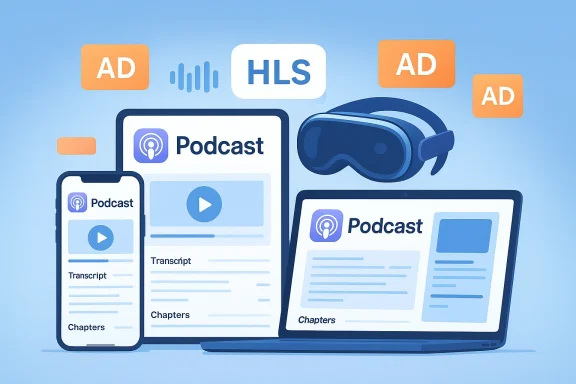
Apple's announcement that Apple Podcasts will natively support video episodes — delivered using HTTP Live Streaming (HLS) and paired with dynamic video ad insertion — is a landmark shift that brings the company squarely into the fastest-growing corner of the podcast economy and reshapes the commercial plumbing for creators, hosts, and advertisers. Apple says the update will arrive as a public rollout this spring, with HLS video available to test today in the iOS 26.4, iPadOS 26.4, and visionOS 26.4 betas, and supported at launch by several major hosting partners including Acast, ART19 (Amazon), Triton’s Omny Studio, and SiriusXM. (apple.com)
Background
Why this matters now
Podcasting began as an audio-first medium distributed by RSS and dominated historically by Apple’s early integration of podcasts into iTunes. Over the last several years, the format has evolved: creators routinely simulcast shows on YouTube, and platforms like Spotify and third-party publishers have invested heavily in video-capable podcast experiences and partnerships. The result is a rising demand for a seamless video-and-audio experience — one that preserves podcast discovery, subscriptions, and measurement while enabling the richer creative and commercial opportunities video offers. Apple’s move to HLS video addresses that demand by replacing or augmenting static file delivery with a streaming-first architecture designed for adaptive quality, seamless device switching, and dynamic ad insertion. (apple.com)The competitive context
Video podcasts are already a commercial battleground. Spotify and other platforms have pushed creators toward video simulcasts and native video feeds, while distribution experiments (including studio-level deals and licensing for streaming platforms) demonstrate advertiser interest in visual formats. Netflix and other major players have also explored podcast-like programming and video podcast distribution, signaling that the medium’s boundaries are blurring with talk shows and long-form streaming content. Apple’s update both closes a capability gap and leverages Apple’s device and services reach to make video podcasting available at scale.What Apple announced — features and technical choices
HLS at the center
Apple is using HTTP Live Streaming (HLS) — the company’s long-standing adaptive streaming protocol — as the delivery backbone for video podcasts. HLS segments media into small chunks and enables adaptive bitrate streaming, which keeps playback smooth across varying network conditions and devices. The HLS approach has clear technical advantages for mobile-first podcast listening and viewing: automatic quality switching, lower startup latency, and robust offline-download mechanics. Apple says users will be able to switch seamlessly between watching and listening, view video episodes in horizontal full-screen, and download video episodes for offline playback. (apple.com)Seamless audio / video toggling and feature parity
A central user-facing claim is the ability to flip video on and off without interrupting the episode’s timeline or discovery experience. Apple also commits to integrating video episodes with existing Apple Podcasts features — recommendations, editorial curation, chapters, transcripts, and personalization — so creators and listeners won’t have to treat video as a separate island. This parity is significant because inconsistent feature support has been a real obstacle to creator adoption with other video simulcasting workflows. (apple.com)Dynamic video ad insertion and Apple’s commercial model
For the first time on Apple Podcasts, creators will be able to insert dynamic video ads — including host-read spots — into episodes distributed via HLS. Apple confirmed it will not charge creators or hosting providers to distribute video podcasts, but it will charge participating ad networks an impression-based fee for delivering dynamic video ads on Apple Podcasts later this year. Apple did not publish fee schedules or rates in its announcement, which leaves the effective economics partially opaque for now. (apple.com)Launch partners, beta timing, and platforms
Apple lists four initial hosting partners supporting HLS video at launch: Acast, ART19 (Amazon), Triton’s Omny Studio, and SiriusXM (including SiriusXM Media, AdsWizz, and Simplecast). HLS video is available for testing in developer betas of iOS 26.4, iPadOS 26.4, and visionOS 26.4; a broader rollout to iPhone, iPad, Apple Vision Pro users, and Apple Podcasts on the web is slated for this spring. That developer-beta window gives early access to publishers and ad networks to test integrations before the wider rollout. (apple.com)Deep dive: technical implications and benefits
Why HLS is the logical choice
HLS is designed for fragmented networks and mobile devices. By choosing HLS Apple gains:- Adaptive bitrate streaming so users get the best quality their connection supports.
- Segmented delivery that makes dynamic ad insertion and late-binding monetization far easier than replacing whole-file RSS workflows.
- Robust offline and resume behavior, because HLS playlists and manifests can orchestrate partial downloads and resume behavior cleanly.
These are precisely the advantages needed to make video podcasting behave like audio podcasting — frictionless, low-latency, and reliable across device contexts. (apple.com)
Creator tooling and production workflows
Apple’s announcement references tools and guidance for creators to produce and distribute HLS video. That implies creators will rely on host-level encoding, manifest generation, and ad-marker tooling rather than wrestling with raw files and manual RSS edits. For larger publishers, HLS simplifies multi-bitrate packaging, DRM choices (if any), and programmatic ad insertion pipelines; for independent creators, third-party hosts will abstract complexity. However, creators will still face investments in lighting, multi-camera setups, editing, post-production, and storage that go beyond audio-only production.Playback UX and cross-device continuity
Apple’s claim of seamless toggling between video and audio implies careful state preservation: timestamps, chapter markers, transcripts, and speed controls must work identically whether video is playing or turned off. Maintaining this parity will be a technical challenge across low-power devices like watchOS and in-car contexts (CarPlay) where video is clearly impractical. Apple’s plan to bring the experience to the web and Vision Pro increases complexity but is consistent with the company’s multi-device approach. (apple.com)Monetization, measurement, and the ad ecosystem
How Apple plans to make money — and who pays
Apple’s model here is subtle: it does not take fees from creators or hosts to distribute video podcasts, but it will charge ad networks an impression-based fee for dynamic video ads served through Apple’s HLS delivery. That design choice signals Apple wants to accelerate creator adoption by removing direct distribution costs while capturing value higher up in the ad supply chain. The exact economics — fee levels, revenue splits, measurement guarantees — were not disclosed in the announcement and will determine whether ad buyers view Apple as a value-add or a cost center. (apple.com)Dynamic ad insertion: promise and measurement gaps
Dynamic video ad insertion unlocks programmatic, updatable campaigns that can reach listeners on older episodes. For brands, video ads can be more engaging and measurable, but they require standardization of metrics across hosts and platforms. Apple says creators retain control of monetization, but the ad ecosystem depends on consistent impression counting, viewability metrics, and cross-platform attribution — areas where the industry has historically lacked uniform standards. Expect advertisers to demand transparent measurement integrations and third-party verification before they shift large budgets into video podcast ads.Who wins and who loses
- Potential winners: Hosting providers that onboard quickly (Acast, ART19, Omny, SiriusXM), established creators with production budgets, ad networks that can buy video inventory programmatically, and Apple’s services business if ad fees scale.
- Potential losers: Small indie creators who can’t afford video production, incumbents relying exclusively on RSS-only workflows if they’re slow to adapt, and ad intermediaries that don’t support video measurement consistently. The net effect depends on adoption speed and how accessible video workflows become for small creators. (apple.com)
Ecosystem and policy questions
Open RSS vs. HLS: a compatibility balance
Apple insists it won’t charge hosts or creators for HLS distribution and frames the feature as compatible with existing shows and downloads. But HLS represents a different delivery paradigm than classic RSS-with-MP3. The question for the industry is whether HLS video will remain optional and interoperable, or whether major players will begin favoring HLS-only workflows for ad targeting and richer features — which could fragment the ecosystem. Apple’s public messaging stresses open distribution through hosts, but the reality will be shaped by which platforms, ads, and measurement standards creators prioritize. (apple.com)Moderation, policy, and content control
Video introduces new moderation vectors: visual content standards, copyright enforcement (video makes it easier to spot clips that reuse protected visuals), and platform liability questions in jurisdictions with stricter content rules. Hosting partners and ad networks will likely require clearer content policies before accepting programmatic buys. Apple’s existing content moderation and developer policies provide a baseline, but video requires expanded enforcement workflows and potentially new ad guidelines. These operational changes are not fully enumerated in Apple’s release and will be worth watching as the rollout proceeds. (apple.com)Privacy and tracking
Video ad insertion and measurement typically rely on impression reporting and user/device identifiers. Apple’s track record on privacy — and its platform controls — will shape how measurement is implemented. If Apple layers strong privacy constraints into HLS ad reporting, some ad buyers may demand adjusted targeting or rely on aggregated measurement. Conversely, if the ad measurement is permissive, privacy advocates could push back. Apple’s press material does not list specific privacy mechanics for video ad reporting; that makes the initial ad-network pilots and documentation critical. (apple.com)Practical implications for creators and publishers
Production realities and cost
Video requires equipment, space, and post-production investments. Many independent podcasters already film interviews for YouTube and repurpose the audio; Apple’s HLS path lowers distribution friction but does not reduce production cost. Creators will face decisions:- Produce full multi-camera shows for video-first monetization.
- Film minimal video (single-camera, static shots) to capture visual presence without heavy editing.
- Keep audio-first workflows and optionally supply an HLS-compatible video track to hosts.
Distribution and discoverability
Because Apple integrates video episodes into the existing Apple Podcasts catalog and editorial tabs, creators who adopt video won’t lose search or recommendation visibility. That reduces the discovery cost often associated with simulcasting to YouTube: creators can reach Apple’s existing search and editorial audiences natively. However, discoverability on non-Apple platforms (Spotify, YouTube) still matters; many creators will continue multi-platform distribution rather than relying solely on Apple’s ecosystem. (apple.com)Industry reaction and competitive consequences
What competitors might do
- Spotify: Already invested in video and creator tooling; Apple’s entry will likely accelerate Spotify’s monetization and distribution features, possibly pushing more programmatic video ad support or improved cross-device playback.
- YouTube / Netflix / Big streamers: These platforms have different commercial dynamics. Some may double down on exclusive video shows or licensing deals that translate to podcast-like consumables. Others may partner with creators to create companion content.
- Ad networks: Expect ad networks to accelerate support for video podcast formats, measurement APIs, and creative templates that work across HLS and other delivery methods.
Market sentiment and investor takeaways
Financial outlets immediately framed the move as a strategic step to protect Apple’s services growth and defend the creator economy that drives subscriptions and ad revenue opportunities. Market commentary noted the timing ahead of product events and raised questions about the short-term revenue impact versus the long-term positioning of Apple’s services ecosystem. The full economic impact will hinge on ad revenue scale, fee rates for ad networks, and creator adoption.Risks, unknowns, and caveats
Fee transparency and advertiser reaction
Apple will charge ad networks an impression-based fee, but has not disclosed fee levels, measurement methodology, or verification partners. This lack of transparency is the single largest near-term unknown: ad buyers will need reliable metrics and predictable pricing before reallocating sizable budgets. Without clear numbers, some advertisers may delay commitments or demand independent verification. (apple.com)Creator economics and access
If video monetization proves meaningfully more profitable, creators without the resources to produce video could see a relative disadvantage. Conversely, if hosts and tools make low-cost video production viable, more creators will migrate. The transition period creates a potential competitive squeeze for small creators unless host platforms provide accessible production tooling and distribution options.Technical rollout and platform parity
Apple’s beta availability in iOS 26.4, iPadOS 26.4, and visionOS 26.4 is a strong signal, but multi-device ecosystem parity is hard: CarPlay, Apple Watch, and third-party platforms may differ in support. The web rollout will mitigate Windows and cross-platform concerns, but browser-based experiences often lag native apps in performance and offline behavior. Expect feature gaps until later iterations mature. (apple.com)What Windows users and podcast listeners should expect
- Apple Podcasts on the web will receive HLS video support this spring, which means Windows users can access video podcasts through the browser without needing Apple hardware. That positions web playback as the primary cross-platform escape hatch for non-Apple device owners. (apple.com)
- However, the best playback experience (seamless toggling between audio and video, offline downloads, integrated transcripts) will likely live first in Apple’s native apps. Windows-focused podcasters and listeners who currently use Spotify, YouTube, or web-first players may find the new Apple features tempting, but they’ll continue to rely on multi-platform distribution strategies.
- For Windows podcast apps and managers, supporting HLS manifests and standardizing on ad measurement formats will become a technical priority if adoption accelerates. Developers should monitor host APIs and ad-reporting specifications released by Apple and participating hosts. (apple.com)
Practical checklist for creators considering video on Apple Podcasts
- Evaluate production costs: cameras, lighting, mics, editing software, and hosting fees.
- Confirm host support: ensure your hosting provider supports HLS packaging or partner with a provider on Apple’s supported list initially.
- Plan ad strategy: review current ad partnerships, consider video ad creative needs, and ask ad networks about Apple’s impression fee and measurement integration.
- Test in beta: if you have developer access, join the iOS/iPadOS/visionOS 26.4 betas to verify playback and ad behavior.
- Monitor analytics: require impression and viewability transparency from hosts and ad partners before shifting majority inventory to video formats. (apple.com)
Conclusion
Apple’s HLS-powered video podcasts are a structural change: they turn podcasting from an audio-first, file-distributed medium into a streaming-capable, ad-ready video-first platform — without charging creators for distribution, while monetizing ad delivery upstream. The update is technically sound (HLS is a proven protocol), commercially plausible (video ads command higher engagement in many formats), and strategically smart for Apple (defend services, keep creators in the ecosystem). But the economics, measurement standards, and creator accessibility will determine whether this is a broad renaissance for podcasting or a platform-driven shift that rewards well-resourced publishers first. For creators, hosts, and advertisers, the next months of beta tests, host integrations, and ad-network pilots will be decisive. In short: Apple has opened a new chapter for podcasting; the industry must now write the rules that make video podcasts reliable, measurable, and fair for creators of all sizes. (apple.com)Source: Intellectia AI https://intellectia.ai/news/stock/apple-to-integrate-video-into-podcasts-amid-growing-demand/