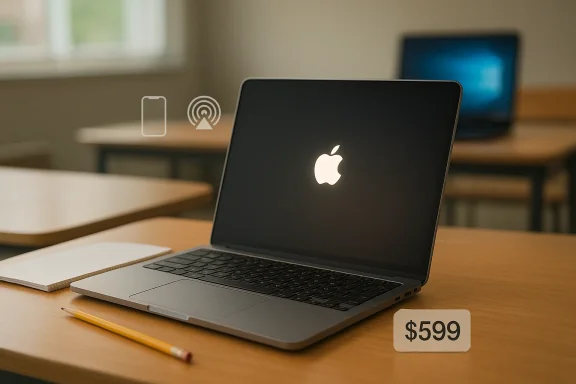
Apple’s surprise move this week — a $599 MacBook Neo built around an Apple A18 Pro chip, paired with news that Apple will base parts of its “Apple Intelligence” on Google’s Gemini models — has the feel of a strategic two‑pronged push: lower the price barrier into Apple’s hardware funnel while riding an AI tide that’s reshaping component markets and platform economics. The result is an unmistakable challenge to the midrange PC and Chromebook world: Apple is courting unit market share in ways it rarely has, and doing so at a moment when memory and storage supply pressures, platform trust, and software perceptions all tilt opportunity toward a carefully staged value play.
Apple’s March 4, 2026 product event introduced the MacBook Neo as the company’s most affordable laptop to date — a 13‑inch aluminum, fanless design with a Liquid Retina panel, 8 GB of unified memory, a baseline 256 GB SSD, and an A18 Pro SoC derived from Apple’s iPhone silicon family. Apple’s U.S. MSRP is $599 and eligible students can buy Neo for $499; preorders opened immediately with shipping listed to begin March 11. These are Apple’s headline facts.
The Neo’s arrival came only weeks after Apple publicly confirmed a multi‑year arrangement to build next‑generation Apple Foundation Models with Google’s Gemini technology and cloud infrastructure — an arrangement Apple frames as private‑cloud‑bound and constrained by Apple’s data rules. That pairing reflects a pragmatic pivot: Apple keeps the device and ecosystem glue while sourcing some of the intensive compute and model capabilities from a hyperscaler with deep AI capex.
At the same time, the underlying market context is volatile. Major research firms and tech press report a broad memory and NAND squeeze driven by data‑center AI capex: DRAM and NAND contract prices have surged, suppliers are prioritizing server/HBM capacity, and analysts expect elevated pricing through 2026. This structural squeeze raises the real cost of building cheaper PCs and phones unless a vendor has scale and supply leverage. Apple’s portfolio and procurement scale — plus a strategy of design tradeoffs — appear to be the mechanism by which it can offer an affordable Mac without unduly stretching its margins.
Ms and Microsoft should respond — practical steps
That said, the Neo is a strategic incision, not a full market conquest overnight. Its success depends on regional pricing, real‑world endurance, OEM reaction, enterprise procurement inertia, and the quality of Apple’s execution on Apple Intelligence features ot by marketing, but by daily usefulness and privacy assurances. Memory and NAND price inflation provides Apple with a transient competitive edge; that advantage will narrow as suppliers respond or as buying patterns shift.
For Microsoft and OEMs, Neo is a wake‑up call: commodity price alone no longer wins buyer hearts. Value now includes perceived quality, out‑of‑box friction, and trustworthiness around AI. How the Windows ecosystem responds — with cleaner experiences, improved displays in cheap notebooks, or stronger service bundles — will determine whether Neo becomes a surprising wedge or a short‑lived market shock.
If you’re deciding whether to buy one: test the Neo against your daily load, think hard about future memory needs, and compare local pricing. For educators and parents, the Neo is plausibly the most interesting education‑price laptop Apple has ever sold. For pros, it’s an elegant, affordable adjunct to an existing power workstation.
Apple put a new arrow in its AI quiver this week — aimed squarely at the mass market. Whether it reorders the battlefield or simply moves a few lines is the story we’ll be watching closely as independent reviews and real‑world adoption data roll in.
Source: AI: Reset to Zero AI: Apple's Macbook Neo a new Arrow in its AI quiver. RTZ #1017
 Background / Overview
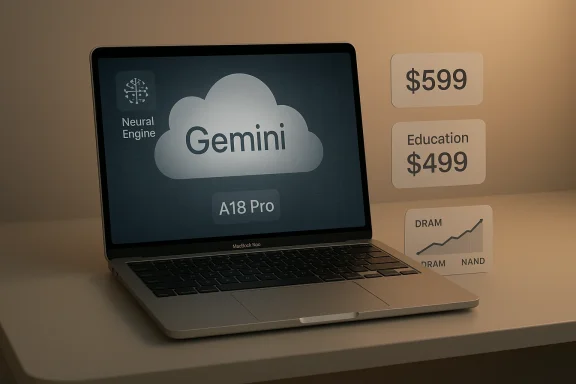
Apple’s March 4, 2026 product event introduced the MacBook Neo as the company’s most affordable laptop to date — a 13‑inch aluminum, fanless design with a Liquid Retina panel, 8 GB of unified memory, a baseline 256 GB SSD, and an A18 Pro SoC derived from Apple’s iPhone silicon family. Apple’s U.S. MSRP is $599 and eligible students can buy Neo for $499; preorders opened immediately with shipping listed to begin March 11. These are Apple’s headline facts.The Neo’s arrival came only weeks after Apple publicly confirmed a multi‑year arrangement to build next‑generation Apple Foundation Models with Google’s Gemini technology and cloud infrastructure — an arrangement Apple frames as private‑cloud‑bound and constrained by Apple’s data rules. That pairing reflects a pragmatic pivot: Apple keeps the device and ecosystem glue while sourcing some of the intensive compute and model capabilities from a hyperscaler with deep AI capex.
At the same time, the underlying market context is volatile. Major research firms and tech press report a broad memory and NAND squeeze driven by data‑center AI capex: DRAM and NAND contract prices have surged, suppliers are prioritizing server/HBM capacity, and analysts expect elevated pricing through 2026. This structural squeeze raises the real cost of building cheaper PCs and phones unless a vendor has scale and supply leverage. Apple’s portfolio and procurement scale — plus a strategy of design tradeoffs — appear to be the mechanism by which it can offer an affordable Mac without unduly stretching its margins.
What Apple announced — the essentials
- Hardware: 13.0‑inch Liquid Retina display (2408 × 1506), Apple A18 Pe GPU in the base SKU, 16‑core Neural Engine), 8 GB unified memory, 256 GB SSD base. Fanless aluminum chassis, color options, and a 1080p FaceTime camera.
- Price & availability: $599 starting price (U.S. MSRP), $499 for education customers; preorders out March 4; shipping March 11 in key markets.
- I/O & networking: Two USB‑C ports (only the left supports external displays), headphone jack, Wi‑Fi 6E, Bluetooth 6.
- Software & AI: Ships with macOS Tahoe and Apple Intelligence features thlean on on‑device neural processing, with a cloud foundation to be shaped by Google’s Gemini models under Apple’s privacy constraints.
Why this move matters strategically
1) A new top‑of‑funnel play for ecosystem grically priced Macs at a premium, defending margin while leaning on services and device loyalty for long‑term unit economics. The Neo is different: it deliberately targnts where consumers historically chose low‑cost Windows notebooks or Chromebooks. By turning the entry price down while keeping hallmark Apple cues (display quality, unibody design, continuity features with iPhone), Apple reduces psychological and economic friction for switchers — students, first‑time computer buyers, and parents. Early coverage from Windows‑focused outlets recognises the tactical sharpness of this play.
- For education procuremenn gains compound over years because schools can create lasting software and familiarity lock‑ins.
2) Sidelining key Windows incumbency arguments
Windows’ historical advantage in unit markets has not just been price: it’s been choice — modular configurations, broad OEM channels, and commodity parts. Apple’s approach is to remove the “cheap hardware” excuse by offering a world‑class display and ergonomics at a near‑commodity price band, while betting that continuity with a user’s iPhone and the promise of a cleaner out‑of‑box experience will be the deciding factors for many marginal buyers. The Neo’s demo spots even placed Microsoft Office in the recent apps list during event marketing — a deliberate reassurance to buyers who require Office compatibility.3) Leveraging external AI infrastructure without owning the entire stack
The Apple–Google arrangement to base future Apple Foundation Models on Gemini, run under Apple’s private compute rules, is a pragmatic compromise: Apple doesn’t have to underwrite the massive model training capex required to stand alone, while still owning the customer experience and data governance perimeter. For device buyers, this will manifest as a mix of local, faster Neural Engine tasks and cloud‑backed capabilities that require server horsepower. The strategic implication is simple: Apple can keep device BOMs tighter while accessing advanced generative AI features, without the full financial burden of hyperscale AI infrastructure.Technical tradeoffs — the Neo’s engineering calculus
Apple had three levers to hit $599: chip choice, memory/configuration limits, and I/O/design tradeoffs.- A‑series SoC in a laptop shell. By using the A18 Pro — an iPhone‑class chip tuned for efficiency and neural tasks — Apple reduces the need for actmargin discrete components. In practice, that translates to a fanless, thin chassis with very good single‑thread responsiveness and a Neural Engine suited to on‑device AI tasks. However, the A‑series’ thermal and memory envelope differs from M‑serieshigher sustained thermal budgets.
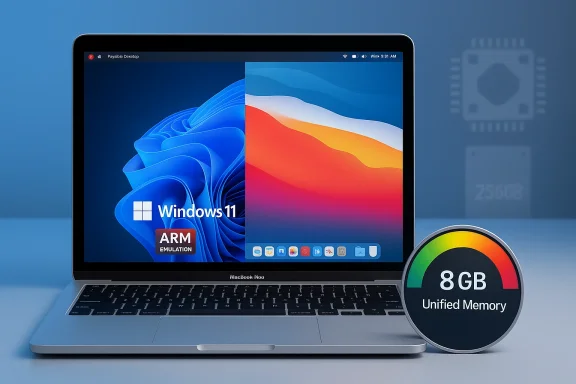
- 8 GB unified memory baseline. Apple’s unified memory architecture remains efficient, but 8 GB is the inflection point where certain workflows — heavy multitasking, large image or video projects, virtualization, and many browser tabs plus background sync services — will expose limits more quickly than machines with 16 GB or more. Apple’s tight software/hardware integration and swap strategies will mitigate this for many users, but the capacity ceiling is real and permanent because memory is soldered.
- Minimal I/O and single external display support. Two USB‑C ports — one display‑capable — along with no SD card slot and no upgrade path, are explicit cost decisions. For many consumers this is manageable; for pros and creators it’s a compromise.
The broader market dynamics that make Neo timely
Memory and component scarcity: an invisible tailwind
Hyperscalers and cloud providers are on a memory binge to feed AI training and inference clusters. As several market analysts and industry outlets have reported, demand for server DRAM, HBM, and enterprise SSDs has driven contract price increases and supply prioritization away from commodity consumer channels. That imbalance artificially inflates the cost of PC BOMs for companies that lack Apple‑level scale or allocation deals. Apple’s scale in procurement and its ability to shift silicon choices — plus built‑in tradeoffs like soldered storage and fixed RAM — reduce the exposure that fragments many PC OEM roadmaps. In plain terms: the memory squeeze makes it harder for smaller OEMs to undercut Apple on price without accepting thinner margins or worse specs.Windows 11 user sentiment and the upgrade story
Data aggregators and press coverage suggest Windows 11 momentum cooled late in 2025: third‑party StatCounter numbers showed a dip in Windows 11 usage in November–December, with Windows 10 reclaiming share in some months. That churn matters because large numbers of users tied to older or unpopular Windows builds are precisely the cohort most receptive to switching devices when their hardware age and upgrade pain coincide. The Neo arrives into that fault line. Note: vendor and third‑party analytics are imperfect proxies; the underlying dynamics are nevertheless real — dissatisfaction often creates switch windows.Perception of “AI shoved at users” vs. a privacy‑framed, measured rollout
Many mainstream consumers have grown wary of aggressive, cloud‑first AI features that appear everywhere and risk telemetry/perception concerns. Apple’s staged approach — emphasizing on‑device neural acceleration, privacy, and a measured cloud partnership — plays to a particular trust narrative. If Apple can deliver genuinely useful local AI features (summaries, image cleanup, writing aids) on a $599 device, that experience may feel less invasive and more helpful than some competitors’ headline‑grabbing but intrusive AI advertising. The Gemini partnership explicitly claims private cloud compute boundaries; whether that proves fully reassuring will depend on implementation details and independent audits.Ms and Microsoft should respond — practical steps
- Reposition entry‑level hardware around user experience, not raw specs. Improve displays, webcams, battery life, and out‑of‑box software hygiene to match the perceived quality differential Apple now fences in the Neo’s price band.
- Simplify setup and trim OEM bloat: the ease‑of‑use story matters. Windows OEMs should run experiences that remove excessive update loops and trial‑ware.
- Bundle tangible value: education and consumer bundles — discounted Microsoft 365, cloud storage, educational apps, and longer warranty/service terms — can counter Apple’s ecosystem pitch.
- Lean into enterprise manageability: stress-tested provisioning, legacy app virtualization, and absolute compatibility guarantees are Windows’ natural counters to a consumer migration narrative.
- Clarify AI value: make AI features optional, transparent, and privacy‑respectful. Microsoft and OEMs can lead with governance and offline options to win trust where other AI rollouts haveps are not simple, but they are actionable — and they focus on the real reasons buyers choose devices beyond sticker price: manageability, compatibility, and predictable ownership costs.
Risks and unresolved questions
- Long‑term performance and longevity. The Neo’s A‑series roots and 8 GB baseline raise legitimate questions about how it will age for users who gradually demand more from a device over three to five years. Will swap patterns and macOS memory management preserve acceptable responsiveness? Independent long‑term testing is required.
- Regional price parity and total cost of ownership. Apple’s $599 U.S. headline masks VAT, tariffs, and local distribution differences that can materially change the competitive landscape in many markets. Buyers outside major Apple markets should compare local pricing and service economics.
- Vendor benchmark framing. Apple’s “up to” claims — up to 50% faster on certain everyday tasks versus a bestselling Intel Core Ultra 5 PC, and up to 3× on selected on‑device AI tasks — stem from vendor‑selected workloads and preproduction test conditions. Treat these numbersdefinitive. Third‑party lab benchmarks will be decisive.
- The “10 million dissatisfaction reports” rumor. Earlier reporting circulated a claim about large counts of internal Windows 11 complaints; this number is anecdotal and not independently verore treating it as evidence of catastrophic platform failure. Verified market indicators (StatCounter patterns) are a more reliable barometer.
- Apple’s reliance on a Google partnership. While the private cloud compute framing reduces direct data exposure, the strategic risk is that Applal layer of AI capability to a third party. If the partnership sours or if regulatory scrutiny complicates cross‑company model hosting, Apple may face short windows of feature disruption. The choice is pragmatic but not without governance complexity.
What this means for consumers and buyers
- Students and mainstream users who value portability, battery life, and a worry‑free setup should strongly consider Neo as a viable option — especially if they already own iPhones or iPads and value the convenience of continuity features.
- Power users, creators, and many enterprise buyers should wait for independent evaluations. If your daily workflow relies on sustained multi‑threaded compute, large VMs, or multiple external displays, the Neo is likely a secondary device at best.
- If you’re buying for the long haul and can’t afford surprises: test the Neo against your real workload at retail, paying attention to memory pressure, external display behavior, and sustained thermal performance. Apple’s efficiency story is real, but capacity matters in the long term.
Final analysis — a calculated gambit with real ripple effects
The MacBook Neo is not a fluke. It is a carefully calculated product: trim hardware compromises, an iPhone‑derived SoC tuned for efficiency and on‑device AI, a standout display, and a price that forces a re‑examination of the entry‑level laptop buyer’s default. By keeping the Neo on a familiar macOS roadmap with Apple Intelligence and a staged cloud partnership for larger models, Apple gains a credible contender for the tens of millions of buyers who previously defaulted to Windows or Chrome OS for cost reasons.That said, the Neo is a strategic incision, not a full market conquest overnight. Its success depends on regional pricing, real‑world endurance, OEM reaction, enterprise procurement inertia, and the quality of Apple’s execution on Apple Intelligence features ot by marketing, but by daily usefulness and privacy assurances. Memory and NAND price inflation provides Apple with a transient competitive edge; that advantage will narrow as suppliers respond or as buying patterns shift.
For Microsoft and OEMs, Neo is a wake‑up call: commodity price alone no longer wins buyer hearts. Value now includes perceived quality, out‑of‑box friction, and trustworthiness around AI. How the Windows ecosystem responds — with cleaner experiences, improved displays in cheap notebooks, or stronger service bundles — will determine whether Neo becomes a surprising wedge or a short‑lived market shock.
If you’re deciding whether to buy one: test the Neo against your daily load, think hard about future memory needs, and compare local pricing. For educators and parents, the Neo is plausibly the most interesting education‑price laptop Apple has ever sold. For pros, it’s an elegant, affordable adjunct to an existing power workstation.
Apple put a new arrow in its AI quiver this week — aimed squarely at the mass market. Whether it reorders the battlefield or simply moves a few lines is the story we’ll be watching closely as independent reviews and real‑world adoption data roll in.
Source: AI: Reset to Zero AI: Apple's Macbook Neo a new Arrow in its AI quiver. RTZ #1017