

Simplilearn’s new Applied Agentic AI program, launched in partnership with Microsoft, is a timely and ambitious attempt to close a widening skills gap at the intersection of product management, systems engineering, and agentic AI architecture — a gap enterprises now say is material as they move from pilots to production-grade autonomous agents.
Agentic AI — systems of autonomous or semi-autonomous agents that can plan, reason, and act across multi-step workflows — has moved from research labs and proofs-of-concept into enterprise roadmaps. Large organizations are reallocating budget and attention toward agentic capabilities, and recent industry research finds the majority of leaders expect agents to take independent action across core operations within the next few years. Specifically, a PwC survey and related market reports show a significant uptick in AI budget commitments, while an IBM executive survey projects a leap in expectations for autonomous decision-making by 2027.
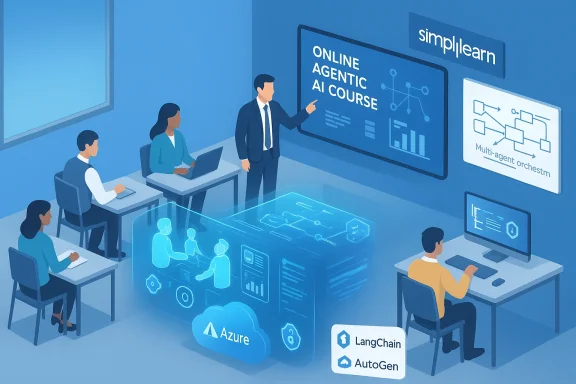
Simplilearn’s offering is framed as a practitioner program designed to meet that demand: a 10-week live-online course that blends systems thinking, product strategy, hands-on engineering with multi-agent frameworks, and an Azure-focused production module — culminating in a capstone intended to demonstrate production-ready agent orchestration. The program page lists 40+ demos, 10+ guided practices, seven projects, and an end-to-end capstone, with Microsoft-branded certification and Azure-centric deployment labs.
We should expect three downstream effects:
That said, expect the program to be a foundation rather than a silver bullet. Real enterprise readiness will require continued engineering investment, organizational process change, and strong governance frameworks. Use this training as part of a broader upskilling roadmap: cohort-based learning, paired on-the-job projects, and continued mentoring are the pathways that turn classroom knowledge into production capability.
In short: Simplilearn’s program is a timely and useful addition to the market. Its Microsoft partnership gives it immediate enterprise relevance, and its production-oriented curriculum addresses the right technical and product problems. Prospective enrollees and sponsors should nevertheless treat it as the beginning of a longer organizational journey toward responsible, observable, and scalable agentic AI.
Source: PR Newswire UK Simplilearn Launches 'Applied Agentic AI: Systems, Design & Impact' Program to Build the Next Generation of Microsoft AI Product and Systems Leaders
 Background
Agentic AI — systems of autonomous or semi-autonomous agents that can plan, reason, and act across multi-step workflows — has moved from research labs and proofs-of-concept into enterprise roadmaps. Large organizations are reallocating budget and attention toward agentic capabilities, and recent industry research finds the majority of leaders expect agents to take independent action across core operations within the next few years. Specifically, a PwC survey and related market reports show a significant uptick in AI budget commitments, while an IBM executive survey projects a leap in expectations for autonomous decision-making by 2027.Simplilearn’s offering is framed as a practitioner program designed to meet that demand: a 10-week live-online course that blends systems thinking, product strategy, hands-on engineering with multi-agent frameworks, and an Azure-focused production module — culminating in a capstone intended to demonstrate production-ready agent orchestration. The program page lists 40+ demos, 10+ guided practices, seven projects, and an end-to-end capstone, with Microsoft-branded certification and Azure-centric deployment labs.
What Simplilearn Is Launching: Program Anatomy and Promises
Program format and target audience
- Duration: 10 weeks, designed for working professionals committing roughly 6–8 hours per week.
- Audience: Mid-to-senior product managers, tech leaders, designers, and others responsible for building or leading AI-native products.
- Delivery: Live online classes led by industry practitioners and Microsoft Certified Trainers, with cohort support and career assistance.
Curriculum at a glance
The curriculum is organized to move from foundations to production readiness, with key modules that include:- Foundations of agentic AI and LLM internals
- Planning systems, agent coordination, and multi-agent architectures
- Agent communication protocols, Model Context Protocol (MCP), and prompt engineering
- Tooling: LangChain, AutoGen, CrewAI, n8n, LangSmith, and many others (25+ tools claimed)
- A focused module on developing and deploying AI agents on Microsoft Azure, including security, orchestration, and compliance
- Hands-on work: 40+ demos, 10+ guided practices, seven projects, and a production-grade capstone.
Certification and career support
Graduates receive a joint program completion certificate from Microsoft and Simplilearn and Microsoft Learn badges for Microsoft-branded courses. The program also offers career services such as AI-powered profile optimization, mock interviews, and group mentoring designed to position learners for roles in the agentic AI product landscape.Why this program arrives now: Market timing and demand signals
Several converging market signals make Simplilearn’s timing logical.- Enterprises are increasing AI spend. Multiple surveys and analyst reports indicate that CIOs and executives are committing larger and more focused AI budgets in 2026, shifting money from pilots and experimentation into production and infrastructure. This dynamic is driving demand for practitioners who understand both product strategy and production-grade AI systems.
- Agentic AI is transitioning from novelty to operational goal. Analysts and vendor research show enterprise leaders expect a rapid expansion of agents’ operational remit; for instance, IBM’s industry research indicates a rise to roughly two-thirds of executives expecting agentic systems to take independent action in their organizations by 2027 — a major increase from the present baseline. That expectation creates an immediate need for leaders who can design governance, observability, and fail-safe mechanisms into agentic systems.
- Platform and tooling maturity. The agentic ecosystem — from Microsoft AutoGen and Copilot Studio to frameworks like LangChain and orchestration tools — has matured quickly enough that vendor tooling supports repeatable engineering patterns for agents. That maturity enables training programs to move beyond theoretical frameworks into productized, hands-on labs.
Critical analysis: Strengths of the Simplilearn–Microsoft collaboration
1. Practicality and production focus
One of the program’s strongest claims is its emphasis on production-readiness rather than mere conceptual learning. The curriculum’s inclusion of Azure deployment modules, observability, security integration, and orchestration reflects the practical challenges teams actually face when moving agentic projects from lab to live. The focus on hands-on labs, multiple guided projects, and a capstone project suggest an outcomes-driven design rather than a purely theoretical course. ([simplileaimplilearn.com/agentic-ai-course-training)2. Microsoft partnership adds platform credibility
A program co-branded with Microsoft gives learners direct exposure to Azure-native patterns, Microsoft tooling (Foundry, Azure AI Studio, Copilot Studio), and the operational practices prominent in many enterprises. That relevance to widely adopted enterprise infrastructure increases the employability of graduates and reduces the friction of adopting their skills within Microsoft-centric shops.3. Role-focused, cross-functional approach
By targeting product managers, designers, and tech leaders rather than solely developers, the program signals awareness that agentic systems require cross-functional coordination: product strategy, governance, human-in-the-loop design, and systems thinking are as essential as ML engineering. This role-focused approach aligns with how enterprises actually staff and scale AI projects.4. Breadth of tooling and frameworks
Claiming hands-on experience with 25+ tools (LangChain, AutoGen, CrewAI, n8n, LangSmith, etc.) means learners will see multiple approaches to common agentic problems: memory, tool use, orchestration, and protocol design. Exposure to multiple toolchains prepares learners for vendor-heterogeneous enterprise environments.Risks, gaps, and areas needing scrutiny
No program can fully remove the operational and ethical complexity of deploying autonomous agents. Below are the primary concerns enterprises and prospective learners should weigh.1. Vendor lock-in vs. transferable engineering patterns
While Microsoft alignment is a strength, it can also narrow the learner’s exposure to platform-agnostic patterns. Enterprises often run multi-cloud stacks or combine specialized on-prem capabilities with cloud AI. Prospective learners should confirm how much of the training focuses on transferable architectural patterns (MCP, protocol design, observability) versus Azure-specific recipes, and ensure the capstone demonstrates portability.2. Governance, auditability, and explainability
Agentic systems raise acute governance needs: who is accountable when an agent acts, how are decisions explained and audited, and how are emergent behaviors mitigated? The course lists modules on security and compliance, but these topics are deep and evolving; a 10-week program can introduce principles, but organizations will still need people and processes to implement robust governance. Learners and employers should treat training as foundation work, not a turnkey governance solution.3. Operational maturity and observability
Production agentic systems require new observability patterns — continuous evaluation (evals), decision logging, model drift detection, and performance SLIs across agents. While labs on monitoring and orchestration are valuable, the real-world complexity of distributed agents in regulated environments (finance, healthcare, critical infrastructure) often exceeds what can be covered in fixed course examples. Organizations must pair trained talent with extended engineering investments in observability and SRE practices.4. Market claims and stat-checking
PR material highlights industry statistics — for example, that 88% of enterprises plan to increase AI budgets by May 2026 and that 67% expect autonomous decision-making in workflows by 2027. Those numbers are consistent with recent consulting and vendor surveys, but survey framing (sample size, industry mix, geographic scope) materially changes interpretation. The 88% figure is aligned with PwC and other executive polls showing high intent to increase AI spend; similarly, IBM’s research supports the 67% expectation for autonomous action by 2027. That said, intent and execution are different: high percentages of planned budget increases do not guarantee successful, governed deployments at scale. Prospective employers and learners should treat these survey results as directional rather than deterministic.How this program fits into enterprise upskilling strategies
Enterprises face three complementary talent needs when adopting agentic AI:- Strategic leaders who can define product vision, governance, ROI, and change management.
- Systems engineers and platform teams who can design orchestration, security, and observability.
- Practitioners who can quickly prototype and validate agentic workflows with existing tools.
- Use role-based cohorts (product + platform + security) to ensure cross-functional alignment.
- Pair training with on-the-job pilot projects that allocate SRE and compliance time.
- Build internal “agent governance playbooks” informed by hands-on capstone learnings and external standards (e.g., NIST’s RFI work on agent identity and authorization).
Recommended evaluation checklist for hiring managers and prospective learners
Before enrolling or sponsoring candidates, use this checklist to verify program fit:- Learning Outcomes: Do the stated outcomes map to job-level expectations (e.g., lead agentic system design, define SLOs for agents, design audit trails)?
- Hands-on Scope: Are the capstone and projects demonstrably production-focused (deployments on Azure, orchestration, logging, fail-safe mechanisms)?
- Tooling Breadth vs. Depth: Does the program balance exposure to multiple tools with deeper labs on core patterns (MCP, planning systems, agent coordination)?
- Governance and Responsible AI: Are compliance, explainability, and auditability covered in depth — including hands-on labs that demonstrate decision logging and human-in-the-loop controls?
- Post-course Support: What career and mentoring services are included, and will the certificate and Microsoft Learn badges be recognized by internal hiring teams?
- Cost and ROI: At the stated fee point, is the expected productivity gain (reduced time to prototype, better risk posture) justified relative to alternate training or internal upskilling programs?
What organizations must do beyond training
Training individuals is a necessary but insufficient step. To reap generative and agentic AI’s benefits at scale, organizations must:- Invest in platform capabilities: standardized model hosting, secure tool endpoints, and identity-based agent authorization.
- Build an observabstack: per-agent decision logs, eval pipelines, drift detection, and human review systems.
- Establish governance and escalation paths: clear accountability for actions taken by agents, including playbooks for rollback and human override.
- Re-skill teams in process design: reconceive workflows so agents operate within defined boundaries and business outcomes are measurable.
The learner’s perspective: what you gain and what to watch for
What learners stand to gain
- Accelerated familiarity with multi-agent architectures and deployment on Microsoft Azure.
- A portfolio of projects and a capstone that can be presented to hiring managers.
- Exposure to both product strategy and technical implementation, which is a rare combination in short-format programs.
What learners should watch for
- Depth vs. breadth trade-offs: 10 weeks is compact; learners should verify which modules provide runnable, reproducible artifacts they can reuse.
- Evidence of instructor credentials and real-world case studies: practitioner-led sessions are valuable if the instructors have recent production experience with agentic systems.
- Post-course placement: career support is helpful, but learners should temper expectations about immediate job transitions; real hiring often requires demonstrable project outcomes within an employer context.
Broader industry implications
This program and similar offerings mark a maturation of the AI skills market: training is moving from model-centric bootcamps to systems-and-product-centric upskilling. That shift reflects the industry’s recognition that agentic AI adoption is not a pure ML engineering problem but a socio-technical transformation requiring product thinking, governance, and lifecycle operations.We should expect three downstream effects:
- A rise in cross-functional job roles (e.g., Agent Product Manager, Agent Reliability Engineer).
- Increased demand for observability and governance tooling vendors.
- A market bifurcation where organizations that master end-to-end agent lifecycle (design → deploy → govern) will extract disproportionate value. Industry surveys underpin this trend, showing major budget allocation shifts to AI infrastructure and productization in 2026.
Final assessment: who should attend, and why it matters
Simplilearn’s Applied Agentic AI program is a pragmatic, market-aware offering targeted at a genuine and growing enterprise need: leaders who can bring agentic AI into production responsibly. For organizations that already plan to deploy agents on Azure or that need cross-functional leaders to coordinate product, engineering, and governance, this program offers an efficient ramp-up. For individual learners, it offers a route to develop a hybrid skill set that blends product strategy with systems design — an increasingly valuable combination as agentic AI proliferates.That said, expect the program to be a foundation rather than a silver bullet. Real enterprise readiness will require continued engineering investment, organizational process change, and strong governance frameworks. Use this training as part of a broader upskilling roadmap: cohort-based learning, paired on-the-job projects, and continued mentoring are the pathways that turn classroom knowledge into production capability.
In short: Simplilearn’s program is a timely and useful addition to the market. Its Microsoft partnership gives it immediate enterprise relevance, and its production-oriented curriculum addresses the right technical and product problems. Prospective enrollees and sponsors should nevertheless treat it as the beginning of a longer organizational journey toward responsible, observable, and scalable agentic AI.
Source: PR Newswire UK Simplilearn Launches 'Applied Agentic AI: Systems, Design & Impact' Program to Build the Next Generation of Microsoft AI Product and Systems Leaders
